SECURE 2.0 Act for CPAs: What Retirement Rule Changes Mean for Your Clients
SECURE 2.0 Act provisions are still rolling out through 2026 and 2027, with catch-up contribution Roth requirements, auto-enrollment mandates, and plan amendment deadlines all converging. This guide breaks down the operational implications for CPAs advising small business owner clients — and how…
The SECURE 2.0 Act for CPAs isn't a single event — it's a rolling implementation spanning multiple years, with provisions that activate in 2024, 2025, 2026, and 2027. Most public coverage treats it as a one-time consumer finance story, but practitioners managing a book of small business owner clients are staring at a far more complex picture: dozens of employers whose plans may need amendments, whose payroll systems may not be configured for new catch-up rules, and whose employees are asking questions that require real answers.
The provisions most likely to create liability exposure right now are the ones that have already taken effect or will take effect before the end of plan year 2025 — specifically the auto-enrollment mandate for new plans, the RMD age transition to 73 (and eventually 75), and the Roth catch-up contribution requirement for higher earners, which was delayed to taxable years beginning after December 31, 2025. Each of these creates a distinct workflow obligation for the CPA firm advising the business. Understanding the SECURE 2.0 Act for CPAs means prioritizing these high-exposure provisions above all others in your compliance calendar.
This guide is written for the practitioner, not the participant. It focuses on what you need to communicate to clients, what deadlines you are tracking on their behalf, and how firms are building operational systems to ensure that retirement plan compliance doesn't fall off the radar between tax seasons. The SECURE 2.0 Act for CPAs presents a unique set of practice management challenges that go well beyond simply knowing the rules.
Key SECURE 2.0 Provisions Still Phasing In Through 2027
Congress passed SECURE 2.0 as part of the Consolidated Appropriations Act, 2023, and the IRS has been issuing guidance in tranches ever since. For CPAs, the critical framework is understanding which provisions are already live, which become mandatory in 2025-2026, and which have implementation flexibility that clients can still elect. Navigating the SECURE 2.0 Act for CPAs requires a clear map of which IRS guidance is final, which is interim, and which provisions still carry meaningful uncertainty.
The RMD age change is the most universally applicable. Participants who turned 72 after December 31, 2022, have an RMD starting age of 73. Participants born in 1960 or later will have an RMD starting age of 75 — a provision effective for distributions required in years beginning after December 31, 2032. This sounds distant, but it matters now for clients doing multi-year Roth conversion planning or business succession work where retirement account balances are a significant factor. For firms evaluating their SECURE 2.0 Act for CPAs approach, this trade-off compounds over time.
The IRS issued Notice 2024-2 providing transitional guidance on many provisions, acknowledging that plan documents and administrative systems needed time to catch up with statutory requirements. CPAs who serve as the primary financial advisor relationship for business clients need to track these notices actively — not just at year-end, but quarterly. Each of these factors directly shapes how the SECURE 2.0 Act for CPAs plays out in practice.
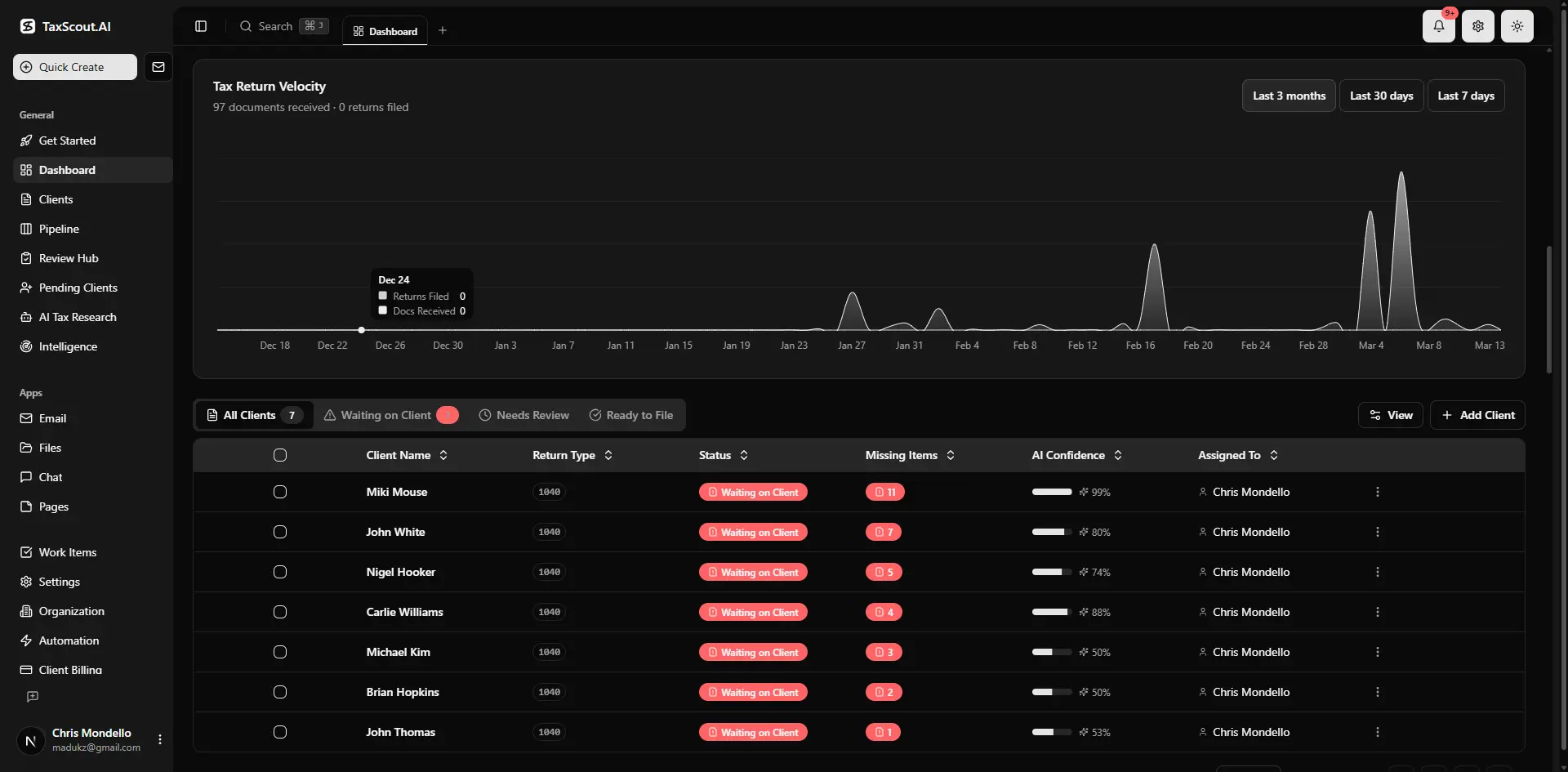
Real-time dashboard showing returns in progress, revenue, and upcoming deadlines
Catch-Up Contributions in 2026: The Roth Requirement Explained
The catch-up contribution Roth rule is the provision generating the most practitioner confusion, partly because the IRS delayed it twice before setting a firm effective date. For taxable years beginning after December 31, 2025, participants with wages exceeding $145,000 (indexed) in the prior year must make their catch-up contributions on a Roth (after-tax) basis if the plan offers a designated Roth account. If the plan does not offer a Roth option, high-earning participants will lose the ability to make catch-up contributions entirely. Understanding the SECURE 2.0 Act for CPAs in this context is what separates firms that scale from those that stall.
For a CPA advising a small business with a SIMPLE IRA, this is immediately practical: SIMPLE IRAs cannot accept Roth contributions under current law, which means the plan sponsor either amends to a different plan type or high-income employees lose catch-up eligibility beginning in 2026. The IRS confirmed this interpretation in Notice 2023-75, so this is not an area where practitioners can wait for additional clarity. This is precisely where a deliberate SECURE 2.0 Act for CPAs strategy pays off.
Your advisory checklist for each affected small business client should include: (1) identifying all employees who received wages over $145,000 in the prior year, (2) confirming whether the plan currently includes a Roth feature, (3) determining whether the plan document needs to be amended before January 1, 2026, and (4) alerting payroll to code these contributions correctly from the first pay period of the new plan year. Firms tracking this across a client base of 40 or 50 small businesses need a systematic approach — ad hoc year-end reviews will miss the window. See our IRS deadlines reference for a broader calendar of compliance milestones. The SECURE 2.0 Act for CPAs sits at the center of this decision — get it wrong and the rest unravels.
A second catch-up provision that gets less attention is the enhanced limit for ages 60-63. Beginning in 2025, participants who are 60, 61, 62, or 63 years old can contribute the greater of $10,000 or 150% of the regular catch-up limit to 401(k) and 403(b) plans. This is an opportunity item for clients, not a compliance risk — but it requires proactive communication from the CPA before the plan year begins, not after. When firms revisit their SECURE 2.0 Act for CPAs priorities, the gaps usually surface here.
Are retirement plan amendment deadlines getting lost between tax seasons?
TaxScout's pipeline management tracks every client obligation through 12 customizable stages — so SECURE 2.0 deadlines never fall off the board.
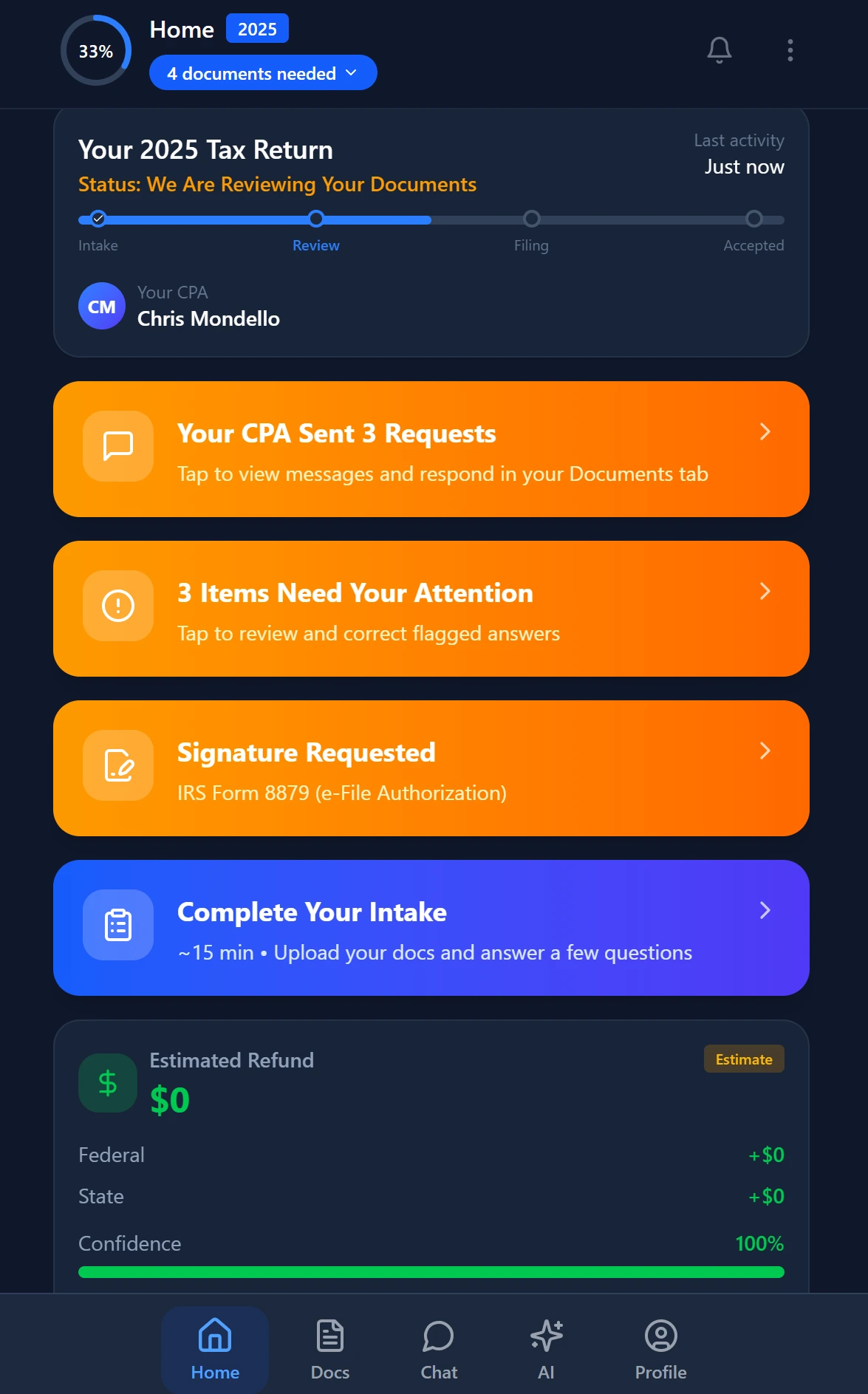
Smart intake auto-fills from uploaded documents and prior-year data
Auto-Enrollment Mandate for New Plans Starting in 2025
Section 101 of SECURE 2.0 requires that most new 401(k) and 403(b) plans established after December 29, 2022, must include an eligible automatic contribution arrangement (EACA) for plan years beginning after December 31, 2024. This means any small business client who started a new 401(k) in 2023 or 2024 must have auto-enrollment in place — with a default deferral rate of at least 3% (escalating to 10-15% over time) and automatic annual escalation of 1% per year — before the end of their first plan year beginning in 2025.
Exceptions exist for small businesses with 10 or fewer employees, businesses less than 3 years old, church plans, and governmental plans. But for a CPA whose client base includes growing S-corps and LLCs that adopted 401(k)s during the post-pandemic hiring wave, this is a live compliance obligation that the SECURE 2.0 Act for CPAs framework makes impossible to ignore. Many of those clients don't know they're subject to it.
The Department of Labor's guidance on automatic enrollment outlines the participant notice requirements that accompany an EACA, including a 30-to-90 day window in which new employees can opt out without tax consequences. As the advising CPA, your responsibility is to ensure the plan document reflects the EACA provisions and that the plan administrator (often a payroll company or TPA) is operationally executing auto-enrollment correctly from the first eligible payroll period.
The practice-management angle here is significant. If you have 30 business clients who adopted 401(k) plans between 2023 and 2024, you theoretically have 30 separate compliance items to track. Most firms have no dedicated system for retirement plan amendment monitoring — it lives in someone's email, a shared spreadsheet, or nowhere at all. That is the workflow gap this article is designed to help you close.
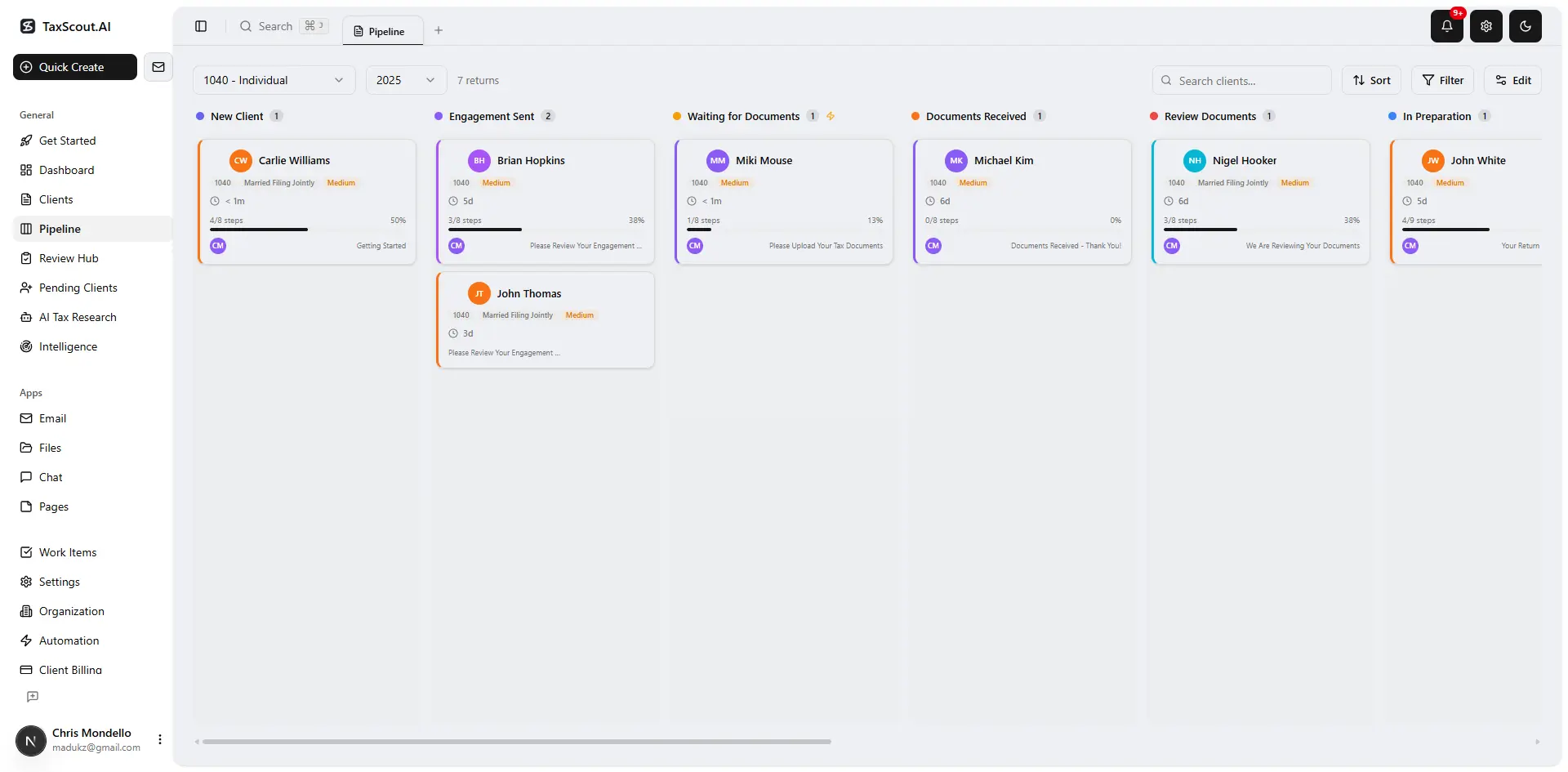
Track every return from intake to filed with drag-and-drop pipeline management
Plan Amendment Deadlines CPAs Must Track for Small Business Clients
Plan amendments required by SECURE 2.0 do not all have the same deadline. The IRS extended the deadline for most discretionary and required SECURE 2.0 amendments to the last day of the first plan year beginning on or after January 1, 2025, for non-governmental plans. In practice, this means a calendar-year plan had until December 31, 2025, to adopt most required amendments — a deadline that has now passed for many provisions. Applying the SECURE 2.0 Act for CPAs lens here means verifying those amendments were actually executed, not just planned.
For practitioners reading this in 2026, the immediate question is whether your clients' plans were actually amended before that deadline. If a plan sponsor failed to adopt required amendments on time, the plan may be out of compliance, which creates exposure under IRS correction programs like EPCRS. The IRS Employee Plans Compliance Resolution System allows plan sponsors to self-correct certain failures, but the correction method and any associated penalties depend on the nature and duration of the failure.
Going forward, the amendment calendar for 2026-2027 includes Roth catch-up implementation (effective January 1, 2026, for calendar-year plans), the optional provision allowing employers to treat student loan payments as elective deferrals for matching purposes, and the long-term part-time employee eligibility rules that expand in 2025. Each provision needs its own tracking entry in your firm's workflow system — not a sticky note, but a tracked task with an assigned owner and a due date that fires well in advance of the actual deadline.
For clients using third-party administrators, the CPA's role is often coordination rather than drafting — but that coordination still requires proactive follow-up. Building a standard annual retirement plan review into your engagement scope, with a defined deliverable (a signed amendment confirmation from the TPA), is one way to convert this advisory activity into recurring revenue while protecting clients from compliance gaps. Our guide on flat-fee billing for CPAs covers how to package and price these types of advisory retainers.

Click any extracted field to see its source highlighted on the original PDF
RMD Age Change: Advising Clients on Planning Opportunities
The RMD age increase from 72 to 73 creates a multi-year planning window that most clients don't fully understand. For a business owner who turned 72 in 2023, there is no RMD until age 73 — an extra year of tax-deferred compounding and an extra year of potential Roth conversion runway. For clients born in 1960 or later, the eventual move to age 75 is even more significant for estate planning and wealth transfer strategies. Framing this through the SECURE 2.0 Act for CPAs perspective helps practitioners translate the legislative timeline into tangible planning conversations.
The catch for CPAs is that clients who started RMDs under the old rules (age 70½ or 72) must continue taking them — the new ages apply only to individuals who have not yet begun distributions. This distinction needs to be communicated clearly, especially for clients who may have heard the age-75 number and assumed it applied to them retroactively. The IRS FAQ on SECURE 2.0 RMD changes is a useful client-facing resource.
On the planning side, clients with significant traditional IRA or 401(k) balances who are now in the 73-74 age window have an opportunity that didn't exist before 2023. A CPA advising these clients should be running projections on Roth conversions during this window, considering the interaction with Medicare IRMAA thresholds (indexed annually by SSA), and documenting those recommendations in writing. This is exactly the kind of high-value advisory work that differentiates a CPA firm from a tax preparation service.
Building a Firm-Wide Workflow to Track Retirement Plan Compliance
The operational challenge SECURE 2.0 creates for CPA firms is not understanding any single provision — it is managing the compliance calendar across 20, 50, or 100 business clients simultaneously, each with different plan types, different effective dates, and different advisory needs. No spreadsheet designed for tax prep will hold this structure reliably over multiple years. A dedicated system built around the SECURE 2.0 Act for CPAs is no longer optional for firms with meaningful retirement plan exposure.
The firms that are handling this well have built retirement plan compliance into their practice management pipeline as a recurring annual work item, not a one-off project. That means each business client with a qualified plan has a dedicated pipeline card that tracks: plan type, TPA contact, most recent amendment date, next required amendment or review date, and any open items from the prior year's review. When a new IRS notice drops — like Notice 2024-2 or any follow-on guidance — the firm can filter its entire client list to identify who is affected and trigger outreach in batch.
TaxScout's pipeline management supports 12 customizable stages with drag-and-drop kanban, which maps well to the retirement plan review cycle: Identify → Review Plan Documents → Coordinate with TPA → Confirm Amendment → Document → Close. The platform's client management layer stores entity structure and filing history, so you can filter your client base by business type, plan type, or any custom tag you assign. For firms that want to go deeper on research when a client's situation involves a less-common plan provision, the AI research agents can pull real-time IRS and Treasury guidance without leaving the platform.
One workflow detail that matters: the communication to clients about retirement plan changes should be documented the same way you document tax advice. Using a system that integrates email, client notes, and document storage — rather than managing retirement plan correspondence in a separate folder or standalone email thread — means you have an audit trail if a client later claims they weren't informed. See other blog resources for additional guides on building compliance-forward workflows in your firm.
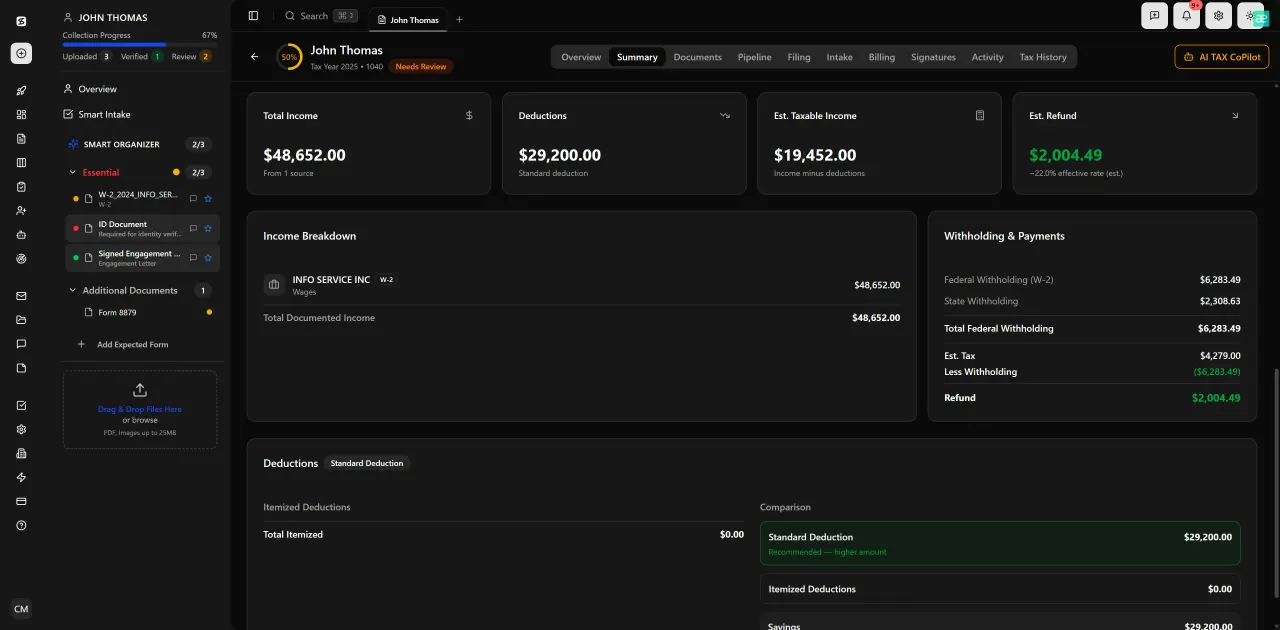
Review with AI assist — 9 agents answer questions with full client context
SECURE 2.0 provisions with the highest advisory impact for small business CPAs
| Provision | Effective Date | Who Is Affected | CPA Action Required |
|---|---|---|---|
| RMD age increases to 73 | January 1, 2023 | Clients turning 72 after Dec 31, 2022 | Update distribution plans; flag Roth conversion window |
| Auto-enrollment mandate (new plans) | Plan years starting after Dec 31, 2024 | New 401(k)/403(b) plans started after Dec 29, 2022 | Confirm EACA in plan document; verify TPA execution |
| Enhanced catch-up for ages 60-63 | January 1, 2025 | Participants aged 60-63 in 401(k) and 403(b) plans | Alert eligible participants before plan year begins |
| Roth catch-up requirement (wages >$145K) | Taxable years starting after Dec 31, 2025 | High earners in plans with Roth option (or without) | Amend plan to add Roth; update payroll coding |
| Student loan matching provision | January 1, 2024 (elective) | Employers who choose to adopt | Advise on adoption; coordinate TPA plan amendment |
| RMD age increases to 75 | 2033 (for those born in 1960+) | Younger business owner clients | Build into long-range retirement and estate projections |

Every client gets organized documents, status tracking, and a complete history
Communicating SECURE 2.0 Changes to Small Business Owner Clients
Most small business owners are not reading IRS notices. They are relying on their CPA to surface what matters, contextualize the impact, and tell them what to do. That means the communication cadence matters as much as the technical accuracy of your advice. Treating the SECURE 2.0 Act for CPAs as an ongoing communication responsibility — not a one-time briefing — is what keeps clients informed and firms protected.
A practical framework: in Q4 of each year, send a retirement plan status memo to every business client with a qualified plan. The memo should cover any amendments required in the current year, any elections available in the coming year, and any participant-level changes (such as the Roth catch-up requirement) that affect payroll setup. This positions you as the proactive advisor and creates a paper trail that the client received timely notice. For firms using a client portal, the memo can be delivered securely with an e-signature acknowledgment — more defensible than a forwarded email.
The auto-enrollment mandate communication is especially important for clients who are not aware they are subject to it. A short, direct explanation — 'Your plan was started in 2023, which means federal law now requires automatic enrollment of new employees at a default deferral rate of 3% starting in your first 2025 plan year' — followed by a clear next step (contact your TPA) is more useful than a comprehensive legislative summary. Save the deep dive for clients who want it; lead with the action.
For clients where retirement plan complexity is high — business owners with both a solo 401(k) and a defined benefit plan, for example, or S-corp owners managing plan discrimination testing — this is also a natural entry point for upgrading the engagement scope. The niche pricing strategy guide covers how CPAs in specialized markets can structure advisory engagements that reflect the actual value being delivered.
Managing SECURE 2.0 compliance for 30 clients in a spreadsheet?
TaxScout gives your firm a structured pipeline, AI research agents for real-time IRS guidance, and a client portal for documented advisory delivery — all under one flat monthly fee with no per-user cost.
Frequently Asked Questions
For most non-governmental calendar-year plans, the IRS extended the deadline to adopt required SECURE 2.0 amendments to December 31, 2025. Plans that missed this deadline may need to use the IRS Employee Plans Compliance Resolution System (EPCRS) to correct the failure. CPAs should confirm with their clients' TPAs that amendments were timely adopted.
Keep reading
Backdoor Roth IRA: How CPAs Execute the Strategy Without Triggering Pro-Rata Tax
Oct 12, 2026 · 1 min read
Amended FBAR Procedures: How CPAs Correct Foreign Account Errors Without Triggering Penalties
Oct 12, 2026 · 1 min read
Transparency in Coverage Final Rules: What CPA Firms Must Do Now
Oct 12, 2026 · 1 min read
Stay up to date
Get the latest tax tech insights delivered to your inbox.