Offer in Compromise: How CPAs Negotiate IRS Debt Settlement for Clients
An Offer in Compromise is one of the most complex — and lucrative — engagements a CPA firm can take on. This guide breaks down the full OIC workflow from reasonable collection potential analysis to IRS correspondence tracking, and shows how AI-native tools eliminate the manual burden at every stage.
An offer in compromise is tax resolution at its most demanding. The IRS accepts fewer than half of all OIC applications, and the ones that succeed require meticulous financial analysis, airtight documentation, and persistent follow-up across a process that can stretch twelve to eighteen months. For CPAs who want to serve clients with serious tax debt, this is a high-stakes, high-reward service line — one that separates generalist preparers from true resolution specialists.
Yet most practice management tools treat OIC cases like any other engagement: a folder, a deadline, a billing line. They offer no support for calculating reasonable collection potential (RCP), no structured workflow for assembling Form 433-A and Form 656, and no way to track IRS correspondence timelines without a spreadsheet running alongside the system. The operational gap between what the engagement demands and what the software provides is enormous. Without purpose-built tooling, managing an offer in compromise from initial eligibility screening through final acceptance becomes an exercise in manual coordination across disconnected systems.
This guide is written specifically for CPA firms — not individual taxpayers. It covers the full offer in compromise workflow from initial eligibility screening through post-acceptance compliance, and explains how AI-native practice management can close the gap between the complexity of OIC cases and the capacity of your team.
What Makes Offer in Compromise Cases Different from Standard Tax Resolution
Most tax resolution work — penalty abatement, installment agreements, currently-not-collectible status — follows a relatively linear path. An offer in compromise is different. It is simultaneously a financial analysis exercise, a legal submission, a negotiation, and a compliance monitoring project. The IRS offer in compromise program allows qualifying taxpayers to settle their tax liability for less than the full amount owed, but acceptance depends on one core determination: whether the settlement amount equals or exceeds the government's reasonable collection potential.
RCP is the sum of the taxpayer's net realizable equity in assets plus the present value of future income available to the IRS over the remaining collection window. Calculating it accurately requires pulling data from bank statements, brokerage accounts, real estate records, vehicle valuations, retirement accounts, and monthly income-and-expense worksheets — then applying IRS allowable expense standards that vary by geography and household size. A single miscalculation can result in rejection or, worse, a counteroffer that locks the client into an amount they cannot afford. Getting RCP wrong in either direction can sink an offer in compromise before it reaches an IRS reviewer's desk.
For CPAs, the challenge is not understanding the mechanics — it is operationalizing them across multiple clients simultaneously without dropping correspondence deadlines, missing the 24-month IRS review window, or letting post-acceptance compliance obligations slip through the cracks. That is a practice management problem as much as a tax problem. Each active offer in compromise case carries its own timeline, documentation requirements, and post-submission obligations that compound quickly when a practice is handling several simultaneously.
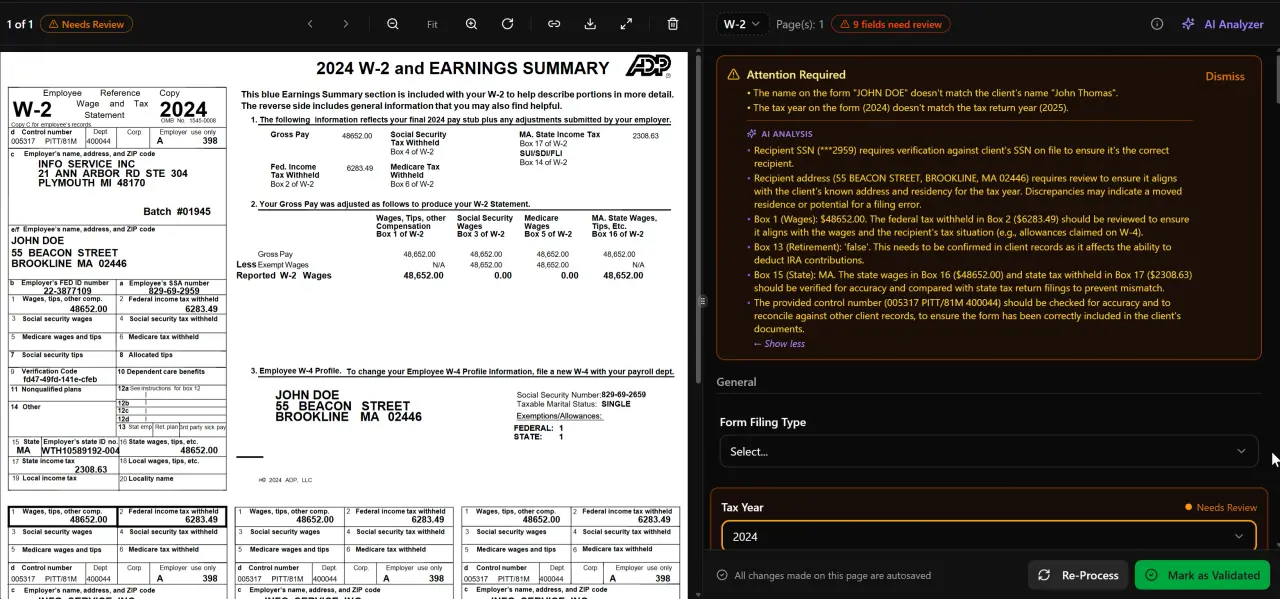
AI classifies, extracts, and validates every document automatically
OIC Eligibility Screening: The Financial Analysis CPAs Must Perform First
Before investing forty or more hours in an offer in compromise engagement, every CPA should perform a structured eligibility screen. The IRS Pre-Qualifier Tool provides a starting framework, but it is not a substitute for professional analysis. A proper screen covers four dimensions: compliance status (all returns filed, no open bankruptcy), collectibility (is RCP genuinely below the total liability?), asset equity (does the client have assets the IRS would expect to liquidate?), and income trajectory (is current income artificially depressed or genuinely impaired?).
The financial analysis for RCP calculation requires gathering 180-plus document types that CPAs typically request at intake — the same W-2s, 1099 variants, bank statements, and mortgage documents that feed into standard return preparation. The difference is that for an OIC, each document is being analyzed for asset value and income projection, not just tax reporting. A platform with AI document extraction that handles over 180 tax form types, including all 1099 variants, K-1s, and supporting financial documents, dramatically reduces the time required to assemble the financial picture.
CPAs should also screen for the three OIC bases: doubt as to collectibility (the most common), doubt as to liability (for disputed assessments), and effective tax administration (for cases where full payment would create economic hardship despite ability to pay). Each basis requires a different documentation strategy and supporting narrative. Mapping this at intake — before the engagement letter is signed — prevents scope creep and protects the firm's fee structure.
For firms managing multiple resolution clients, see our document management guide for accounting firms for structured intake workflows that apply equally well to OIC cases.
Spending more time on OIC spreadsheets than on client strategy?
TaxScout.ai gives CPA firms AI-native tools to manage offer in compromise workflows end-to-end — from document extraction and financial analysis to IRS correspondence tracking — at a flat monthly rate with no per-user fees.

Click any extracted field to see its source highlighted on the original PDF

Your clients see your brand — OTP login, document upload, and real-time status
Form 656 Preparation and the Supporting Financial Statements
Form 656 is the formal offer application — but it is the supporting documents that win or lose the case. Form 433-A (OIC) for individuals and Form 433-B (OIC) for businesses require a complete picture of every asset, liability, income source, and monthly expense. The IRS cross-references the information on these forms against tax transcripts, third-party records, and national and local expense standards published by the IRS Collection Financial Standards.
Form 656 preparation is document-intensive. A single individual OIC package typically includes bank statements for the prior three months across all accounts, documentation for every real and personal property asset, retirement account balances, vehicle valuations, business financials if self-employed, and a detailed monthly budget. For business OICs, the package also includes business bank statements, accounts receivable aging, inventory valuations, and corporate financial statements. Assembling this package manually — downloading, renaming, organizing, and cross-referencing each document — can consume ten or more hours before the CPA has written a single line of analysis.
TaxScout's AI document extraction processes over 180 form types with a 5-layer validation pipeline that includes OCR cross-verification and 15 deterministic math rules. For OIC intake, this means the financial data from bank statements and tax documents flows directly into a structured workspace rather than requiring manual re-entry. The split-screen PDF viewer with click-to-source field highlighting allows CPAs to verify extracted figures against source documents in seconds rather than minutes.
Once documents are assembled, the CPA's analysis layer begins: calculating net realizable equity for each asset category using IRS quick-sale value discounts (typically 80% of fair market value for most assets), projecting disposable monthly income using allowable expense standards, and determining the offer amount based on the 12-month (lump-sum cash offer) or 24-month (periodic payment offer) income projection multiplier.
Managing the OIC Pipeline: Stages, Deadlines, and IRS Correspondence
After submission, an offer in compromise enters a queue that the IRS processes in the order received. The IRS OIC processing timeline historically runs six to twelve months for initial review, though complex cases take longer. During this window, the CPA firm must monitor for IRS correspondence, respond to requests for additional information within strict deadlines, track the tolling of the collection statute of limitations (CSED), and maintain client compliance with all filing and payment obligations — a single missed quarterly payment can void the offer.
This is where generic project management tools fail resolution practices. A kanban board built for annual tax returns does not accommodate the multi-month, multi-stage nature of an OIC case. TaxScout's pipeline management feature supports 12 customizable stages with drag-and-drop workflow. For OIC cases, firms typically configure stages such as: Eligibility Screen, Document Collection, RCP Analysis, Form 656 Preparation, Submission, IRS Review, Information Request Response, Negotiation, Accepted/Rejected, and Post-Acceptance Compliance. Each stage can carry deadline triggers and assigned team members.
IRS correspondence tracking is particularly critical. When the IRS issues a supplemental information request (commonly called a 'development letter'), the firm typically has 30 days to respond — and failure to respond timely results in rejection. TaxScout's communication hub integrates Gmail OAuth, Outlook Graph, and IMAP/POP3 with AI classification, which means incoming IRS correspondence can be automatically flagged, routed to the correct case file, and assigned a response deadline without manual triage.
For firms that handle multiple OIC cases simultaneously, the ability to see all active cases by stage across a single dashboard — with deadline visibility and document status — is the difference between a manageable resolution practice and a compliance liability. Review our other blog resources for more guides on building scalable CPA workflows.
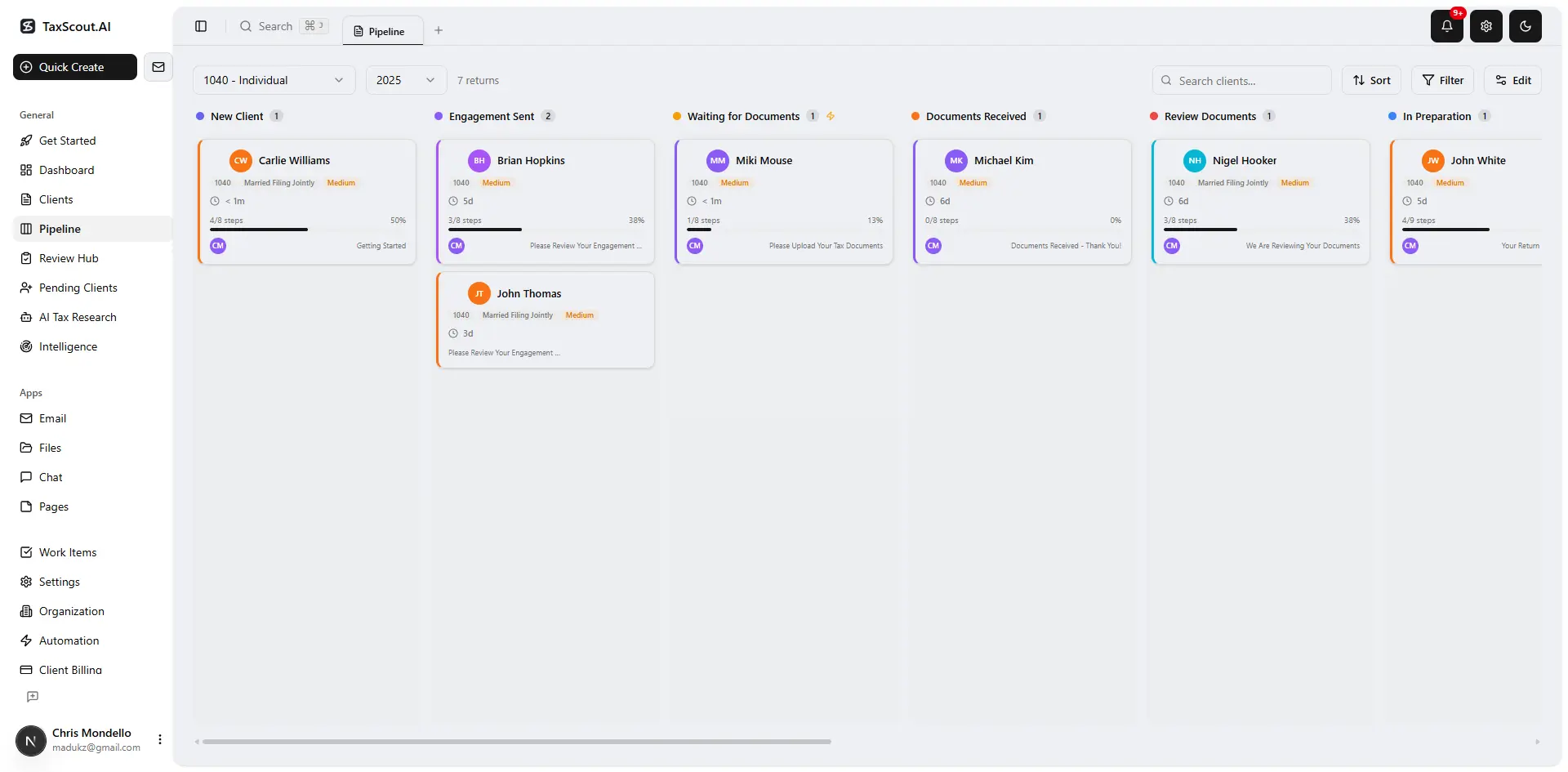
Track every return from intake to filed with drag-and-drop pipeline management
Practice management capability comparison for OIC workflow support
| Capability | TaxScout.ai | TaxDome | Canopy |
|---|---|---|---|
| AI document extraction (180+ form types) | Yes — 5-layer validation | No | No |
| Customizable pipeline stages for OIC tracking | 12 stages, drag-and-drop | Limited | Limited |
| AI research agents with IRS/Treasury search | 9 specialized agents | No | No |
| IRS correspondence auto-classification | Yes — Gmail, Outlook, IMAP | Basic | No |
| Client portal with OTP login for document exchange | Yes — branded, no passwords | Yes | Yes |
| Flat pricing (no per-user fees) | Yes — $149/mo for 10 seats | ~$500/mo (10 users) | ~$660/mo (10 users) |
| E-signatures for engagement letters and Form 8879 | Yes — via Documenso | Yes | Yes |
| Post-cancellation read-only archive | Yes — $99/year | No | No |
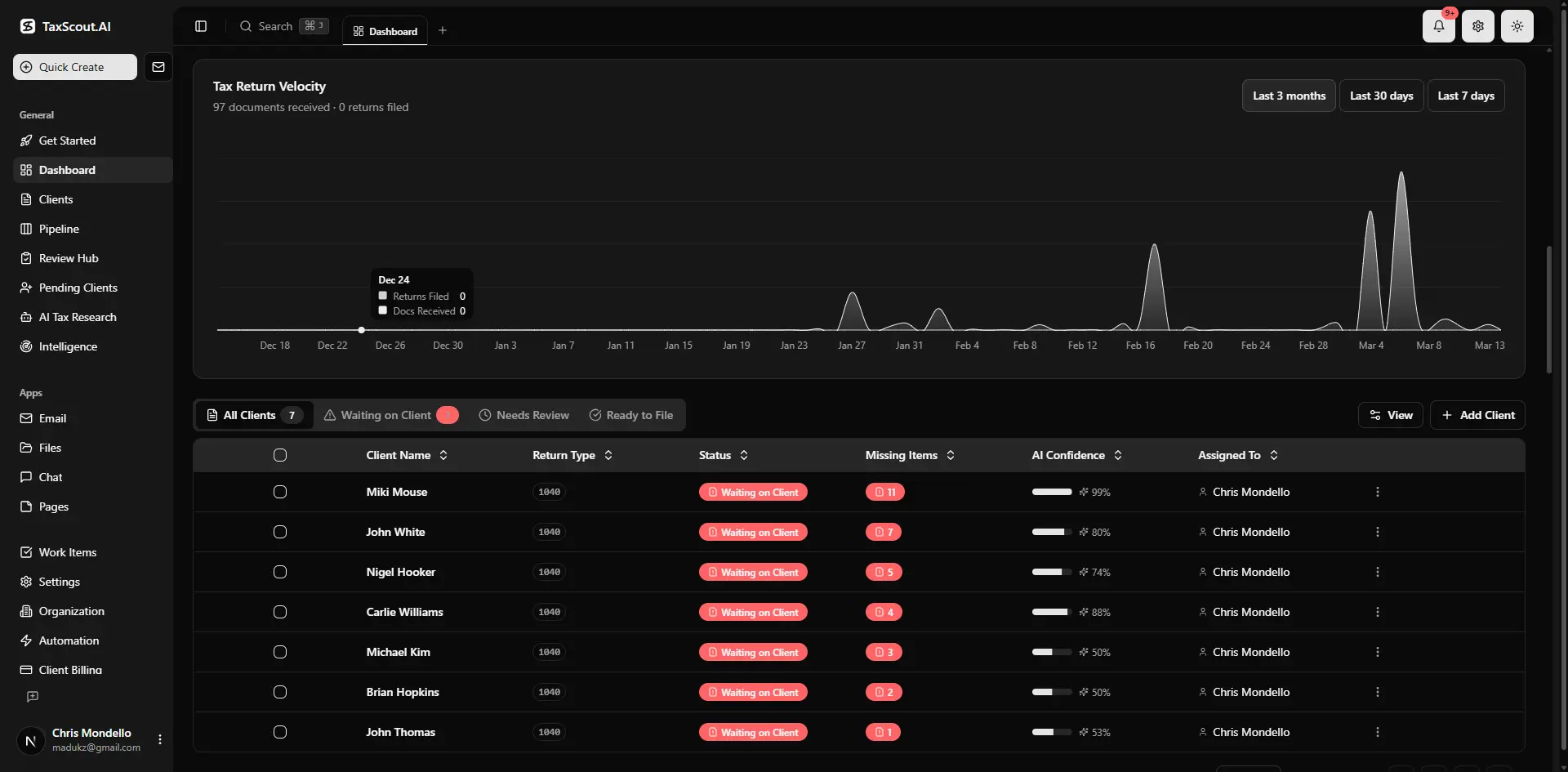
Real-time dashboard showing returns in progress, revenue, and upcoming deadlines
How AI Research Agents Support OIC Analysis and IRS Negotiation
Offer in compromise cases frequently involve nuanced legal questions: How does the IRS value a fractional ownership interest in real estate? What expense allowances apply to a taxpayer who lives in a high-cost-of-living area where national standards fall well short of actual costs? How does a pending CDP hearing affect the CSED calculation? These questions require access to current IRS guidance, Tax Court precedents, and Treasury regulations — often simultaneously.
TaxScout's AI research agents include nine specialized agents with real-time search capability across IRS.gov, Treasury, Cornell Law's Legal Information Institute, and Congressional sources. For OIC work, this means a CPA can query the platform for the current allowable expense standards for a specific county, retrieve the relevant Internal Revenue Manual section governing asset valuation, or pull recent Tax Court cases addressing doubt-as-to-liability offers — without leaving the client workspace.
Client-context AI memory retains entity structures, filing history, and prior returns, which means the research agents can contextualize answers against the specific client's financial profile rather than returning generic guidance. For a resolution practice handling ten or more active OIC cases, this capability compresses research time significantly — the kind of time savings documented in our AI accounting productivity guide.
The combination of AI-assisted research and structured pipeline management also supports the firm's negotiation posture. When the IRS issues a counteroffer or requests additional substantiation, the CPA can quickly retrieve the relevant IRM authority, cross-reference it against the client's documented financials, and prepare a response that cites specific regulatory support — a level of rigor that strengthens acceptance rates.
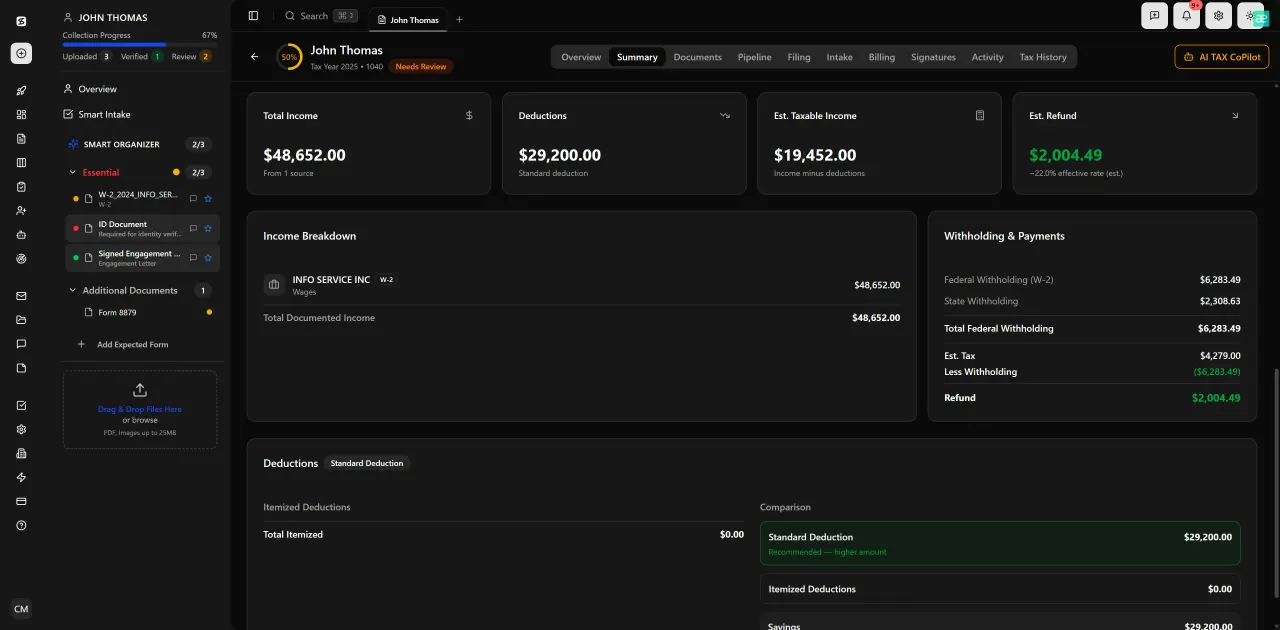
Review with AI assist — 9 agents answer questions with full client context
Pricing and Packaging OIC as a Premium Service Line
Offer in compromise engagements should never be priced like return preparation. The complexity, risk, time horizon, and potential value to the client are categorically different. A client with $80,000 in tax debt who achieves acceptance at $12,000 has received $68,000 in economic value — and a flat fee of $3,500 to $7,500 for a well-managed OIC engagement is both defensible and competitive with the resolution industry's typical pricing.
The standard pricing models for OIC work fall into three categories: flat fee (most common for straightforward cases), flat fee plus a percentage of the 'discount' achieved, and hourly. For CPA firms trying to build a scalable resolution practice, flat-fee pricing tied to engagement scope is the most predictable — for both the firm and the client. Our flat fee billing guide for CPAs covers the mechanics of structuring fixed fees for complex engagements in detail.
Packaging matters as much as pricing. A well-structured OIC service tier might include: initial eligibility analysis (a standalone paid consultation), full OIC package preparation and submission, IRS correspondence management through acceptance or rejection, and post-acceptance compliance monitoring for the standard two-year period. Each phase can be priced separately or bundled, and the engagement letter should specify exactly what triggers a scope-change conversation. E-signatures via Documenso make it straightforward to execute engagement letters, amendments, and Form 8879 authorizations without printing or mailing.
Resolution work also generates ongoing advisory relationships. Clients who successfully complete an OIC often need tax planning, filing compliance support, and business advisory services for years afterward — making the initial resolution engagement a high-value acquisition point for long-term firm revenue. According to the Journal of Accountancy, firms that expand into resolution services consistently report higher average revenue per client than pure compliance practices.
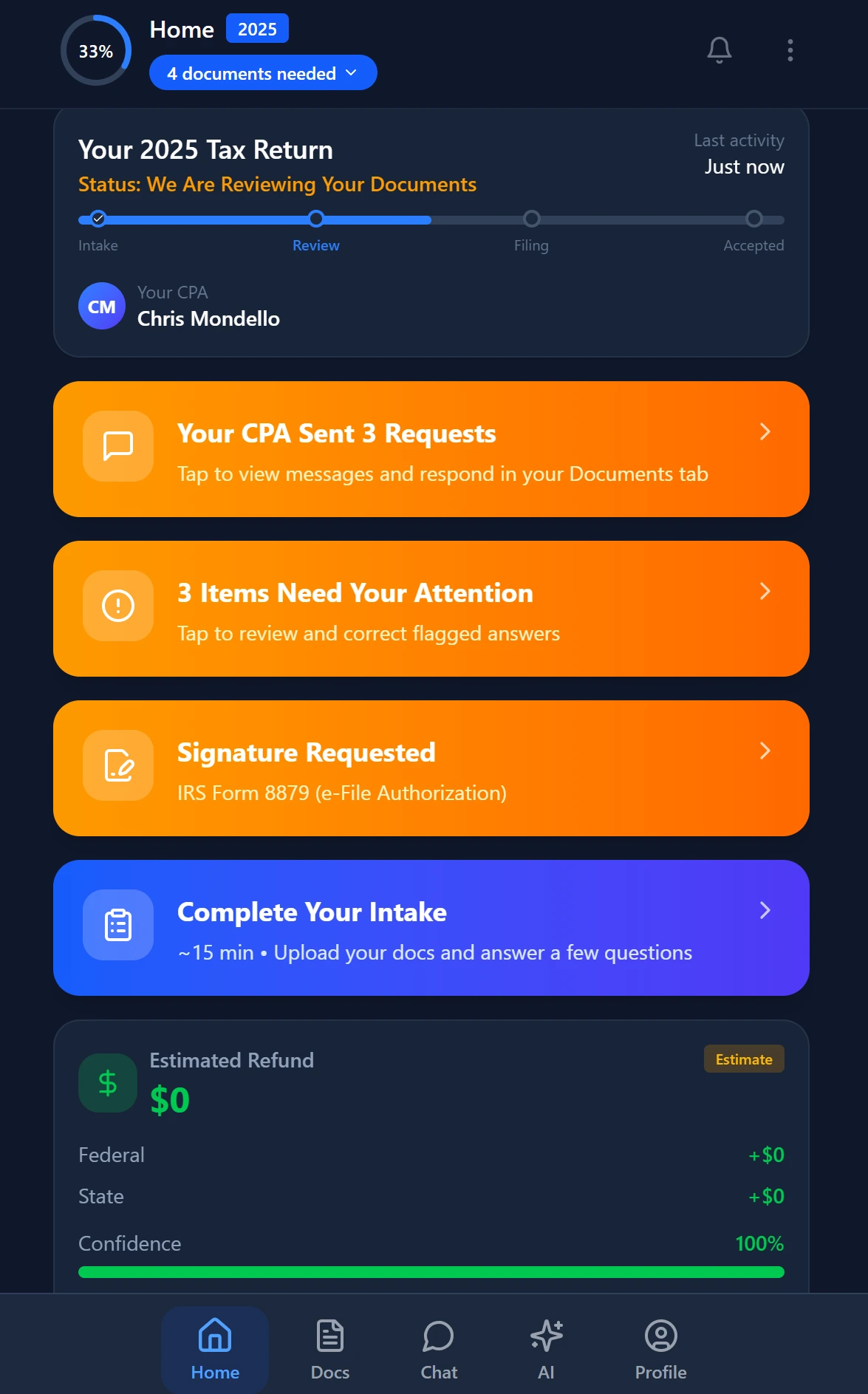
Smart intake auto-fills from uploaded documents and prior-year data
Post-Acceptance Compliance: Protecting the Client After OIC Approval
IRS acceptance of an offer in compromise is not the end of the engagement — it is the beginning of a two-year compliance period during which the client must file all required returns on time, pay all taxes due, and refrain from incurring new tax liabilities. Any violation during this window can result in the offer being defaulted and the full original liability being reinstated, plus accrued interest. Per IRS Publication 594, the IRS also retains any tax refunds due for the year the offer is accepted.
For CPA firms, post-acceptance monitoring is an ongoing service opportunity. The firm should track the client's filing and payment calendar for the full compliance period, confirm that estimated tax payments are submitted on schedule, and verify that no new assessments are issued. TaxScout's pipeline management allows firms to create a dedicated post-acceptance compliance stage with automated deadline reminders and client-facing status updates through the client portal.
The branded client portal with OTP login (no passwords required) is particularly useful for the compliance period because it gives clients a single location to upload quarterly proof of payment, receive deadline reminders, and communicate with the firm without generating unmanaged email chains. For firms also managing AI-powered client intake, the same portal handles onboarding for new resolution clients — creating a consistent experience from initial consultation through post-acceptance closeout.
Firms that systematize post-acceptance monitoring also protect themselves from liability. If a client defaults on a two-year compliance obligation because the firm failed to flag a missed estimated payment, the professional exposure is significant. A structured pipeline with deadline tracking and documented client communication creates an auditable record that the firm fulfilled its advisory responsibilities — which is as important for professional liability as it is for client outcomes.
Managing OIC cases across spreadsheets, email, and disconnected tools?
TaxScout.ai consolidates your entire offer in compromise workflow — AI document extraction, pipeline tracking, IRS research agents, and client portal — in one flat-fee platform built for CPA firms.
Frequently Asked Questions
The IRS typically accepts between 30% and 40% of submitted OIC applications in a given year. Acceptance rates vary based on the quality of the financial analysis, the accuracy of the RCP calculation, and whether the taxpayer meets all compliance requirements. Cases prepared by CPAs with structured documentation and properly substantiated allowable expenses consistently achieve higher acceptance rates than self-prepared applications.
Keep reading
Uniform Capitalization Rules: How CPAs Apply UNICAP to Inventory and Self-Constructed Assets
Oct 17, 2026 · 1 min read
Non-Applicability of Section 357(c) to Consolidated Groups: What CPA Firms Must Do Now
Oct 17, 2026 · 1 min read
Reasonable Basis Defense: How CPAs Shield Clients From Accuracy-Related Penalties
Oct 17, 2026 · 1 min read
Stay up to date
Get the latest tax tech insights delivered to your inbox.