Non-Filer Back Tax Returns: How CPAs Reconstruct Expenses Without Records
When a non-filer client hands you nothing but a box of cash-deposit records and a vague memory of what they spent, reconstructing Schedule C expenses becomes an exercise in forensic accounting. This guide walks CPAs through IRS-accepted methods, industry expense ratio sources, and the…
Non-filer back tax returns are among the most labor-intensive engagements a CPA firm can take on. The client hasn't filed in three, five, sometimes eight years. Income is reconstructed from third-party transcripts, bank records, and the occasional 1099 that survived a move. But the income side is often the easier half — the real problem is business expenses. When a sole proprietor operated without bookkeeping for years, there is frequently nothing to work from beyond a general sense of what the business did.
The IRS does not require perfect records to claim Schedule C deductions. What it does require — especially in examination — is a reasonable, documented basis for every number on the return. For practitioners, that means you need a methodology that is explainable, reproducible, and grounded in third-party data before you ever file. A number you can defend is worth far more than a precise number you cannot. This is especially true in non-filer back tax returns, where the absence of timely filing often means the absence of organized records as well.
This guide covers the core approaches CPAs use when reconstructing business expenses with little or no contemporaneous records: the IRS-approved reconstruction methods, where to find industry-level expense ratio data keyed to NAICS codes, how to combine multiple sources into a defensible position, and how to document your work so an examiner understands your reasoning at a glance. If you take on non-filer clients regularly, having this methodology systematized inside your practice is not optional — it is risk management. These techniques are particularly relevant for non-filer back tax returns, where reconstructing expenses from scratch is the norm rather than the exception.
Why Expense Reconstruction on Non-Filer Returns Is Different
Most CPA engagements begin with some records — a QuickBooks file, bank statements, credit card exports. Non-filer back tax return work often begins with nothing but the client's memory and whatever third-party income data you can pull from IRS transcripts via Form 4506-C. That changes the engagement economics and the liability profile significantly. Non-filer back tax returns present a unique challenge because even the baseline documentation that most engagements rely on may be years out of reach or simply never existed.
Under the Cohan rule, established in Cohan v. Commissioner (39 F.2d 540), courts have long recognized that a taxpayer who cannot produce exact records is still entitled to a reasonable estimate of deductible expenses — as long as there is an evidentiary basis for the estimate. The Tax Court has applied this standard hundreds of times. However, the rule has important limits: certain categories (listed property, business meals, travel, home office) require strict substantiation that Cohan cannot rescue. Those categories need to be handled separately or excluded entirely when records are unavailable. For firms evaluating their non-filer back tax returns approach, this trade-off compounds over time.
The practitioner's job is to build an estimate that satisfies Cohan's "reasonable basis" standard. That means using sources a court or examiner would recognize as authoritative, documenting how you selected and applied those sources, and flagging explicitly which deductions were estimated versus substantiated. For multi-year engagements, apply the same methodology consistently across all open years — inconsistency is a red flag in examination. Each of these factors directly shapes how non-filer back tax returns plays out in practice.
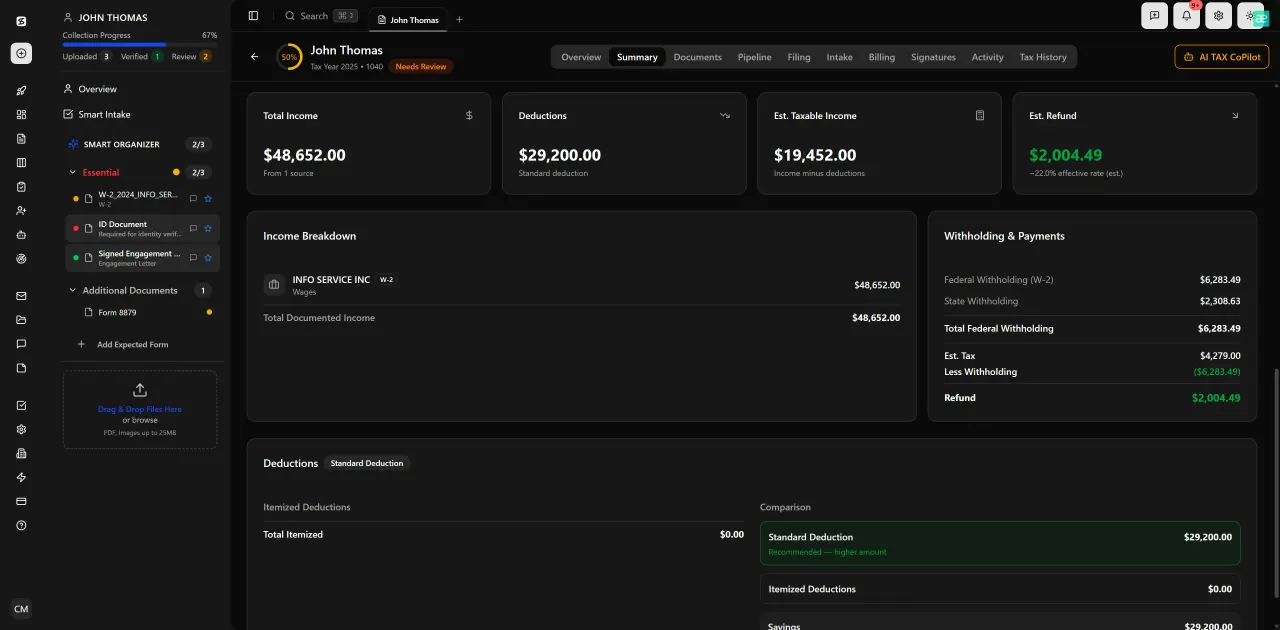
Review with AI assist — 9 agents answer questions with full client context
Step 1: Identify the NAICS Code and Verify It Against IRS Data
Every expense reconstruction begins with the correct North American Industry Classification System (NAICS) code. The NAICS code determines which industry benchmarks apply, and using the wrong code — even a close cousin — can produce ratios that are materially off. A residential painter and a commercial painting contractor carry very different overhead structures. Understanding non-filer back tax returns in this context is what separates firms that scale from those that stall.
Start by having the client describe the business in concrete terms: What did they sell or do? Who were their customers — consumers or businesses? Did they use subcontractors or only their own labor? Did they maintain inventory? These answers map to a specific 6-digit NAICS code. Cross-reference the client's answer against the NAICS manual at the U.S. Census Bureau to confirm the match. Document your selection rationale in your workpaper. This is precisely where a deliberate non-filer back tax returns strategy pays off.
Once you have the NAICS code, pull the IRS Statistics of Income (SOI) data for sole proprietorships. The IRS publishes SOI Table 1 for Nonfarm Sole Proprietors broken down by industry group and income level. This table shows average gross receipts, cost of goods sold, and major expense categories as a percentage of net profit for each industry segment — exactly the kind of third-party benchmark that satisfies an examiner. Pull the year-specific table for each back year you are filing, because ratios shift over time. Non-filer back tax returns sits at the center of this decision — get it wrong and the rest unravels.
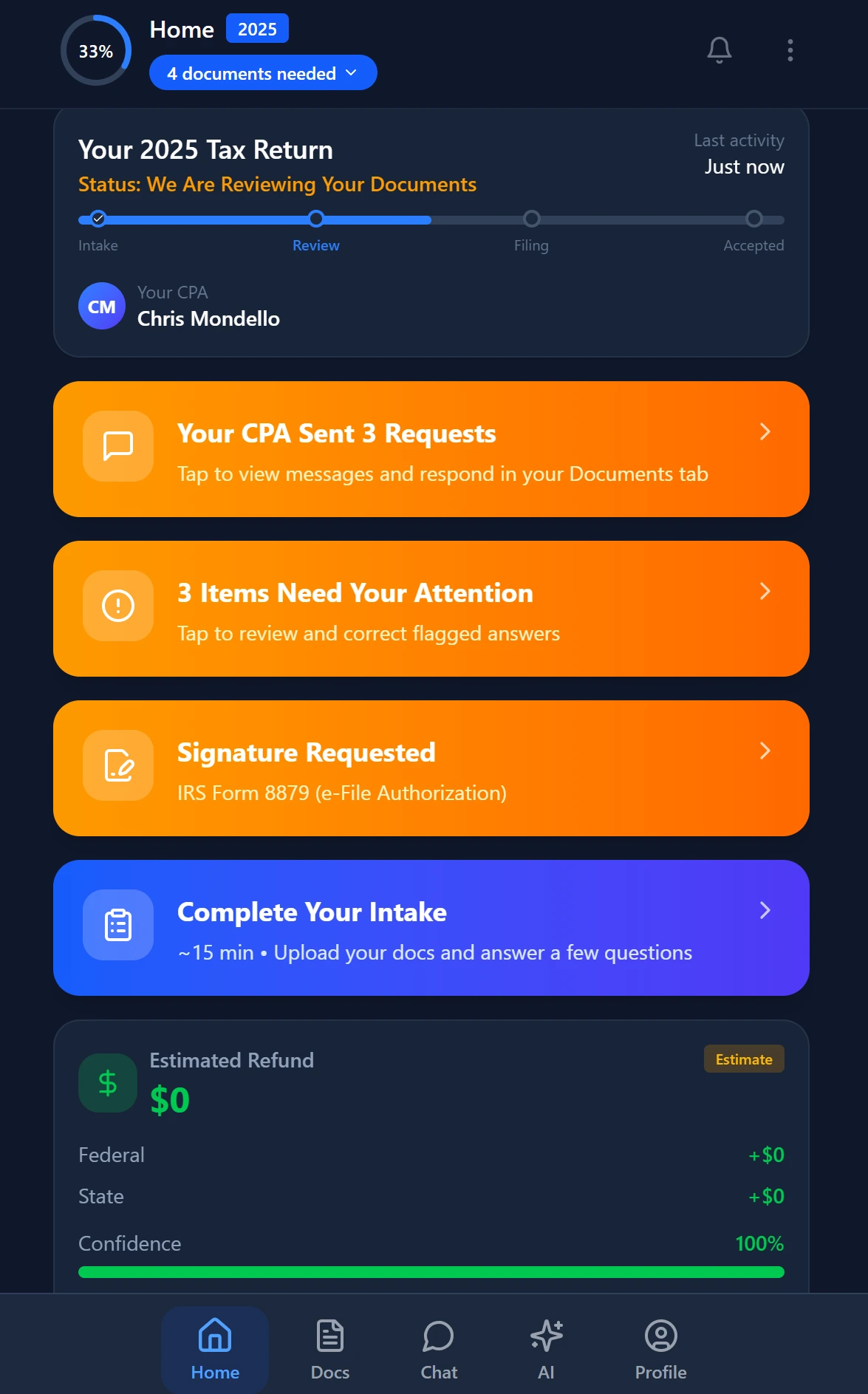
Smart intake auto-fills from uploaded documents and prior-year data
Step 2: Supplement IRS SOI Data With BLS and Industry Sources
IRS SOI tables are useful but granular only to broad industry groups. For more precise expense ratio benchmarks, layer in data from additional sources. The U.S. Bureau of Labor Statistics Occupational Outlook Handbook contains wage and compensation data that helps you build a realistic labor cost estimate for a business of the client's reported size. If the client had employees, BLS average wages for that occupation in the client's state and year provide a defensible basis for deducted wages. When firms revisit their non-filer back tax returns priorities, the gaps usually surface here.
For cost of goods sold and materials, industry trade associations often publish annual operating surveys. The Small Business Administration's size standards and industry data can help bound the universe of applicable benchmarks. Risk Management Association (RMA) Annual Statement Studies, available in most public libraries and many university business school databases, break down financial ratios by SIC/NAICS code and revenue tier — they are specifically designed for the kind of benchmarking you need here.
The key discipline is to document every source: title, publisher, year, page or table number, and the specific ratio you used. If your estimate for advertising expense comes from an RMA median for NAICS 238910 (Site Preparation Contractors) in a specific revenue band, write that down in your workpaper. An examiner who can follow your reasoning is far less likely to disallow the deduction than one who sees a number with no trail.
Drowning in multi-year non-filer workpapers across your team?
TaxScout.ai centralizes document reconstruction, pipeline tracking, and client communication for back-tax engagements — all at a flat monthly price with no per-user fees.
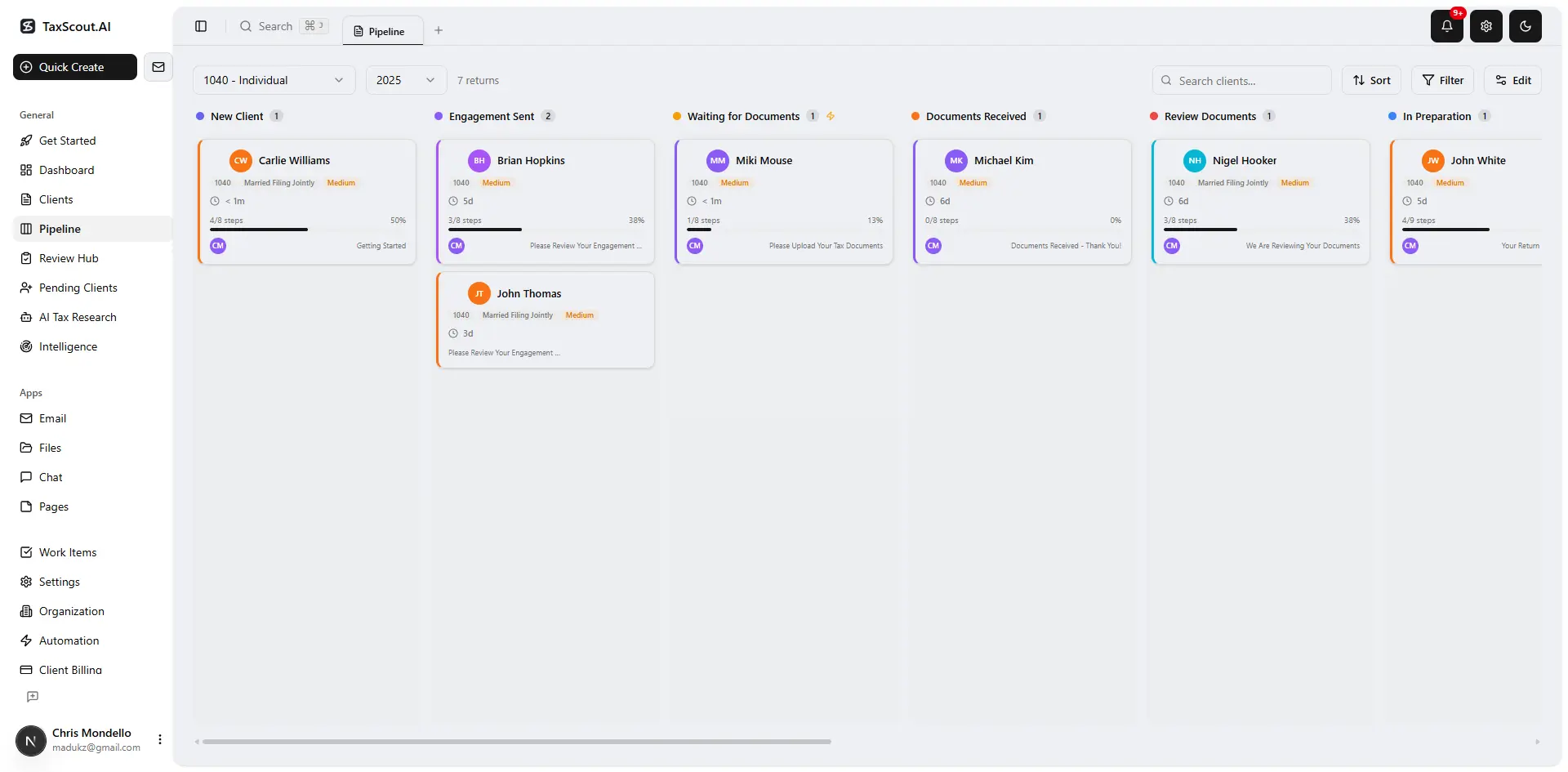
Track every return from intake to filed with drag-and-drop pipeline management
Step 3: Apply the Bank Deposit Method to Bound Gross Receipts First
Before estimating expenses, you need a reliable gross receipts figure. The bank deposit method is the IRS's own preferred indirect income reconstruction technique (IRM 4.10.4.6), and courts treat it as credible when properly applied. Pull all bank statements for each open year, total deposits, and then subtract non-income items: transfers between accounts, loan proceeds, gifts, and returns. What remains is a defensible income proxy.
The gross receipts figure matters for expense reconstruction because most ratio-based benchmarks express expenses as a percentage of revenue. A business with $80,000 in reconstructed gross receipts and a 35% materials-to-revenue ratio for its NAICS code produces a $28,000 materials estimate — but only if you trust the revenue base. If the client had significant cash receipts not deposited, document any adjustment methodology you use to gross up the bank deposits. Use a consistent multiplier across all years and support it with whatever contemporaneous evidence exists (invoices, contracts, text messages with customers).
Cross-reference your reconstructed gross receipts against any third-party information returns the IRS has on file. Transcripts will show 1099-K, 1099-NEC, and 1099-MISC payments issued to the taxpayer. If your bank deposit reconstruction is lower than the 1099 totals on transcript, you have a problem — resolve it before filing. See our guide on understanding Form 1099-NEC vs 1099-MISC for how different payment types are reported and what gaps to look for.

Click any extracted field to see its source highlighted on the original PDF
Step 4: Build the Reconstructed Schedule C Line by Line
With gross receipts established and NAICS benchmarks in hand, work through Schedule C systematically. For each line, apply one of three treatments: (1) use actual substantiated figures where records exist, (2) apply a benchmark ratio where records are absent and the expense category supports estimation under Cohan, or (3) exclude the deduction entirely where strict substantiation requirements apply and records are unavailable.
Categories that typically survive Cohan-based estimation for a sole proprietor include cost of goods sold, materials and supplies, contract labor (supported by reasonable labor rates), advertising, rent on business property, insurance, and utilities for a standalone business location. Categories that require strict substantiation and should be excluded or minimized without records: home office (must meet exclusive-use and principal-place tests with documentation), vehicle expenses (mileage logs or actual expense records required; use the IRS standard mileage rate as a floor only if the client can credibly attest to business miles), and listed property such as computers and equipment purchased after 2017 (bonus depreciation rules mean the stakes are high, but so is the scrutiny).
For each estimated line, create a separate workpaper tab showing: the NAICS benchmark source and ratio, the gross receipts base applied, the resulting dollar estimate, and any adjustments made for the client's specific circumstances. If the client recalls a specific major expense — a piece of equipment, a large materials purchase, a lease — and can provide any corroborating evidence (a serial number, a landlord's name, a vendor the examiner can contact), include it as a supplemental override with a note explaining why you departed from the industry average.
Step 5: Document the Methodology and Obtain Written Client Representations
A reconstructed return without a documented methodology is a liability waiting to happen. Before filing, prepare a reconstruction memorandum that summarizes: (1) the years covered and the reconstruction approach used for each year, (2) the income reconstruction method (bank deposits, third-party documents, or other), (3) the NAICS code selected and the rationale for that selection, (4) each benchmark source used and the specific ratio applied, (5) the categories excluded due to strict substantiation requirements, and (6) any client-provided corroboration used to adjust benchmark figures.
Pair the memorandum with a client representation letter that the taxpayer signs before filing. The letter should state, at minimum, that the client has reviewed the reconstructed figures, that the estimates represent the client's best recollection of actual expenses, and that the client understands the returns may be subject to examination. This shifts responsibility appropriately and protects you under Circular 230 standards for tax return preparers. For multi-year engagements, require a signed engagement letter that specifies the reconstruction methodology by reference before you begin any work — see our glossary entry on engagement letters for the key terms every non-filer engagement should include.
Store all workpapers, source documents, and signed representations in a single organized file. If you are using TaxScout.ai, the file management system and e-signature workflow via Documenso let you attach reconstruction memos and representation letters directly to the client record, time-stamped and accessible if you ever need to pull the file for an exam. For more on other blog resources covering complex CPA workflows, the TaxScout blog has additional guides on documentation practices and AI-assisted research.
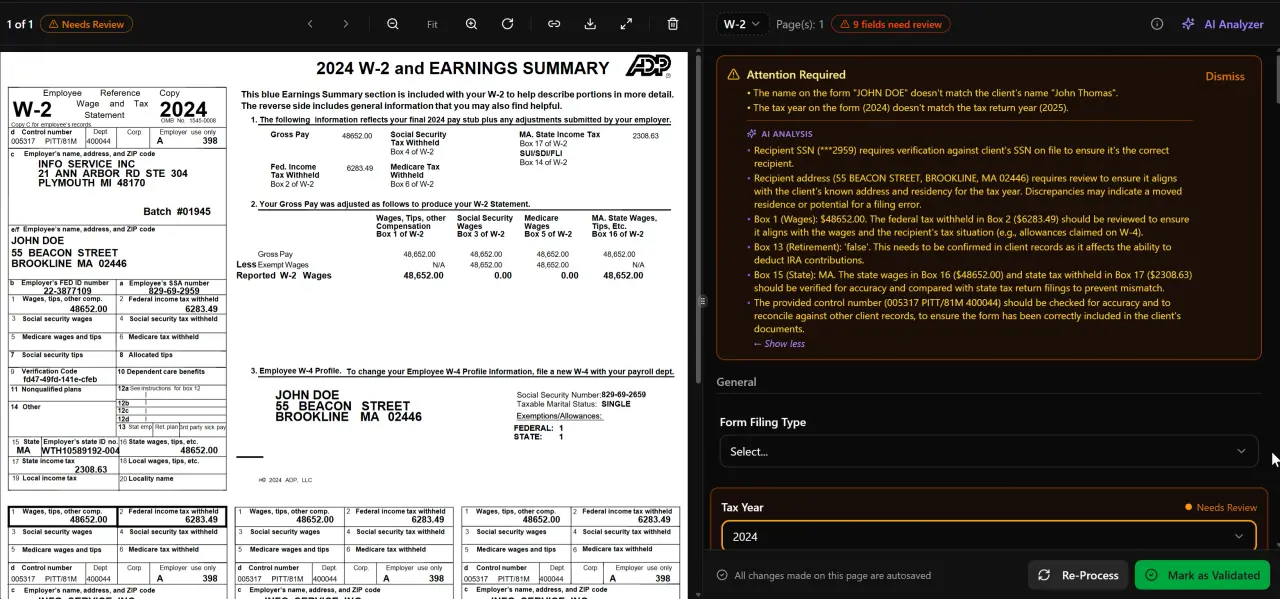
AI classifies, extracts, and validates every document automatically

Every client gets organized documents, status tracking, and a complete history
Using AI Research Agents to Source Benchmark Data Faster
Finding the right IRS SOI table, BLS wage data, and RMA ratios for five open years across two NAICS codes is genuinely time-consuming when done manually. This is one area where AI-powered research tools accelerate back-tax preparation meaningfully. TaxScout.ai's AI Research Agents include specialized agents that search IRS, Treasury, Cornell Law, and BLS in real time — so you can query "average expense ratios for sole proprietors in NAICS 238210 electrical contractors for tax year 2020" and receive sourced, citable results in seconds rather than minutes of tab-switching.
The same agents can surface relevant Tax Court decisions applying the Cohan rule to specific expense categories, Treasury Regulations governing substantiation requirements, and IRS guidance on indirect income reconstruction methods. For a complex multi-year non-filer engagement, having those citations already pulled and cited in your reconstruction memorandum is a significant time saver — and it demonstrates to any examiner that your methodology was research-backed, not invented.
Pair the research capability with TaxScout's pipeline management to track each non-filer engagement through your custom stages: transcript ordered, income reconstructed, expense memo drafted, client representations signed, return filed. Multi-year engagements have too many moving parts to manage on a shared spreadsheet, and a missed step on a back-tax return creates risk that outlasts the filing season. For a broader look at how AI tools are changing document-heavy workflows, see What Is AI Document Extraction for CPAs.
Penalties, Abatement, and Setting Client Expectations
When you file reconstructed non-filer back tax returns, the tax liability itself is rarely the only financial issue. Late filing penalties under IRC §6651(a)(1) are 5% per month up to 25% of unpaid tax. Late payment penalties under §6651(a)(2) run an additional 0.5% per month. Interest accrues from the original due date. For a client who hasn't filed in five years, the combined penalties and interest can exceed the underlying tax on modest incomes.
First-time penalty abatement (FTA) under IRM 20.1.1.3.6.1 is available for the first failure-to-file, failure-to-pay, or failure-to-deposit penalty if the taxpayer has no prior penalties in the three preceding years and is currently compliant. For a multi-year non-filer, you can typically apply FTA to the earliest open year and reasonable cause for subsequent years. Document the reasonable cause narrative carefully — personal hardship, serious illness, or reliance on a third party who failed to file can all support abatement. Reference our guide on avoiding penalties with estimated quarterly tax payments to help clients understand ongoing compliance obligations once the back years are resolved.
Set clear expectations with the client in writing before you file. A reconstructed return with estimated expenses may produce a different liability than a return with perfect records. Explain that the reconstruction methodology is designed to be defensible, not to maximize deductions, and that if the IRS examines and adjusts the return, additional tax may result. Clients who understand the process upfront are far less likely to become difficult clients when they receive an exam notice.
Handling non-filer back tax returns across multiple years and clients?
TaxScout.ai gives your firm AI research agents, pipeline tracking, e-signatures, and a flat-fee pricing model — so you can take on complex engagements without adding overhead.

Your clients see your brand — OTP login, document upload, and real-time status
Frequently Asked Questions
The Cohan rule, from Cohan v. Commissioner (2d Cir. 1930), holds that a taxpayer who cannot produce exact expense records is still entitled to a reasonable estimate of deductible expenses if there is a credible evidentiary basis for the estimate. For non-filer back tax returns, CPAs use industry benchmarks, IRS SOI data, and indirect reconstruction methods to satisfy this standard. Note that the Cohan rule does not apply to listed property, business meals, travel, or home office — those categories require strict substantiation regardless.
Keep reading
Backdoor Roth IRA: How CPAs Execute the Strategy Without Triggering Pro-Rata Tax
Oct 12, 2026 · 1 min read
Amended FBAR Procedures: How CPAs Correct Foreign Account Errors Without Triggering Penalties
Oct 12, 2026 · 1 min read
Transparency in Coverage Final Rules: What CPA Firms Must Do Now
Oct 12, 2026 · 1 min read
Stay up to date
Get the latest tax tech insights delivered to your inbox.