Net Operating Loss Carryforward: How CPAs Maximize Deductions for Clients With Business Losses
TCJA permanently altered the mechanics of net operating loss carryforwards — eliminating most carrybacks, capping annual deductions at 80% of taxable income, and allowing indefinite carry periods. This guide walks CPAs through the calculation workflow, entity-specific tracking rules, and strategic…
For clients who sustain a net operating loss carryforward, the tax benefit is real but deferred — and the rules governing when and how much of that loss can offset future income have changed significantly since the Tax Cuts and Jobs Act. CPAs who understand the post-TCJA mechanics can turn what looks like a bad year into a multi-year tax savings strategy. Those who don't may leave significant deductions on the table or, worse, trigger an accuracy-related penalty by misapplying the limitation rules.
The core changes under IRC §172 as amended by TCJA — indefinite carryforward periods, the 80% of taxable income cap, and the near-elimination of carrybacks — interact in non-obvious ways with other deductions like the qualified business income deduction under §199A and bonus depreciation under §168(k). Getting the ordering right each year determines not only how much NOL gets absorbed but also whether the §199A deduction survives at all. Understanding how a net operating loss carryforward interacts with the qualified business income deduction is essential for accurate planning under the post-TCJA framework.
This guide covers the full workflow: computing the NOL correctly, tracking it across entity types, deciding between carryback and carryforward for clients who still qualify, and sequencing deductions strategically when multiple tax attributes compete for the same dollar of taxable income. Properly applying a net operating loss carryforward requires careful attention to ordering rules when multiple tax attributes are competing for the same dollar of taxable income.
How TCJA Changed Net Operating Loss Carryforward Rules
Before TCJA, most taxpayers could carry a net operating loss back two years for an immediate refund, then forward 20 years. The Tax Cuts and Jobs Act of 2017 replaced that framework with three structural changes that are now permanent law under P.L. 119-21 (signed July 4, 2025): (1) NOLs arising in tax years beginning after December 31, 2017 generally cannot be carried back; (2) the carryforward period is indefinite — losses never expire; and (3) the annual net operating loss deduction is capped at 80% of taxable income computed before the NOL deduction. The shift to an indefinite net operating loss carryforward period fundamentally changed the planning calculus that CPAs had relied on for decades.
The 80% NOL limitation means a profitable year rarely zeroes out a large carryforward. If a client has $500,000 of taxable income and $800,000 of NOL carryforward, only $400,000 of the loss is deductible in that year — leaving $400,000 in the carryforward pool and a $100,000 tax bill the client did not expect. Many advisors who built projections under the pre-TCJA two-year carryback model have underestimated the cash-flow impact of this cap. For firms evaluating their net operating loss carryforward approach, this trade-off compounds over time, making it critical to stress-test projections across multiple profitable years rather than assuming a single year absorbs the full balance.
P.L. 119-21 made the TCJA individual and pass-through provisions permanent. The TCJA NOL rules are not sunsetting; they are the permanent framework. CPAs should update any client projection models that still reference a reversion to pre-TCJA treatment after 2025. For additional context on related permanent TCJA provisions, see our guide on IRC 163(j) interest limitations, which was also made permanent under the same legislation. Each of these factors directly shapes how a net operating loss carryforward plays out in practice.
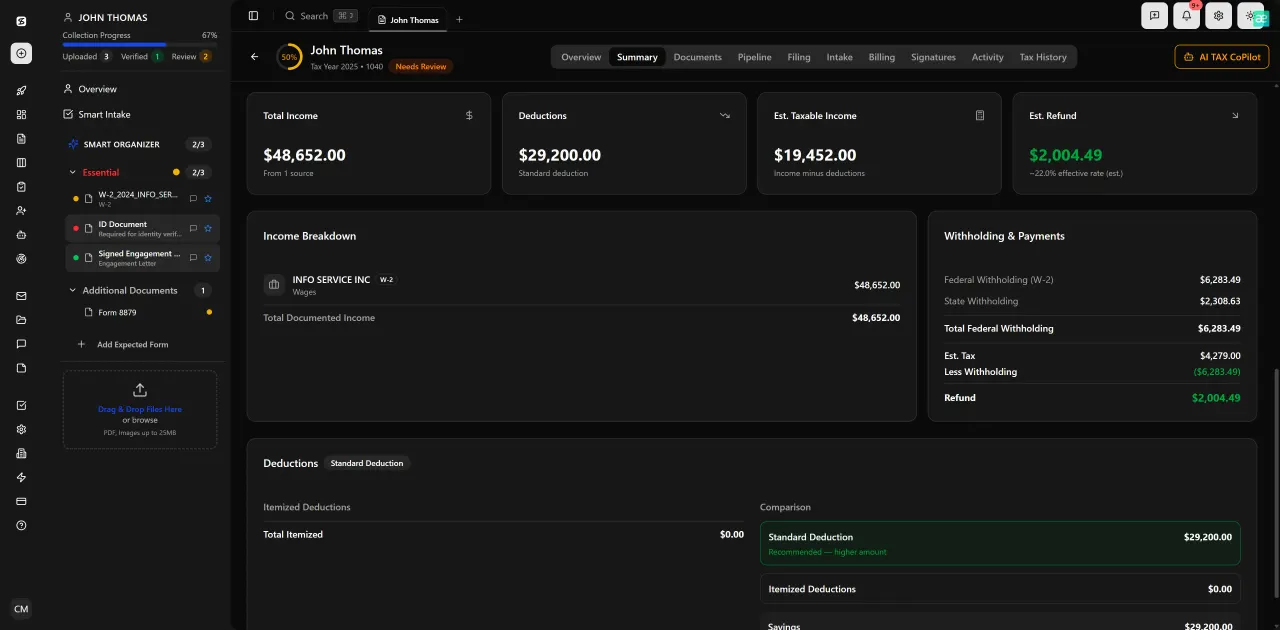
Review with AI assist — 9 agents answer questions with full client context
Calculating the NOL: What Goes In and What Stays Out
The starting point for an individual or pass-through owner is adjusted gross income, reduced by the standard deduction or itemized deductions, with specific add-backs. Under IRC §172(d), capital loss deductions cannot exceed capital gains in the NOL computation, and the deduction for nonbusiness deductions (itemized deductions other than casualty losses attributable to a trade or business) cannot exceed nonbusiness income. In practice, this means a Schedule C loss can generate a net operating loss carryforward but a stock portfolio loss generally cannot. Understanding net operating loss carryforward in this context is what separates firms that scale from those that stall.
For pass-through owners — S corporation shareholders and partnership partners — the NOL calculation begins at the owner's individual return, not at the entity level. The entity itself does not carry an NOL; it passes losses through to owners, who absorb them subject to basis, at-risk, and passive activity rules before any NOL analysis even begins. CPAs should confirm that the owner has sufficient basis to claim the full loss before calculating whether a net operating loss carryforward exists. Our guide on basis tracking for S corp shareholders covers that prerequisite in detail. This is precisely where a deliberate net operating loss carryforward strategy pays off.
C corporations follow a different path. Under §172, a C corporation computes its NOL entirely at the entity level, and the 80% limitation applies to taxable income before the dividends-received deduction. The net operating loss carryforward belongs to the corporation, not its shareholders, which creates complications in M&A transactions where acquiring companies cannot freely use target NOLs — §382 limitations apply upon an ownership change exceeding 50 percentage points over a rolling three-year period. Net operating loss carryforward sits at the center of this decision — get it wrong and the rest unravels.
Nonbusiness Deduction Limitation in Practice
For individual filers, the nonbusiness deduction floor can reduce an expected NOL substantially. Suppose a sole proprietor reports $200,000 of Schedule C losses and $30,000 of investment interest expense. The $30,000 is a nonbusiness deduction capped at nonbusiness income (say, $10,000 of dividends), leaving only $10,000 deductible in the NOL year. The $20,000 disallowed excess does not disappear — it carries forward as an investment interest carryover under §163(d) — but it does not increase the net operating loss carryforward either. When firms revisit their net operating loss carryforward priorities, the gaps usually surface here.
Wage income, rental income, and Schedule E pass-through income each require careful classification as business or nonbusiness before finalizing the NOL amount. The IRS instructions for Form 1045 provide a detailed worksheet (Worksheet 1) that walks through each line of the 1040 with the required modifications, and CPAs should complete that worksheet — not rely on software defaults — to verify the NOL is computed correctly.
Tracking NOL carryforwards across multiple clients and tax years taking up too much time?
TaxScout.ai's AI research agents and client-context memory keep NOL schedules, entity structures, and prior-year filing history organized — so you spend time on strategy, not spreadsheet maintenance.
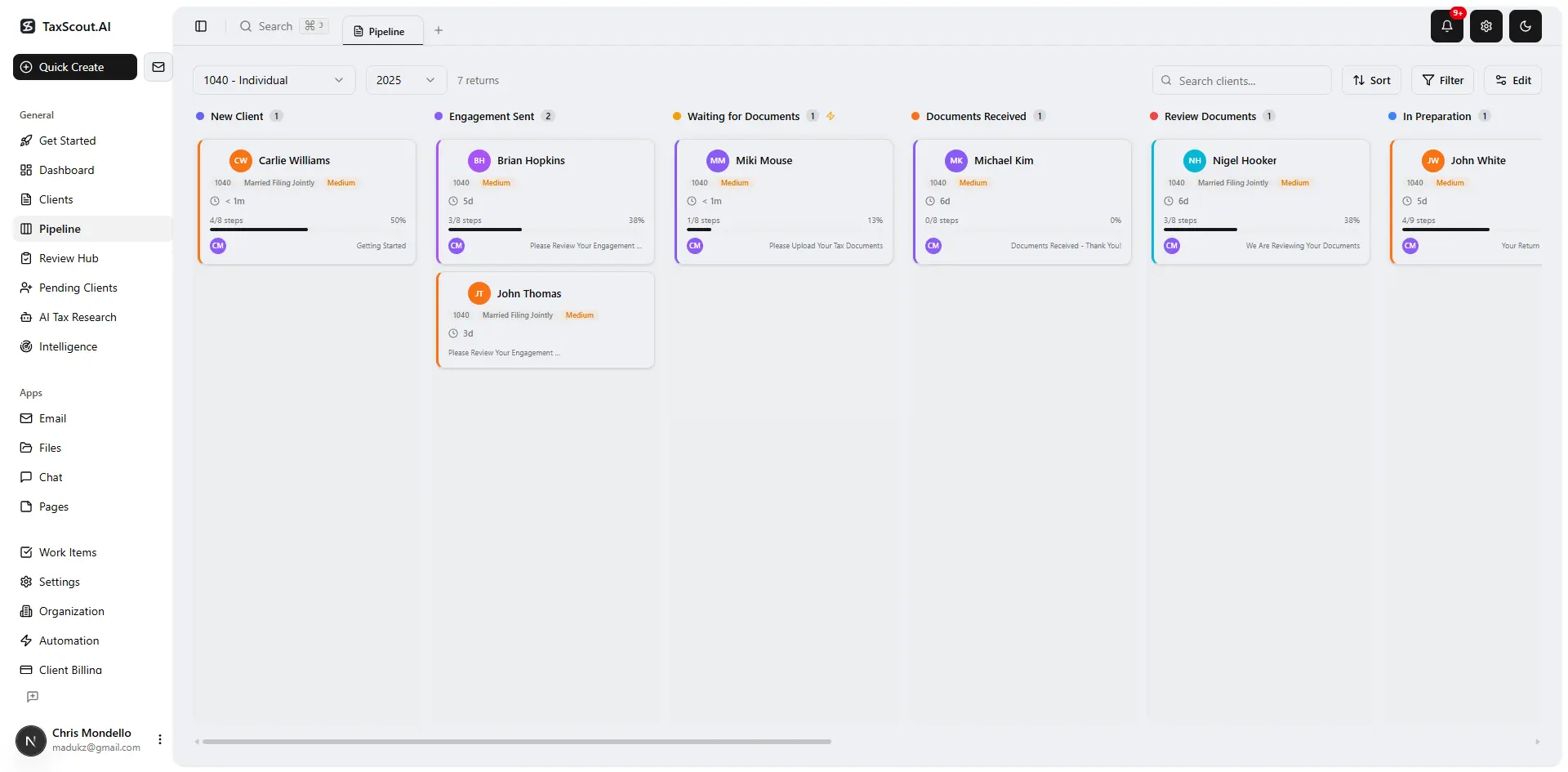
Track every return from intake to filed with drag-and-drop pipeline management
The 80% Taxable Income Limitation: Mechanics and Common Errors
The NOL 80 percent limitation applies to each carryforward year separately. Taxable income for this purpose is computed before the net operating loss deduction itself, but after all other deductions — including the §199A QBI deduction, §163(j) business interest limitation, and any §179 expensing. The IRS confirms this ordering in Publication 536: the §199A deduction reduces taxable income before applying the 80% cap, which means a large QBI deduction in a profitable year lowers the ceiling for NOL absorption.
Consider the interaction: a client with $600,000 of taxable income before §199A and a $500,000 net operating loss carryforward claims a $120,000 QBI deduction, reducing taxable income before NOL to $480,000. The 80% cap is $384,000. Only $384,000 of the $500,000 NOL carryforward is deductible, leaving $116,000 to carry into the next year. If the CPA had not modeled the §199A interaction, they might have projected a zero-tax year incorrectly.
A second common error: the 80% limitation is computed separately for NOLs arising in different years when the taxpayer has multiple vintage carryforward pools. The oldest carryforwards are consumed first (FIFO ordering), but the 80% cap applies to the total NOL deduction claimed that year, not to each vintage separately. Maintaining a schedule that tracks the year of origin, original amount, and remaining balance for each NOL tranche is essential for accurate annual calculations.
For clients with both pre-2018 NOL carryforwards (grandfathered under the old rules — unlimited carryforward amount but capped at 20 years from the year of the loss) and post-2017 NOLs, the 80% limitation applies only to the post-2017 net operating loss carryforward. Pre-2018 NOLs can still offset 100% of taxable income in a carryforward year, and they should be consumed before post-2017 NOLs since the old 20-year expiration clock is still running on those older losses.

Every client gets organized documents, status tracking, and a complete history
Tracking NOL Carryforwards Across Entity Types
Entity type determines where the NOL lives, who owns it, and which limitations apply — and getting these distinctions wrong creates compounding errors across tax years.
For sole proprietors and single-member LLCs taxed as disregarded entities, the NOL is a personal tax attribute reported on Schedule A of Form 1045 or carried directly on Form 1040. For partnerships and S corporations, there is no entity-level NOL; each partner or shareholder receives their share of the entity's loss on their K-1, absorbs it at the individual level (subject to basis and at-risk rules), and potentially generates an individual-level net operating loss carryforward if the loss plus other items produces a negative taxable income after the required modifications.
C corporations maintain their own NOL accounts entirely separate from shareholders. The NOL belongs to the corporation and cannot be distributed or transferred except through a tax-free reorganization — and even then, §382 limitations may cap annual usage of the acquired NOL to a percentage of the acquired company's fair market value multiplied by the federal long-term tax-exempt rate. For clients considering a merger or acquisition, the §382 analysis should precede the deal structure decision.
Multi-state operations add another layer of complexity. States often have their own NOL rules that do not conform to the federal framework. Some states retained the two-year carryback; others have shorter carryforward windows or different income modification rules. The state conformity analysis is a separate calculation from the federal net operating loss carryforward, and the two numbers frequently differ. Consult each state's department of revenue guidance or the AICPA state tax resources for current conformity status.

Click any extracted field to see its source highlighted on the original PDF
NOL Carryback Elections for Farming Losses and Non-Life Insurance Companies
TCJA's general prohibition on carrybacks has two statutory exceptions that CPAs must understand: farming losses and losses of non-life insurance companies. Under IRC §172(b)(1)(B), a farming loss (as defined in §172(b)(1)(B)(ii)) may be carried back two years. A non-life insurance company loss may be carried back two years under §172(b)(1)(C).
For farming clients, the carryback election is made by attaching a statement to a timely filed (including extensions) original or amended return for the year of the loss. Alternatively, the taxpayer may elect out of the carryback entirely and treat the farming loss as a standard post-2017 net operating loss carryforward with an indefinite carryforward period. The election to forgo the carryback is irrevocable once made, so the decision requires a careful present-value comparison: an immediate two-year carryback generates a refund at the tax rates paid in those prior years, while a carryforward benefits the client only in future profitable years at potentially higher or lower rates depending on rate projections.
When a carryback refund is available, the quickest path is Form 1045, Application for Tentative Refund, which the IRS is required to process within 90 days of receipt (or 90 days after the due date of the return for the loss year, whichever is later). The alternative, Form 1040-X, has no statutory processing deadline and commonly takes 16–20 weeks. For farmers facing liquidity pressure, the Form 1045 route is almost always preferable.
The carryback decision also interacts with the excess business loss limitation under §461(l), which limits individual business losses to an inflation-adjusted threshold (confirmed at IRS.gov for the applicable year) and converts amounts above the threshold into a net operating loss carryforward rather than a current deduction. Farming clients may simultaneously face §461(l) analysis before the §172 carryback question even arises. Review both provisions in sequence before advising a farming client on their loss year strategy.
Coordinating NOL Usage With QBI and Bonus Depreciation
This is the area most competitor guides skip entirely, yet it is where strategic planning creates the largest variance in after-tax outcomes across a multi-year engagement. The interaction between NOL carryforwards, the §199A QBI deduction, and bonus depreciation requires the CPA to model deduction ordering across at least two or three years before advising which tax year to deploy each attribute.
The §199A deduction is 20% of qualified business income, permanently in place under P.L. 119-21. Critically, §199A(c)(4) provides that if an owner has an NOL for the year, the QBI deduction is zero for that year — a net loss year produces no §199A benefit. Moreover, any net QBI loss carries forward and reduces next year's QBI computation. This means a year in which the net operating loss carryforward absorbs all taxable income may also trigger a QBI loss carryforward that reduces the §199A deduction in a subsequent profitable year.
Bonus depreciation interacts with this framework in a way that requires particularly careful modeling. Under IRC §168(k) as amended by P.L. 119-21, 100% bonus depreciation is available for qualifying property acquired after January 19, 2025. Property acquired before that date (including under written binding contracts signed before January 20, 2025) phases down: 40% for property placed in service in 2025, 20% in 2026. A client who places $1,000,000 of equipment in service in 2025 under a pre-January 20 contract takes only a $400,000 bonus deduction — not $1,000,000 — which may affect whether a loss year occurs at all. Timing bonus depreciation elections alongside net operating loss carryforward deployment requires projecting taxable income under multiple scenarios.
The practical coordination rule is: in a profitable year, maximize §199A first (because it does not cost cash and is limited by taxable income), then apply NOL carryforward up to the 80% cap. Do not let the NOL absorb income that would have produced a QBI deduction. If the NOL pool is large enough that absorbing it now versus next year has minimal present-value difference, the better result in the current year is often to claim the §199A deduction on the full income and carry the net operating loss carryforward into future years. Tax-rate differences across years, estimated payments, and cash flow needs all affect the final recommendation, so build the model before committing. You can explore additional pass-through deduction interaction considerations in our other blog resources covering advanced tax planning topics.
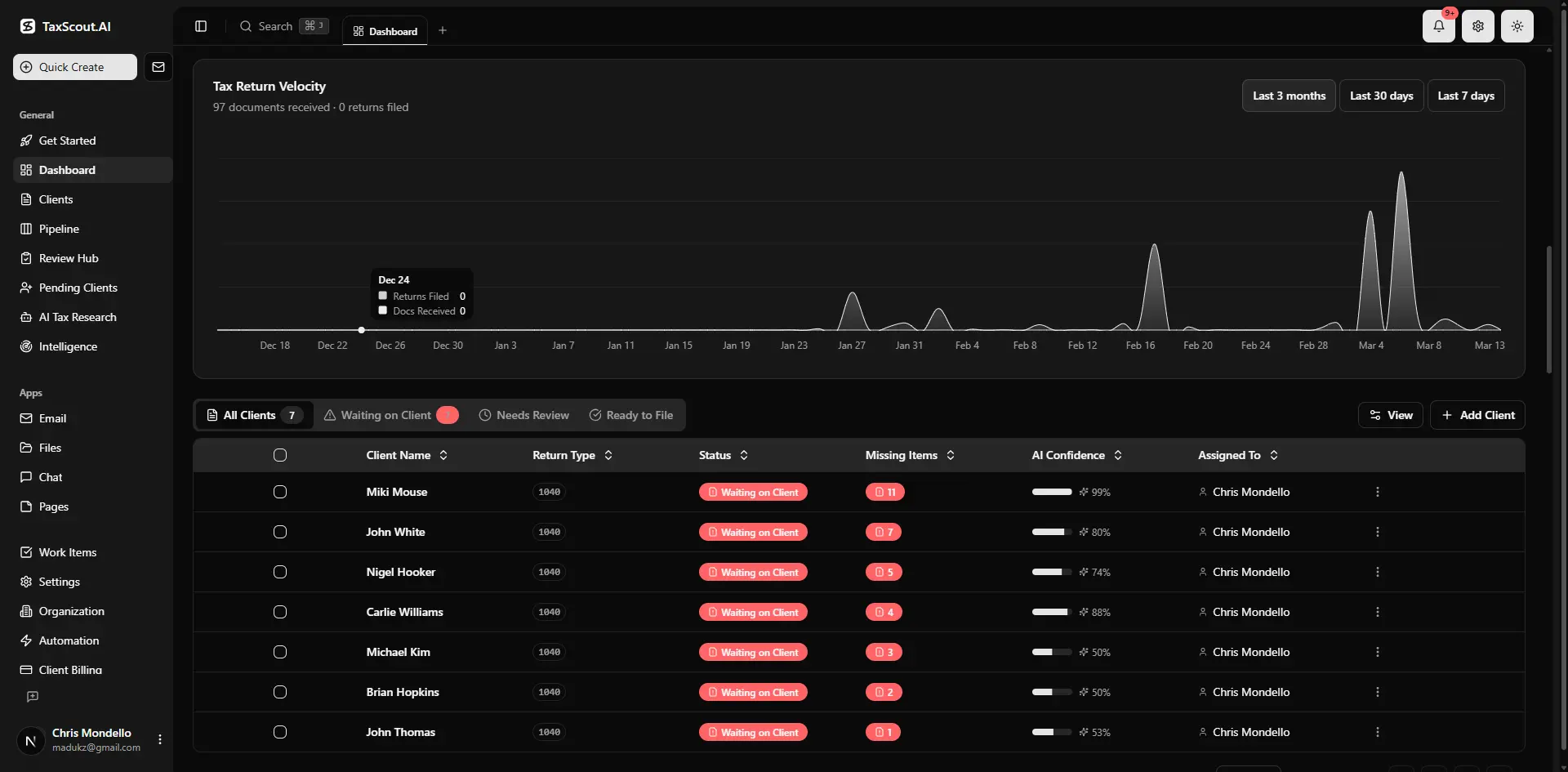
Real-time dashboard showing returns in progress, revenue, and upcoming deadlines
Pre-TCJA vs. Post-TCJA NOL Rules at a Glance (Federal, Non-Farm Individual/C-Corp)
| Rule Feature | Pre-TCJA (NOLs through 2017) | Post-TCJA (NOLs from 2018 forward) |
|---|---|---|
| Carryback period | 2 years (general) | Not permitted (general rule) |
| Carryforward period | 20 years | Indefinite |
| Annual deduction cap | 100% of taxable income | 80% of taxable income (pre-NOL) |
| Farming loss carryback | 5 years | 2 years (statutory exception preserved) |
| Pre-2018 NOL expiration | Expires after 20-year carryforward window | Still expires; 20-year clock still running |
| C corp §382 limitation | Applies on ownership change | Still applies on ownership change |
| State conformity | Generally conformed | Varies widely by state — check each |

Track firm performance with real-time analytics and client activity monitoring
Workflow for Tracking and Deploying NOL Carryforwards in a CPA Practice
Accurate NOL management requires a dedicated tracking schedule that survives staff turnover and software changes. At minimum, each client file should contain a net operating loss carryforward schedule showing: (1) the tax year the loss arose; (2) the original NOL amount; (3) amounts used in each subsequent year; (4) the remaining carryforward balance; and (5) whether the NOL is pre-2018 (100% offset, expiring) or post-2017 (80% cap, indefinite). This schedule should be reconciled to the prior-year return before preparing the current year.
For C corporation clients with §382 limitations on acquired NOLs, the tracking schedule must also include the annual §382 limitation amount, the valuation date, and the applicable federal long-term tax-exempt rate used in the calculation. Any net operating loss carryforward that cannot be used within five years after an ownership change because the corporation had no continuity of business (see §382(c)) is subject to complete disallowance, so business activity documentation matters for the file.
Practice management platforms that maintain client-context memory across tax years significantly reduce the manual reconciliation burden. TaxScout.ai's AI research agents and client management tools store entity structure, filing history, and carryforward notes in a persistent client profile, so the data is available when preparing the current-year return rather than buried in a prior-year PDF. For the research component — verifying §382 rates, confirming state conformity, or checking current excess business loss thresholds — the AI research agents query IRS, Treasury, and Cornell Law sources in real time and surface authoritative citations directly in the workflow.
For the §461(l) excess business loss analysis that frequently precedes the §172 NOL calculation for individual clients, CPAs should also review section 1231 gain planning strategies in the same engagement — because unrecaptured §1231 gains in a subsequent year may affect how aggressively to deploy the net operating loss carryforward versus preserve capital gains treatment. Multi-attribute planning rarely involves only one provision in isolation.
Documentation, Disclosure, and Statute of Limitations Considerations
An NOL carryforward extends the effective statute of limitations. Under IRC §6501(h), the period to assess tax deficiencies attributable to an NOL carryback is generally three years from the date the return was filed for the year in which the NOL is used. But for the year the loss originated, the assessment period does not begin to run until the return for the year the carryforward is fully absorbed is filed. In practice, this means a 2020 net operating loss carryforward used partially in 2024 and partially in 2027 keeps the 2020 return open to IRS examination until at least 2030 (three years after the 2027 absorption return).
CPAs should retain the full return package for the NOL origination year — including all schedules, workpapers, and the Form 1045 or 1040-X if a carryback was claimed — for as long as any portion of the carryforward remains unused plus three years. This is longer than the standard seven-year retention guideline for most returns. Firms using TaxScout.ai's file management tools and the optional Retained Archive add-on have a cost-effective mechanism for storing historical return packages beyond the normal retention period without cluttering active file systems.
When a client discloses a net operating loss carryforward for the first time after several years of not claiming it — a surprisingly common situation with self-prepared or lightly reviewed returns — the amended return strategy depends on which years are still open. Form 1040-X can be filed for any open year (generally within three years of the original due date), but the taxpayer cannot amend a closed year. The carryforward schedule should reflect what amounts could realistically have been used in open years under the correct 80% limitation, distinguishing those from amounts that would have been used in closed years and are now simply preserved as future carryforward.
Managing NOL carryforward schedules, §382 limitation pools, and QBI coordination across dozens of clients without a system?
TaxScout.ai brings AI-powered document extraction, persistent client memory, and real-time tax research into one platform — built specifically for CPA firms handling complex multi-year tax attributes.
Frequently Asked Questions
Under IRC §172 as amended by TCJA, post-2017 NOL carryforwards can only offset up to 80% of taxable income in the carryforward year, computed before the NOL deduction itself but after all other deductions including §199A and §163(j). This means a profitable year will rarely fully absorb a large NOL carryforward — the remaining balance carries forward indefinitely to future years.
Keep reading
IRC 163(j) Interest Limitation: How CPAs Minimize the Impact on Heavily Leveraged Clients
Nov 7, 2026 · 1 min read
Passive Foreign Investment Company Rules: How CPAs Minimize PFIC Tax for Clients With Foreign Mutual Funds
Nov 7, 2026 · 1 min read
Meals and Entertainment Deductions: How CPAs Navigate the Post-TCJA Rules for Business Clients
Nov 5, 2026 · 1 min read
Stay up to date
Get the latest tax tech insights delivered to your inbox.