Multistate Payroll Tax Compliance: How CPAs Manage Withholding for Remote Workers
Remote work has made multistate payroll tax compliance one of the most common—and most misunderstood—issues CPA firms face. This guide walks through reciprocity agreements, nexus-triggering thresholds, the convenience-of-employer doctrine, and the exact workflow steps your firm needs to protect…
Multistate payroll tax compliance has gone from an edge case to a front-of-mind issue for nearly every CPA advising business clients. When a software company in Ohio hires a developer who works from Tennessee, or a marketing agency in New York allows employees to relocate to Florida, the employer's withholding obligations can multiply overnight—and the penalties for getting it wrong land squarely on your client, not their HR software.
The challenge is that the rules are not uniform. Some states use physical-presence nexus tests with day-count thresholds. Others impose the convenience-of-employer doctrine, which can require the employer-state to withhold even when the employee never sets foot there. A patchwork of reciprocity agreements adds another layer that can either simplify or complicate matters depending on which two states are involved. Navigating multistate payroll tax compliance becomes especially difficult because these rules are not uniform across jurisdictions.
Most published guidance on this topic stays at the conceptual level. This article goes further: it walks through the doctrine state by state, explains how reciprocity agreements translate into real employer action steps, and lays out the repeatable workflow your firm can use to catch new remote hires before a quarterly deposit deadline passes. Most published guidance on multistate payroll tax compliance stays at the conceptual level.
Why Remote Work Permanently Changed Payroll Tax Nexus
Before 2020, most payroll nexus questions arose from business travel or brief assignment rotations. A salesperson spending 30 days in California triggered withholding requirements, but the pattern was predictable and easy to monitor. Permanent remote work broke that predictability entirely. Employees now make unilateral decisions to relocate—sometimes without notifying HR—and each relocation creates a new payroll tax nexus exposure for the employer. Before 2020, most multistate payroll tax compliance questions arose from business travel or brief assignment rotations.
Physical presence is the most common nexus trigger. Most states assert jurisdiction to tax wages earned within their borders, and that right attaches the moment an employee works from the state, regardless of whether the employer has an office there. Several states use de minimis thresholds—typically 14 to 30 working days—below which withholding is not required. Pennsylvania uses a resident/nonresident distinction that interacts differently with remote work than most CPAs expect, and California's Franchise Tax Board requires withholding from the first day of work performed in state, with no threshold grace period. For firms evaluating their multistate payroll tax compliance approach, this trade-off compounds over time.
The practical consequence: a client who hires three remote employees in three different states in a single quarter may suddenly owe registrations, withholding accounts, and quarterly deposits in states where the business has never operated. Without a systematic intake process—like the kind built into TaxScout's AI intake engine—these additions fall through the cracks until an audit notice arrives. Each of these factors directly shapes how multistate payroll tax compliance plays out in practice.
For a deeper look at how multistate issues intersect with annual filing, see our post on state tax considerations in 1040 reviews, which covers common multistate omissions on individual returns that ripple back to employer withholding questions. Understanding multistate payroll tax compliance in this context is what separates firms that scale from those that stall.
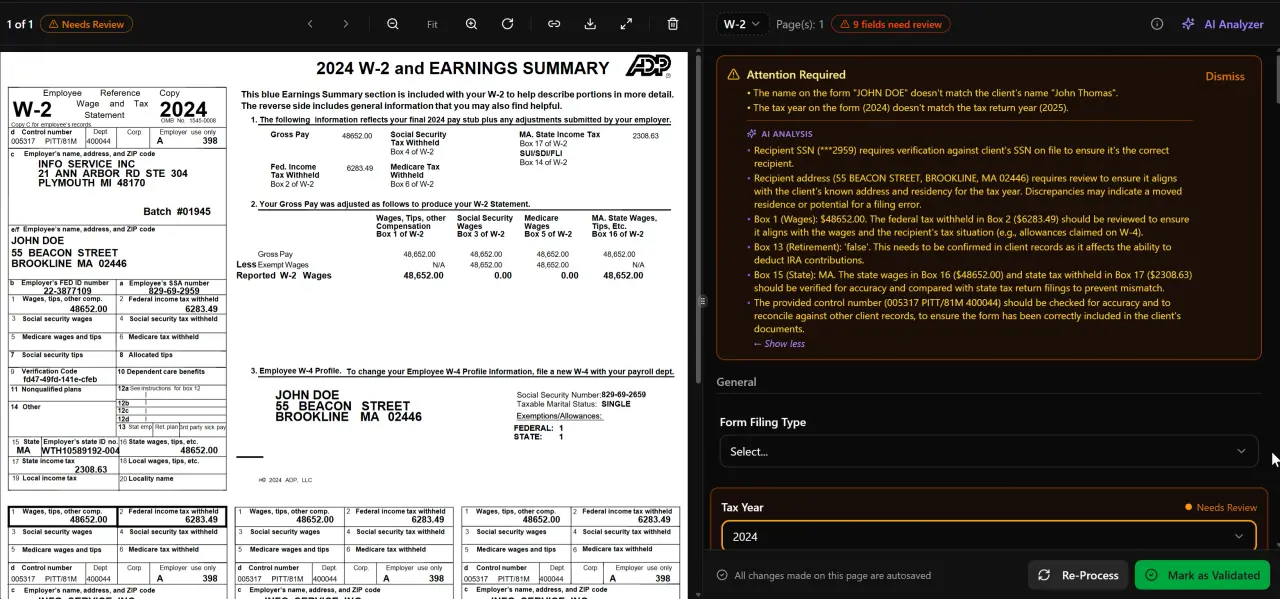
AI classifies, extracts, and validates every document automatically
Reciprocity Agreements: What They Cover and What They Do Not
Reciprocity agreements between states allow employees who live in one state and work in another to pay income tax only to their state of residence, eliminating the need for the employer to withhold for the work state. As of 2026, approximately 17 states and the District of Columbia participate in one or more reciprocity agreements—though the SSA link covers federal totalization rather than state reciprocity, the conceptual framework for bilateral tax relief is analogous. This is precisely where a deliberate multistate payroll tax compliance strategy pays off.
Common reciprocity pairs include Illinois-Iowa, Maryland-DC, New Jersey-Pennsylvania, Virginia-DC-Maryland-Pennsylvania, and the broader Midwest cluster. But reciprocity only applies to income tax withholding—it does not cover unemployment insurance (UI), which is generally owed to the state where work is performed regardless of any income tax agreement. Employers frequently conflate the two, leading to UI under-registration even when income tax withholding is correctly handled. Multistate payroll tax compliance sits at the center of this decision — get it wrong and the rest unravels.
The employer-side action steps when a reciprocity agreement applies are specific: (1) collect a completed exemption certificate from the employee—each state has its own form, such as Virginia Form VA-4 or Maryland Form MW507; (2) register the home state as a withholding jurisdiction if not already active; (3) document the exemption certificate in the employee's file and set a calendar reminder to verify continued residency annually; and (4) maintain awareness of the work state's UI registration requirement even though income tax withholding is waived. When firms revisit their multistate payroll tax compliance priorities, the gaps usually surface here.
When an employee moves mid-year and the reciprocity status changes, the employer must switch withholding jurisdictions effective the first payroll period after the change is reported. Retroactive corrections are possible but expensive—both in time and in potential penalty exposure. Building a standing update prompt into your client onboarding and annual engagement process prevents most of these late corrections.
Tired of discovering multistate withholding gaps only when clients get audit notices?
TaxScout's AI research agents surface state-specific withholding rules in real time, so your firm can advise clients before the next payroll runs.

Click any extracted field to see its source highlighted on the original PDF
The Convenience of Employer Rule: A State-by-State Breakdown
The convenience-of-employer doctrine is the most misunderstood rule in multistate payroll tax compliance. Under this doctrine, wages earned by a nonresident employee who works remotely for the employer's convenience—not out of necessity—are treated as earned in the employer's state, not the employee's home state. The result: double withholding obligations unless the employee's resident state provides a credit.
As of 2026, the following states apply some form of the convenience-of-employer rule: New York, Connecticut, Delaware, Nebraska, Pennsylvania, and Arkansas. New York's version is the most aggressive. Under New York's convenience rule, a nonresident employee assigned to a New York office who works from home in another state is still treated as earning New York wages for every day worked remotely, unless the remote arrangement was required by the employer as a condition of employment—not merely permitted.
Connecticut adopted a mirror version of New York's rule specifically to protect Connecticut employers whose employees work in New York. Delaware, Nebraska, and Pennsylvania apply similar but less litigated versions. Arkansas applies the rule narrowly and has rarely enforced it against out-of-state employers.
For CPAs advising clients with New York headquarters, the practical consequence is significant: a New York-based employer with 10 employees who relocated to New Jersey, Florida, or Texas after 2020 may still owe New York withholding on every one of those employees' wages—while also owing withholding in the state where each employee actually works. The credit mechanism reduces double taxation for the employee but does not eliminate the employer's administrative burden.
The defense against New York's rule is documenting a genuine employer necessity. If the employee's job function genuinely cannot be performed from the New York office—because the role was created as a remote position, because the office space was eliminated, or because the client base is geographically tied to another location—that necessity argument can rebut the presumption. CPAs should work with clients to document these facts contemporaneously, not after an audit begins. See other blog resources on multistate and state tax compliance topics for additional depth on related issues.
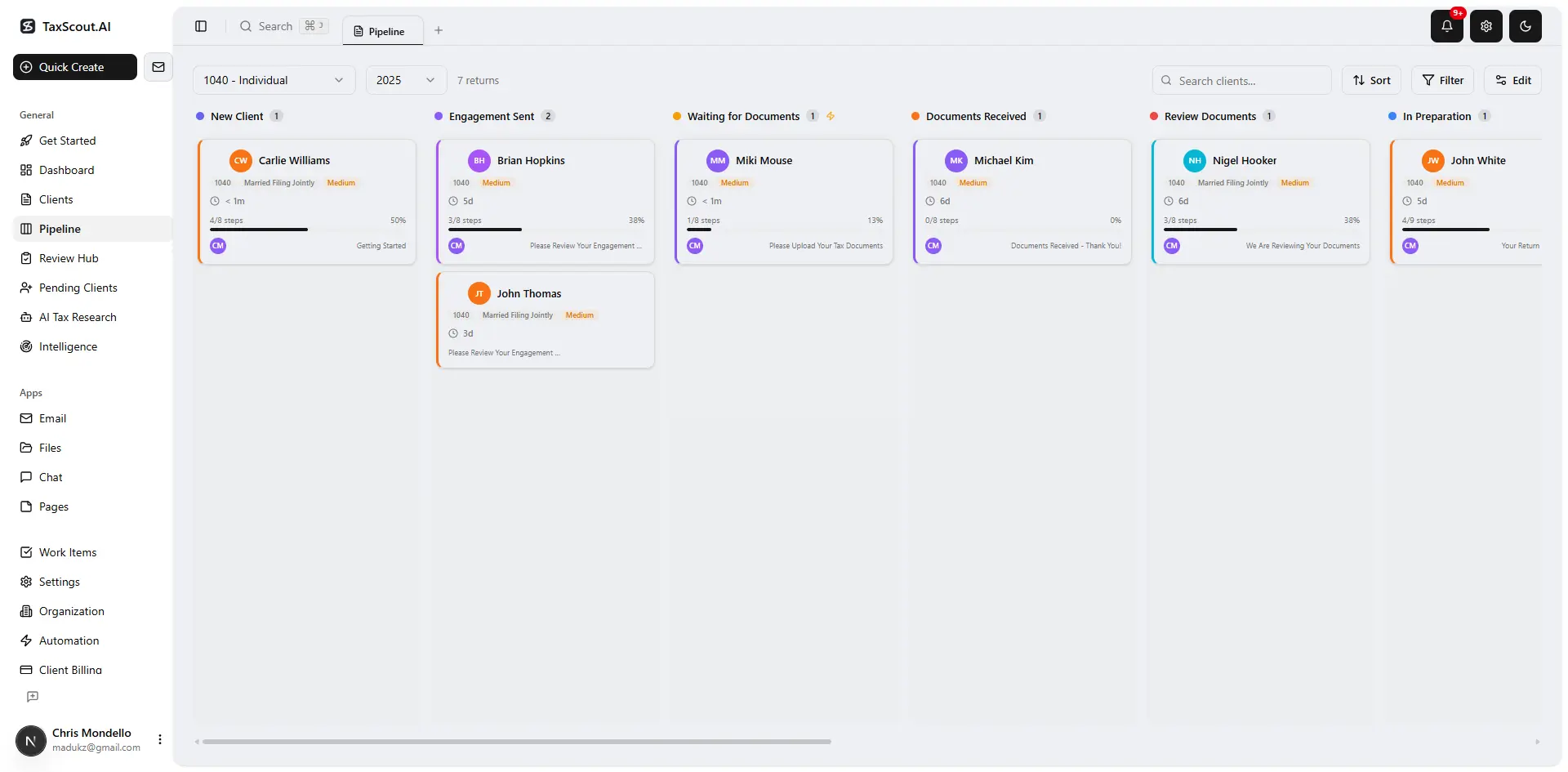
Track every return from intake to filed with drag-and-drop pipeline management
Nexus Thresholds and Day-Count Tracking for Employers
For states that do apply a de minimis threshold before requiring withholding, the burden of tracking is on the employer. The most common thresholds are 14 days (used by several Midwestern states), 20 days (Michigan, Minnesota), and 30 days (a small minority). Some states count calendar days in-state; others count working days. New York, California, and Pennsylvania have no threshold—a single day of work in state triggers the obligation.
Employers with traveling employees—consultants, field engineers, account managers—need a formal day-tracking system. This is not optional; Treasury guidance and state-level administrative rules consistently place the documentation burden on the employer. A spreadsheet is legally sufficient but operationally fragile. The better practice is to build day-tracking into the firm's annual payroll review for any client whose employees cross state lines.
CPAs can add real value by helping clients design a lightweight internal process: a shared calendar tag for out-of-state workdays, a quarterly reconciliation against each state's threshold, and a trigger point—say, Day 10 in any state—that automatically initiates a withholding registration review. This kind of proactive advisory work, as discussed in our engagement profitability analysis guide, is exactly the type of recurring service that generates predictable revenue without proportional time cost.
Remote workers who permanently relocate do not need a threshold—they are in-state every working day. The CPA's job for these employees is to confirm registration is active in the new state, verify that any prior-state withholding obligation has been properly closed or transferred, and update the employee's Form W-4 equivalent for the new state. A checklist approach, embedded in your firm's engagement template, ensures nothing is missed.

Your clients see your brand — OTP login, document upload, and real-time status
Building a Repeatable Multistate Withholding Review Workflow
The most common reason CPA firms miss multistate withholding exposures is not ignorance of the rules—it is the absence of a systematic trigger. Clients hire remote employees, employees move, and the firm only finds out when W-2s are prepared at year-end. By then, the missed withholding has compounded across four quarters, and back-payments plus interest plus potential penalties can easily exceed what a proper advisory fee would have cost.
A repeatable workflow has four components. First, a new-hire trigger: every time a client adds a payroll employee, the firm receives notification—ideally via an automated integration with the client's payroll system or a standing instruction in the engagement letter—and a multistate flag is set if the employee's address is outside the employer's primary state. Second, a quarterly check-in: the firm reviews the active employee roster for any address changes reported since the last review. Third, an annual deep-dive: a full multistate withholding reconciliation is included in the year-end engagement scope, covering all states where at least one employee was active at any point during the year.
Fourth—and most underutilized—a departure protocol: when an employee leaves a state where they were the sole nexus-creating presence, the client should close the withholding registration account within the state's prescribed window (typically 30 days after the final payroll). Failure to close accounts leads to ongoing filing obligations for zero-activity periods, which itself generates penalty notices.
For firms managing these workflows across multiple clients, TaxScout's pipeline management allows you to build a 12-stage customizable kanban with explicit stages for multistate review—so every client with remote employees has a visible, trackable status. Combined with AI-powered document extraction, W-2s and payroll summaries can be processed quickly to surface state-by-state withholding breakdowns for the annual reconciliation. You can also review our guide to building CPA firm SOPs for a framework to formalize this workflow across your entire practice.
State-Level Remote Worker Withholding Rules at a Glance (2026)
| State | De Minimis Threshold | Convenience-of-Employer Rule | Reciprocity Agreements |
|---|---|---|---|
| New York | None (1 day triggers) | Yes — aggressive, well-litigated | None |
| California | None (1 day triggers) | No | None |
| Pennsylvania | None (1 day triggers) | Yes — moderate | NJ, VA, MD, IN, OH, WV, DE, KY |
| Connecticut | None | Yes — mirrors NY rule | None |
| Delaware | None | Yes — limited enforcement | None |
| Nebraska | None | Yes — employer burden | None |
| Virginia | None | No | DC, MD, PA, KY, WV |
| Michigan | 20 working days | No | IL, IN, KY, MN, OH, WI |
| Minnesota | 20 working days | No | MI, ND, SD, WI |
| Illinois | 30 calendar days | No | IA, KY, MI, WI |
| Florida | No income tax | N/A | N/A |
| Texas | No income tax | N/A | N/A |
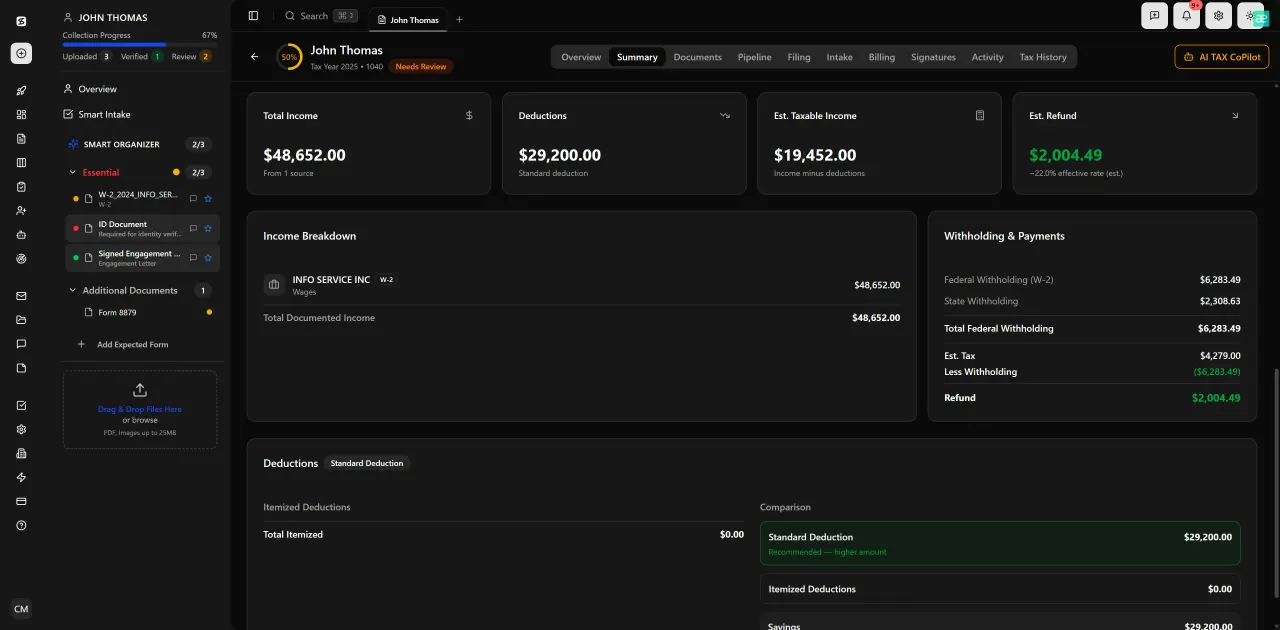
Review with AI assist — 9 agents answer questions with full client context
Scoping and Pricing Multistate Payroll Compliance as a Recurring Service
Many CPA firms absorb multistate withholding advisory work into their base engagement fee, which is a pricing mistake. The research, registration coordination, quarterly threshold monitoring, and year-end reconciliation involved in serving a client with even three remote-work states can easily represent 8–15 additional hours per year. At standard billing rates, that is a material scope expansion that deserves an explicit add-on fee.
The most effective pricing model is a tiered flat fee based on the number of states where the client has active remote employees: a base multistate module (e.g., 2–3 states), a mid-tier (4–6 states), and an enterprise tier (7+ states). Each tier should include defined deliverables: annual withholding registration review, quarterly threshold monitoring report, year-end W-2 multistate reconciliation, and nexus alert notifications when new hires trigger registration in a new state.
Engagement letter language matters here. The IRS has consistently held that withholding errors are first the employer's responsibility, but CPA firms have faced professional liability claims when they had payroll advisory scope and failed to catch obvious multistate exposures. Defining exactly what is and is not included in the engagement—and at what tier of monitoring—protects both the client and the firm. For guidance on structuring these add-on engagements without triggering client billing disputes, having the scope documented upfront in a signed engagement letter is non-negotiable.
Firms using TaxScout's e-signature tools can deploy updated engagement letters at scale across their client base—pre-populating the multistate module terms, routing for signature via the branded client portal, and archiving executed copies automatically. When a new remote hire triggers a scope change mid-year, the updated letter can be issued and signed within the same workflow, closing the documentation loop before the next payroll runs. See TaxScout's pricing page for details on how flat-rate practice management fits into your advisory service model.
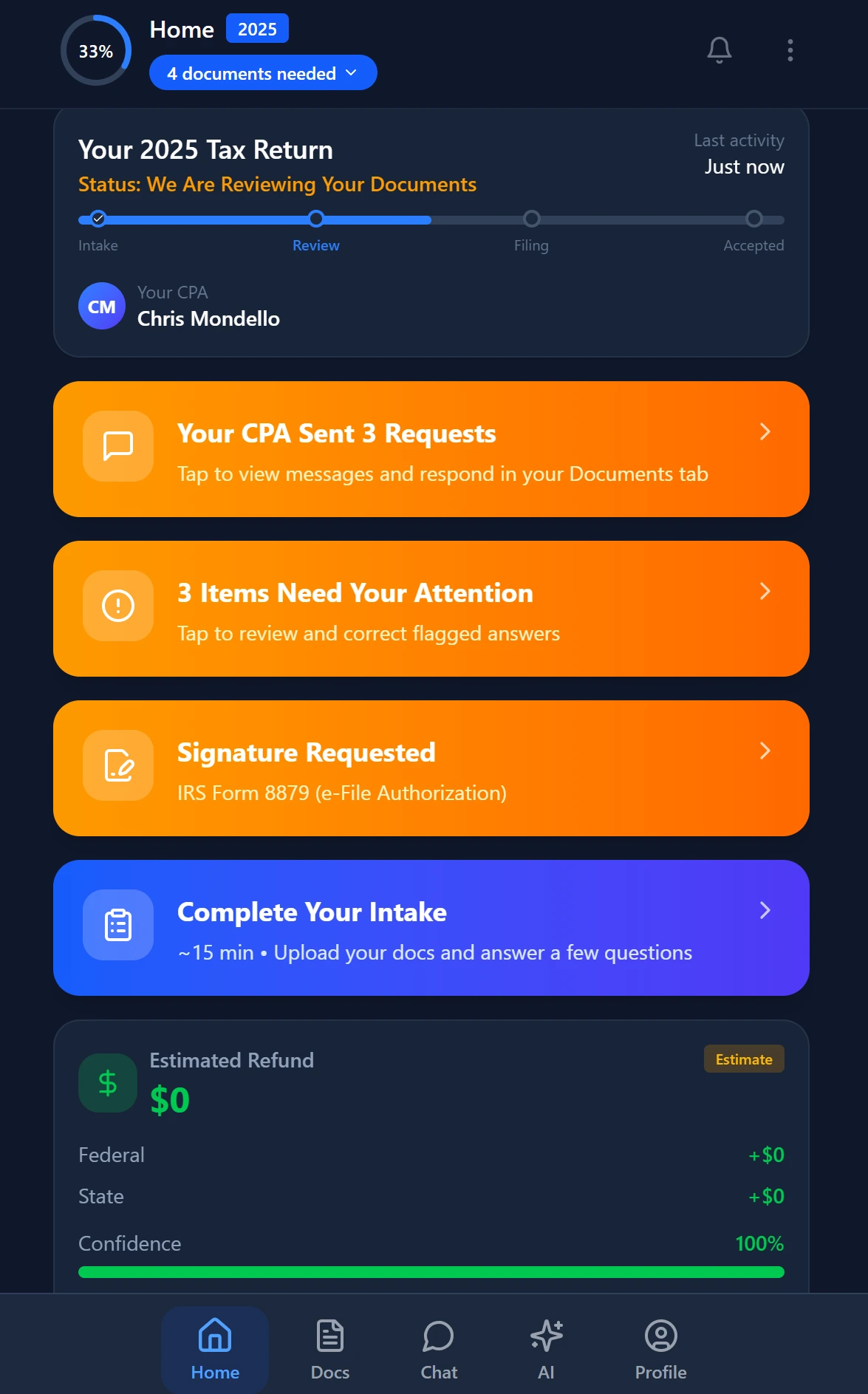
Smart intake auto-fills from uploaded documents and prior-year data
Using AI Research Agents to Stay Current on State Rule Changes
State withholding rules change more frequently than most CPAs realize. Reciprocity agreements can be unilaterally terminated—New Jersey terminated its agreement with Pennsylvania in 2017 before reversing under political pressure, and similar breakdowns have occurred in other states. Day-count thresholds are adjusted by legislative session. The convenience-of-employer doctrine has been the subject of multiple state tax court rulings and federal circuit decisions in recent years.
Staying current manually—monitoring each state's department of revenue, tracking legislation, and reading administrative guidance—is operationally impractical for a firm with a full client calendar. AI research tools that maintain real-time access to state tax authority publications, legislative databases, and treasury guidance can surface relevant changes before they affect client obligations.
TaxScout's 9 specialized AI research agents include dedicated search across IRS, Treasury, Cornell Law, and SSA sources, with client-context memory that connects research results to the specific entities in your client file. When a state amends its withholding threshold or issues new guidance on the convenience-of-employer rule, an agent-assisted search can surface the change, summarize its impact on affected clients, and draft a client communication in minutes rather than hours. For CPAs building advisory depth around regulatory intelligence, this kind of proactive monitoring is what differentiates a forward-looking practice from a reactive one.
Ready to turn multistate payroll complexity into a profitable, systematic advisory service?
TaxScout gives your firm AI research agents, pipeline management, and automated engagement workflows—all at a flat monthly rate with no per-user fees.
Frequently Asked Questions
In most states, yes. Physical presence is the primary nexus trigger, and a permanent remote employee working full-time from a state generally creates withholding obligations in that state from the first day of work. States like California and New York have no de minimis threshold. Some Midwestern states allow 14–30 working days before withholding is required, but those thresholds apply primarily to traveling employees, not permanent remote workers.
Keep reading
Multistate Payroll Tax Compliance: How CPAs Keep Distributed Clients Out of Trouble
Oct 4, 2026 · 1 min read
Multistate Payroll Tax Compliance: How CPAs Handle Remote Employees for Business Clients
Oct 4, 2026 · 1 min read
Federal Scholarship Tax Credit: What CPA Firms Must Do Now
Oct 4, 2026 · 1 min read
Stay up to date
Get the latest tax tech insights delivered to your inbox.