Multistate Payroll Tax Compliance: How CPAs Keep Distributed Clients Out of Trouble
Remote work has turned a manageable multistate payroll tax compliance problem into a minefield — and most business clients have no idea how many states are watching. This operational playbook shows CPAs exactly how to audit a client's payroll footprint, navigate withholding registration deadlines…
Multistate payroll tax compliance was already complicated before 2020. Then remote work scattered employees across state lines, and what used to be a clean two-state withholding question became a 7-state audit risk hiding inside a client's QuickBooks payroll setup. The states noticed. Enforcement budgets expanded. And now CPAs are fielding calls from panicked business owners who just received a withholding registration demand from a state they had no idea they owed anything to.
The core problem is that most business clients — and many of their payroll processors — conflate payroll nexus with income tax nexus. They are related but not identical triggers, and the withholding registration obligation almost always arrives faster, carries stricter deadlines, and generates personal liability exposure under trust fund recovery rules. A single remote employee hired in a new state can create a registration obligation within the employee's first day of work in some states. Multistate payroll tax compliance adds another layer of complexity because payroll nexus and income tax nexus, while related, are not identical triggers and rarely follow the same timeline.
This guide is written for CPAs who want to be the advisor who catches these issues before a state revenue agency does — not the one explaining why the client owes back withholding, penalties, and interest across four states they never registered in. You will find a practical workflow for auditing a client's current payroll setup, a decision framework for registration timelines, and a system for monitoring ongoing compliance without adding a dedicated headcount. CPAs who build a reliable process around multistate payroll tax compliance are far better positioned to catch registration gaps before a state revenue agency sends its first notice.
How Remote Work Created a Payroll Nexus Epidemic
Before hybrid work became permanent, most small and mid-size businesses had employees concentrated in one or two states. Payroll was registered where the company operated. The withholding matched the employee's physical location. That world is gone for a large portion of the CPA's business client base. That simpler era made multistate payroll tax compliance a niche concern, but the permanent shift to hybrid and fully remote work has pushed it squarely into the mainstream of what business clients now need from their CPAs.
Today, a 25-person technology company headquartered in Illinois might have employees living and working in Texas, Georgia, Colorado, Virginia, and Washington. Each of those states has its own withholding registration requirement, its own deposit frequency rules, its own annual reconciliation return, and its own enforcement mechanism for non-filers. Unlike income tax nexus — which often requires a threshold of receipts or property before a state can assert jurisdiction — payroll nexus is triggered by physical presence. One employee working from home in a new state is generally enough. For firms evaluating their multistate payroll tax compliance approach, this trade-off compounds over time.
The IRS guidance on employment taxes governs federal obligations, but state requirements layer on top with their own timelines and procedures. The U.S. Bureau of Labor Statistics remote work data consistently shows that roughly 20% of workers telework, meaning a significant portion of your business clients have employees creating payroll nexus in states where the employer has never filed anything. The gap between where employees actually work and where the employer is registered for withholding is where state enforcement actions begin. Each of these factors directly shapes how multistate payroll tax compliance plays out in practice.
For CPAs, the risk is not just the client's exposure — it is the professional liability that comes from advising on business structure, compensation, or benefits without identifying that the underlying payroll footprint is non-compliant. The Journal of Accountancy has covered how CPA firms are increasingly being named in client disputes where multistate withholding failures were overlooked during routine engagements. Discovering this risk and addressing it proactively is now a core advisory deliverable, not an optional add-on. Understanding multistate payroll tax compliance in this context is what separates firms that scale from those that stall.
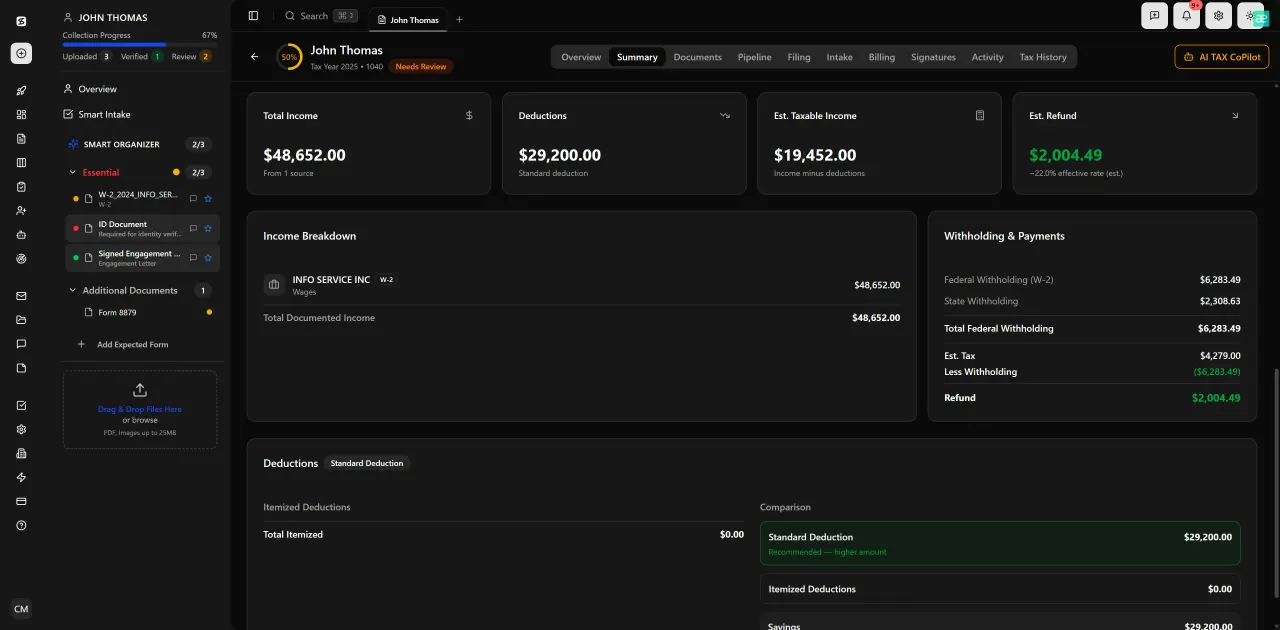
Review with AI assist — 9 agents answer questions with full client context
Identifying Every State Where Withholding Registration Is Required
The first step in any multistate payroll tax compliance review is building an accurate employee-location map. This sounds obvious, but in practice most clients do not maintain a formal record of which employees work from which state on a day-to-day basis. The employer's HR system may show a hire address that has not been updated since the employee moved. The payroll processor may be withholding for the wrong state entirely — or only for the state of corporate headquarters.
A practical audit starts with four data sources: the payroll register (which employees are being paid, and what state withholding is being deducted), the employee W-2 address file (where each employee's most recent mailing address is recorded), state new hire reporting records (which states received new hire notifications when each employee was hired), and the employer's own payroll account registrations (what state withholding accounts are actually open and in good standing). Cross-referencing these four sources reveals the gap — employees appearing in states where no withholding account exists. This is precisely where a deliberate multistate payroll tax compliance strategy pays off.
Once the gap is identified, the CPA needs to determine the registration obligation for each affected state. Most states require registration before the first payroll is run in that state, though enforcement of that timing varies. Some states, like California, have particularly aggressive enforcement and require employers to register with the EDD before the first payroll. Others have de minimis periods or grace windows. A working knowledge of these timelines, or a system for looking them up quickly across all 50 states, is the difference between a reactive and a proactive advisory practice. Multistate payroll tax compliance sits at the center of this decision — get it wrong and the rest unravels.
This is also where TaxScout's AI research agents become operationally useful — rather than manually consulting each state's revenue department website, the research layer can pull current registration requirements, deposit frequencies, and reconciliation deadlines across states in a structured format that the CPA can review and act on. That capability matters when a client discloses that they hired remote employees in six states last year and needs answers before their next payroll run. When firms revisit their multistate payroll tax compliance priorities, the gaps usually surface here.
Tired of discovering multistate withholding gaps after the state already has?
TaxScout's AI research agents surface state registration requirements, deposit rules, and reciprocity agreement status in real time — so your advisory recommendation is ready before the client's next payroll run.
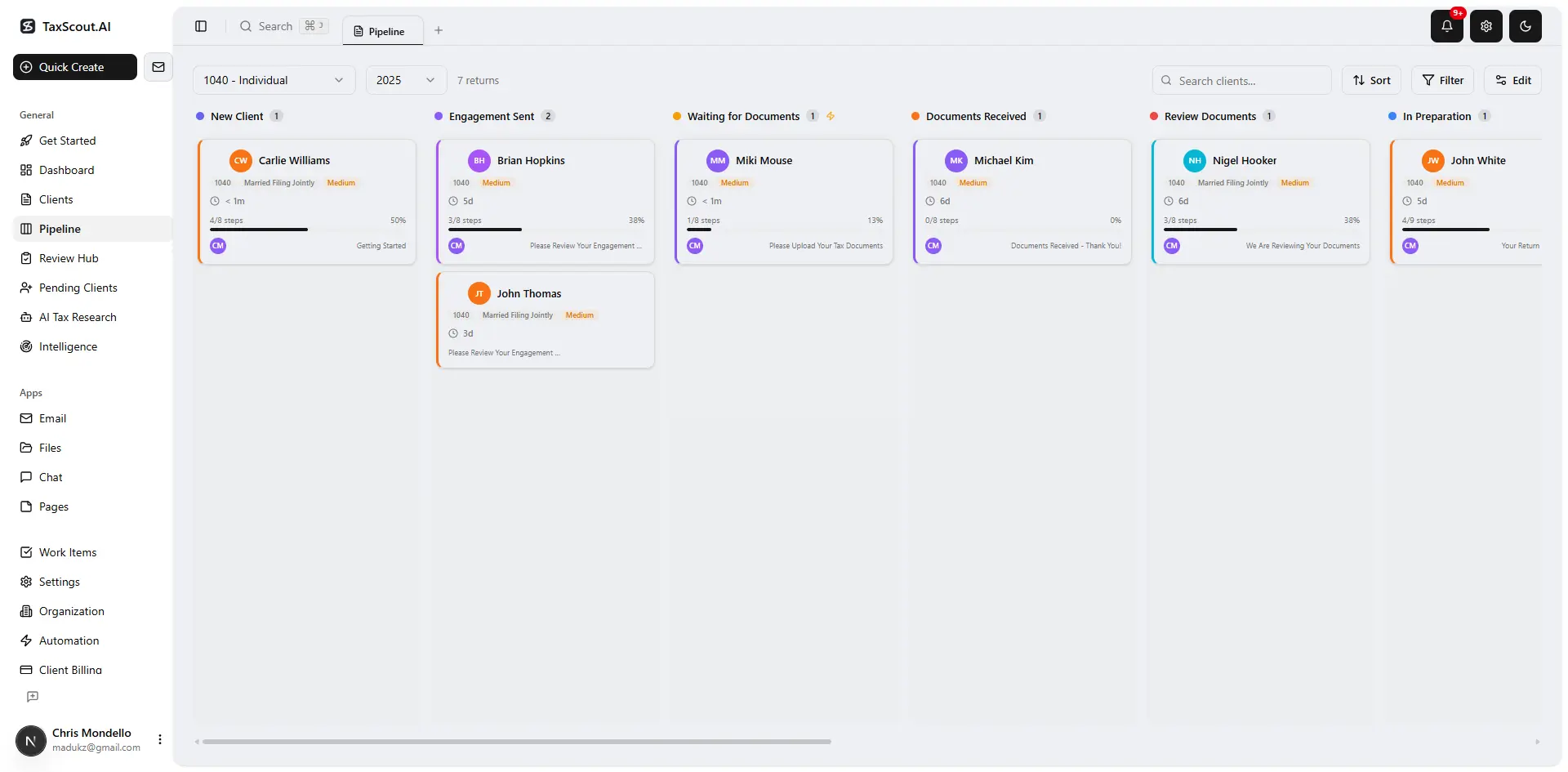
Track every return from intake to filed with drag-and-drop pipeline management

Click any extracted field to see its source highlighted on the original PDF
State Withholding Registration Timelines CPAs Must Know
The registration obligation and the registration deadline are two different things, and conflating them causes CPAs to underestimate how quickly a client's non-compliance clock starts running. As a general rule, the obligation arises on the employee's first day working from a new state. The deadline for completing registration varies, but most states expect it to occur before or concurrent with the first payroll that includes compensation earned in that state.
Retroactive registrations — where a client has been paying employees in a state for months or years without a withholding account — require voluntary disclosure in most cases. Many states have voluntary disclosure programs that reduce or eliminate back penalties in exchange for prompt registration and back remittance of withheld amounts. The Multistate Tax Commission administers a multistate voluntary disclosure program that can streamline this process when multiple states are involved. CPAs should understand this program and position it as a risk-mitigation tool rather than a confession of wrongdoing.
Deposit frequency is the other registration variable that clients consistently get wrong. States set deposit schedules based on the employer's aggregate withholding liability — monthly, semi-weekly, or quarterly in most cases — and those schedules can change as the client's payroll grows. Missing a deposit frequency upgrade is itself a penalty trigger. Building a calendar that tracks deposit due dates across all registered states is a workflow item that falls directly in the CPA's lane when the client does not have a dedicated payroll manager.
For CPAs managing multiple business clients with distributed workforces, the /features/pipeline-management tools in a structured practice management system let you assign state registration tasks to specific engagement phases, set deadline reminders by state, and track completion without relying on memory or a spreadsheet that lives in one person's inbox.
Reciprocity Agreements: What They Cover and Where They Break Down
Reciprocity agreements between states are one of the most misunderstood areas in multistate payroll tax compliance. When a reciprocity agreement is in place, an employee who lives in State A but works in State B only has withholding obligations in their state of residence — the employer withholds for State A, and the employee is exempt from State B withholding. This eliminates the need for the employee to file a resident return in one state and a non-resident return in the other.
The practical benefit is real, but the limitations are significant. First, reciprocity agreements are bilateral and relatively rare. As of 2025, fewer than 20 states have reciprocity agreements with any other state, and they are not universal — the agreement between Maryland and Virginia does not help a Maryland resident working in California. Second, reciprocity agreements apply to wages and salaries only; they do not cover self-employment income or business income reported on Schedule K-1. Third, and most critically for CPAs: reciprocity agreements can be terminated, often with relatively short notice.
Indiana terminated its reciprocity agreement with Kentucky effective for tax years beginning January 1, 2022, and Virginia terminated its agreement with several states in prior years. When a termination occurs mid-engagement, the CPA must act quickly: the employer needs to register for withholding in the new state, update employee withholding forms, and notify affected employees so they can adjust their estimated tax payments. Employees who lived under a reciprocity assumption and were not notified promptly can face underpayment penalties — a situation your clients can avoid with proactive advisory. See our guide to estimated tax penalty waivers for how to help employees in that situation after the fact.
The practical workflow for CPAs is to maintain a reciprocity status log for each business client with out-of-state employees and review it at least annually — ideally in Q4 before the new tax year begins. State reciprocity terminations are sometimes announced months in advance but buried in revenue notices that no one on the client's HR team reads. Resources like law.cornell.edu's state labor law library and individual state Department of Revenue notices are the most reliable sources, but monitoring them manually for every client at scale requires a system.
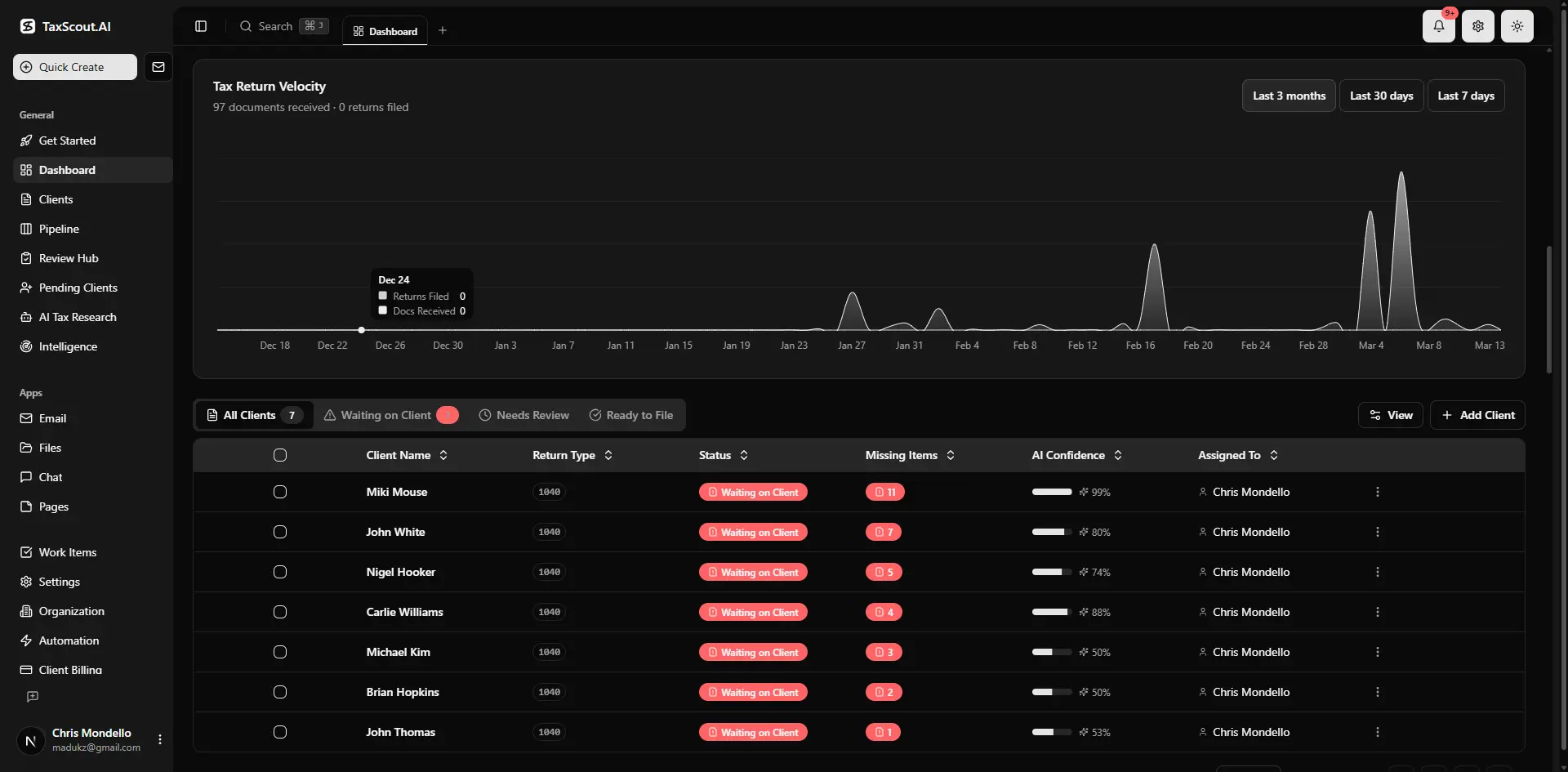
Real-time dashboard showing returns in progress, revenue, and upcoming deadlines

Track firm performance with real-time analytics and client activity monitoring
Building a Systematic Multistate Payroll Review Workflow
The CPA firms that handle multistate payroll tax compliance effectively do not do it by being smarter than other firms — they do it by having a repeatable system. The firms that struggle are the ones where multistate review happens ad hoc, triggered by a client question or a state notice, rather than at a defined point in each engagement cycle.
A practical system has three layers. The first is an onboarding audit: every new business client with more than one employee gets a payroll nexus questionnaire before the first tax engagement deliverable. The questionnaire asks where each employee works (not where they were hired or where HR is located), what states currently have open withholding accounts, when each account was opened, and whether any reciprocity agreements are claimed. The answers tell you whether you are starting from a clean slate or a remediation situation.
The second layer is a mid-year check-in built into the engagement calendar, typically in July or August. The check-in asks the client to confirm whether any employees have changed their primary work location, whether any new hires work remotely from states not already covered, and whether the payroll processor has flagged any new state withholding obligations. This 15-minute conversation catches the hire-in-a-new-state problem before it compounds into multiple quarters of missing deposits.
The third layer is year-end reconciliation — verifying that each state withholding account has a reconciliation return filed, that the amounts on the returns match the W-2 totals, and that all annual registration renewals are current. Many states require employers to re-register or renew accounts annually, and a lapsed registration creates the same enforcement exposure as a missing registration. For CPAs looking to automate tax client intake across these review points, building these questions into a structured intake workflow — rather than relying on phone calls — dramatically reduces the risk of something slipping through. You can also review other blog resources covering practice workflow and compliance advisory for additional frameworks to adapt to your firm.
Documenting the Payroll Footprint for Each Client
The payroll footprint document does not need to be complex — a single page that lists every state where the client has employees, the date each withholding account was opened, the current deposit frequency for each state, any reciprocity claims in effect, and the name of the payroll contact at the employer. This document becomes the working file for every multistate payroll review and the reference point if a state notice arrives.
Storing this document in a structured client management system — rather than in email or a shared drive folder — ensures that anyone on your team can pull it immediately when a client calls about a state notice. Client management features that support custom field tracking and document tagging make this kind of structured storage practical at scale without a separate database.
Using AI Research Tools to Monitor State Rule Changes
State payroll tax rules change frequently — deposit frequency thresholds, reconciliation return formats, new hire reporting requirements, and reciprocity agreement status all shift in ways that affect client compliance. Manually monitoring 50 state revenue department websites is not realistic for most CPA practices.
The AI research agents in TaxScout can query current IRS, Treasury, and state-level authority sources in real time, returning structured summaries of rule changes relevant to a specific client's registered states. This is meaningfully different from a static reference guide that gets updated annually — it reflects current published guidance and flags when something has changed since the last time you reviewed a client's setup. For CPAs managing 20 or more business clients with distributed workforces, this kind of real-time research capability is what makes the advisory scalable.
The Trust Fund Recovery Penalty Risk CPAs Must Address
When a discussion of multistate payroll compliance stays at the level of registration and deposit rules, it undersells the stakes for the business owner. The trust fund recovery penalty — which applies to federal payroll taxes under IRC Section 6672 — makes responsible parties personally liable for unpaid employee-side withholding. Most states have analogous provisions for state withholding.
Personal liability means the penalty pierces the corporate veil entirely. An S-corp owner, a CFO, or a bookkeeper with signing authority over payroll accounts can each be assessed individually for 100% of the unpaid trust fund taxes — the employee's share of withheld income tax and FICA. In a multistate context, if the company has been paying employees in three unregistered states for two years, the exposure is not just three registration penalties. It is two years of withheld amounts that were never remitted to any state, potentially assessed personally against anyone deemed responsible.
CPAs who understand this exposure and communicate it clearly to clients in the context of a payroll nexus review are providing a service with direct, quantifiable value. A business owner who understands that a remote-work hiring decision created personal liability will act on a registration recommendation in a way they would not for a general compliance memo. For guidance on related state tax compliance considerations, see our backup withholding guide for third-party network transactions and the broader withholding glossary entry for terminology reference.
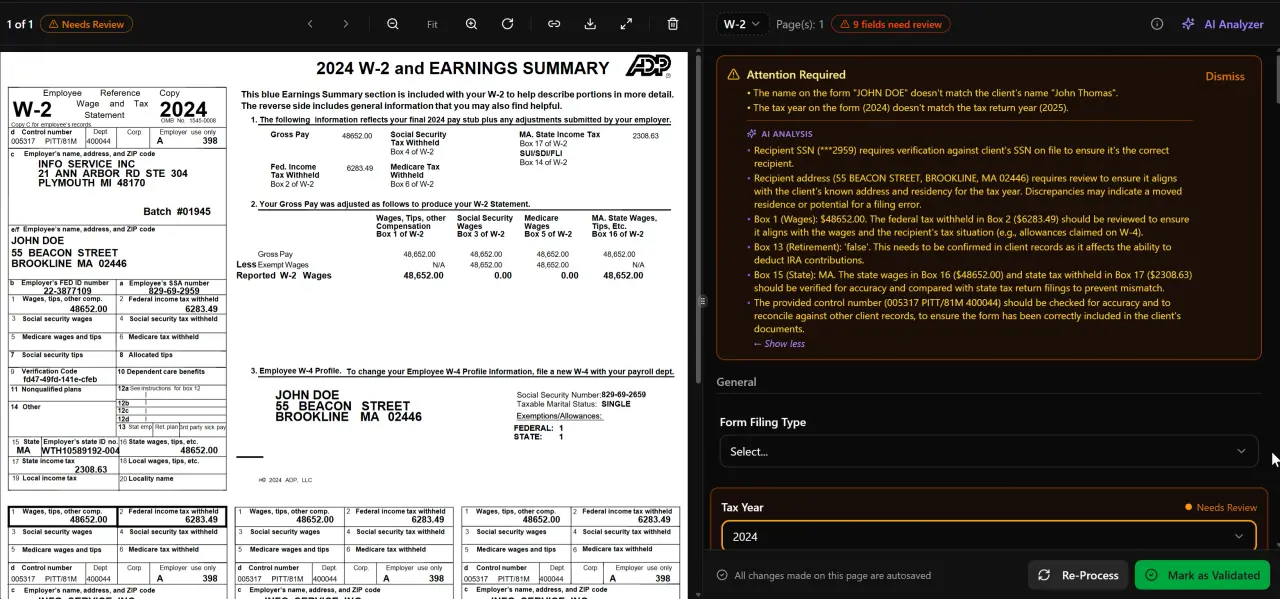
AI classifies, extracts, and validates every document automatically
State Withholding Registration: Key Variables CPAs Must Track Per State
| Compliance Variable | What It Governs | Common CPA Oversight Risk |
|---|---|---|
| Registration Trigger | When the employer must open a withholding account in a new state | Assuming corporate nexus rules apply — payroll nexus is typically triggered by Day 1 of work |
| Deposit Frequency | How often withheld amounts must be remitted (monthly, semi-weekly, quarterly) | Failing to upgrade frequency as payroll grows — triggers underpayment penalties |
| Reconciliation Return | Annual or quarterly return reconciling deposits to W-2 totals | Missing the state reconciliation even when all deposits were made — creates late filing penalties |
| Reciprocity Status | Whether a bilateral agreement allows residence-state-only withholding | Not monitoring termination notices — mid-year changes create immediate registration obligations |
| Voluntary Disclosure Eligibility | Whether back-year liability can be resolved with reduced penalties | Waiting for a state notice instead of initiating voluntary disclosure proactively |

Your clients see your brand — OTP login, document upload, and real-time status
Scaling Multistate Payroll Advisory Without Adding Headcount
The most common reason CPA firms do not systematize multistate payroll tax compliance review is capacity. Adding a structured review process for every business client sounds like additional hours that do not fit in existing fee structures. But the framing is backwards — the cost of not doing it is client attrition when a state notice arrives and the client wonders why you did not catch it, plus professional liability exposure that is far more expensive than the time the review would have taken.
The practical answer is technology leverage and structured engagement scoping. On the technology side, using AI-powered research tools to quickly surface state-specific registration requirements means the CPA is not spending billable time on basic rule lookups — that time is compressed dramatically. TaxScout's platform is designed for exactly this kind of advisory task: the research layer handles the information gathering, and the CPA focuses on applying judgment and communicating recommendations to the client.
On the engagement scoping side, multistate payroll compliance review should be a defined service item with its own scope and fee — not a free add-on to the annual tax preparation engagement. Most business clients with distributed workforces will pay for a dedicated payroll compliance review once they understand what the exposure is. The CPA's job is to frame the service around the risk, not around the hours. For CPAs considering how to price and structure advisory services, the value-based pricing glossary entry provides a useful framework, and engagement profitability analysis covers how to evaluate which advisory services actually move the needle on firm revenue.
Practice management infrastructure also matters here. When multistate payroll reviews are tracked through a defined pipeline stage — with clear tasks, assigned owners, and deadline reminders by state — nothing falls through the gaps when a staff member changes or a busy season compresses the calendar. The pipeline management features in TaxScout support 12 customizable stages with drag-and-drop kanban, which is well-suited to tracking registration tasks across multiple states for multiple clients simultaneously. Explore TaxScout's pricing to see how the platform scales with your firm's client volume.
Ready to build a multistate payroll compliance system your whole team can run?
TaxScout gives CPA firms AI research agents, client-context memory, and pipeline management in one platform — so distributed client reviews happen on schedule, not in response to state notices.
Frequently Asked Questions
In most states, the obligation arises on the employee's first day working from that state. Unlike income tax nexus, which often requires a threshold of sales or property before a state can assert jurisdiction, payroll nexus is triggered by physical presence — meaning a single remote employee working from home in a new state is generally sufficient to require the employer to open a withholding account in that state before the next payroll is run.
Keep reading
Stay up to date
Get the latest tax tech insights delivered to your inbox.