IRS Expands Tax Pro Account for Business Client Payments
The IRS announced on November 6, 2026 that authorized tax professionals can now submit certain payments on behalf of their business clients directly through Tax Pro Account. The expansion covers a range of entity types and introduces new operational steps for CPA firms. Here is a concise breakdown…
The IRS expands Tax Pro Account for business client payments as of November 6, 2026, giving authorized representatives a direct portal path to submit certain payments on behalf of business entities — no more routing clients through EFTPS or chasing down confirmation screenshots. The official announcement, IRS expands Tax Pro Account for business client payments, went live on the IRS Newsroom the same day and marks the most significant upgrade to Tax Pro Account since the tool launched for individual taxpayers.
For small and mid-size CPA firms, the practical effect is immediate: engagements that previously required a client to log in and pay separately can now be completed end-to-end within the professional's own IRS online account. That reduces friction at closing, cuts the risk of missed estimated payments, and tightens the control loop for firms that manage dozens of business returns simultaneously. The reason this workflow is now possible is that the IRS expands Tax Pro Account for business client payments, giving practitioners a single portal to manage both compliance and settlement tasks.
This brief extracts the operational signal from the announcement. We skip the agency boilerplate and go straight to which client segments are affected, what the authorization mechanics look like, and the specific steps your firm should take before the week is out. Understanding exactly how the IRS expands Tax Pro Account for business client payments will help your firm prioritize which client segments to migrate to the new workflow first.
What the IRS Changed and When It Takes Effect
Prior to this update, Tax Pro Account payment functionality was limited to individual (1040-series) taxpayers. A tax professional could view a business client's balance and transcript data via the third-party authorizations dashboard, but could not initiate a payment on that client's behalf through the portal. Business payments had to be executed by the client directly — typically through the Electronic Federal Tax Payment System (EFTPS) or by mailing a check with a voucher. That limitation is now being removed as the IRS expands Tax Pro Account for business client payments, opening up direct payment initiation for entity-level taxpayers for the first time.
IR-2026-134, published November 6, 2026, removes that restriction for authorized professionals. CPAs, enrolled agents, and other practitioners holding a valid Form 2848 (Power of Attorney) or Form 8821 (Tax Information Authorization, where applicable) can now navigate to the business entity section of Tax Pro Account and submit qualifying payments directly. The effective date is the publication date — there is no phase-in period for existing authorizations. For firms evaluating their irs expands tax pro account for business client payments approach, this trade-off compounds over time.
The IRS Tax Pro Account portal is accessible via IRS.gov and requires identity-verified login through ID.me or Login.gov. Firms that have not yet enrolled their staff should treat that step as immediate prerequisite work — enrollment can take 24 to 48 hours to clear. Each of these factors directly shapes how irs expands tax pro account for business client payments plays out in practice.
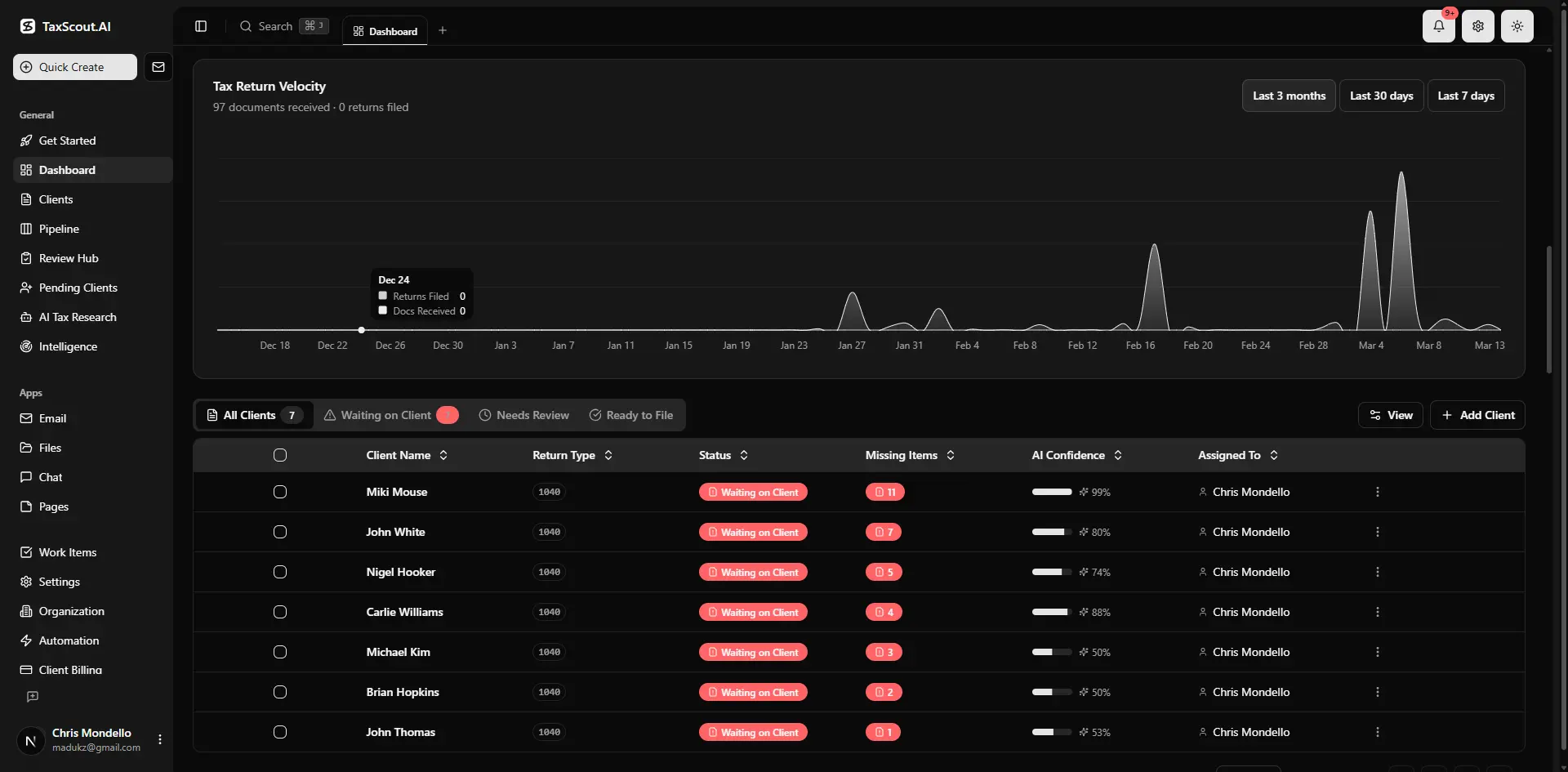
Real-time dashboard showing returns in progress, revenue, and upcoming deadlines
Which Entity Types and Filing Situations Are Affected
The expansion applies broadly to business entity accounts accessible under an active Form 2848 authorization. Based on the announcement and IRS guidance on third-party authorizations, the affected entity types include: Understanding irs expands tax pro account for business client payments in this context is what separates firms that scale from those that stall.
C corporations and S corporations — Practitioners holding POA for corporate clients can now make balance-due payments, estimated tax deposits, and penalty payments where the IRS has assessed a balance. For S-corp engagements specifically, this overlaps with basis-tracking workflows; see our related post on basis tracking for S corp shareholders for context on year-end coordination. This is precisely where a deliberate irs expands tax pro account for business client payments strategy pays off.
Partnerships — General and limited partnerships with an EIN and an active authorization are in scope. Firms managing complex pass-through structures — particularly those with international components covered by Schedule K-3 — should note that the payment capability does not extend to foreign partner withholding remittances under IRC §1446, which remain outside Tax Pro Account. Irs expands tax pro account for business client payments sits at the center of this decision — get it wrong and the rest unravels.
Sole proprietors filing on Schedule C — Payments tied to the business's EIN (as opposed to the individual's SSN) fall under the business payment expansion. Estimated payments tied solely to the individual's SSN continue under the existing individual Tax Pro Account functionality. When firms revisit their irs expands tax pro account for business client payments priorities, the gaps usually surface here.
Tax-exempt organizations — Nonprofits subject to unrelated business income tax (UBIT under IRC §511-514) and those with Form 990-T balance-due situations appear to fall within scope, though firms should verify access against their specific authorization type before relying on the portal for a deadline-critical payment.
Entity types not explicitly addressed in IR-2026-134 — such as certain trust arrangements — should be tested against the portal before the practitioner commits to handling the payment on behalf of the client. When in doubt, fall back to EFTPS and document the method.
Still routing business clients to EFTPS for every payment?
TaxScout.ai gives CPA firms a unified practice management hub — pipeline, client portal, e-signatures, and document processing — so you spend less time chasing and more time advising.

Your clients see your brand — OTP login, document upload, and real-time status
Authorization Requirements Your Firm Must Verify
Access to the new business payment functionality is gated on a valid, IRS-processed Form 2848. The authorization must be submitted through the Tax Pro Account portal itself (not faxed or mailed) to appear in the online dashboard in real time. Authorizations submitted via the traditional fax/mail route can take weeks to process and will not unlock the portal payment feature until they clear.
Key authorization details to confirm before attempting a payment: (1) the EIN on the 2848 must exactly match the entity account you are accessing; (2) the tax matter and year(s) must encompass the period for which the payment applies; and (3) the practitioner's CAF number must be current and linked to their ID.me or Login.gov profile.
For firms that use e-signature workflows to obtain client authorization on engagement documents, this is a good moment to audit whether Form 2848 is included in the standard business engagement packet. Adding it as a default document — pre-populated with the client's EIN, entity name, and relevant tax periods — eliminates a last-minute scramble when a balance comes due.
The IRS Taxpayer Advocate Service has noted recurring delays in CAF processing during peak filing periods. Firms should not assume a 2848 submitted this week will be portal-active in time for a November 15 corporate deadline. Confirm status in the dashboard before the payment window closes.
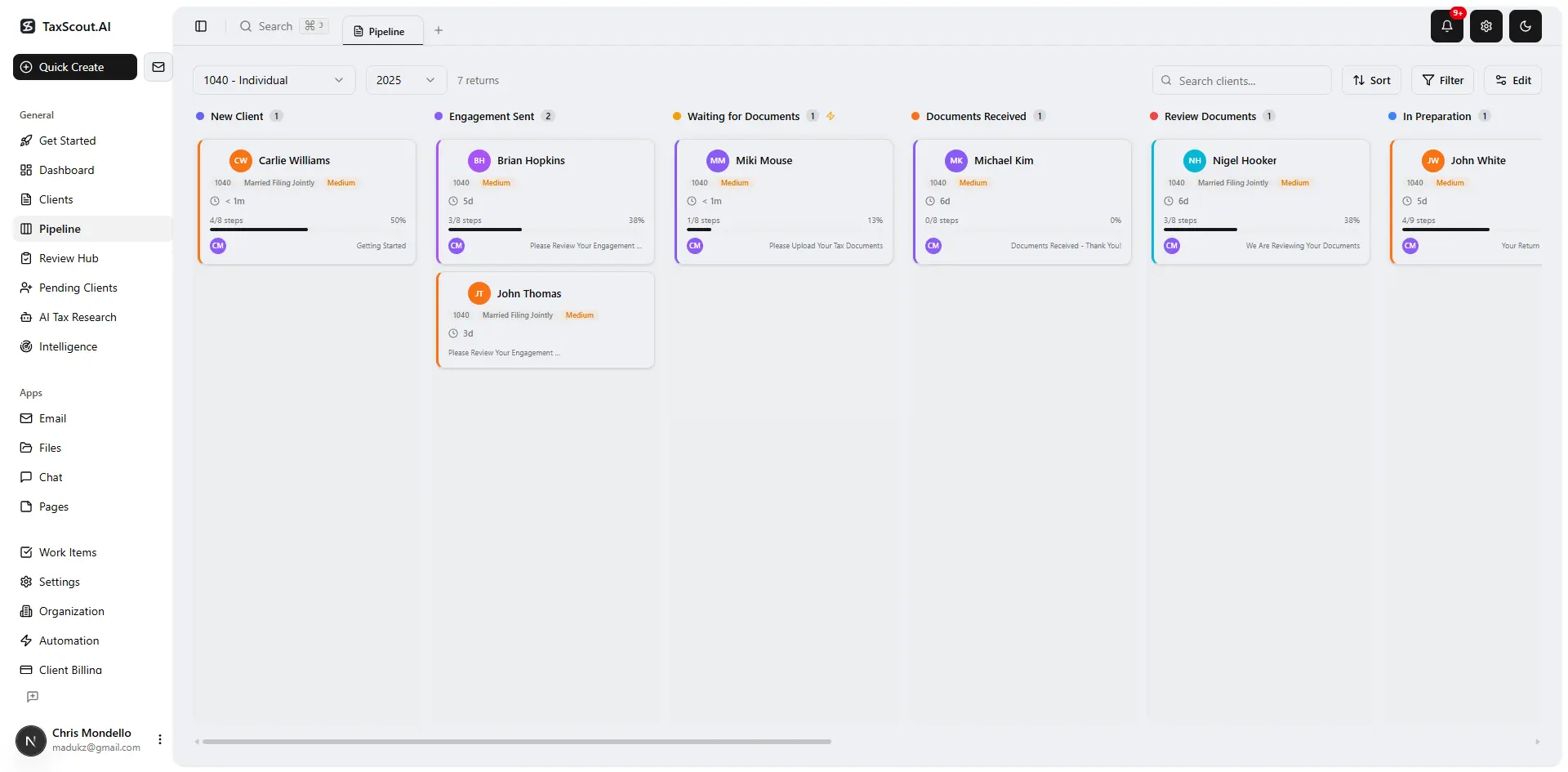
Track every return from intake to filed with drag-and-drop pipeline management
What to Do This Week: Action List for CPA Firms
The following steps are sequenced by urgency. Firms with upcoming corporate deadlines (November 15 extended due dates for calendar-year C corporations) should start at step one today.
Step 1: Verify staff ID.me or Login.gov enrollment. Every team member who may need to initiate a business payment must have an identity-verified IRS account. Check enrollment status now — do not wait for a deadline to surface the gap. The IRS online account enrollment page is the starting point.
Step 2: Audit active Form 2848s for business clients. Pull the list of business clients with balance-due or estimated-payment obligations in the next 60 days. Confirm each has a portal-submitted 2848 that is visible in the Tax Pro Account dashboard. Flag any that were submitted by fax or mail and are still pending.
Step 3: Test the payment interface on a low-stakes account. Before relying on the feature for a time-sensitive payment, navigate to a business client account with a small or zero balance and confirm the payment UI renders correctly. This surfaces any access or EIN-mismatch issues before they become deadline problems.
Step 4: Update your engagement letter template. If Form 2848 is not already part of your standard business engagement packet, add it. Firms using pipeline management workflows should add a 2848-verification checkpoint to the business return stage.
Step 5: Communicate the change to clients. A brief note explaining that your firm can now submit payments directly — with client approval embedded in the existing authorization — reduces confusion and prevents clients from making duplicate payments through their own EFTPS accounts. Your client portal or email integration is the right channel for this message.
For broader context on IRS operational updates affecting CPA firms, browse our complete news coverage for current developments alongside this announcement.
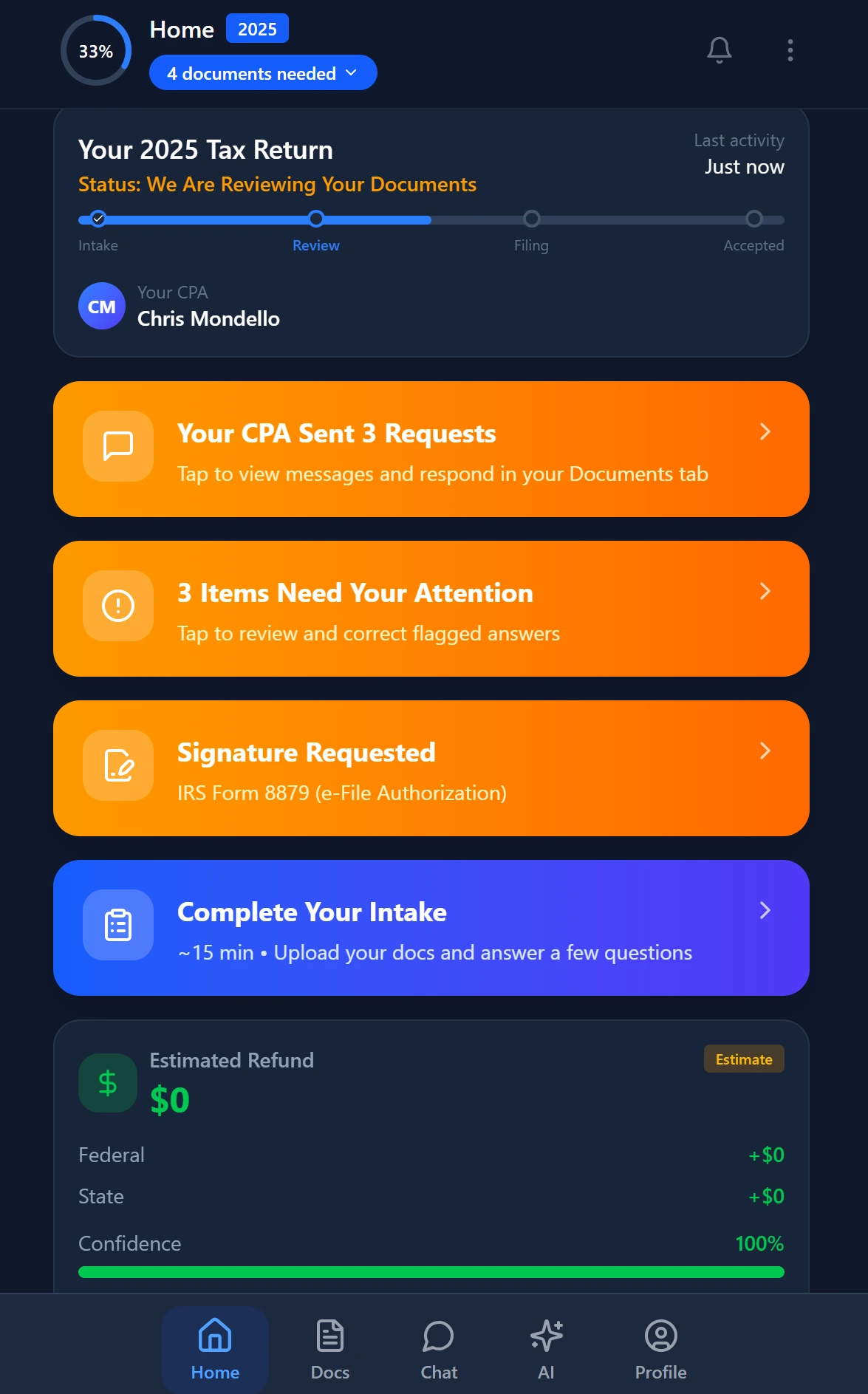
Smart intake auto-fills from uploaded documents and prior-year data
Operational Impact on Firm Workflows
The immediate workflow impact is most visible in the closing sequence for business returns. Previously, the payment step was a handoff — the firm prepared the return, calculated the balance due, and then waited for the client to log into EFTPS and confirm the payment before the engagement could be marked complete. That gap created a category of returns that were technically finished but administratively open.
With the Tax Pro Account expansion, firms can complete the payment within the same session as the return review, provided the 2848 is in place and the client has approved the amount. For firms using automation workflows that trigger status changes on payment confirmation, the new portal path means that trigger can fire without a client-side action.
There is also a compliance documentation benefit. Tax Pro Account generates a payment confirmation record tied to the practitioner's CAF number. That record lives on the IRS side and is visible in the authorization dashboard — a cleaner audit trail than a screenshot of an EFTPS confirmation email forwarded by the client.
Firms managing S-corp or partnership clients with complex pass-through structures should also cross-reference this capability with their AI research agents for any jurisdiction-specific payment rules that may not align with the federal portal approach. Some states with entity-level pass-through entity tax (PTET) elections have their own payment portals that operate independently of IRS infrastructure.
Limitations and Edge Cases to Know
The announcement does not specify a payment ceiling per transaction or per period, but practitioners should confirm any applicable limits within the Tax Pro Account interface before processing large balance-due payments. EFTPS has historically imposed a same-day limit of $10 million per transaction; whether Tax Pro Account inherits or differs from that limit is not stated in IR-2026-134.
Payroll tax deposits (Form 941 trust fund taxes) are a distinct category with strict same-day or next-day deposit rules under IRS Publication 15. Nothing in the announcement changes those deposit mechanics. The Tax Pro Account expansion targets balance-due and estimated income tax payments — not payroll deposit obligations, which remain on the EFTPS schedule.
Firms advising clients on IRS collection matters — installment agreements, currently-not-collectible status, or offers in compromise — should note that Tax Pro Account payments made through the portal will post to the client's account and may affect collection status. Coordinate with the IRS revenue officer or appeals officer before using the portal to make payments on accounts in active collection status.
Finally, the expansion is a federal portal feature only. State income tax, franchise tax, and gross receipts tax payments continue to require the applicable state payment portal or paper remittance. Check your state tax authority's online services page — the IRS state tax links directory provides a starting point — for state-specific payment options.
Want a practice management platform built around how CPA firms actually work?
TaxScout.ai handles AI document extraction, client intake, pipeline tracking, and e-signatures — all for a flat monthly rate with no per-user fees.
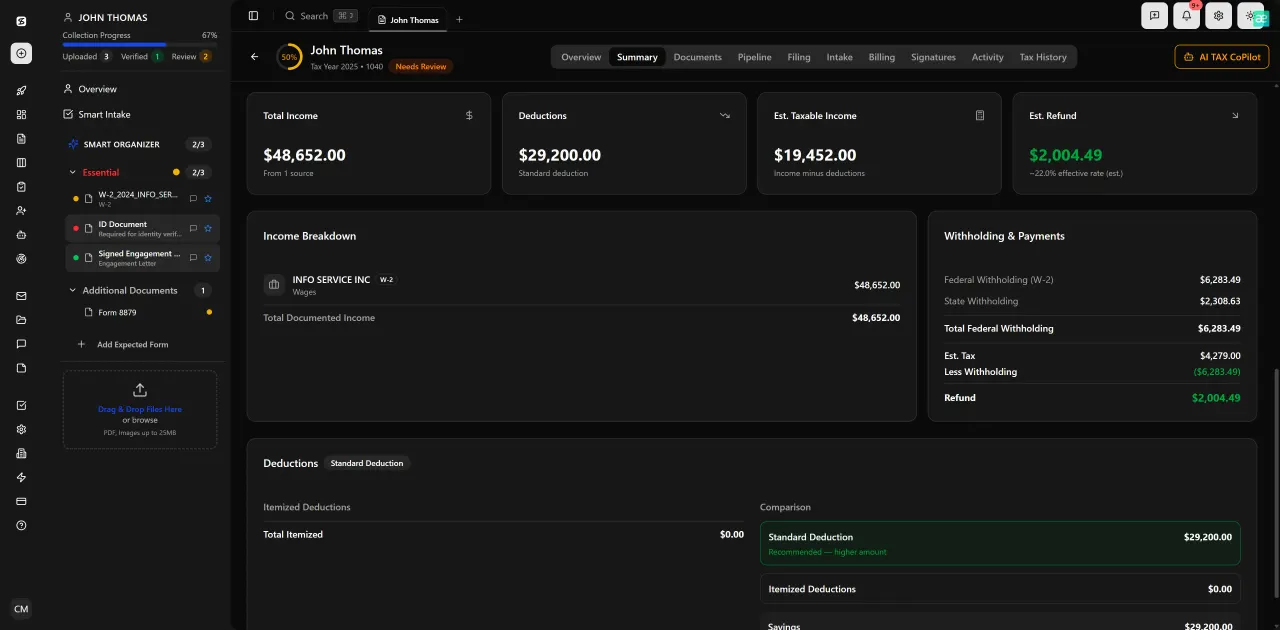
Review with AI assist — 9 agents answer questions with full client context
Frequently Asked Questions
As of November 6, 2026, authorized practitioners can make certain payments for C corporations, S corporations, partnerships, and sole proprietors with EINs. Tax-exempt organizations with unrelated business income tax balances appear to be in scope as well, though firms should verify access for each entity type in the dashboard before relying on the portal for a deadline-critical payment.
Keep reading
Regulations Regarding Payment of Tax by Commercially Acceptable Means: What CPA Firms Must Do Now
Oct 21, 2026 · 1 min read
IRS Installment Agreement CPAs: How to Negotiate Payment Plans for Clients
Jun 5, 2026 · 1 min read
Meals and Entertainment Deductions: How CPAs Navigate the Post-TCJA Rules for Business Clients
Nov 5, 2026 · 1 min read
Stay up to date
Get the latest tax tech insights delivered to your inbox.