IRS Collection Due Process: How CPAs Request a CDP Hearing to Stop Levies
When a client receives a Notice of Federal Tax Lien or Notice of Intent to Levy, a CPA has a narrow 30-day window to file Form 12153 and trigger IRS collection due process rights. This guide walks through every step — from identifying the correct notice type to presenting collection alternatives…
IRS collection due process is one of the most powerful but underused protections available to taxpayers facing enforced collection action. When the IRS files a Notice of Federal Tax Lien (NFTL) or issues a Final Notice of Intent to Levy, the client has a statutory right under IRC §§ 6320 and 6323 to request a CDP hearing before the IRS Office of Appeals — and that request immediately suspends the levy action. For CPAs, understanding exactly how to invoke that right, and precisely when, is the difference between stopping a wage garnishment or bank seizure and watching a client's accounts drain.
Most guides conflate CDP hearings with general penalty abatement or blur the line between a timely CDP request and the far less powerful equivalent hearing available after the deadline passes. This guide draws that line clearly. It covers Form 12153 instructions, the strict 30-day window, the arguments Appeals will and will not entertain, how CDP suspends the collection statute of limitations, and how to use the hearing as a platform to negotiate installment agreements or offers in compromise. See other blog resources for additional CPA practice guidance across related tax topics. Understanding IRS collection due process is essential before diving into the procedural distinctions this guide draws.
What Triggers IRS Collection Due Process Rights
CDP rights arise from two distinct statutory triggers. Under IRC § 6320, the IRS must notify a taxpayer in writing within five business days of filing a Notice of Federal Tax Lien. Under IRC § 6330, the IRS must give at least 30 days' notice before levying on property, using the Final Notice of Intent to Levy (typically Letter 1058 or LT11). Both notices carry independent CDP rights, so a client who received both a lien filing notice and a levy notice potentially has two separate hearings available — though they are often consolidated. These two code sections form the statutory backbone of IRS collection due process, each triggered by a separate enforcement action.
It is critical to identify which notice the client received and when it was delivered. The IRS uses certified mail or personal delivery, and the clock starts on the date of the notice — not the date the client actually opened the envelope. CPAs representing clients with unreviewed mail or forwarded correspondence need to reconstruct the timeline immediately. Checking IRS account transcripts for the TC 971 action codes associated with lien filing and levy notices provides an authoritative date record that does not rely on the client's recollection. Missing this deadline can permanently forfeit a client's IRS collection due process rights, making timely identification of the notice type a non-negotiable first step.
Not every IRS levy notice triggers CDP rights. Jeopardy levies, levies on state tax refunds, and levies to collect employment taxes under certain circumstances fall outside the standard CDP framework. Confirming the notice type before advising the client protects both the client and the CPA from a misfiled or untimely request. For firms evaluating their IRS collection due process approach, this trade-off compounds over time.
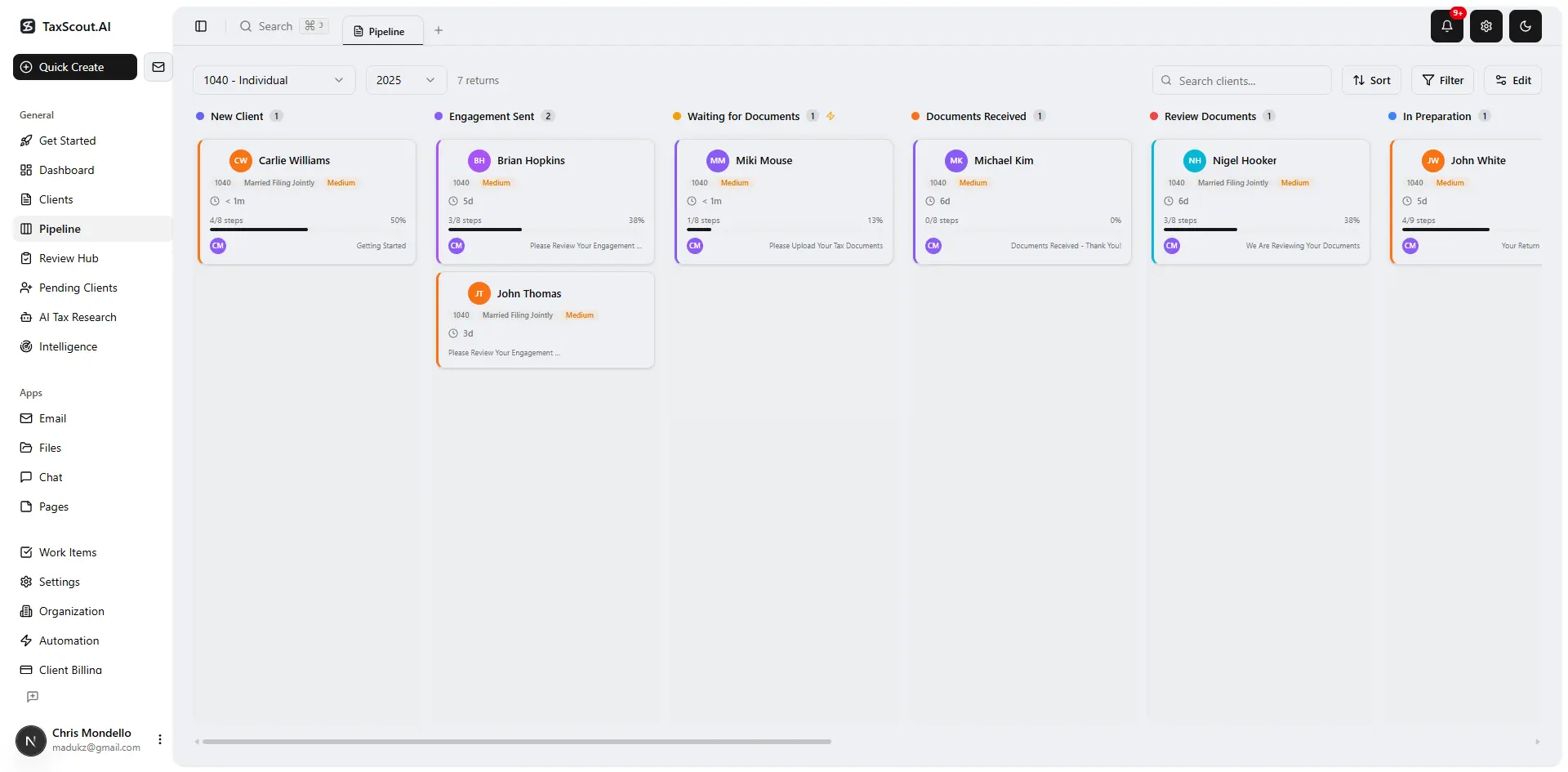
Track every return from intake to filed with drag-and-drop pipeline management
The 30-Day Deadline: CDP vs. Equivalent Hearing
The single most consequential fact in IRS collection due process practice is the 30-day filing deadline. A taxpayer must submit Form 12153 (Request for a Collection Due Process or Equivalent Hearing) within 30 days of the date on the CDP notice to preserve full CDP rights. Filing within that window gives the taxpayer the right to judicial review in the U.S. Tax Court if Appeals denies relief — a right that disappears entirely once the deadline passes.
A request filed after the 30-day window is treated as an equivalent hearing request. The IRS Office of Appeals will still consider it, and the taxpayer can still raise collection alternatives, but the protections are materially weaker. Most critically, an equivalent hearing does not suspend the statute of limitations on collection under IRC § 6502, and the taxpayer loses the right to Tax Court review of the Appeals determination. The levy action is also not automatically stayed pending the equivalent hearing — the IRS retains discretion to proceed. Each of these factors directly shapes how IRS collection due process plays out in practice.
Because the downstream consequences of missing the deadline are so severe, many CPA firms build an immediate calendar trigger into their intake workflow the moment a client produces a lien or levy notice. The AI intake tools in modern practice management platforms can flag notice dates during document upload and prompt staff to calculate the response deadline automatically, reducing the risk of deadline errors in busy season. Understanding IRS collection due process in this context is what separates firms that scale from those that stall.
One common source of confusion: the 30-day CDP window and the Collection Appeals Program (CAP) under Revenue Procedure 2012-18 are separate processes. CAP is faster but provides no Tax Court review and no suspension of the collection statute. CPAs should default to the CDP route whenever the 30-day window is still open. This is precisely where a deliberate IRS collection due process strategy pays off.
Tired of reconstructing IRS notice timelines from client shoe boxes?
TaxScout.ai automatically classifies IRS notices on upload, flags deadlines, and keeps your entire CDP case file organized in one place — no per-user fees, unlimited clients. IRS collection due process sits at the center of this decision — get it wrong and the rest unravels.

Your clients see your brand — OTP login, document upload, and real-time status
Step 1: Obtain a Power of Attorney Before Filing
Before touching Form 12153, confirm that a valid Form 2848 (Power of Attorney and Declaration of Representative) is on file with the IRS and covers collection matters. The CAF (Centralized Authorization File) unit processes Form 2848 independently of the return it was filed with, and a POA that lists only examination authority does not authorize a CPA to act in collection proceedings. Log into the IRS Tax Pro Account to verify CAF authorization status and correct any gaps before the CDP deadline. When firms revisit their IRS collection due process priorities, the gaps usually surface here.
If the client is a business entity, confirm that the POA is signed by an officer with binding authority and that the entity has not changed its responsible party since the POA was filed. Trust Fund Recovery Penalty matters — which often run alongside levy situations — require separate individual POAs for each assessed officer. For a deeper look at penalty exposure in collection contexts, review our guide on the reasonable basis defense, which covers accuracy-related penalties that sometimes accompany balance-due assessments.
Step 2: Complete Form 12153 Correctly
Form 12153 is a one-page document, but errors on it can limit the arguments available at the hearing. The form asks for the type of CDP notice received (lien or levy), the tax periods and tax types at issue, and — critically — the specific issues the taxpayer wants to raise. This issues section is not a formality. Under Treas. Reg. § 301.6330-1(b)(2), only issues raised on the Form 12153 or otherwise identified prior to the hearing can be raised at the CDP hearing and subsequently appealed to Tax Court.
For collection alternative requests, check the boxes for installment agreement, offer in compromise, currently-not-collectible status, or lien discharge or subordination — whichever applies. If there is a viable argument that the underlying liability is incorrect (for example, a statutory notice of deficiency the client never received, or an assessable penalty subject to supervisor approval under IRC § 6751), check the underlying liability box. Note that the underlying liability challenge is only available at CDP if the taxpayer did not previously have a prior opportunity to dispute the liability — a client who already petitioned Tax Court over the same period cannot relitigate it at CDP.
Mail the completed Form 12153 to the address shown on the CDP notice via certified mail, return receipt requested, and retain the postmark evidence. The IRS Taxpayer Advocate Service publishes guidance on timely-mailed rules under IRC § 7502 — a postmark on or before the 30th day counts even if the envelope arrives late.
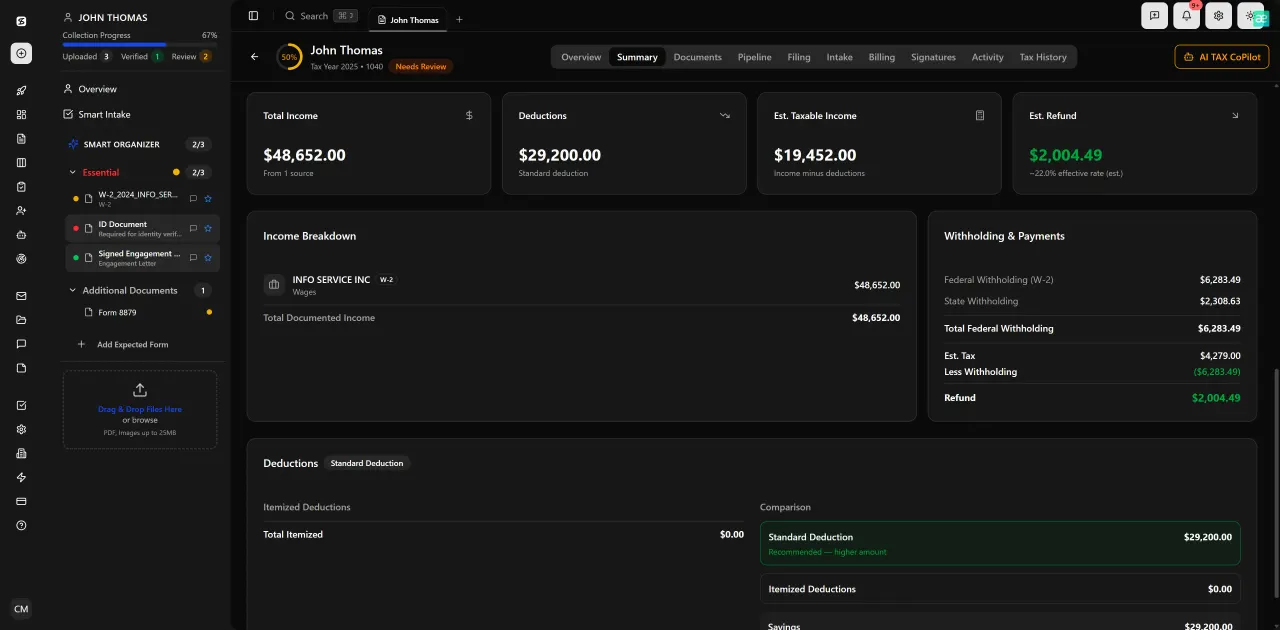
Review with AI assist — 9 agents answer questions with full client context
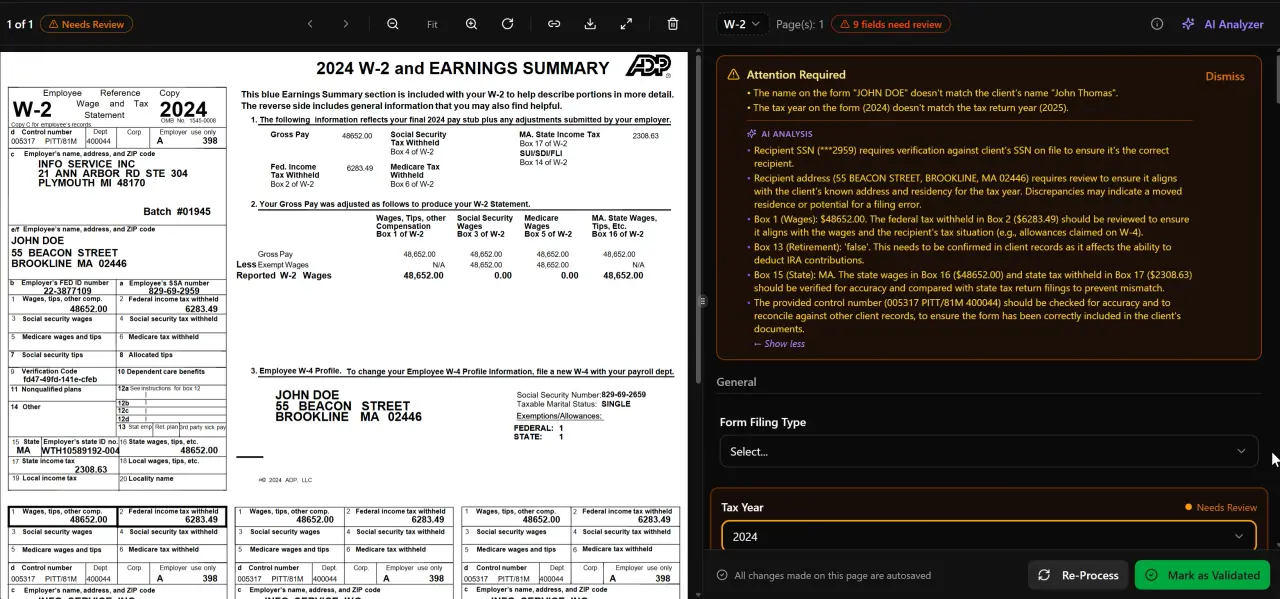
AI classifies, extracts, and validates every document automatically
How CDP Suspends the Collection Statute of Limitations
This is the CDP mechanic that most competitor content ignores entirely: filing a timely Form 12153 suspends the 10-year collection statute of limitations under IRC § 6502 for the entire period that the CDP hearing is pending, plus 90 days. The suspension also extends through any subsequent Tax Court proceeding. For clients with assessments close to the 10-year expiration date, a CPA who files a CDP request and then drags the process out — even legitimately — can inadvertently revive a nearly dead statute.
Conversely, for clients whose collection statute would otherwise expire soon, the CPA must weigh whether invoking CDP is strategically sound. In some cases, allowing the statute to run without filing Form 12153 produces a better outcome than requesting a hearing, because the IRS's ability to collect evaporates at CSED expiration regardless of the account balance. Checking the Collection Statute Expiration Date (CSED) from the IRS transcript before advising the client is mandatory due diligence.
The CSED can also be tolled by other events — installment agreement requests, bankruptcy filings, and prior CDP hearings all toll the clock. Practitioners advising clients in repeated-collection situations should map the CSED timeline carefully before recommending any action that triggers additional tolling. This analysis pairs well with the penalty calculation work covered in our late filing penalty relief guide.
Step 3: Prepare the Collection Alternative Package for Appeals
Once a timely Form 12153 is filed, the IRS Office of Appeals will schedule a conference — typically by phone, though in-person is available on request. The CPA should arrive prepared with a complete collection alternative package, because Appeals cannot negotiate without financials. Prepare Form 433-A (individuals) or Form 433-B (businesses) with supporting documentation: three months of bank statements, pay stubs or P&L, vehicle registrations, real property valuations, and monthly expense schedules.
Appeals will evaluate three primary collection alternatives. An installment agreement under IRC § 6159 is the most common outcome; the monthly payment is generally the liability divided by the remaining CSED months, though partial-pay installment agreements (PPIAs) are available when full payment by CSED expiration is not feasible. An offer in compromise under IRC § 7122 requires demonstrating either doubt as to collectibility (assets and income are insufficient to pay the full liability within the collection window) or doubt as to liability (the assessment is factually or legally incorrect). Currently-not-collectible (CNC) status is available when allowable expenses exceed income and liquidating assets would create economic hardship under IRM 5.16.1.
For clients with real property subject to a federal tax lien, also consider requesting a lien discharge under IRC § 6325(b) or a lien subordination under IRC § 6325(d) as part of the CDP package. A discharge releases a specific property from the lien (allowing a sale to close), while subordination allows a senior lienholder to maintain priority over the IRS lien. Both requests require Form 14135 (discharge) or Form 14134 (subordination) and are appropriate when the client has equity and is trying to refinance or sell. See the IRS collection financial standards for the national and local expense standards that drive installment agreement calculations.
Using AI research agents to pull current IRM provisions on collection alternatives during case preparation — rather than relying on memory or outdated printed guides — significantly reduces the risk of presenting a package that fails on a technicality Appeals encounters regularly.

Click any extracted field to see its source highlighted on the original PDF
Arguments Appeals Will and Will Not Consider at CDP
Understanding the scope of permissible CDP arguments prevents wasted preparation time and preserves credibility with the Appeals officer. Appeals will consider: (1) whether the IRS followed required collection procedures, including proper notice; (2) whether collection alternatives exist that would fully protect the government's interest; (3) whether the proposed collection action is disproportionate or constitutes an abuse of discretion; and (4) underlying liability challenges, but only where the taxpayer had no prior opportunity to contest the liability.
Appeals will not consider arguments that were not raised on Form 12153, arguments about tax years not covered by the CDP notice, or constitutional challenges to the tax system broadly. Frivolous positions — including arguments that wages are not income or that the tax code does not apply to a particular class of taxpayer — can result in a $5,000 penalty under IRC § 6702 for a frivolous collection due process submission. CPAs have an independent professional responsibility to screen out these arguments regardless of client pressure.
When underlying liability is genuinely at issue — for example, a client who was in bankruptcy when the notice of deficiency was issued and claims they never received it — the CDP hearing may be the only remaining forum after Tax Court deadlines have passed. Document the chain of custody carefully, including any certified mail receipt records from both the IRS and the client, before raising this argument.
For clients dealing with partnership-level assessments that flow to individual partners, the CDP analysis intersects with TEFRA and BBA regime rules. Our partnership guaranteed payments guide covers related compliance considerations for pass-through entities.
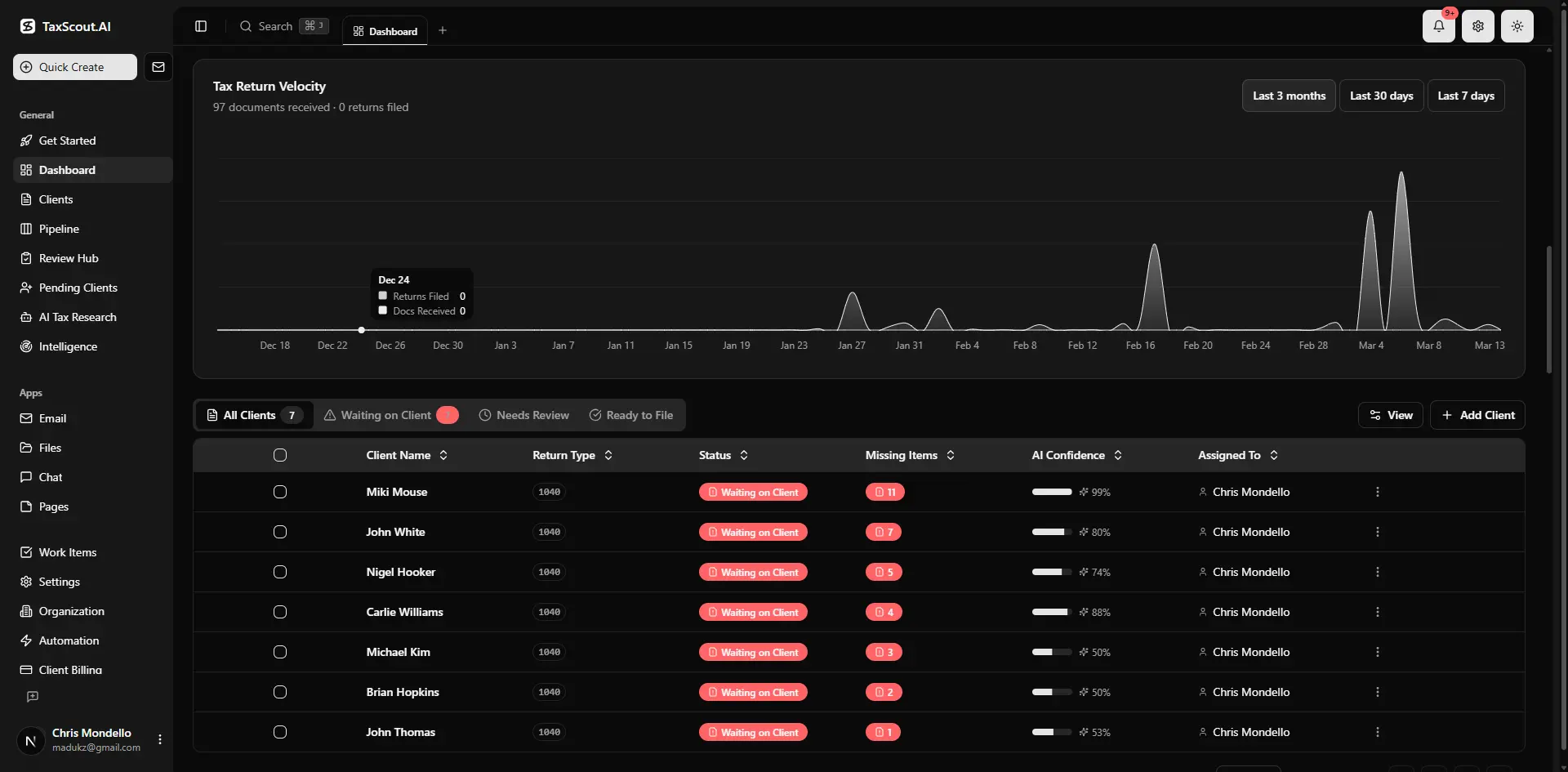
Real-time dashboard showing returns in progress, revenue, and upcoming deadlines
Step 4: After the Hearing — Judicial Review and Next Steps
If Appeals issues a Notice of Determination that is unfavorable, a taxpayer who filed a timely CDP request has 30 days from the date of the determination to petition the U.S. Tax Court under IRC § 6330(d)(1). The Tax Court reviews the Appeals determination under an abuse-of-discretion standard for collection alternative denials and a de novo standard when underlying liability is at issue. Filing the Tax Court petition again suspends levy action.
If the client accepted an installment agreement or OIC at the hearing, confirm the agreement terms in writing and set calendar reminders for every required payment. A defaulted installment agreement reinstates the IRS's right to levy, and the CDP protections no longer apply — the client must use Form 9423 (Collection Appeal Request) under CAP to challenge reinstatement, and as noted earlier, CAP does not provide Tax Court review.
Document the entire CDP engagement thoroughly, including the notice dates, Form 12153 submission date, certified mail tracking number, all correspondence with Appeals, the financial package submitted, and the final determination. This file protects the CPA professionally and provides a foundation if a subsequent Tax Court petition becomes necessary. The file management and e-signatures tools within TaxScout can keep the engagement letter, POA, and all CDP correspondence linked to the client record and date-stamped.
CDP Hearing vs. Equivalent Hearing: Key Differences
| Feature | CDP Hearing (Timely) | Equivalent Hearing (Late) |
|---|---|---|
| Filing deadline | Within 30 days of CDP notice date | After 30-day window, within 1 year of levy notice |
| Levy suspended during hearing | Yes — levy is stayed by statute | No — IRS retains discretion to levy |
| Tax Court review of determination | Yes — petition within 30 days | No — determination is final |
| Suspends collection statute (CSED) | Yes — plus 90 days after determination | No — CSED continues to run |
| Collection alternatives available | Yes — IA, OIC, CNC, lien discharge | Yes — same alternatives available |
| Underlying liability challenge | Yes — if no prior opportunity to contest | Yes — same limitation applies |
| Frivolous submission penalty risk | Yes — IRC § 6702 applies | Yes — IRC § 6702 applies |
Managing CDP deadlines, CSED calculations, and Appeals packages across dozens of collection cases?
TaxScout.ai gives your firm AI-powered document extraction, built-in pipeline management, and research agents trained on IRS guidance — all at a flat rate with no per-user fees.

Track firm performance with real-time analytics and client activity monitoring
Frequently Asked Questions
A CDP hearing is requested within 30 days of the IRS collection notice and gives the taxpayer the right to a levy stay, Tax Court review of the Appeals determination, and suspension of the collection statute of limitations. An equivalent hearing is requested after that 30-day window. Appeals will still consider collection alternatives at an equivalent hearing, but the levy is not automatically stayed, Tax Court review is not available, and the CSED continues to run. CPAs should always pursue the timely CDP route when the window is still open.
Stay up to date
Get the latest tax tech insights delivered to your inbox.