IRS Audit Representation: How CPAs Defend Clients and Win
Most audit rep content is written for taxpayers — not for CPAs building a repeatable service line. This guide covers everything from engagement letter language and Form 2848 workflows to AI-assisted document staging and IRS agent communication protocols, so your firm can deliver audit defense…
IRS audit representation is one of the highest-value services a CPA firm can offer — and one of the least systematized. While most published guides explain the audit process from the taxpayer's perspective, the practitioner side of the equation gets far less attention. How do you structure the engagement? How do you gather and stage documents before the IRS examiner asks for them? How do you build a repeatable process that scales beyond one senior partner?
The gap shows. Firms that handle audits ad hoc — pulling documents from email chains, chasing clients for records at the last minute, drafting responses from scratch each time — burn through hours they can't bill and introduce unnecessary risk. Firms that treat audit defense as a structured service line, with defined intake, document workflows, and communication protocols, close cases faster and keep clients for life. Firms that treat IRS audit representation as a structured service consistently outperform those that improvise their way through each engagement.
This guide is written for the CPA building or refining that service line inside their firm. We cover engagement setup and fee structures, Form 2848 execution, document gathering workflows, IRS correspondence protocols, and how AI-assisted document retrieval tools dramatically reduce prep time on every case. Whether you are just launching IRS audit representation at your firm or tightening an existing process, each section is designed to give you immediately actionable frameworks.
Why Audit Representation Deserves Its Own Service Line
Tax controversy work — from IRS correspondence audits to full field examinations — represents a recurring, largely recession-proof revenue stream. The IRS audited roughly 0.44% of individual returns in fiscal year 2023, and enforcement priorities under current Treasury Department guidance continue to shift toward high-income filers, pass-through entities, and business credits. That means the population of clients needing IRS audit representation is growing. For firms evaluating their IRS audit representation approach, this trade-off compounds over time.
Unlike tax preparation, audit support service work can be priced on a flat-fee or hourly retainer basis independent of the original return fee. Clients who came to you for a $900 1040 may now represent a $3,000–$8,000 engagement. More importantly, CPAs who successfully resolve audits generate some of the strongest client loyalty and referrals in the profession. Each of these factors directly shapes how IRS audit representation plays out in practice.
The challenge is operational. Audit cases involve document-intensive research, time-sensitive IRS deadlines, and coordination between the client, the preparer, and the examiner. Without a defined workflow, these cases drag on and erode margins. Building a structured audit representation service line — with standardized intake, templated engagement letters, and a documented document-staging process — transforms ad hoc casework into a predictable, scalable practice area. See our broader post on advisory services for how audit rep fits into a full-service CPA value ladder. Understanding IRS audit representation in this context is what separates firms that scale from those that stall.

Track every return from intake to filed with drag-and-drop pipeline management
Structuring the Audit Engagement: Letters, Scope, and Fees
Every audit representation matter should begin with a signed engagement letter that clearly defines scope, limits liability, and sets billing expectations. This is not optional. A well-drafted CPA audit engagement letter should specify: (1) the tax year(s) and return type(s) under examination; (2) the type of audit (correspondence, office, or field); (3) services included (document gathering, IRS communications, Appeals if necessary) and excluded (Tax Court representation unless separately engaged); (4) your fee structure and retainer; and (5) client responsibilities — including timely document production. This is precisely where a deliberate IRS audit representation strategy pays off.
On pricing, the profession has moved toward flat-fee audit representation packages for correspondence audits ($750–$2,500 for straightforward cases) with hourly billing or phased flat fees for office and field examinations. Structuring tiers based on audit complexity — correspondence vs. office vs. field vs. Appeals — lets you quote confidently and collect a retainer upfront. Pair this with invoicing via Stripe so clients can pay electronically at engagement start. IRS audit representation sits at the center of this decision — get it wrong and the rest unravels.
One underused practice: include a document-production clause in the engagement letter that puts the burden on the client to deliver records within a defined window (e.g., 10 business days of request). This single clause dramatically reduces the most common source of audit rep delays — waiting on the client. Cross-reference your client onboarding checklist to see how intake processes can front-load this document collection before the IRS timeline tightens. When firms revisit their IRS audit representation priorities, the gaps usually surface here.
Tired of rebuilding audit workflows from scratch for every IRS notice?
TaxScout.ai gives your firm a structured pipeline, AI document staging, and e-signature for Form 2848 — so every audit engagement runs on rails from day one.

Click any extracted field to see its source highlighted on the original PDF

Your clients see your brand — OTP login, document upload, and real-time status
Form 2848 Power of Attorney: Filing, Tracking, and Automation
IRS Form 2848 — Power of Attorney and Declaration of Representative — is the foundational document in every audit representation engagement. Without a properly executed 2848 on file with the IRS CAF (Centralized Authorization File) unit, you cannot communicate directly with IRS examiners, receive correspondence, or access transcripts on the client's behalf. Getting this filed correctly and promptly is the first operational step in any IRS audit representation engagement.
Common 2848 errors that delay CAF processing include: incomplete taxpayer identification (missing SSN or EIN for each covered year), missing representative designation (credential type and CAF number), inadequate description of tax matters (be specific — 'Form 1040, tax years 2021 and 2022, audit' is better than 'all tax matters'), and unsigned or undated documents. The IRS CAF unit processes paper 2848 submissions within 5–10 business days; the fax-to-CAF option can reduce this to 1–3 days in time-sensitive situations.
From a workflow standpoint, the 2848 should be generated, sent for e-signature, and submitted to the IRS within 24–48 hours of engagement letter execution. TaxScout's e-signature feature — powered by Documenso — supports Form 2848 natively, meaning the client signs via OTP login on the branded portal and you submit the executed document the same day. Track CAF confirmation numbers in the client's practice management record so any team member can verify authorization status without calling the Practitioner Priority Service line.
For firms handling multiple audit matters simultaneously, maintaining a simple 2848 status tracker — filed date, CAF confirmation received, expiration date — prevents the common problem of discovering mid-audit that a prior-year POA has lapsed or covers the wrong tax period.
Document Gathering Workflows That Reduce IRS Response Time
The IRS Information Document Request (IDR) is the examiner's primary tool for gathering evidence. Correspondence audits typically issue IDRs with 30-day response windows; field examinations give you slightly more runway but involve far more document categories. In both cases, your ability to respond completely and on time determines whether the audit closes favorably, expands in scope, or triggers a Notice of Deficiency.
A disciplined tax audit defense workflow starts before the IDR arrives. When you accept an IRS audit representation engagement, immediately request and organize: the original return and all supporting documents for the years under examination, any prior-year returns for context, bank statements and receipts for the specific line items flagged, and any correspondence the client has already received from the IRS. Firms using AI document extraction can ingest and classify these materials automatically — TaxScout's extraction engine handles 180+ form types including W-2s, all 1099 variants, K-1s, and supporting schedules — so documents are staged and searchable before the examiner asks.
When the IDR arrives, map each requested item to the documents already in your system. Use a response matrix: column one lists each IDR item, column two identifies the document satisfying it, column three notes any gaps requiring client follow-up. This matrix becomes both your internal checklist and the cover sheet for your IDR response package. Submitting a well-organized, indexed response package — rather than a stack of unsorted PDFs — signals competence to the examiner and often accelerates case resolution.
For document organization, TaxScout's PDF tools support Bates numbering, merge, split, and PII masking — useful when you need to redact unrelated taxpayer information before submitting to the IRS. See our detailed post on AI document extraction for CPAs for a deeper look at how automated classification reduces prep time on document-heavy cases.
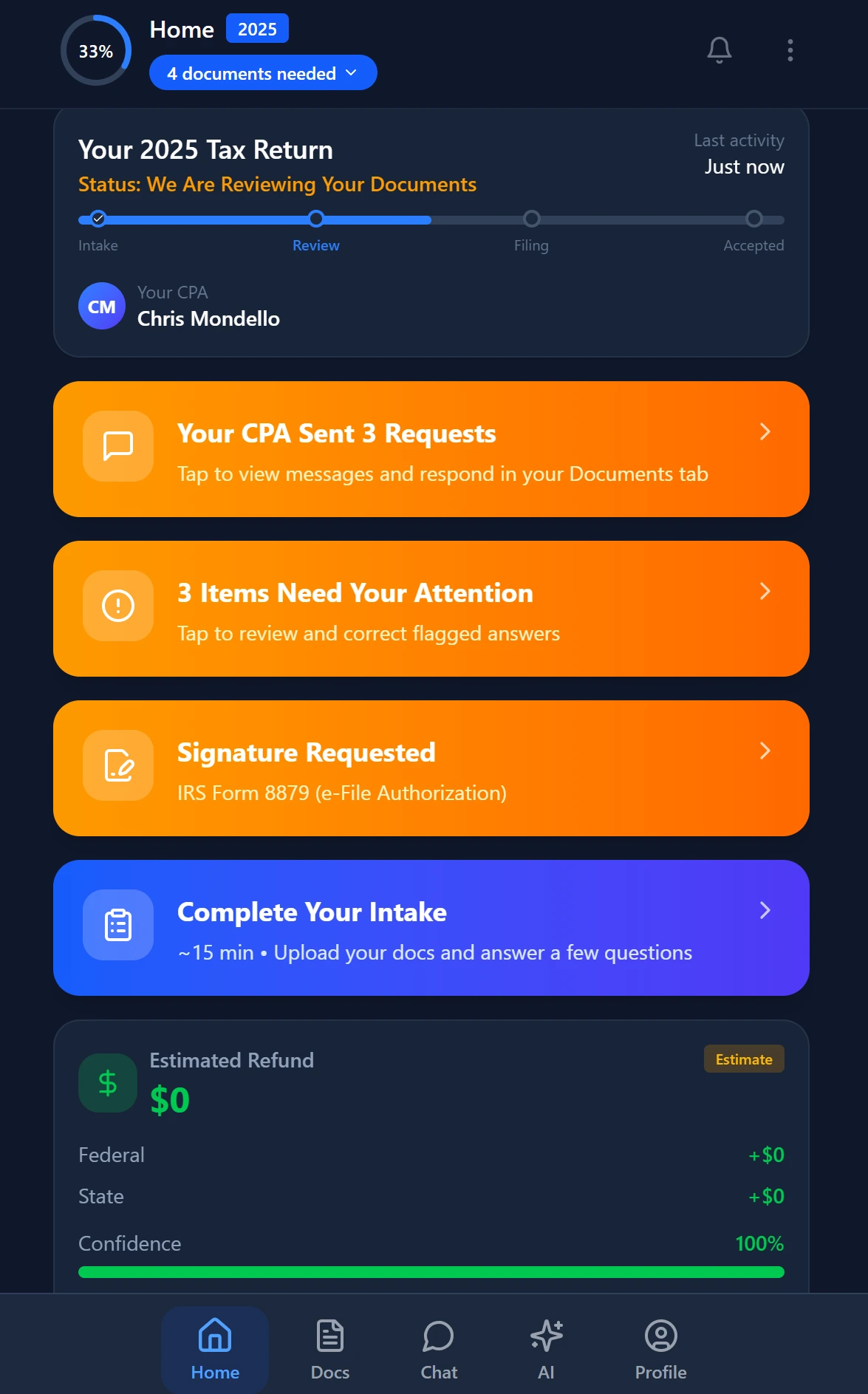
Smart intake auto-fills from uploaded documents and prior-year data
IRS Correspondence Audit Communication Protocols
Correspondence audits — conducted entirely by mail or fax — represent the majority of IRS individual audits. They typically focus on specific line items: unreported income (mismatched 1099s), inflated charitable deductions, home office or vehicle expense claims, and refundable credit eligibility. While less invasive than office or field audits, they carry strict deadlines and require precise, document-supported responses. Effective IRS audit representation in these cases depends on disciplined communication protocols as much as on the underlying documentation.
Your communication protocol for IRS correspondence audit matters should follow a standard sequence. First, calendar every IRS deadline immediately on receipt of any notice, and set internal reminders 10 and 5 days before the response deadline. IRS notice deadlines are non-negotiable — missing a response window can convert an auditable issue into an automatic assessment. Second, respond in writing to every IRS inquiry, even phone requests for information. Written responses create a record and prevent misunderstandings about what was agreed.
Third, match every response to the specific items requested in the IDR — no more, no less. Volunteering unrequested information is one of the most common ways correspondence audits expand into field examinations. Fourth, confirm receipt. If submitting by mail, use certified mail with return receipt. If faxing, retain the confirmation sheet. If using the IRS's Document Upload Tool for eligible cases, retain the confirmation screen. Log every submission in the client's file with date, method, and content summary.
For client communication, maintain a running communication log in your practice management system. TaxScout's communication hub with Gmail OAuth, Outlook Graph, and IMAP integration with AI classification keeps all client correspondence threaded and searchable, so any team member can review the full case history without digging through personal email folders.
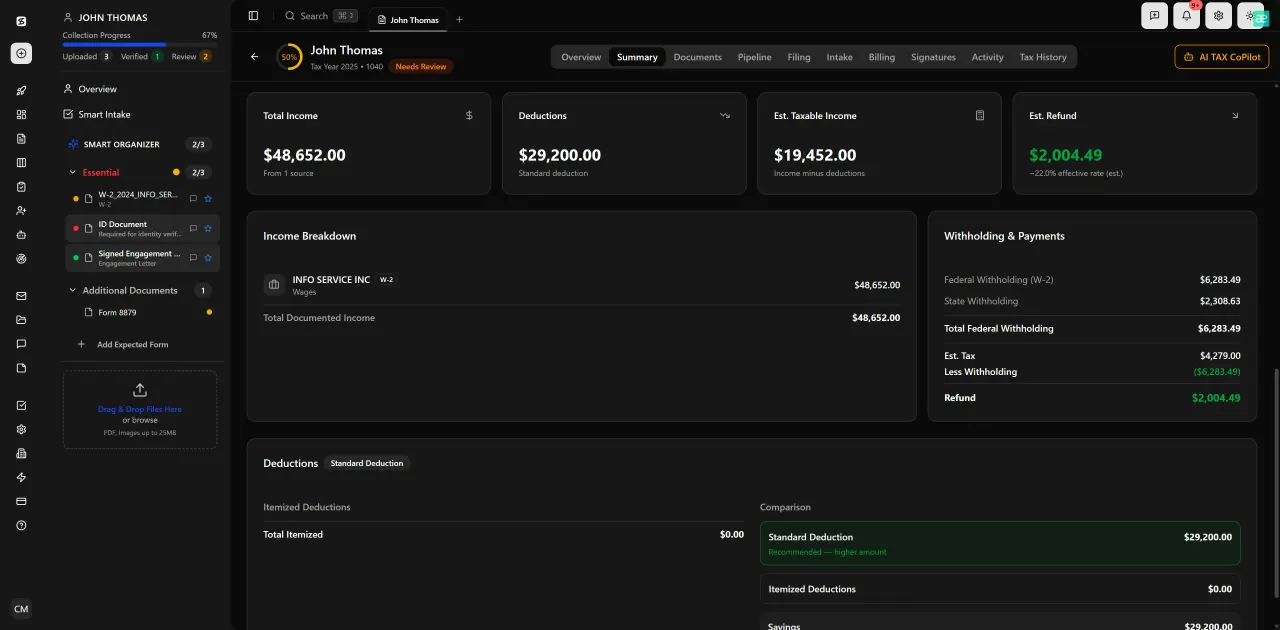
Review with AI assist — 9 agents answer questions with full client context
AI-Assisted Document Retrieval and Research in Audit Defense
The most time-intensive part of audit representation is not the IRS conversation — it's the preparation. Locating supporting documents across multiple filing years, verifying that math and classifications are internally consistent, and researching the applicable legal standards for the disputed items can consume 10–20 hours on a moderately complex case. AI tools purpose-built for tax practice can compress this substantially, making them a natural fit for firms scaling their IRS audit representation workload.
TaxScout's AI research agents give audit practitioners on-demand access to 9 specialized agents that search IRS guidance, Treasury regulations, Cornell Law's USC Title 26, SSA databases, and Congressional records in real time. When you're defending a home office deduction, an agent can surface the current IRS Publication 587 standards, relevant Tax Court decisions, and any recent revenue rulings — in seconds rather than hours. This is especially valuable for correspondence audit items where the legal standard is clear but the citation needs to be precisely stated in your response letter.
On the document side, TaxScout's split-screen PDF viewer with click-to-source field highlighting lets you open the original return side-by-side with supporting documents and trace every figure back to its source in seconds. The 5-layer validation pipeline — which includes cross-document validation and 15 deterministic math rules — flags discrepancies between what was reported and what the source documents show, giving you an early warning system before the IRS spots the same issue. Client-context AI memory retains entity structures, filing history, and prior returns so you never start a case cold.
For firms moving toward a paperless audit defense workflow, the combination of AI extraction, PDF tooling, and a structured pipeline means that document staging for a correspondence audit that previously took half a day can be reduced to under two hours — freeing senior CPAs to focus on the legal and strategic elements of the IRS audit representation rather than document logistics.
Practice Management Platform Comparison for Audit Representation Workflows
| Capability | TaxScout.ai | TaxDome | Karbon |
|---|---|---|---|
| AI document extraction (180+ form types) | Yes — 5-layer validation | No | No |
| E-signature for Form 2848 and engagement letters | Yes — Documenso native | Yes | No |
| AI research agents (IRS/Treasury/Cornell) | Yes — 9 agents | No | No |
| Split-screen PDF viewer with source highlighting | Yes | No | No |
| Client-context AI memory (prior returns, history) | Yes | No | No |
| Branded client portal with OTP login | Yes | Yes | No |
| Pipeline with customizable audit stages | Yes — 12 stages | Limited | Yes |
| Flat pricing (no per-user fees) | Yes — $149/mo for 10 seats | ~$500/mo for 10 users | ~$590/mo for 10 users |
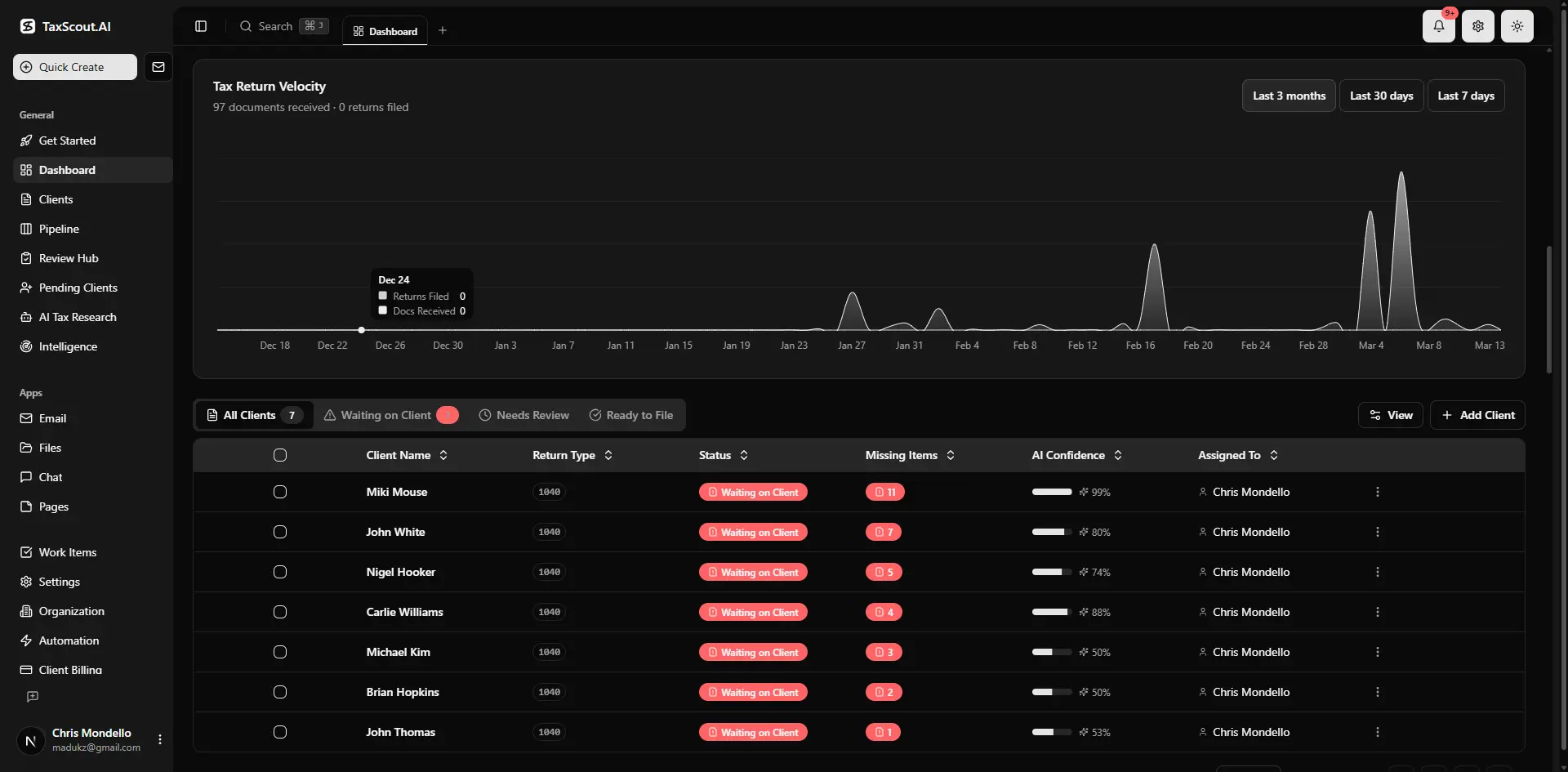
Real-time dashboard showing returns in progress, revenue, and upcoming deadlines
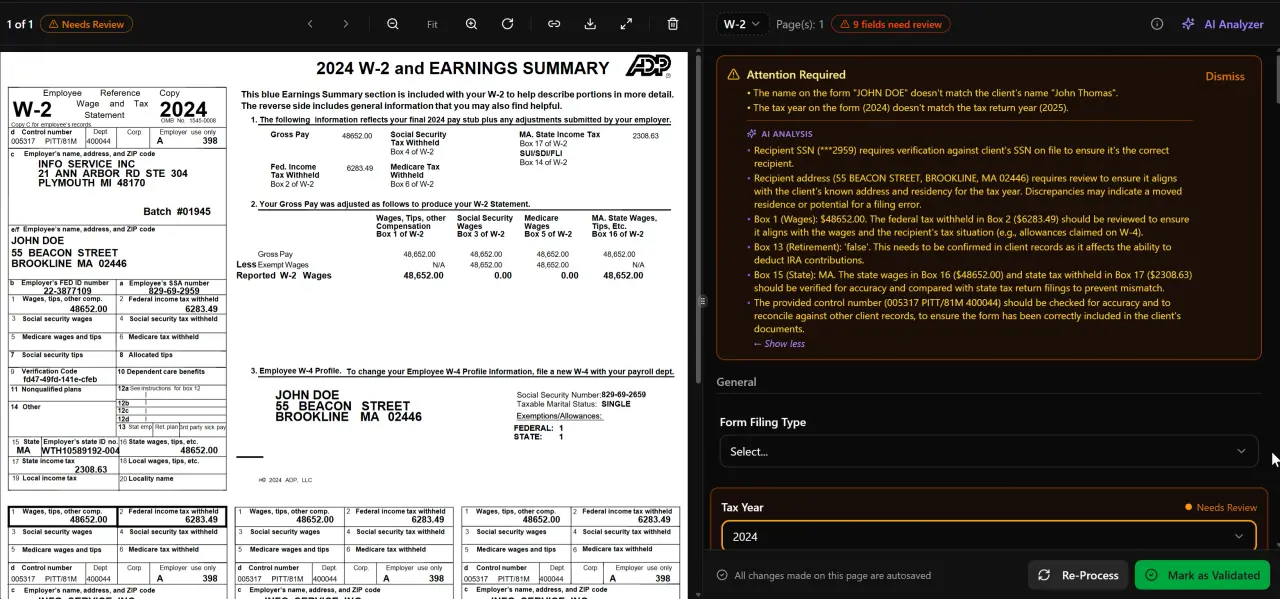
AI classifies, extracts, and validates every document automatically
Pricing and Packaging Audit Representation as a Recurring Service
Audit representation should not be treated as a one-off emergency service. For clients with complex tax profiles — real estate investors, S-corp shareholders, self-employed individuals with significant deductions — an annual audit support retainer is a defensible and attractive offering. A retainer priced at $500–$1,500 per year can cover audit notice triage, initial IDR response, and up to a defined number of hours of IRS audit representation, with hourly rates for work beyond that scope.
Packaging this as a named offering — 'Audit Shield,' 'IRS Defense Retainer,' or similar — gives clients a concrete product to say yes to at the close of their annual planning meeting. It also lets you price predictably, since correspondence audit cases that stay within scope are largely templated work once your workflow is systematized. More involved cases (office audits, field audits, Appeals) are naturally scope-expanded with additional flat-fee tiers or hourly billing.
From a practice management standpoint, audit cases should flow through a dedicated pipeline with stages such as: Engagement Signed → 2848 Filed → IDR Received → Documents Staged → Response Drafted → Response Submitted → Awaiting IRS Reply → Case Closed. TaxScout's pipeline management supports 12 customizable stages with drag-and-drop kanban, so your team has a real-time view of where every open audit matter stands. Pair this with the revenue engine to track audit rep billing separately from your preparation revenue — giving you clean data to evaluate and grow this service line over time.
Per-user pricing models from competitors like TaxDome and Karbon create a financial disincentive to assigning multiple team members to audit matters. TaxScout's flat pricing — $149/month total for up to 10 seats — means you can assign a senior CPA, a document specialist, and an administrative coordinator to the same audit file without your monthly software bill increasing. Compare the full cost picture at TaxScout vs. TaxDome.
Ready to turn audit representation into a structured, profitable service line?
TaxScout.ai gives your firm everything you need — AI document staging, Form 2848 e-signatures, 9 AI research agents, and a customizable audit pipeline — all at one flat monthly price.
Frequently Asked Questions
CPAs are authorized to represent taxpayers before the IRS at all levels — including examinations, Appeals, and collections — under Circular 230. To appear before the IRS, a CPA must have an active state license in good standing and a valid CAF number, which is assigned automatically when you file your first Form 2848. Enrolled Agents and attorneys share this unlimited representation right; unenrolled preparers are limited to audit representation only for returns they personally prepared.
Keep reading
Amended FBAR Procedures: How CPAs Correct Foreign Account Errors Without Triggering Penalties
Oct 12, 2026 · 1 min read
Transparency in Coverage Final Rules: What CPA Firms Must Do Now
Oct 12, 2026 · 1 min read
Backdoor Roth IRA: How CPAs Execute the Strategy for High-Income Clients
Oct 12, 2026 · 1 min read
Stay up to date
Get the latest tax tech insights delivered to your inbox.