Financial Cents Alternatives: Why AI-Native Tools Win
Most CPA firms evaluating Financial Cents alternatives in 2026 are comparing the wrong tools. While legacy workflow platforms debate kanban boards and templates, AI-native firms have already replaced manual processes entirely. Discover why the smartest CPA practices are treating both Financial…
Most CPA firms evaluating Financial Cents alternatives in 2026 are asking the wrong question. They're comparing checklist tools against other checklist tools — debating whether Financial Cents or Jetpack Workflow has better recurring task templates, cleaner kanban boards, or more affordable per-user pricing. Meanwhile, the firms pulling ahead this tax season aren't running better checklists. They've replaced the entire manual-data-entry, chase-the-client, hope-you-caught-the-error workflow with something architecturally different.
This article doesn't just compare Financial Cents vs Jetpack Workflow. It introduces a third option — one that neither company can replicate with a feature update — and explains why more CPA firms are treating both tools as stepping stones rather than destinations. For firms actively researching Financial Cents alternatives, that third option is the one worth understanding before making any long-term commitment.
What Financial Cents and Jetpack Workflow Actually Are (And What They're Not)
Both Financial Cents and Jetpack Workflow are workflow management tools. They're well-built for what they do: organizing recurring tasks, tracking client work through completion, and keeping small teams from dropping deadlines. If your practice management needs start and end at "who is working on what," either tool can serve you. Most firms searching for Financial Cents alternatives are really searching for something that goes beyond task tracking — even if they haven't framed it that way yet.
But here's the architectural reality: both platforms were designed around the assumption that humans handle document collection, data extraction, client communication, error-checking, and research. The software tracks the work. Humans do the work. That distinction matters enormously when evaluating Financial Cents alternatives, because the most meaningful upgrade isn't a better tracker — it's a platform that reduces how much tracking humans need to do at all.
That was a reasonable assumption in 2019. It's an expensive one in 2026.
Financial Cents focuses on workflow, time tracking, and basic client communication. It's popular with bookkeeping and accounting firms that need simple recurring task management. Its client portal is functional but limited. It has no AI document extraction, no validation engine, and no AI research capability.
Jetpack Workflow is similarly positioned — task and workflow management, recurring job templates, basic client database. It gained traction with small accounting firms that needed an affordable alternative to enterprise tools. Like Financial Cents, it has no document intelligence, no AI agents, and no client-context memory.
Neither platform was built to solve the hard problems that define a CPA firm's daily workload in 2026: extracting data accurately from 180+ tax form types, validating that data against 15 deterministic math rules before it reaches your preparer, onboarding clients without back-and-forth email, or answering a complex multi-state research question in 90 seconds instead of 90 minutes. Firms exploring Financial Cents alternatives often discover these gaps only after committing to a platform.
For a deeper look at how to evaluate any practice management tool against these criteria, our guide to choosing CPA practice management software walks through a 7-question AI checklist worth running before you commit to any platform.
Still manually chasing documents and re-keying data into your tax software? See how TaxScout's AI extraction and 5-layer validation handle it automatically. → Book a 15-Min Demo — See It Live
The Real Cost of Checklist-Based Practice Management
Running a 10-person CPA firm on Financial Cents costs roughly $49–$59 per user per month, or $490–$590 monthly for your team. Jetpack Workflow is similarly priced around $36–$45 per user. For 10 users, that's $360–$450 monthly.
Those numbers look reasonable until you add up what neither tool eliminates — and why so many firms begin researching Financial Cents alternatives mid-season when the true cost becomes visible:
Manual document extraction. A preparer processing a moderately complex individual return — W-2s, two 1099-DIVs, a 1099-B, a K-1, and a mortgage interest statement — spends 45–75 minutes on data entry alone. Multiply that across 200 returns per season and you've consumed roughly 250 staff hours on transcription. That's not a workflow problem. That's an AI document extraction problem.
Client intake friction. Without an intelligent intake engine, every new client engagement involves a version of the same cycle: email a PDF organizer, wait for a response, follow up, decipher handwriting, follow up again about missing items. The AICPA estimates administrative tasks consume 30–40% of a typical tax professional's time — and intake is a major driver.
Post-extraction errors. Manual data entry produces errors. Not because your staff is careless, but because transcribing numbers from PDFs into software at volume is inherently error-prone. A transposed digit on a 1099-INT, a missed W-2 box 12 code, a K-1 passive loss entered incorrectly — these slip through checklist-based workflows because those workflows have no mechanism to catch them.
Research lag. A complex question about PFIC taxation, a state conformity issue for a multi-state client, or a foreign tax credit carryover calculation can consume an hour of research time. Financial Cents and Jetpack Workflow offer no research capability whatsoever.
For a detailed look at how AI is addressing these workflow bottlenecks specifically, our CPA firm workflow automation guide covers the full picture.

Click any extracted field to see its source highlighted on the original PDF
How TaxScout Is Architecturally Different
TaxScout isn't a workflow tool with AI features bolted on. It was built from the ground up as an AI-native practice management platform — meaning the intelligence is the foundation, not an add-on. For firms that have exhausted what Financial Cents alternatives in the checklist category can offer, this architectural difference is the key distinction.
AI Document Extraction That Actually Works
TaxScout extracts data from 180+ tax form types — every W-2 variant, all 1099 series (A through SA), K-1s for partnerships, S-corps, and trusts, the full 1098 series, 1095 health coverage forms, Schedule C, D, E, F, and 30+ supporting document categories. When a client uploads their tax documents, TaxScout reads them, extracts every field with a per-field confidence score between 0.0 and 1.0, and flags anything below threshold for human review.
Financial Cents doesn't touch this problem. Jetpack Workflow doesn't touch this problem. This isn't a feature gap — it's an architectural gap.
5-Layer Validation Before the Preparer Sees It
What separates TaxScout from tools that claim "AI extraction" is what happens after extraction. The 5-layer AI validation pipeline catches errors that manual review misses:
- Layer 0 routes documents by quality — recognized forms, unrecognized documents, and outright junk are handled differently from the start
- Layer 1 runs AI extraction with per-field confidence scoring
- Layer 1.5 runs OCR cross-verification using four matching strategies: exact substring matching, currency variant matching, identifier partial matching, and fuzzy name matching via Levenshtein distance
- Layer 2 applies 15 deterministic math rules — including tax equation chain validation, FTC carryover checks, and phantom 1099-INT hallucination detection (a specific failure mode where AI invents interest income that doesn't exist)
- Layer 3 runs 18 post-extraction rules covering tax math, cross-field consistency, and foreign activity flags
No checklist tool catches a phantom 1099-INT. No checklist tool detects W-2 component explosion — another validation layer that catches cases where AI misreads multiple W-2s as one. These aren't edge cases. As we explored in our technical guide to AI document extraction, these failure modes occur regularly with single-layer extraction systems. They're also invisible to firms still evaluating Financial Cents alternatives that remain in the task-tracking category.
Automated Client Onboarding Without the Back-and-Forth
TaxScout's smart intake engine — modeled on IRS Form 13614-C — uses a 4-layer prefill system that eliminates most of the back-and-forth from client onboarding:
- Document-first prefill: Upload a W-2, and the employer name, wages, and withholding auto-populate the intake form
- Prior-year prefill: Last year's return data pre-populates the current intake
- Profile prefill: Entity and client profile data flows automatically into the form
- AI gap analysis: A background workflow detects what's missing and generates prioritized follow-up questions
The result is a client portal with zero account creation friction — clients authenticate via one-time email code, see a branded portal specific to your firm, and complete intake in minutes rather than days. For a detailed walkthrough of what this looks like end-to-end, our guide to automating client onboarding covers the full process.
9 AI Research Agents for Real-Time Tax Research
When a preparer needs to know whether a specific foreign income exclusion applies, or how a state's conformity to federal bonus depreciation affects a client's return, TaxScout's research agents search IRS.gov, law.cornell.edu, congress.gov, treasury.gov, and ssa.gov in real time — not a static database. This isn't a chatbot trained on 2023 data. It's live research against authoritative sources.
The Document Intelligence agent understands the full context of each client's profile — entity structures, filing history, prior-year returns, and all uploaded documents — across sessions. Ask a follow-up question about a client three months later and it remembers the context.
Feature Comparison: Financial Cents vs Jetpack Workflow vs TaxScout
| Feature | Financial Cents | Jetpack Workflow | TaxScout |
|---|---|---|---|
| AI document extraction | ✗ | ✗ | 180+ form types |
| 5-layer validation pipeline | ✗ | ✗ | ✓ (15 math rules + 18 post-extraction rules) |
| Per-field confidence scoring | ✗ | ✗ | ✓ (0.0–1.0 per field) |
| Client portal | Basic | Basic | Branded, OTP login, zero passwords |
| Smart intake with AI prefill | ✗ | ✗ | ✓ (4-layer prefill system) |
| AI research agents | ✗ | ✗ | 9 specialized agents, live IRS search |
| E-signatures | Limited | ✗ | Form 8879, 4868, FBAR, engagement letters |
| Pipeline management | ✓ (basic) | ✓ (basic) | 12 stages, auto-advance, kanban |
| PDF tools | ✗ | ✗ | 14+ built-in tools including PII masking |
| Invoicing/billing | Limited | Limited | Stripe Connect, ACH + card, auto-reminders |
| Pricing (10-person firm) | ~$490–590/mo | ~$360–450/mo | $49/mo flat |
| Per-user fees | Yes | Yes | Never |
That last row deserves emphasis. TaxScout's flat pricing model — $49/month for up to 10 team members on Starter — is not a discount offer. It's a structural pricing decision. Adding a staff member to TaxScout costs nothing. Adding a staff member to Financial Cents or Jetpack Workflow adds another monthly fee. For a growing firm, that difference compounds quickly — and it's one of the most practical reasons firms researching Financial Cents alternatives end up making the switch.
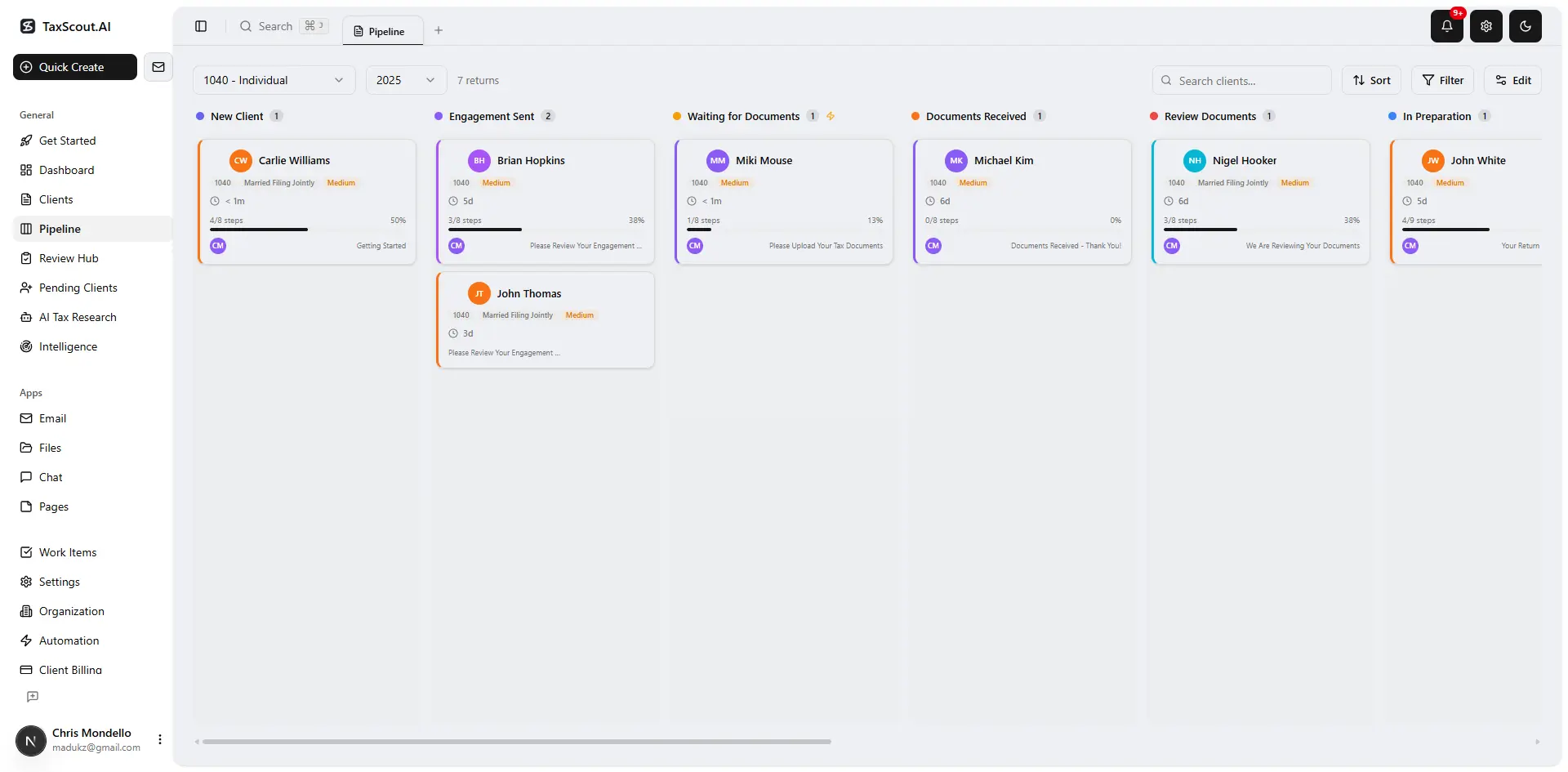
Track every return from intake to filed with drag-and-drop pipeline management
A Real-World Workflow Example: Tax Season, Week 3
Consider a mid-size firm in tax season, processing 180 individual returns with a team of 8. Here's how the same workflow plays out across three platforms:
Financial Cents / Jetpack Workflow workflow: Client emails documents. Staff manually downloads attachments, renames files, sorts into folders. Preparer opens each document, re-keys data into Drake or Lacerte. Supervisor spot-checks for errors. Client emails back to say they forgot a 1099. Process repeats. Research question from preparer sits in a queue until the manager has time.
TaxScout workflow: Client receives a branded intake link with OTP login. They upload documents directly. TaxScout extracts all 180+ form types automatically, runs the 5-layer validation pipeline, and flags three fields with confidence scores below threshold. The preparer sees a split-screen PDF viewer — click any extracted field and the exact source location highlights in the original document. The intake form pre-fills from the extracted data. An AI gap analysis identifies that the client's foreign dividend income suggests a potential Form 8938 requirement and adds a targeted follow-up question. The research agent answers the preparer's PFIC question in 90 seconds using live IRS Publication 514 and Treasury Regulation sources. The Excel 1040 calculator with 66 sheets auto-populates from extracted data. E-signature requests for Form 8879 go out from the portal. Invoice goes out via Stripe. Done.
The checklist in Financial Cents or Jetpack Workflow tracked that work. TaxScout did most of it.
Who Should Still Use Financial Cents or Jetpack Workflow?
Fairness matters here. If your firm is primarily a bookkeeping or CAS practice — focused on monthly close work, QuickBooks reconciliations, and write-up — and your client document volume is low, Financial Cents can handle basic workflow tracking at a low cost. It integrates reasonably well with QBO for bookkeeping-centric teams. For those practices, the search for Financial Cents alternatives may not be urgent.
Jetpack Workflow similarly works for very small firms (1–3 people) where the primary need is recurring task tracking and deadline management with minimal budget.
But if your firm handles tax preparation — meaning you're processing W-2s, 1099s, K-1s, Schedule C returns, or multi-state filings at any volume — you're using a tool that wasn't built for the core of your work. Every hour your staff spends on manual extraction, intake chasing, and research is time your per-user-fee tool is charging you to not solve. That's the core reason tax-focused practices keep circling back to Financial Cents alternatives built around AI rather than task management.
For context, our comparison article on TaxScout vs Canopy 2026 covers how even more feature-complete platforms fall short when AI architecture is the evaluation criterion — worth reading if you're considering a broader market comparison.
Ready to Move Beyond Checklist-Based Practice Management?
TaxScout gives your firm AI document extraction, 5-layer validation, automated client onboarding, and 9 research agents — for $49/mo flat, no per-user fees.
Frequently Asked Questions
Both Financial Cents and Jetpack Workflow are fundamentally checklist and task-tracking tools — they organize who is working on what, but they don't reduce manual data entry, automate client follow-up, or catch errors before they reach a return. CPA firms searching for Financial Cents alternatives in 2026 often discover that switching between these two tools solves a UI preference problem, not a workflow efficiency problem. TaxScout.ai addresses the underlying issue: its AI-native architecture eliminates the manual-entry and client-chasing steps entirely, rather than just giving those steps a better kanban board.
Keep reading
Backdoor Roth IRA: How CPAs Execute the Strategy Without Triggering Pro-Rata Tax
Oct 12, 2026 · 1 min read
Amended FBAR Procedures: How CPAs Correct Foreign Account Errors Without Triggering Penalties
Oct 12, 2026 · 1 min read
Backdoor Roth IRA: How CPAs Execute the Strategy for High-Income Clients
Oct 12, 2026 · 1 min read
Stay up to date
Get the latest tax tech insights delivered to your inbox.