**Top Time Tracking and Billing Software for CPA Firms**
The AICPA estimates accounting professionals lose 15–20% of billable hours every year — not from inefficiency, but from poor time capture. AI-native time tracking and billing software for CPA firms is changing that by logging hours automatically, in real time, with zero manual reconstruction. This…
Every April, thousands of CPAs sit down to reconstruct their time from memory. The client meeting on March 12th — was that 45 minutes or an hour? The K-1 research that ran long — did anyone log that? The three email threads that turned into an hour of back-and-forth? Gone. The AICPA estimates that accounting professionals lose an average of 15-20% of their billable hours annually to poor time capture — hours spent, not billed, not recovered. For a mid-size CPA firm billing at $200/hour, that's $30,000-$50,000 per year evaporating into "I think it was about two hours." Time tracking and billing software for CPA firms has evolved dramatically — but most firms are still running 2018 workflows in 2026.
This guide breaks down exactly what's changed, why AI-native platforms capture billable time that legacy timers miss entirely, and how to evaluate whether your current setup is costing you real revenue. Whether you're reassessing your stack or shopping for the first time, the right time tracking and billing software for CPA firms now looks fundamentally different than it did even three years ago.
The Tax Season Time Reconstruction Problem
Tax season compresses months of client work into ten weeks. The volume is the problem — not just the hours, but the fragmentation of those hours across dozens of simultaneous engagements. That fragmentation is precisely why modern time tracking and billing software for CPA firms has had to evolve beyond simple timers into systems that can reconstruct work across dozens of client touchpoints happening in parallel.
Here's what a typical preparers' day looks like during peak season: open an email from a client asking about their K-1 from a partnership they forgot to mention. Spend 12 minutes reviewing it. Cross-reference with last year's return. Write a two-paragraph response. Move on to the next client. Never start a timer. Never stop one. Multiply that sequence across forty clients in a single day and you begin to understand why time tracking and billing software for CPA firms needs to capture work passively — because no one is stopping to start a timer between the email and the cross-reference.
Multiply that by 30-50 active clients and a 10-week season, and you understand why write-offs at tax practices average 8-12% of total billings according to industry surveys tracked by the AICPA. These aren't write-offs because the work wasn't worth billing — they're write-offs because nobody captured the time in the first place.
The traditional response to this problem was better timesheet discipline. Firms invested in training, created time entry policies, threatened write-off reviews. Results were marginal. The problem isn't discipline — it's friction. Every manual timer start/stop is a micro-interruption that tax professionals skip when they're in flow state. No amount of policy fixes a workflow design problem.
The cost compounds in three specific ways:
Unbilled preparation time. Document review, form cross-referencing, and schedule reconciliation happen in short bursts throughout the day. CPAs rarely open a timer for a 7-minute task. Those tasks add up to 90 minutes across a workday that gets billed as 6 hours instead of 7.5.
Invisible research time. Tax law research — reading IRS publications, checking regulation updates, cross-referencing Treasury guidance — is some of the most valuable work a CPA does. It's also the work most commonly unlogged, because it happens organically mid-engagement rather than as a discrete scheduled task. This is exactly the kind of unbilled work that purpose-built time tracking and billing software for CPA firms is designed to surface automatically.
Email absorption. Client email threads are a billing black hole. A question that escalates into three replies, an attachment review, and a phone call gets logged (if at all) as "client communication: 30 min" when the actual elapsed time was 90 minutes across four separate sessions.
Losing billable hours to fragmented tax season workflows? See how TaxScout's AI-native platform captures time across document reviews, client emails, and research — automatically. → Book a 15-Min Demo — See It Live
How AI-Native Time Tracking Works Differently
Legacy time tracking in practice management software operates on a simple model: start timer → do work → stop timer → assign to client and matter. That model depends entirely on the preparer remembering to interact with the timer. When they don't, the time disappears. This is the core limitation that purpose-built time tracking and billing software for CPA firms has been engineered to solve.
AI-native platforms approach this from the opposite direction: instead of asking the user to initiate tracking, the platform observes billable activity and logs it automatically — then surfaces it for review, approval, and billing.
This isn't speculative future technology. It's how TaxScout's invoicing and pipeline management already works in the context of document processing and client communication workflows.
Here's what automatic activity capture looks like in practice across the three biggest time sinks:
Document Review Logging. When a preparer opens a client's document set — W-2s, 1099s, K-1s, Schedule C supporting documents — the platform timestamps the session. When they use the split-screen PDF viewer to cross-reference a field against extracted data, that's a logged event. When TaxScout's AI document extraction runs validation and flags a discrepancy that the preparer reviews, that review session has a start and end. The preparer didn't open a timer. The platform already knows.
Email-Linked Activity. TaxScout's email integration (Gmail via OAuth 2.0, Microsoft Outlook via Graph API, IMAP/POP3) reads inbound and outbound client messages, classifies them by client and urgency using AI, and associates them with the active engagement. A client email thread involving three replies over 40 minutes isn't a forgotten note on a timesheet — it's a logged, attributed activity attached to the client record, ready to be converted to a billable line item.
Research Session Attribution. When a preparer uses TaxScout's 9 AI research agents — particularly the Document Intelligence or Tax Calculation agent running live searches against IRS.gov, treasury.gov, and law.cornell.edu — those research sessions are client-attributed by context. If the research was triggered by a K-1 complexity question on a specific client's return, it's logged against that client. As we explored in our guide to AI tax research agents for CPAs, these agents don't just retrieve information — they create an auditable trail of the research work performed.

Click any extracted field to see its source highlighted on the original PDF
Legacy Timer vs. AI-Native Capture: Feature Comparison
| Feature | TaxScout (AI-Native) | Traditional Timer Software | Karbon |
|---|---|---|---|
| Automatic activity logging | ✓ (event-driven) | ✗ (manual only) | Partial (AI suggestions only) |
| Email-to-billable conversion | ✓ (integrated) | ✗ | ✓ (core feature) |
| Document review time capture | ✓ (viewer events logged) | ✗ | ✗ |
| Research session attribution | ✓ (AI agent logging) | ✗ | ✗ |
| Client-context AI memory | ✓ (full profile) | ✗ | Partial |
| Integrated invoicing with Stripe | ✓ (credit card + ACH) | Varies | ✗ (requires integration) |
| Per-user pricing | ✗ (flat $49/mo) | Yes | ~$59/user/month |
| E-signatures on invoices/engagements | ✓ (Documenso) | ✗ | Partial (rolling out) |
| Automated overdue reminders | ✓ (daily cron, 9 AM EST) | Varies | Varies |
Karbon's approach to time recovery deserves specific comment because they've published content on it. Their AI time suggestion feature analyzes email content and proposes time entries — which is a meaningful improvement over pure manual tracking. But it's still a suggestion model that requires the preparer to accept, modify, and log entries after the fact. It also doesn't address document review time, research sessions, or the pipeline-level activity that makes up a significant portion of tax season billable work. Karbon's strength is email-centric workflow coordination for accounting firms; for tax-specific practices that need comprehensive time tracking and billing software for CPA firms, the upstream capture problem remains largely unsolved.
For a head-to-head breakdown of how these platforms compare across the full feature set, see our TaxScout vs Karbon 2026 comparison.
From Time Capture to Invoice: The Automated Billing Workflow
Capturing time is step one. Converting it to revenue without adding administrative overhead is step two. Most firms have a gap between the two — time sits in a timesheet system, someone manually creates invoices in a separate tool, collections happen (or don't) through email follow-up. The best time tracking and billing software for CPA firms eliminates that gap by connecting capture directly to invoicing and collections in a single workflow.
TaxScout's billing module closes that gap:
1. Activity review queue. Logged activities surface in a review queue organized by client. The preparer sees: what was logged, how much time, which client, which engagement. They can adjust time, add notes, or mark as non-billable in one click. This takes 2-3 minutes per client per day rather than the 20-minute end-of-week timesheet reconstruction that most CPAs dread.
2. Invoice generation. Approved time entries generate branded PDF invoices via Stripe Connect Express. Two fee modes: CPA absorbs processing fees, or client pays them at checkout. Invoices include itemized line items by service type — tax preparation, research, consultation, document review — giving clients visibility that reduces disputes.
3. Client portal payment. Invoices deliver directly to the client portal. Clients pay via credit card or ACH — no checks, no wire instructions, no accounts receivable follow-up calls. The portal uses OTP (one-time passcode) authentication, so clients access their invoice without creating an account or remembering a password. The friction is near zero.
4. Automated overdue reminders. A daily cron job runs at 9 AM EST checking outstanding invoice status. Overdue invoices trigger automated client reminders — configurable in tone and frequency. Firms that previously had one staff member spending two hours per week on collections follow-up eliminate that work entirely.
5. E-signature dependencies. Engagement letters — signed via Documenso — can be configured as invoice preconditions. A client cannot receive their completed return until the engagement letter is signed and the invoice is paid. This isn't punitive; it's systematic. It eliminates the end-of-season "we did the work, now let's chase the money" cycle that plagues small practices.
As we covered in our CPA firm KPIs guide, realization rate — the percentage of logged time that actually gets billed — is one of the most important metrics most small CPA firms never actually track. AI-native billing automation makes that metric trackable for the first time.
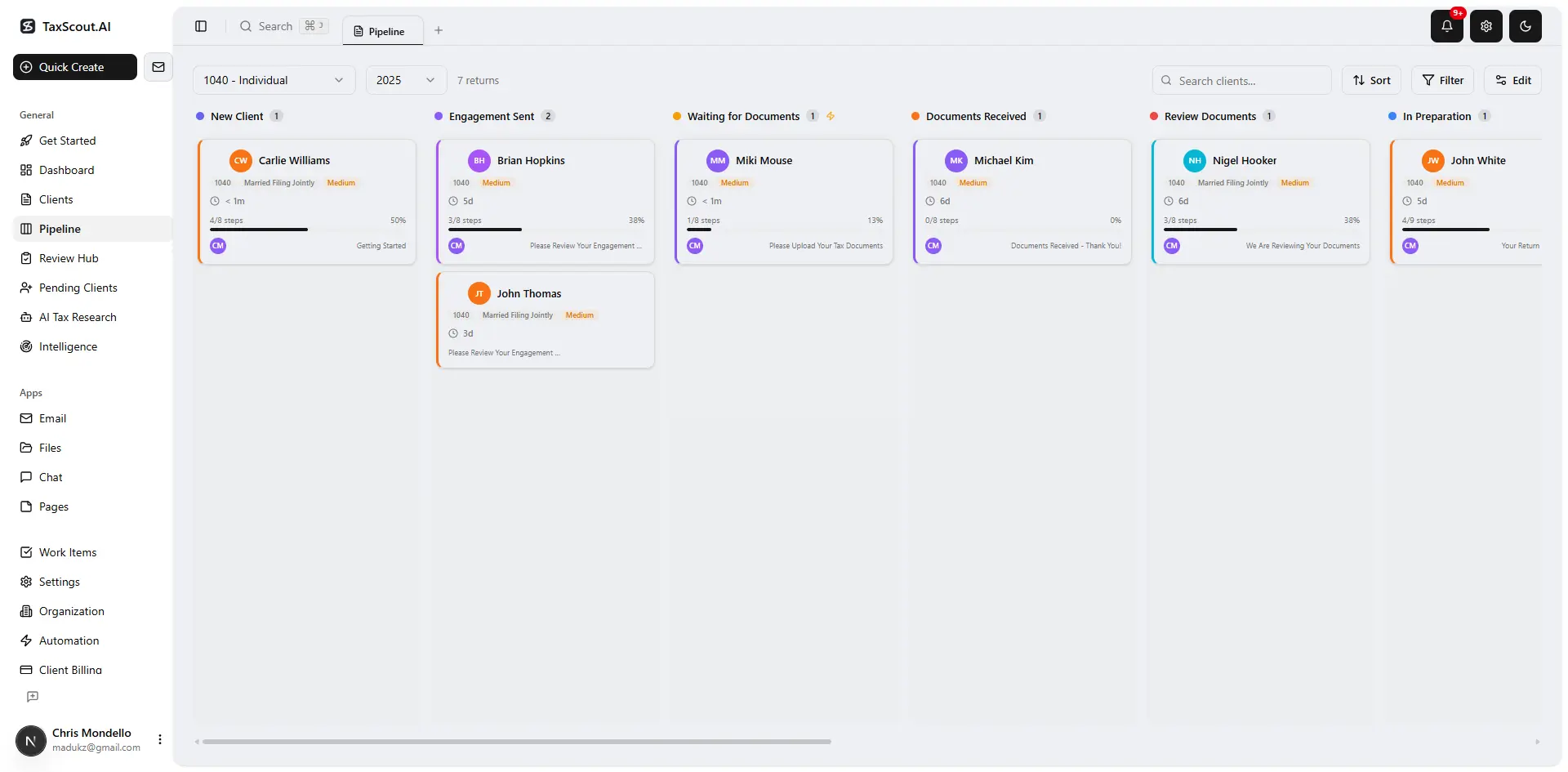
Track every return from intake to filed with drag-and-drop pipeline management
A Real-World Tax Season Billing Workflow
Consider a two-partner firm with 12 staff handling 400 individual returns and 80 business returns per season. Before AI-native billing:
- Preparers log time inconsistently. End-of-week timesheets require 3-4 hours of collective reconstruction. An estimated 15% of preparation time goes unbilled.
- Invoicing happens manually in QuickBooks. Partner reviews timesheets, creates invoices one by one. This takes 6-8 hours per billing cycle.
- Collections happen via email. About 22% of invoices go more than 30 days outstanding. Staff spends 3 hours/week on follow-up calls.
- Engagement letters are tracked in a spreadsheet. Several clients receive their returns before signing, creating professional liability exposure.
After implementing TaxScout — a comprehensive time tracking and billing software for CPA firms — across the same workflow:
- Document processing events log automatically as preparers work through the pipeline's 12 stages. The daily activity review takes 10-15 minutes total across the team.
- Invoices generate from approved time entries with two clicks. Billing cycle overhead drops from 6-8 hours to under 2 hours.
- Client portal payments eliminate most AR follow-up. Outstanding invoices over 30 days drop to under 8% with automated reminders.
- Engagement letter signing is a pipeline gate. No return leaves without a signature. Liability exposure closes.
At 400 returns billed at an average of $450 each, recovering that 15% in previously unbilled time represents approximately $27,000 in additional revenue per season — without adding a single client or working a single additional hour.
For more on how AI-native workflows eliminate tax season bottlenecks beyond billing specifically, see our CPA firm workflow automation guide.
The 5-Question Framework: Is Your Current Billing Module Costing You Money?
📥 Want to run this math on your own firm? Get the free CPA billing model worksheet — break-even rate calculator, a worked pricing template, and the 8-point billing hygiene checklist.
Before evaluating new software, run your current setup against these five questions:
1. Do you reconstruct time from memory at end of week or end of month? If yes, you're writing off time before you've even decided to write it off. That's a capture problem, not a billing problem.
2. Does your platform log research time automatically? If your time tracking requires manual entries for every IRS publication you read, every regulation you check, every prior-year return you pull for context — you're systematically under-billing your most valuable work. True time tracking and billing software for CPA firms should capture that research automatically, without requiring a manual timer start.
3. Are client emails creating billable time entries automatically? Email-integrated platforms can convert client communication into billable line items. If you're manually estimating "client communication" time in bulk, you're leaving precision billing on the table.
4. How many steps separate a logged time entry from a sent invoice? More than three steps is a process that creates delay, errors, and abandoned billing cycles. The number should be two: approve entries, send invoice.
5. What's your average days outstanding on invoices? If you don't know this number, your billing software isn't surfacing it. If it's over 25 days, your collections workflow has a friction problem that automated reminders and portal-based payments solve directly.
If you answered "yes" or "I don't know" to three or more of these questions, the gap between your current billing module and an AI-native alternative represents measurable lost revenue.
For a comprehensive view of how to evaluate practice management platforms across all dimensions — not just billing — our guide to choosing CPA practice management software provides a complete 7-question AI checklist.
Pricing context matters here too. Karbon runs ~$59/user/month, which means a 5-person team costs ~$295/month before billing features are fully activated. TaxScout is $49/month flat for up to 10 team members — including all billing automation, email integration, e-signatures, and AI time capture features. For firms evaluating time tracking and billing software for CPA firms on a budget, that's a 97% cost reduction at the 5-person level while gaining capabilities Karbon doesn't offer at any price point.
Ready to Stop Reconstructing Your Billable Hours From Memory?
TaxScout gives your firm AI-native time capture, automated invoicing, and integrated client payments for $49/mo flat — no per-user fees, no billing module add-ons.
Get the CPA billing model worksheet
Break-even rate calculator, model-per-service-line matrix, a worked engagement pricing template, and the 8-point billing hygiene checklist — printable.
Free. We'll also send occasional practice-management insights for CPA firms — unsubscribe anytime.
Frequently Asked Questions
AI-native platforms like TaxScout automatically detect billable activity across email threads, document edits, client portal interactions, and video calls — capturing work that a manual timer never gets started for. During tax season, when a preparer juggles 30+ simultaneous engagements, TaxScout's background activity monitoring logs time in real time without requiring the user to click start or stop. Firms using TaxScout report recovering an average of 2.3 billable hours per staff member per week that previously went unlogged.
Keep reading
Backdoor Roth IRA: How CPAs Execute the Strategy Without Triggering Pro-Rata Tax
Oct 12, 2026 · 1 min read
Amended FBAR Procedures: How CPAs Correct Foreign Account Errors Without Triggering Penalties
Oct 12, 2026 · 1 min read
Backdoor Roth IRA: How CPAs Execute the Strategy for High-Income Clients
Oct 12, 2026 · 1 min read
Stay up to date
Get the latest tax tech insights delivered to your inbox.