CPA Client Meeting Skills: How to Explain Tax Issues Without Losing the Room
Early-career and solo CPAs often know the tax code cold but struggle to keep clients engaged in advisory meetings. This guide delivers a repeatable framework for structuring prospect and planning conversations so clients understand what matters — and act on it.
CPA client meeting skills are rarely taught in licensing programs. You spend years learning depreciation schedules, passive activity rules, and QBI deduction thresholds — then you sit across from a business owner and watch their eyes glaze over the moment you mention adjusted gross income. The technical knowledge is there; the communication framework is not.
A thread on r/taxpros captures this perfectly: CPAs asking for real-world advice on how to run better client meetings, how to stop over-explaining, and how to make sure prospects actually sign engagements after the first call. The responses were candid — most advisors admitted they learned meeting structure through trial, error, and a few painful silences. Developing strong cpa client meeting skills is exactly what these practitioners were searching for, yet most admitted they had never received formal training in this area.
This guide gives you the frameworks that experienced practitioners wish they had earlier: how to structure a tax advisory meeting from open to close, how to translate technical concepts into language clients act on, and how to avoid the common traps that turn a promising prospect call into a polite dead end. Think of this as your practical playbook for building cpa client meeting skills that convert prospects and retain long-term clients.
Why CPA Client Meeting Skills Are a Separate Discipline
Tax expertise and client communication are genuinely different skill sets. The Journal of Accountancy has documented for years that client attrition at CPA firms is driven less by technical errors and more by perceived lack of communication — clients who felt uninformed or talked past. The content was fine; the delivery lost them. This gap is precisely why investing in cpa client meeting skills can have a more immediate impact on firm growth than pursuing additional technical certifications.
The problem is structural. CPAs are trained to be precise. Precision in a client meeting, however, can easily become jargon-dense monologue. When you explain a passive activity loss limitation or a Section 179 election without anchoring it to the client's specific situation, you are technically correct and practically useless to that listener. For firms evaluating their cpa client meeting skills approach, this trade-off compounds over time.
Research from the U.S. Small Business Administration confirms that small business owners rank clarity and responsiveness as their top two criteria for retaining professional advisors — above price, above credentials. That means your ability to run a clean, focused meeting is a direct revenue lever, not a soft skill you can defer. Each of these factors directly shapes how cpa client meeting skills plays out in practice.
For early-career CPAs and solo practitioners, this is especially high-stakes. You cannot rely on a firm brand or a senior partner to carry the room. Your CPA client meeting skills are the product, and refining them compounds over time into a distinct competitive advantage.
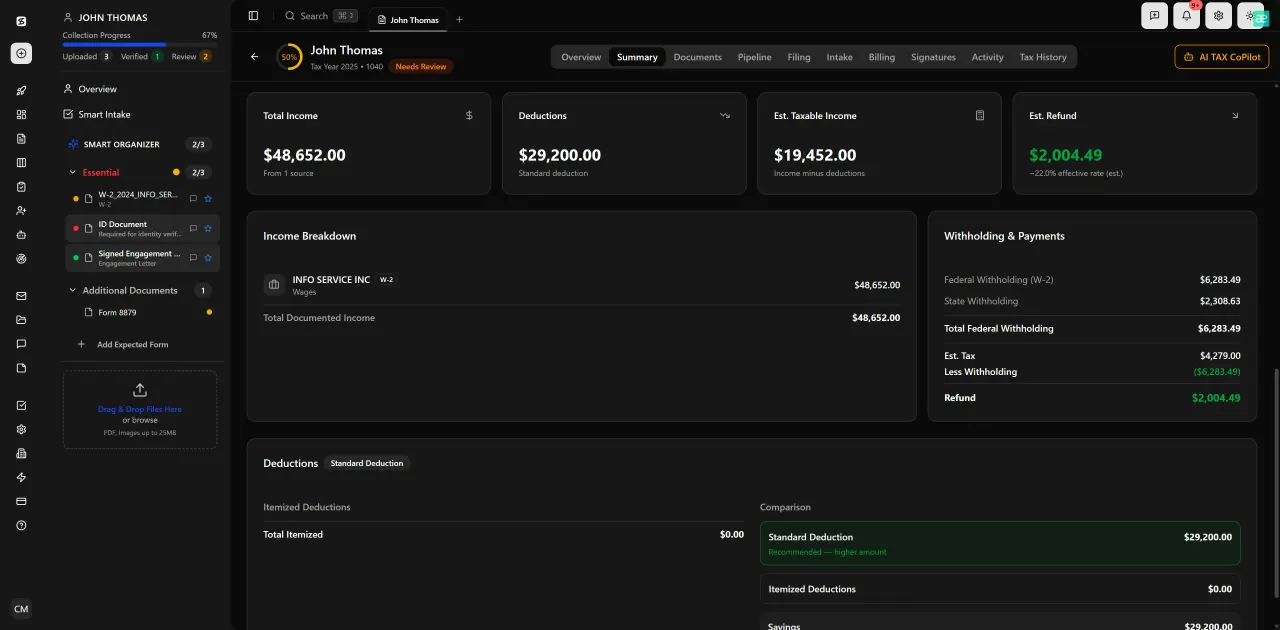
Review with AI assist — 9 agents answer questions with full client context
Step 1: Set the Agenda Before the Meeting Starts
The single most effective change most CPAs can make is sending a one-paragraph agenda 24 hours before any advisory or prospect call. It does three things: it signals professionalism, it pre-frames the conversation so clients arrive mentally prepared, and it limits scope creep that turns a 30-minute planning discussion into a 90-minute ramble. Understanding cpa client meeting skills in this context is what separates firms that scale from those that stall.
A good pre-meeting note looks like this: 'We'll spend the first ten minutes reviewing your Q3 estimated payments, then walk through two S-corp structuring options, and close with action items and next steps. Please have last year's K-1s handy if you have them.' That's it. No jargon, no promises you can't keep in the time allotted. This is precisely where a deliberate cpa client meeting skills strategy pays off.
This agenda habit also makes your client onboarding meetings dramatically more productive. New clients arrive not knowing what to expect from a tax advisory relationship; a crisp agenda immediately differentiates you from the prior accountant who simply asked for a pile of documents and disappeared until April. Cpa client meeting skills sits at the center of this decision — get it wrong and the rest unravels.
If you are using a structured intake process — TaxScout's AI intake feature pre-populates meeting prep data from prior-year returns and document uploads before the call even starts — you can walk in already knowing the gaps, so your agenda reflects the actual conversation worth having rather than a fishing expedition for basic facts.

Your clients see your brand — OTP login, document upload, and real-time status
Step 2: Open With the Client's Language, Not Yours
The fastest way to lose a prospect in the first five minutes is to open with a tax concept rather than a business concern. The IRS Taxpayer Advocate Service has noted that taxpayer confusion about obligations is one of the most common drivers of non-compliance — which means clients often don't understand their own situation even before you start advising them.
Open instead with a question tied to what they care about: 'Walk me through how the business did last year — revenue, any big expenses, anything that felt like a surprise at tax time.' This gives you the narrative context you need and immediately signals that the meeting is about their reality, not your taxonomy.
From their answer, you can map business events to tax concepts rather than presenting tax concepts in isolation. A client who says 'we bought a new truck in October' is giving you a Section 179 or bonus depreciation conversation. A client who says 'my partner bought me out' is giving you a cost basis and capital gains conversation. Let their language set the entry point.
This technique — sometimes called 'concept anchoring' in communication coaching — is particularly valuable for explaining estimated tax payments and withholding to W-2 employees who receive 1099 income for the first time. Instead of explaining the mechanics, you say: 'You know how your employer takes taxes out of your paycheck before you see it? This year, nobody did that for your consulting income, so we need to catch up — and set up a system so it doesn't happen again.'
Spending more time on meeting prep than the meeting itself?
TaxScout's AI intake and client portal surface the right client data before you walk into any advisory conversation — so you can focus on advising, not information gathering.
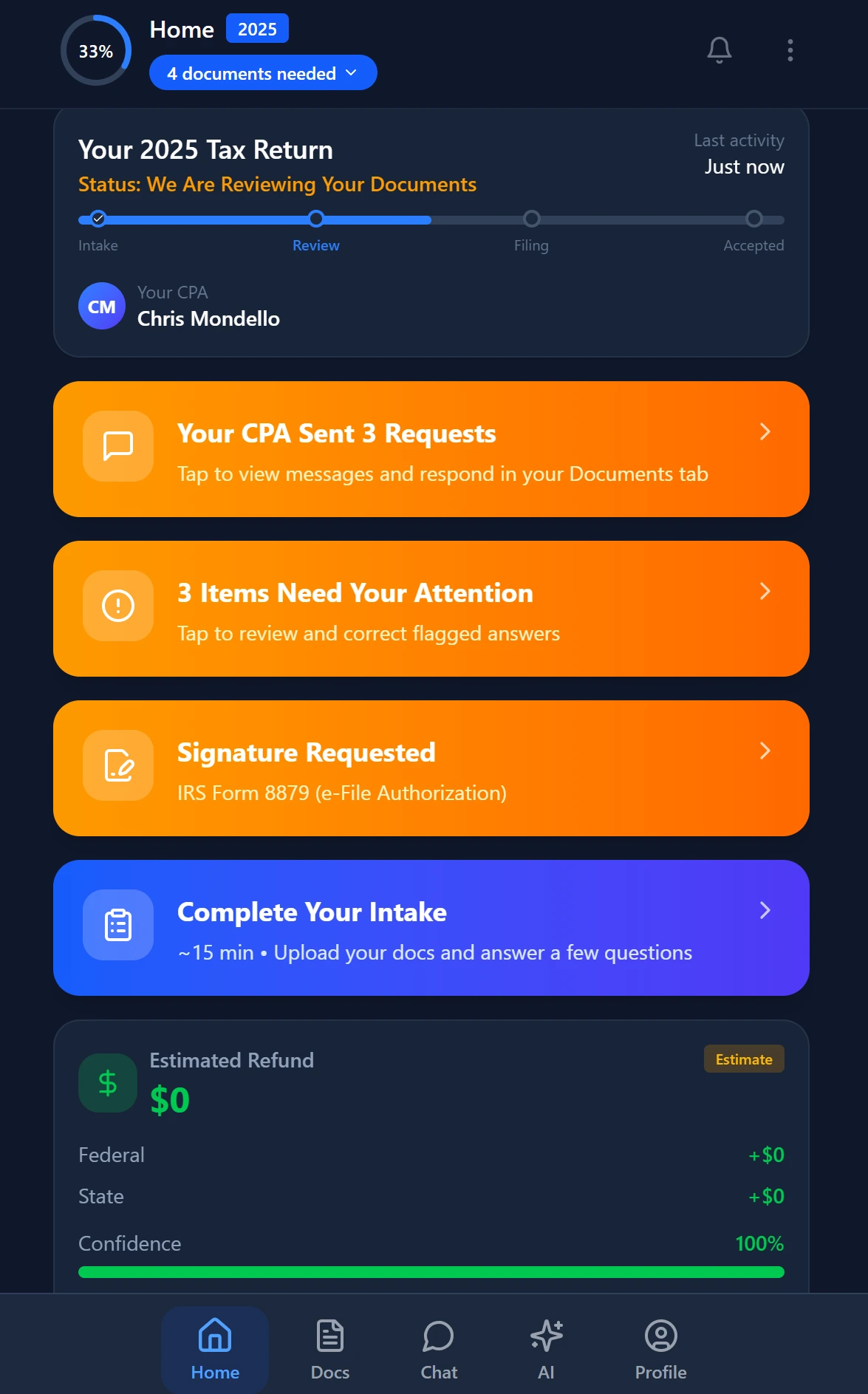
Smart intake auto-fills from uploaded documents and prior-year data
Step 3: Use the Three-Layer Explanation Framework
Complex tax topics almost always require three layers of explanation: what happened, why it matters in dollars, and what we do about it. Most CPAs start at layer one and stop there. Clients need all three to feel informed rather than just informed at.
Consider explaining a pass-through entity to a new LLC owner. Layer one: 'Your LLC income flows directly to your personal return.' Layer two: 'That means you owe self-employment tax on net profits — roughly 15.3% before income tax — which surprised you last year.' Layer three: 'We can elect S-corp status and pay yourself a reasonable salary, which could save you four to six thousand dollars annually in SE tax depending on your profit level.'
The Cornell Legal Information Institute publishes the underlying statutes for most of these elections in plain-language form, which can be a useful resource when clients want to verify what you're telling them independently. Pointing clients toward authoritative references actually increases trust rather than undermining it.
Notice that layer three always ends with a number or a decision. This is non-negotiable for client communication in advisory meetings. If you explain a tax issue without landing on a concrete so-what, the client has no way to evaluate whether the conversation was worth their time. Concrete outcomes — dollars saved, risk eliminated, a deadline to act before — are what convert advisory conversations into engagement expansions.
Handling the Follow-Up Questions You Dread
Clients often ask questions that sound adversarial but are actually anxiety-driven: 'Why didn't my last accountant tell me this?' or 'Are you sure about that?' The instinct is to defend your analysis or over-cite authority. Instead, pause, validate, and redirect: 'That's a fair question — this rule changed in the last few years, and it's genuinely one that catches a lot of business owners off guard. Here's what the current law says and here's what it means specifically for your situation.'
For genuinely complex research questions you can't answer confidently in the moment, say so explicitly rather than speculating. 'I want to verify the exact treatment on that before I give you a number — I'll send you a written summary by Thursday.' This is more credible than an uncertain on-the-spot answer, and it creates a natural follow-up touchpoint that keeps the relationship active.

Click any extracted field to see its source highlighted on the original PDF
Step 4: Structure Prospect Meetings to Move Toward Commitment
Prospect meetings have a different objective than ongoing advisory sessions: they need to end with a clear next step, ideally a signed engagement letter. This requires a slightly different structure — one that mixes discovery, value demonstration, and a low-friction close.
A reliable 45-minute prospect meeting structure runs as follows. Minutes 0-10: discovery questions about their business, prior CPA relationship, and biggest tax frustrations. Minutes 10-25: walk through one specific finding or opportunity you spotted in their prior-year return or initial documents — something concrete that demonstrates you already understand their situation better than a generic competitor would. Minutes 25-35: explain your service scope and fees without apologizing for them. Minutes 35-45: discuss onboarding, set a timeline, and ask for the engagement directly.
The value demonstration segment (minutes 10-25) is where most prospect meetings are won or lost. If you can say, 'I noticed you're not taking the QBI deduction on your rental income — that's potentially a few thousand dollars you're leaving on the table,' you have earned the meeting in a way that no credentials recitation could match.
For advisory services beyond compliance, the conversation shifts from 'here is what I will do for you at tax time' to 'here is what I will help you avoid, plan for, and decide throughout the year.' Articulating that distinction — and backing it with specific examples from similar clients — is what separates a $500 prep engagement from a $5,000 retainer. You can find more tips on positioning advisory work and adjusting your pricing in our post on niche pricing strategy for CPAs.
Check out other blog resources for more frameworks on building a stronger advisory practice.
Step 5: Close Every Meeting With Written Action Items
The meeting is not over when you stop talking. For CPA client meeting skills to translate into client retention and revenue growth, every conversation — prospect or advisory — must end with a written list of action items sent within 24 hours.
The follow-up note should be short: what was decided, what the CPA will do and by when, what the client will do and by when. This serves dual purposes. First, it demonstrates responsiveness — a quality Treasury and advisory researchers consistently identify as a differentiator in professional services. Second, it creates a paper trail that protects both parties if questions arise about what was discussed.
For multi-entity clients with complex structures, your meeting notes can also feed directly into your workflow pipeline. Using a tool like TaxScout's pipeline management feature, each meeting outcome can trigger the next stage automatically — whether that is collecting documents, preparing an amended return, or scheduling a quarterly check-in. That continuity between the conversation and the work is what makes advisory feel like a managed process rather than a series of disconnected calls.
You can also pair your meeting follow-up with automated messaging through a communication hub so clients receive status updates between meetings without you manually sending each one. That ambient communication keeps the relationship warm even during quieter periods of the year.
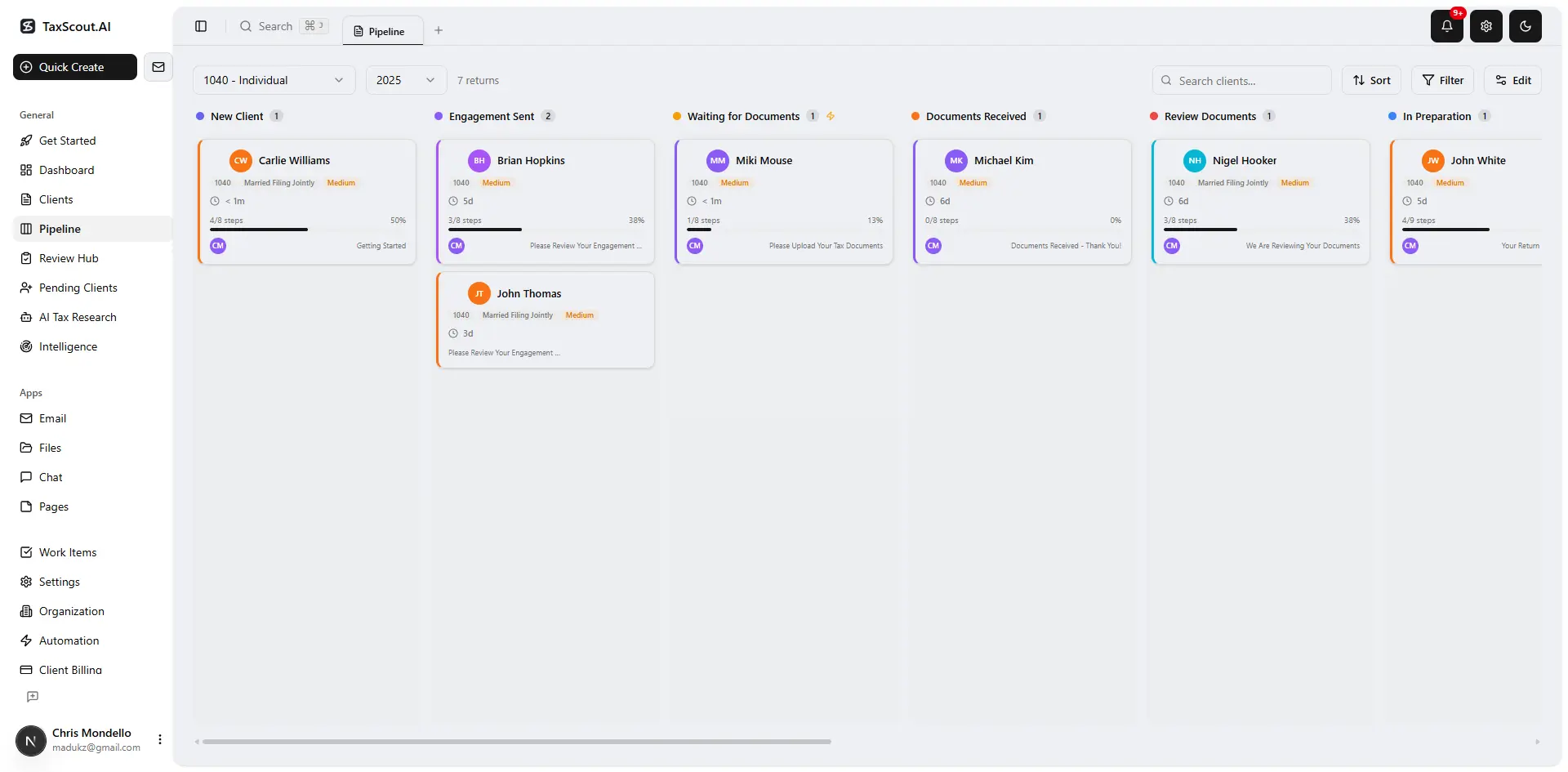
Track every return from intake to filed with drag-and-drop pipeline management
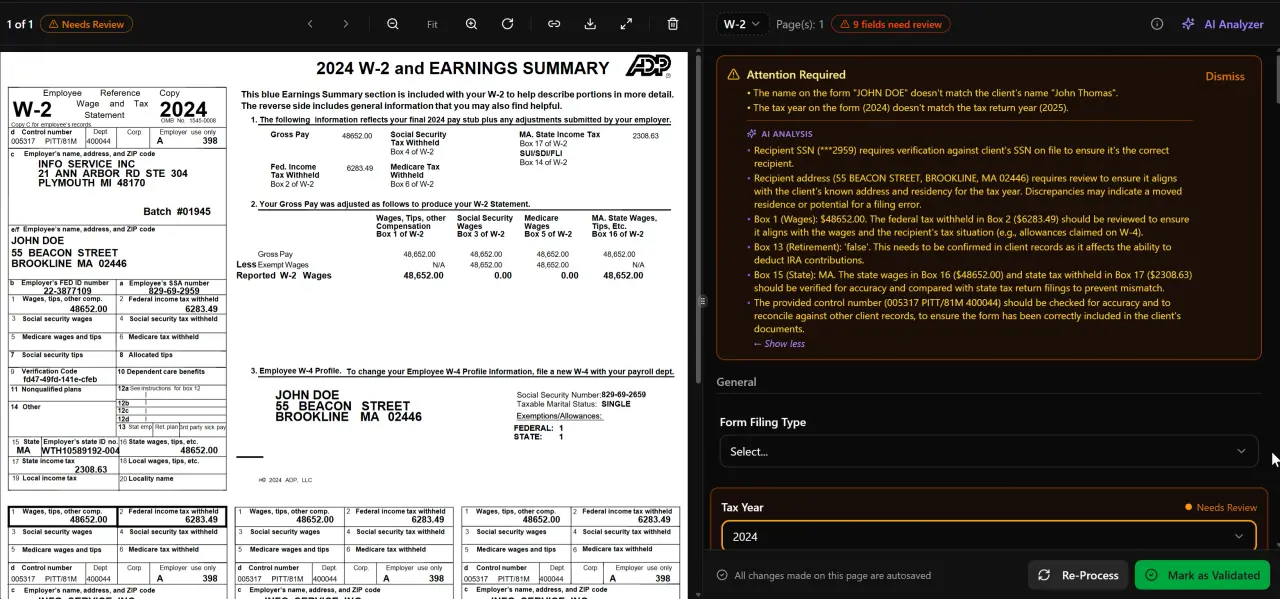
AI classifies, extracts, and validates every document automatically
Common Tax Advisory Meeting Mistakes and How to Avoid Them
Even experienced CPAs fall into patterns that undermine meeting effectiveness. The most common are: starting with the return rather than the client's story, using IRS publication language verbatim (which reads as bureaucratic and cold), giving tax advice without the dollar context that makes it actionable, and failing to ask for the next commitment before the call ends.
A subtler mistake is over-meeting. Not every client question requires a Zoom call. When you treat every inquiry as a meeting, you dilute the value of actual advisory sessions and erode your own time. Build a clear protocol: document questions get answered asynchronously through a secure portal, estimated tax payments get handled via a standardized quarterly note, and full advisory calls are reserved for strategy and decisions. TaxScout's client portal allows clients to upload documents, review status, and ask questions outside of scheduled calls — which naturally filters what actually needs a meeting.
Another pattern worth auditing: CPAs who apologize for fees during prospect calls lose the room immediately. If you catch yourself softening a price quote with 'I know it's a lot, but…' you are undercutting the value you just spent 30 minutes establishing. State the fee with the same tone you used to explain the QBI finding — matter-of-fact, confident, tied to outcome.
For a related perspective on managing difficult client dynamics, our post on firing your worst clients covers the boundaries that make every meeting more productive by ensuring you only meet with clients worth meeting.
Using Technology to Strengthen Meeting Preparation
Strong CPA client meeting skills are amplified, not replaced, by the right technology. The pre-meeting prep that used to take 30-45 minutes — pulling prior returns, scanning for missing documents, flagging open items — can be compressed dramatically when your practice management system surfaces that context automatically.
TaxScout's AI research agents can run real-time searches across IRS, Treasury, Cornell LII, and SSA sources so that when you walk into an advisory meeting about a new S-corp election or a multi-state nexus question, you have already reviewed the current guidance. That preparation converts into meeting confidence, which clients read as competence — because it is.
For prospect meetings specifically, having a client portal that lets prospects upload their prior-year return and key documents before the first call means you can complete the value demonstration segment with real numbers rather than hypotheticals. That specificity is what closes engagements.
TaxScout's AI document extraction processes 180+ form types so that by the time the meeting starts, you already know which schedules were filed, where the anomalies are, and what questions to ask. You can review the pricing page to see how the platform fits into a solo or small-firm budget — plans start at $49/month with no per-user fees.
See also our guide on boosting AI accounting productivity for a broader look at how AI tools fit into a modern CPA workflow beyond just meeting prep.
Want to walk into every client meeting already knowing the right questions to ask?
TaxScout auto-extracts documents, surfaces client history, and equips your AI research agents before any advisory session — so your CPA client meeting skills get the data infrastructure they deserve.

Every client gets organized documents, status tracking, and a complete history
Frequently Asked Questions
A well-structured advisory meeting follows four phases: (1) a brief agenda confirmation and discovery check-in, (2) a review of the specific tax issue or opportunity you identified before the call, (3) a clear three-layer explanation covering what happened, the dollar impact, and the recommended action, and (4) a close with written action items assigned to both the CPA and the client. Sending the agenda and any pre-read material 24 hours in advance significantly improves how prepared clients arrive.
Keep reading
Backdoor Roth IRA: How CPAs Execute the Strategy Without Triggering Pro-Rata Tax
Oct 12, 2026 · 1 min read
Amended FBAR Procedures: How CPAs Correct Foreign Account Errors Without Triggering Penalties
Oct 12, 2026 · 1 min read
Transparency in Coverage Final Rules: What CPA Firms Must Do Now
Oct 12, 2026 · 1 min read
Stay up to date
Get the latest tax tech insights delivered to your inbox.