Bookkeeping Workflow Automation: From Receipt to Reconciliation
Bookkeeping workflow automation is reshaping how accounting firms handle the full receipt-to-reconciliation pipeline. Firms leveraging AI are closing month-end books in days — not weeks — while eliminating up to 15 hours of manual work per client. This guide breaks down every stage of the…
Bookkeeping workflow automation has quietly become the sharpest competitive divide in public accounting. Firms that have automated the receipt-to-reconciliation pipeline are closing month-end books in days. Firms still running checklist-based workflows — the kind Canopy distributes as static PDFs and Karbon wraps in task templates — are burning 15–20 hours per client per month on work that should take four. This guide maps the complete bookkeeping workflow stage by stage, shows exactly where AI eliminates manual intervention, and explains why the architecture of your practice management platform determines how much of that automation you can actually capture.
Why Checklist-Based Bookkeeping Workflows Are Hitting a Wall
Traditional bookkeeping workflow tools gave firms something better than a spreadsheet: structured checklists, assignable tasks, and progress tracking. That was meaningful in 2018. In 2026, it's a low ceiling. Firms serious about staying competitive in 2026 need to look past checklists and embrace bookkeeping workflow automation that actually executes work, not just organizes it.
Here's the structural problem. A checklist tells a staff member what to do next. An AI-native workflow does the next thing automatically and surfaces only the exceptions that require human judgment. The gap between those two architectures isn't incremental — it compounds across every stage of the month-end close. That architectural gap is precisely why the shift from task management to true bookkeeping workflow automation isn't a feature upgrade — it's a fundamental rethinking of how accounting work gets done.
The AICPA estimates accounting professionals lose 15–20% of billable hours annually not from inefficiency, but from tasks that were never automated in the first place: manual data entry, re-keying transactions, formatting client deliverables, chasing missing receipts. For a firm with 40 bookkeeping clients at $600/month average, eliminating even 6 hours of manual work per client per month at a $75 fully-loaded hourly rate recovers $216,000 per year in staff capacity — without a single new hire. Bookkeeping workflow automation directly targets this category of loss, converting those never-automated tasks into system-handled processes that free staff for higher-value work.
Canopy's bookkeeping workflow resources are template-based. Karbon covers month-end close tactically but frames it as a task management problem, not an AI automation problem. Neither platform maps the receipt-to-reconciliation pipeline with specific AI touchpoints. That's the gap this guide closes.
As we've covered in CPA Firm Workflow Automation: The Complete Guide to Eliminating Bottlenecks in 2026, the real bottlenecks in firm workflows aren't visible in a kanban board — they're buried in document handling, data extraction, and exception management. Bookkeeping is where that dynamic is most acute, and where bookkeeping workflow automation delivers its sharpest returns.
Still running month-end close on checklists and manual data entry? See how TaxScout's AI-native workflow automation handles the full receipt-to-reconciliation pipeline. → Book a 15-Min Demo — See It Live
The 5-Stage Bookkeeping Workflow: Where AI Eliminates Manual Work
Stage 1: Receipt Capture and Document Ingestion
The first failure point in most bookkeeping workflows isn't categorization or reconciliation — it's intake. Clients send receipts via email, text photos, bank portals, and physical mail. Staff spend real time sorting, renaming, and routing documents before any accounting work begins.
Bookkeeping workflow automation starts here. An AI-native platform should:
- Accept documents from multiple ingestion channels (email, portal upload, direct integration)
- Automatically classify document type on arrival — receipt, bank statement, invoice, utility bill
- Route documents to the correct client folder without staff intervention
- Flag low-quality scans or illegible documents immediately rather than letting them become a problem at reconciliation
TaxScout's document intelligence layer handles 180+ document types through its AI document extraction engine, including business receipts, vendor invoices, and bank statements. Documents uploaded to the client portal are immediately routed, classified, and staged for extraction — no staff renaming or sorting required.
TaxScout's client portal uses OTP login (one-time code via email, no password, no account creation) so clients actually use it. Fewer clients emailing documents directly means less staff time managing the inbox routing problem.
Stage 2: AI Extraction and Categorization
Once documents are ingested, the next manual bottleneck is data extraction — reading amounts, dates, vendor names, and account codes from raw documents and entering them into the general ledger. For high-volume bookkeeping, this is where bookkeeping workflow automation delivers the most measurable ROI.
TaxScout's extraction engine uses a 5-layer validation pipeline that matters specifically for bookkeeping accuracy:
Layer 0 routes documents by confidence — recognized, unrecognized, or junk — before any extraction attempt.
Layer 1 runs AI extraction with per-field confidence scoring (0.0–1.0). Every extracted field — vendor name, amount, date, payment method — carries an individual confidence score. Low-confidence fields are flagged for human review rather than silently passed through.
Layer 1.5 cross-verifies extracted values against the raw OCR output using four matching strategies: exact substring match, currency format variants, identifier partial matching, and fuzzy name matching via Levenshtein distance. A vendor name that OCR renders as "AMZN Marketplace" and AI extracts as "Amazon" gets verified, not blindly accepted.
Layer 2 runs 15 deterministic math rules. For bookkeeping documents — invoices with line items, expense reports with subtotals — this catches arithmetic errors in source documents before they reach the ledger.
Layer 3 applies 18 post-extraction validation rules including cross-field consistency checks. An invoice dated January with a payment date in December of the prior year gets flagged.
This is what "accurate AI extraction" actually looks like mechanically. Compare that to Canopy's "basic AI document rename" capability — a feature that renames files, not one that validates extracted financial data. The difference matters when a miscategorized $4,200 equipment expense versus a $420 office supply expense survives three months of close cycles before anyone notices.
You can review the full technical architecture of AI extraction in our complete guide to AI document extraction for CPAs.
Stage 3: Transaction Matching
After extraction, bookkeeping automation software needs to match extracted transactions to bank feed items, cleared checks, and payment records. Manual matching is the most time-consuming reconciliation task — and the most prone to human error at scale. Implementing bookkeeping workflow automation at this stage is what transforms reconciliation from a multi-hour slog into an exception-only review.
Effective automated matching uses:
- Exact matching: Amount, date, and payee all align — auto-clear without human review
- Fuzzy matching: Amount aligns, payee name differs slightly (e.g., "Shell Oil #4422" vs. "Shell Gas Station") — auto-suggest with one-click confirmation
- Exception flagging: No match found or amount discrepancy above threshold — route to preparer review queue
The goal isn't to automate 100% of matches. The goal is to automate the 80–85% of transactions that are clean and present only the 15–20% that require judgment. A bookkeeper spending 4 hours on reconciliation currently handles all matches manually. The same workflow with automated matching takes 45 minutes on exceptions only.
Stage 4: Automated Month-End Close
Automated month-end close is where the cumulative time savings from Stages 1–3 compound into a structural workflow advantage. When extraction is accurate and matching is handled automatically, the month-end close sequence shifts from data processing to exception resolution.
A checklist-based month-end close (Karbon's approach) requires a staff member to manually advance each task — mark "bank statement downloaded," mark "transactions categorized," mark "reconciliation complete." The checklist documents what happened; it doesn't do the work.
An AI-native month-end close in TaxScout works differently:
- Documents arrive via the client portal throughout the month
- AI extraction and categorization run automatically on ingestion
- Pipeline stage advances automatically when all required documents for a client are present and validated
- Exception queue is populated automatically — only items requiring human judgment appear
- When exceptions are cleared, reconciliation status updates and the stage advances to client review
TaxScout's pipeline management supports 12 customizable stages with auto-advance conditions — a stage moves forward automatically when defined criteria are met, not when a staff member manually clicks a checkbox. This is the architecture difference between workflow management and workflow automation.
For firms tracking month-end close metrics, this maps directly to realization rate improvement. As we covered in CPA Firm KPIs to Track: Top 10 With AI Automation, realization rate is the KPI most directly affected by how much time your team spends on automatable work. Bookkeeping workflow automation is the single highest-leverage place to move that metric.
Stage 5: Client Review and Delivery
The final stage of the bookkeeping workflow — delivering financials to the client and getting approval — is where many firms' "automation" abruptly ends. The close is done, the reports are generated, and then someone emails a PDF attachment and waits.
Automated receipt-to-reconciliation workflows should extend through client delivery:
- Branded client portal delivery: Financial statements posted directly to the client's portal with a notification — no email attachment, no version confusion
- E-signature for approvals: Client signs off on financials or engagement deliverables directly in the portal via e-signatures
- Automated invoicing trigger: When the close is approved, an invoice generates automatically via invoicing through Stripe Connect, with payment link embedded — credit card and ACH supported
- Automated follow-up: Overdue invoice reminders run on a daily cron at 9 AM EST without staff intervention
This is the part of accounting workflow automation that no competitor article addresses end-to-end. Karbon covers client communication. Canopy covers billing. Neither maps the automated sequence from close completion to client payment as a single connected workflow. End-to-end bookkeeping workflow automation means the pipeline runs from first document upload through collected payment — not just through reconciliation.

Click any extracted field to see its source highlighted on the original PDF
Bookkeeping Automation Software: Feature Comparison
| Feature | TaxScout | Canopy | Karbon |
|---|---|---|---|
| AI document extraction (180+ types) | ✅ | Basic rename only | ❌ |
| 5-layer extraction validation | ✅ | ❌ | ❌ |
| Per-field confidence scoring | ✅ | ❌ | ❌ |
| Auto-advance pipeline stages | ✅ | ❌ | ❌ |
| Client portal (no-password OTP) | ✅ | ✅ | Basic only |
| E-signatures | ✅ | ✅ | Rolling out |
| Automated invoice + payment | ✅ | ✅ | ❌ |
| AI research agents (9 specialized) | ✅ | ❌ | ❌ |
| Real-time IRS research | ✅ | ❌ | ❌ |
| Flat pricing (no per-user fee) | ✅ | ❌ | ❌ |
| Monthly cost (10-person firm) | $49–$199/mo | ~$660/mo | ~$590/mo |
Canopy charges approximately $45/user/month per module — and Smart Intake costs an additional $11/client. Karbon runs approximately $59/user/month. For a 10-person bookkeeping firm, TaxScout's Pro plan at $199/month is a different cost structure entirely — and it supports full bookkeeping workflow automation rather than checklist management at a premium price.
Real-World Workflow: Month-End Close for a 40-Client Bookkeeping Practice
Here's what the automated receipt-to-reconciliation workflow looks like in practice for a firm managing 40 small business bookkeeping clients.
Week 1 (ongoing throughout month): Clients upload bank statements, receipts, and vendor invoices via the branded TaxScout portal. AI extraction runs automatically on every document — amounts, dates, vendors, and account codes extracted and validated through the 5-layer pipeline. Documents that fail quality thresholds are routed back to clients with specific requests generated by TaxScout's Gap Detection agent.
Week 3–4: AI transaction matching runs against the month's extracted data. Clean matches are auto-cleared. Exception queue shows the 15–20% requiring human review — typically split transactions, unusual vendors, and items over a review threshold. A preparer works the exception queue in 45 minutes per client rather than 4 hours.
Month-end: When reconciliation is complete, the pipeline stage auto-advances to Client Review. Financial statements are posted to the client portal automatically. Client receives a notification, reviews statements, and signs off via e-signature on the engagement deliverable. Upon signature, Stripe invoice generates automatically.
Collections: Automated overdue reminders fire daily at 9 AM EST for any unpaid invoices. The bookkeeper never manually follows up on outstanding bills.
Across 40 clients, this workflow eliminates approximately 200+ hours of monthly manual work — time that a firm reinvests in new client capacity or advisory services rather than data processing. That's the compounding effect of bookkeeping workflow automation applied consistently across every stage of the month-end close.
The security architecture behind this matters too. TaxScout stores all client financial data on US-based AWS and Azure infrastructure with AES-256-GCM encryption, row-level security (RLS) on all database tables, and a dedicated SSN vault with rate-limited access. For bookkeeping firms handling business financial data, the security and compliance architecture is a client trust issue, not just a technical one. Reviewed in more depth in our CPA firm cybersecurity guide.
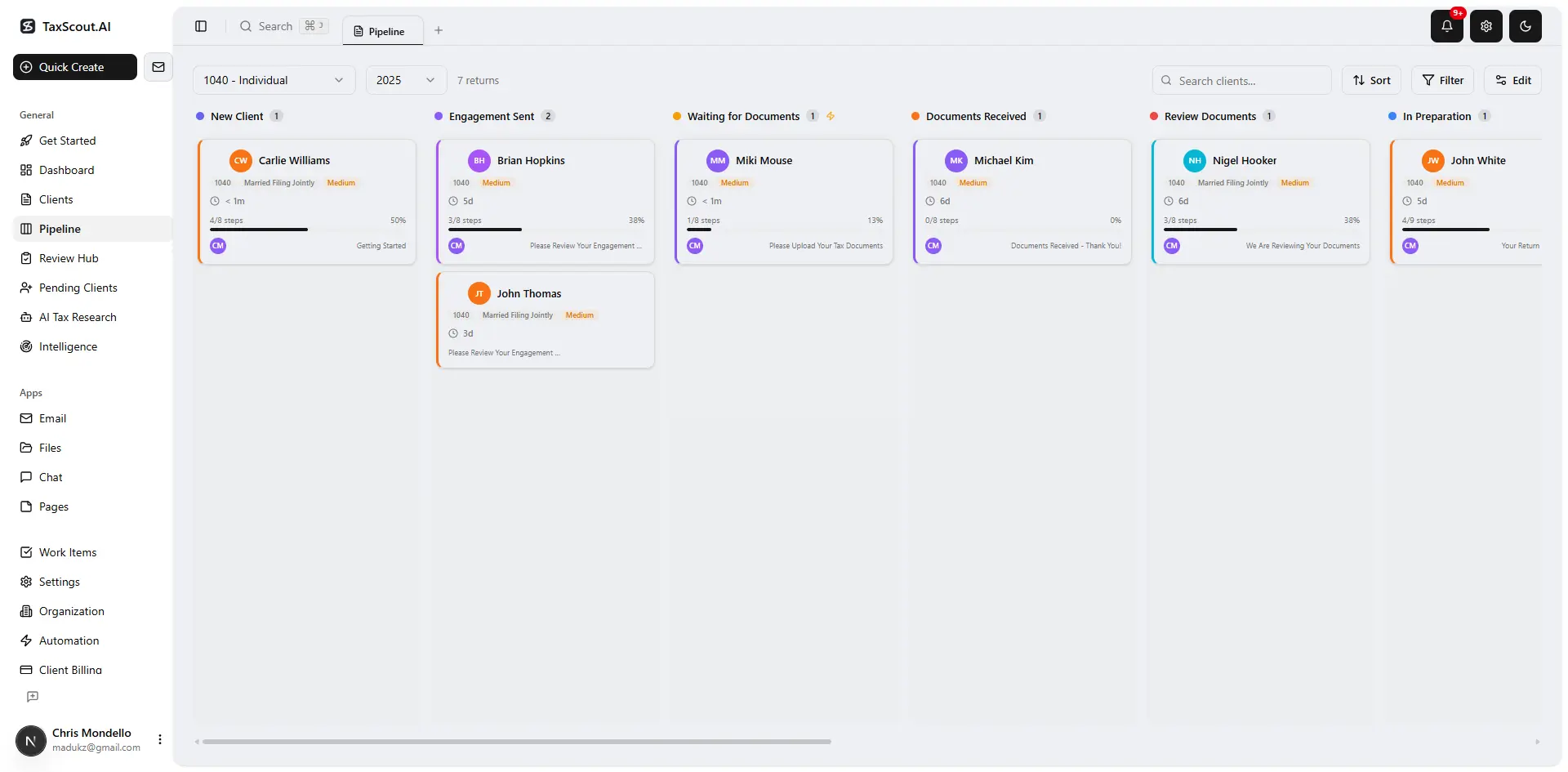
Track every return from intake to filed with drag-and-drop pipeline management
Ready to Automate Your Full Bookkeeping Workflow?
TaxScout gives your firm the complete receipt-to-reconciliation automation infrastructure — AI extraction, 5-layer validation, auto-advance pipeline, client portal delivery, e-signatures, and automated invoicing — for $199/mo flat, regardless of team size.
The firms building capacity in 2026 aren't hiring faster — they're automating deeper. Bookkeeping workflow automation isn't about replacing judgment; it's about eliminating the 80% of the workflow that doesn't require it. A static checklist in Canopy or a task template in Karbon documents that your team did the work. TaxScout's AI-native pipeline ensures most of the work happens automatically, and your team reviews only what requires a professional's eye.
That's the structural difference between workflow management and workflow automation — and it shows up directly in how many bookkeeping clients your firm can serve without adding staff. See TaxScout pricing for the full plan breakdown, or compare architectures directly at TaxScout vs Canopy.
Frequently Asked Questions
TaxScout's AI-native workflow eliminates manual intervention at each stage of the receipt-to-reconciliation pipeline. Instead of staff members working through static checklists, TaxScout automatically categorizes imported transactions, flags anomalies, matches receipts to line items, and queues only true exceptions for human review. The result is that routine bookkeeping tasks — which account for roughly 75% of traditional close time — are completed without staff touchpoints, compressing a 15–20 hour monthly engagement down to approximately 4 hours of focused exception handling and client communication.
Stay up to date
Get the latest tax tech insights delivered to your inbox.