Accounting Firm Rebranding: How to Pivot From Compliance to Advisory
Most CPA firms that attempt a compliance-to-advisory pivot underestimate how much work lives outside the service delivery model — the brand, the website, the pricing, and the client conversations. This 8-step accounting firm rebranding playbook covers every tactical layer competitors skip, from…
Accounting firm rebranding is rarely just a logo refresh. When a CPA firm decides to pivot from compliance-first tax preparation to a proactive advisory model, the brand is the last thing to change — but it signals everything. Clients who have paid you $800 for a 1040 for six years need a reason to believe you are now worth $6,000 annually in a retainer. Your website, your pricing page, your intake process, your email signature, and your Google Business Profile all need to tell the same story at once.
The problem is that most advice on this transition stops at the feel-good stage: "clarify your value proposition," "get internal buy-in," "train your team." That is necessary but insufficient. Firms that actually complete the pivot do something harder — they treat rebranding as a multi-layer operational project, not a marketing exercise. They update contracts, fire low-margin compliance-only clients, retool their tech stack, rewrite service descriptions, and brief every client personally before the new pricing goes live. Successful accounting firm rebranding requires going far beyond surface-level messaging changes to address the deeper operational and cultural shifts that make the advisory pivot stick.
This guide gives you an 8-step playbook for that full transition. Each step is actionable, sequenced in the order that minimizes client attrition, and grounded in the reality that technology choices — especially your practice management platform — either accelerate or undermine every other effort you make. For additional resources across the full spectrum of firm operations, browse our complete guide to accounting practice topics alongside this playbook. Whether you are just beginning to explore accounting firm rebranding or are already mid-transition, this playbook is designed to move you from intention to measurable execution.
Step 1: Audit Your Current Positioning Before Changing Anything
Before you redesign a single page or rewrite a single service description, you need an honest audit of where your firm stands today. Pull your last 12 months of revenue by service line. How much comes from compliance-only work — tax prep, bookkeeping, payroll? How much comes from advisory engagements — tax planning, entity structuring, retirement strategy, or CFO services? Most firms attempting this pivot discover that 80–90% of revenue is still compliance-anchored, which means the rebrand must be phased, not announced overnight. This diagnostic step is foundational to any accounting firm rebranding effort, because you cannot credibly position around advisory services if your revenue data tells a different story.
Audit your client list with the same rigor. Segment clients into three buckets: (1) advisory-ready clients who already ask forward-looking questions and have sufficient complexity to justify planning fees, (2) compliance clients with advisory potential who could be upgraded with a conversation, and (3) compliance-only clients who are transactional by nature and will likely churn when pricing changes. The Journal of Accountancy regularly publishes benchmarks on advisory revenue mix — typical advisory-first firms target advisory services at 40–60% of total revenue within 36 months of a pivot. For firms evaluating their accounting firm rebranding approach, this trade-off compounds over time.
Also audit your digital footprint. Search your firm name on Google. Read every review on your Google Business Profile. Look at how you are described in your own website meta descriptions, your LinkedIn summary, and any directory listings on AICPA referral directories or state CPA society sites. You will almost certainly find that your current digital presence screams "tax preparer" — and that is what needs to change systematically, not just cosmetically. Each of these factors directly shapes how accounting firm rebranding plays out in practice.
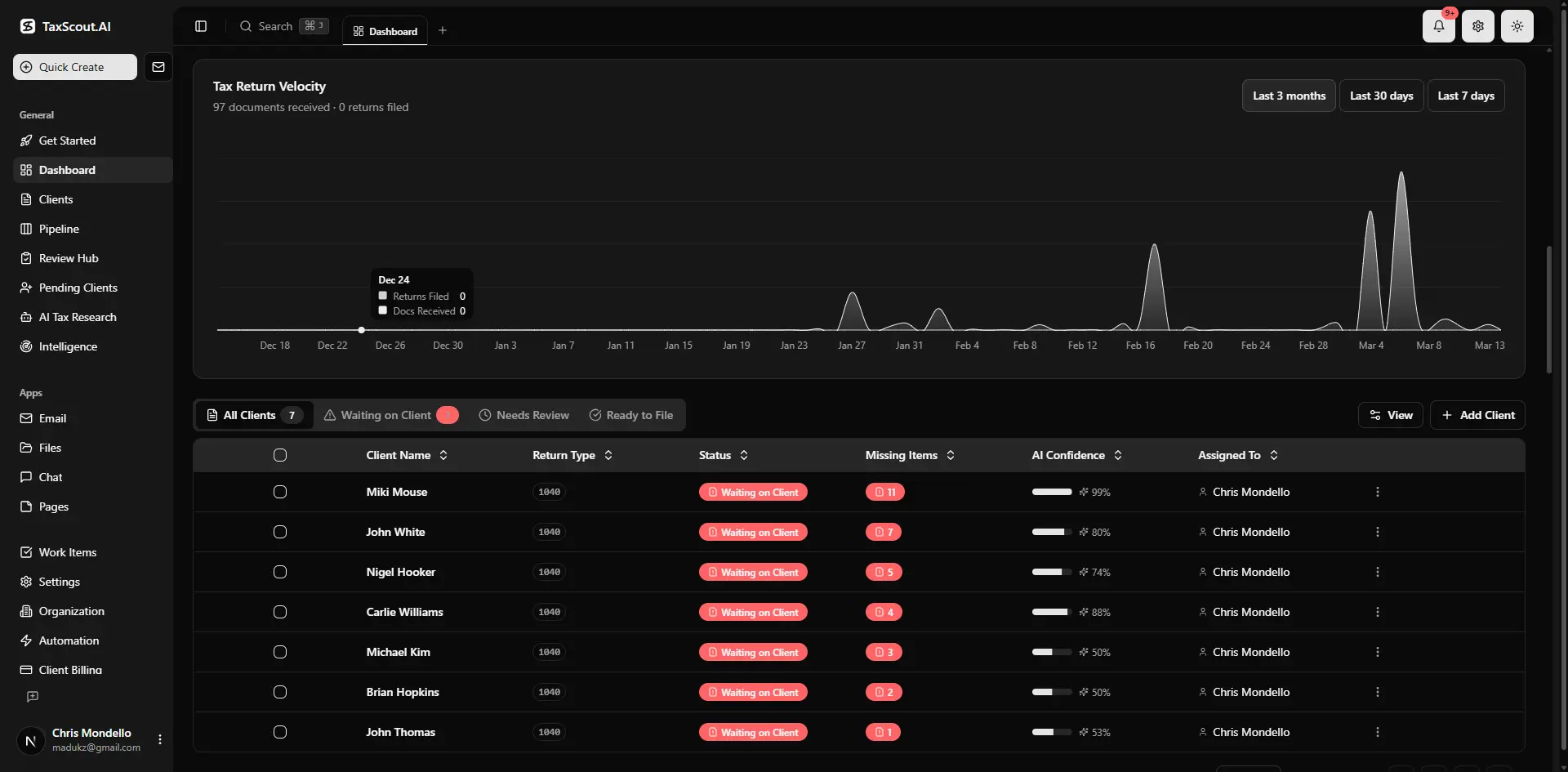
Real-time dashboard showing returns in progress, revenue, and upcoming deadlines
Step 2: Define Your Advisory Positioning and Service Tiers
Advisory positioning is not a tagline. It is a specific, defensible claim about who you serve, what outcomes you deliver, and what you charge. Vague language like "we go beyond tax prep" signals nothing to a prospective client scanning your homepage in eight seconds. Instead, commit to a niche or a client archetype — S-corporation owners in professional services, real estate investors with passive losses, or founders approaching a liquidity event, for example. Understanding accounting firm rebranding in this context is what separates firms that scale from those that stall.
Once you have a clear client archetype, build service tiers that map to outcomes, not hours. A value-based pricing model anchors fees to the financial impact of your advice — a proactive S-corp election that saves a client $14,000 in self-employment tax is worth far more than the hours required to analyze it. Structure three tiers: a foundational compliance tier (likely your current base), an advisory tier that includes quarterly planning calls and proactive tax strategy, and a premium CFO/controller tier for clients with complex entities or growth trajectories. This is precisely where a deliberate accounting firm rebranding strategy pays off — firms that define their tiers clearly before announcing changes retain significantly more clients through the transition.
Document your service descriptions in writing at this stage. Each tier should list specific deliverables, response time commitments, and what is explicitly excluded. This documentation becomes the backbone of your updated engagement letters and is essential before you brief a single client on the change. See also our post on client onboarding checklists for how these service definitions flow into the intake process. Accounting firm rebranding sits at the center of this decision — get it wrong and the rest unravels.
Tired of practice management software built for transaction-volume compliance work? When firms revisit their accounting firm rebranding priorities, the gaps usually surface here.
TaxScout is designed for advisory-first CPA firms — AI-native intake, client-context memory, and flat-rate pricing with no per-user fees.

Smart intake auto-fills from uploaded documents and prior-year data
Step 3: Reprice and Renegotiate With Legacy Clients
Repricing is the most uncomfortable step in any compliance-to-advisory CPA transition — and the one most firms delay until it derails the entire rebrand. The longer you wait, the more your new brand positioning is undercut by the revenue reality of deeply discounted legacy clients who expect 2018 fees indefinitely.
Start with your top 20% by revenue potential, not by current fees. Draft individualized letters or schedule 20-minute calls explaining that the firm is restructuring its service model around proactive advisory work and that your pricing is being adjusted to reflect that expanded scope. Be specific: tell clients exactly what they will receive under the new structure, what the new annual fee is, and when it takes effect. The IRS's own guidance on professional service valuations makes clear that service value should reflect outcomes, not input hours — a framing you can share with clients who push back. Many firms find that framing repricing as part of a broader accounting firm rebranding effort, rather than a standalone price increase, helps clients understand and accept the change.
Expect 10–20% of legacy compliance clients to leave. Plan for it. The clients who leave are almost always the ones who would never have engaged with advisory services anyway, and their departure improves your revenue-per-client metric, frees capacity for advisory work, and reinforces to your remaining clients that you are serious about the new model. Use invoicing tools with Stripe Connect to set up new retainer billing structures before any client calls happen — stumbling on payment logistics mid-conversation undermines the professional impression you are trying to create.
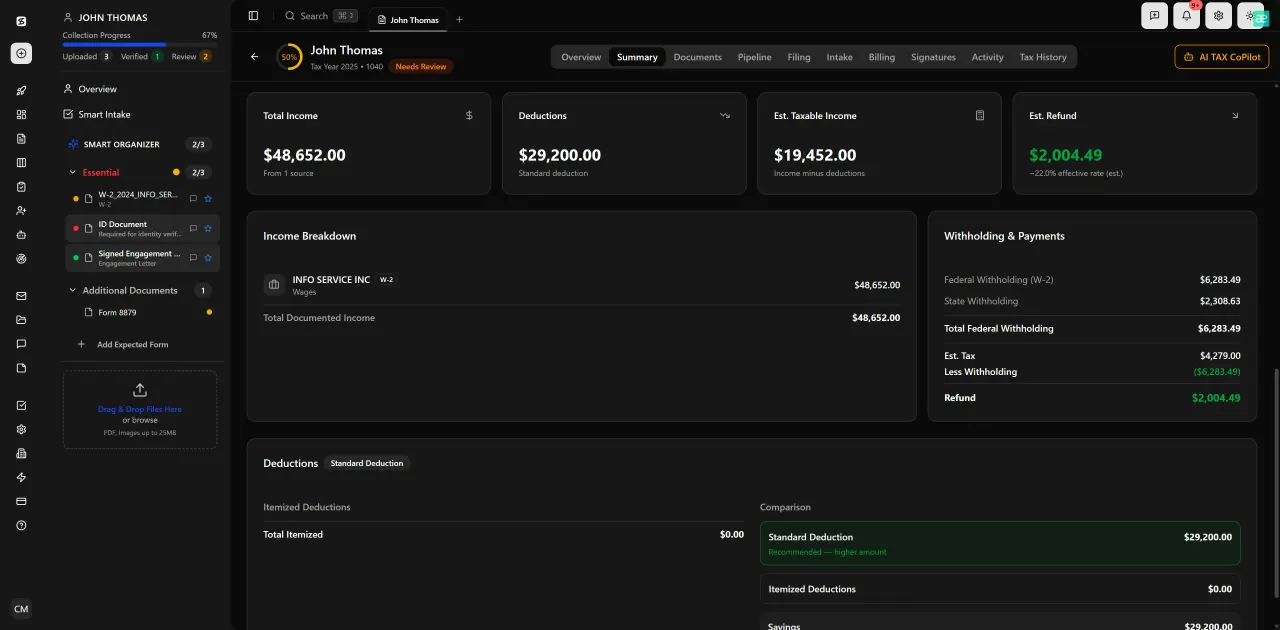
Review with AI assist — 9 agents answer questions with full client context
Step 4: Update Your Tech Stack for Advisory Delivery
The technology a firm uses signals its operational DNA. A firm running on a fragmented stack of spreadsheets, generic project management tools, and manual PDF workflows is structurally a compliance shop — regardless of what the homepage says. Advisory firms need platforms that make proactive client service operationally feasible at scale. Accounting firm rebranding stalls when the technology infrastructure still reflects the old compliance-first model, so this step is as much about internal credibility as it is about client-facing systems.
The compliance-to-advisory pivot typically requires three technology changes: first, a client communication layer that supports ongoing dialogue rather than annual document drops — a branded client portal with asynchronous messaging and document exchange replaces the seasonal email scramble; second, an AI research layer that lets staff answer complex planning questions in minutes rather than hours — AI research agents that search IRS, Treasury, Cornell Law, and SSA in real time reduce the cost of delivering sophisticated advice; third, a pipeline management layer that tracks advisory engagements through multiple stages rather than just tax return status.
TaxScout combines all three on a single platform with no per-user pricing. A 10-person firm pays $149/month total — versus approximately $500/month for TaxDome or $660/month for Canopy at comparable seat counts. See our full pricing comparison for a breakdown by firm size. For firms currently using Drake, CCH Axcess, UltraTax CS, Lacerte, or ProConnect, TaxScout works alongside your existing tax software rather than replacing it — a critical point when you are managing a transition that already has significant internal change fatigue.
Platform cost for a 10-person advisory CPA firm (verified March 2026)
| Platform | Monthly Cost (10 users) | AI Extraction | AI Research Agents | Per-User Fees |
|---|---|---|---|---|
| TaxScout Prep Pro | $149/mo total | Yes — 180+ form types | Yes — 9 specialized agents | No — flat rate |
| TaxDome | ~$500/mo | No | No | Yes — ~$100/user |
| Canopy | ~$660/mo | No | No | Yes — ~$45/user + modules |
| Karbon | ~$590/mo | No | No | Yes — ~$59/user |

Your clients see your brand — OTP login, document upload, and real-time status
Step 5: Rewrite Your Website, Metadata, and Google Business Profile
Your website is the most visible artifact of your old positioning. Most compliance-era CPA sites lead with "tax preparation," "bookkeeping," and "IRS representation" in H1 headings and meta descriptions. An advisory-first firm leads with client outcomes — "reduce what you owe this year and next," "plan the exit before it happens," or "CFO-level strategy without the full-time hire." Accounting firm rebranding becomes concrete the moment a prospective client lands on your updated homepage and immediately understands the planning-oriented value you deliver.
Rewrite your homepage H1 and meta description first. Then rewrite each service page to describe outcomes before listing deliverables. Update your title tags — these are what appear in Google search results and shape the first impression of searchers who have never heard of your firm. According to IRS Publication 1345 guidance on digital practitioner presence, practitioners are also responsible for ensuring their digital representations accurately describe their scope of services — a compliance angle that reinforces why accuracy in your updated descriptions matters.
Your Google Business Profile (GBP) deserves a dedicated pass. Update your primary business category from "Tax Preparation Service" or "Accountant" to "Financial Consultant" or "Business Management Consultant" if your advisory services genuinely extend to those areas. Rewrite your business description using advisory language. Upload new photos showing advisory conversations, not just branded tax documents. Solicit updated reviews from advisory clients specifically — reviews that mention planning, strategy, and proactive advice reinforce the new positioning to every searcher reading your profile.
Finally, audit any directory listings — state CPA society directories, local chamber profiles, Google Maps, Yelp. These often contain stale descriptions that contradict your new positioning and can suppress the credibility you are building elsewhere. Also consider refreshing your CPA landing page if you use TaxScout's built-in lead generation pages — they pull from your platform profile and should reflect the advisory framing.

Click any extracted field to see its source highlighted on the original PDF
Step 6: Create Client Communication Scripts for the Rebrand Announcement
One of the most consistent gaps in compliance-to-advisory transition advice is the absence of actual client communication scripts. "Have a conversation" is not a plan. Clients who have worked with you for years will have questions, objections, and anxiety — and your ability to handle those interactions consistently across your team determines how much revenue survives the transition.
Draft three communication templates: a proactive announcement email for advisory-ready clients, a repricing conversation framework for compliance clients being upgraded, and a graceful offboarding script for clients who are not a fit for the new model. The announcement email should lead with what the client gains — not what has changed internally. Something like: "Over the next 90 days, we are restructuring our services so that every client relationship includes proactive tax planning year-round, not just at filing time. Here is what that means for your engagement..." followed by specifics on new deliverables, new fees, and the transition timeline. Framing the announcement around accounting firm rebranding — rather than simply a price change — helps clients understand they are being offered a fundamentally different and more valuable relationship.
For the repricing conversation, train every team member on two objection responses: (1) "I only need my taxes done" — respond by quantifying one specific planning opportunity you have already identified for that client, making the abstract value concrete; (2) "I can find cheaper" — respond by acknowledging the price point and confirming the new scope genuinely is different, not just repackaged. For seamless document exchange during this transition period, a client portal your clients will actually use eliminates friction that can cause second thoughts.
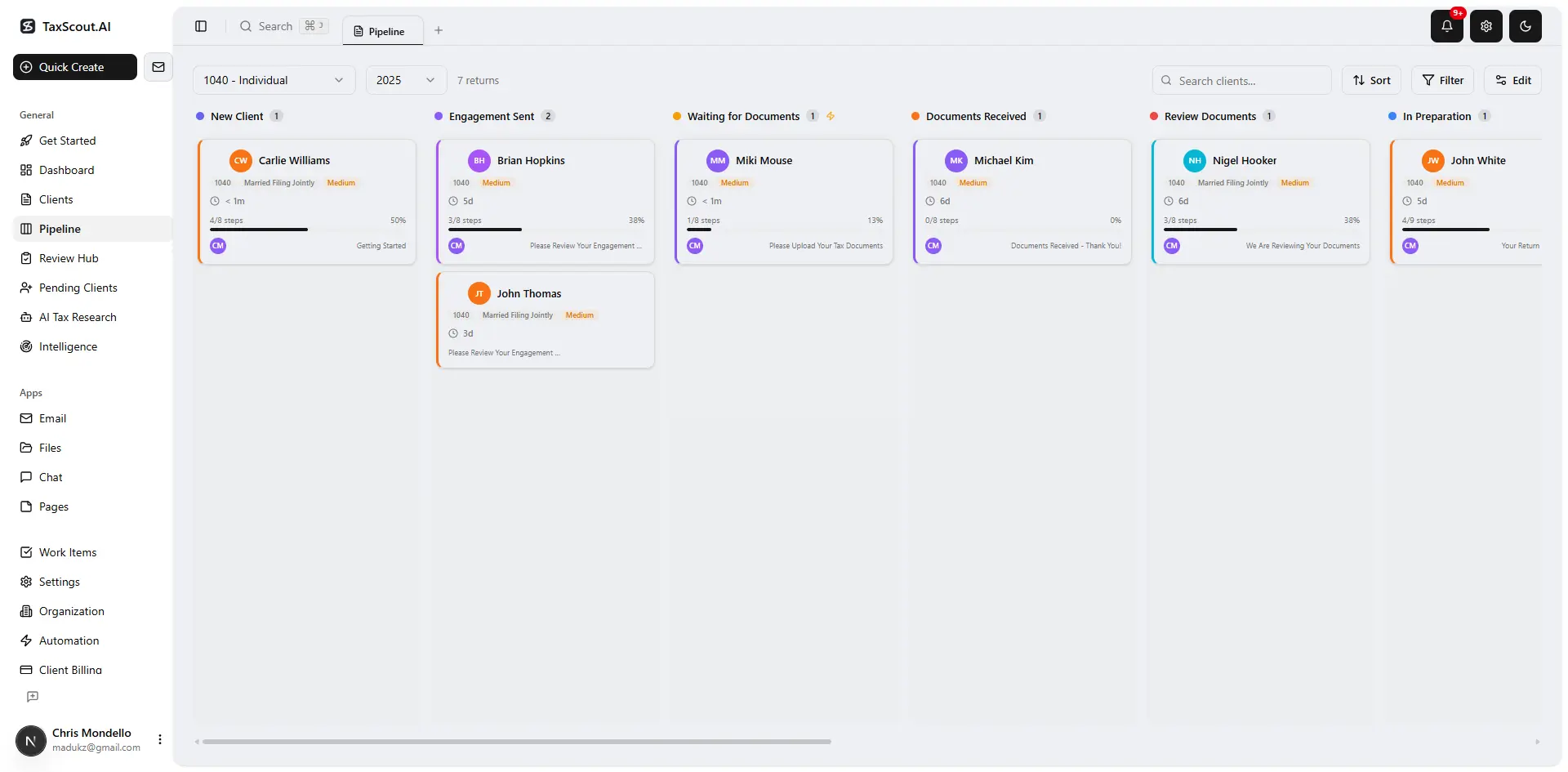
Track every return from intake to filed with drag-and-drop pipeline management
Step 7: Retrain Your Team on Advisory Service Delivery
Internal buy-in is frequently cited as a prerequisite for an advisory pivot — but what firms actually need is internal capability, which is different. A staff accountant who is excellent at return preparation has not necessarily been trained to run a tax planning meeting, frame a projection with multiple scenarios, or document a recommendation memo that justifies a fee of $3,000. Those are learnable skills, but they require deliberate investment. Accounting firm rebranding only holds up externally when the team behind it can consistently deliver on the advisory promise in every client interaction.
Build a simple training curriculum around three competencies: discovery conversations (how to ask questions that surface planning opportunities), tax strategy fundamentals (entity structure, timing, retirement vehicles, real estate strategies — the IRS Small Business and Self-Employed Tax Center is a free starting resource), and documentation standards (what an advisory deliverable looks like compared to a tax return). Pair training with technology — staff who use AI research agents confidently can answer a novel planning question in a client meeting rather than deferring it to a callback, which materially changes the client experience.
Set KPIs for the transition. Track advisory revenue as a percentage of total revenue monthly. Track client upgrade conversion rate — what share of compliance clients accepted the new advisory tier. Track advisory hours per client and compare to compliance hours per client to quantify the margin improvement. Our post on accounting firm KPI dashboards walks through the full metrics framework in detail.

Every client gets organized documents, status tracking, and a complete history
Step 8: Build an Advisory-First Content and Referral Engine
The final step in an accounting firm rebrand is ensuring your inbound pipeline reflects the new positioning. Compliance-era firms get referrals from peers and existing clients for compliance work. Advisory-first firms need referral sources who understand the planning value they deliver — estate attorneys, financial advisors, business brokers, and commercial lenders are ideal partners because their clients have exactly the complexity that justifies advisory fees.
Build a content strategy around the planning questions your ideal advisory clients actually have. A quarterly article answering questions like "how should an S-corp owner time a distribution to minimize self-employment tax" or "what entity structure works best before a Series A" signals expertise to exactly the right audience in organic search. Treasury.gov's tax policy resources and Cornell Law's tax code annotations give you authoritative primary sources to cite, which improves both credibility and search ranking. Explore the referral program features in TaxScout to formalize attorney and advisor referral tracking.
Finally, tie your client portal experience to the advisory brand. A branded client portal with your new firm name, logo, and advisory-oriented intake questions creates the first impression that advisory clients receive before they ever speak with a staff member. Smart intake — pre-filled from prior-year data and AI gap analysis — reduces friction while simultaneously demonstrating that your firm is operating at a different level than the generic tax preparer they left. Compare this approach to what you get from legacy platforms in our TaxDome alternative comparison.
Ready to build the platform infrastructure your advisory-first firm actually needs?
TaxScout gives CPA firms AI extraction, advisory-grade research agents, a branded client portal, and flat-rate pricing — all in one platform built for the compliance-to-advisory pivot.
Frequently Asked Questions
Most firms complete the full transition in 18–36 months. The first 90 days focus on positioning, repricing, and tech stack changes. Client migration to advisory tiers typically takes 6–12 months, and building an inbound pipeline that reflects the new positioning takes another 12–18 months of consistent content and referral development.
Keep reading
Business Valuation for CPAs: How to Price a Client Company Without Hiring an Appraiser
Sep 18, 2026 · 1 min read
Equity Partner Compensation: How CPA Firms Structure Pay for Owners
Sep 18, 2026 · 1 min read
Accountant Shortage Solutions: How CPA Firms Survive the Talent Crisis Without Overpaying
Sep 18, 2026 · 1 min read
Stay up to date
Get the latest tax tech insights delivered to your inbox.