1099 Preparation Checklist for CPA and EA Firms
Most 1099 preparation checklists are written for business owners. This one is built for the firm managing 1099 season across dozens of clients — covering W-9 collection workflows, IRS penalty exposure per filing, and when to refer overflow volume to other preparers.
Every January, CPA and EA firms face the same collision: clients who ignored vendor data requests all year, W-9s that were never collected, and a hard IRS deadline that cannot be extended the way a 1040 can. A solid 1099 preparation checklist is not just a task list — it is an operational system that determines whether your firm controls January or gets controlled by it.
The compliance burden is real and growing. According to IRS Third Party Information Reporting statistics, 1099-NEC filings have risen sharply since the form was reintroduced in 2020, reflecting the expansion of gig and contractor payments across the small business economy. Each filing represents a data collection task, a verification step, a transmission record, and a penalty exposure point — multiplied across every client in your book. Having a structured 1099 preparation checklist is no longer optional for firms managing clients with significant contractor workforces.
This guide is built for the firm owner, not the solo filer. It covers the operational layer that generic checklists skip: how to build a repeatable W-9 collection workflow before year-end, how to manage clients who miss your data deadlines, what per-filing penalty exposure actually looks like, and how to decide when to handle 1099 preparation in-house versus refer it to another preparer. For additional context on running a tax season at scale, see our accounting busy season guide. A well-designed 1099 preparation checklist addresses each of these operational gaps in a way that generic year-end resources simply do not.
1099 Basics: Who Files, What Forms, and When
Before building a workflow, every member of your team needs a shared understanding of which forms apply to which payment types. The core information returns your clients are likely to issue include: 1099-NEC for nonemployee compensation of $600 or more paid to individuals and unincorporated entities; 1099-MISC for rent, royalties, attorney payments, and other miscellaneous income; 1099-INT and 1099-DIV for interest and dividends; and 1099-K for payment card and third-party network transactions. The IRS General Instructions for Certain Information Returns is the definitive source for form-by-form thresholds and exceptions. Your 1099 preparation checklist should map each form type to the specific payment categories your clients commonly use, so no filing obligation slips through during review.
The 1099-NEC deadline is January 31 for both recipient copies and IRS e-filing — there is no February 28 paper-filing extension for NEC. The 1099-MISC recipient copy deadline is also January 31 for payments in Box 8 or Box 10; all other MISC boxes give you until February 15 for recipients and February 28 (paper) or March 31 (e-file) for IRS copies. Firms filing 10 or more information returns of any type in a calendar year are required to e-file under the lower threshold introduced by the Taxpayer First Act regulations. For firms evaluating their 1099 preparation checklist approach, this trade-off compounds over time.
One frequently overlooked rule: payments to corporations are generally exempt from 1099-NEC reporting, but attorney fees paid to law firms — including professional corporations — are not exempt. Medical and healthcare payments to corporations are also not exempt. Train your staff to flag these categories during the vendor review phase, not during the final reconciliation the week of the deadline. Each of these factors directly shapes how a 1099 preparation checklist plays out in practice across your client base.
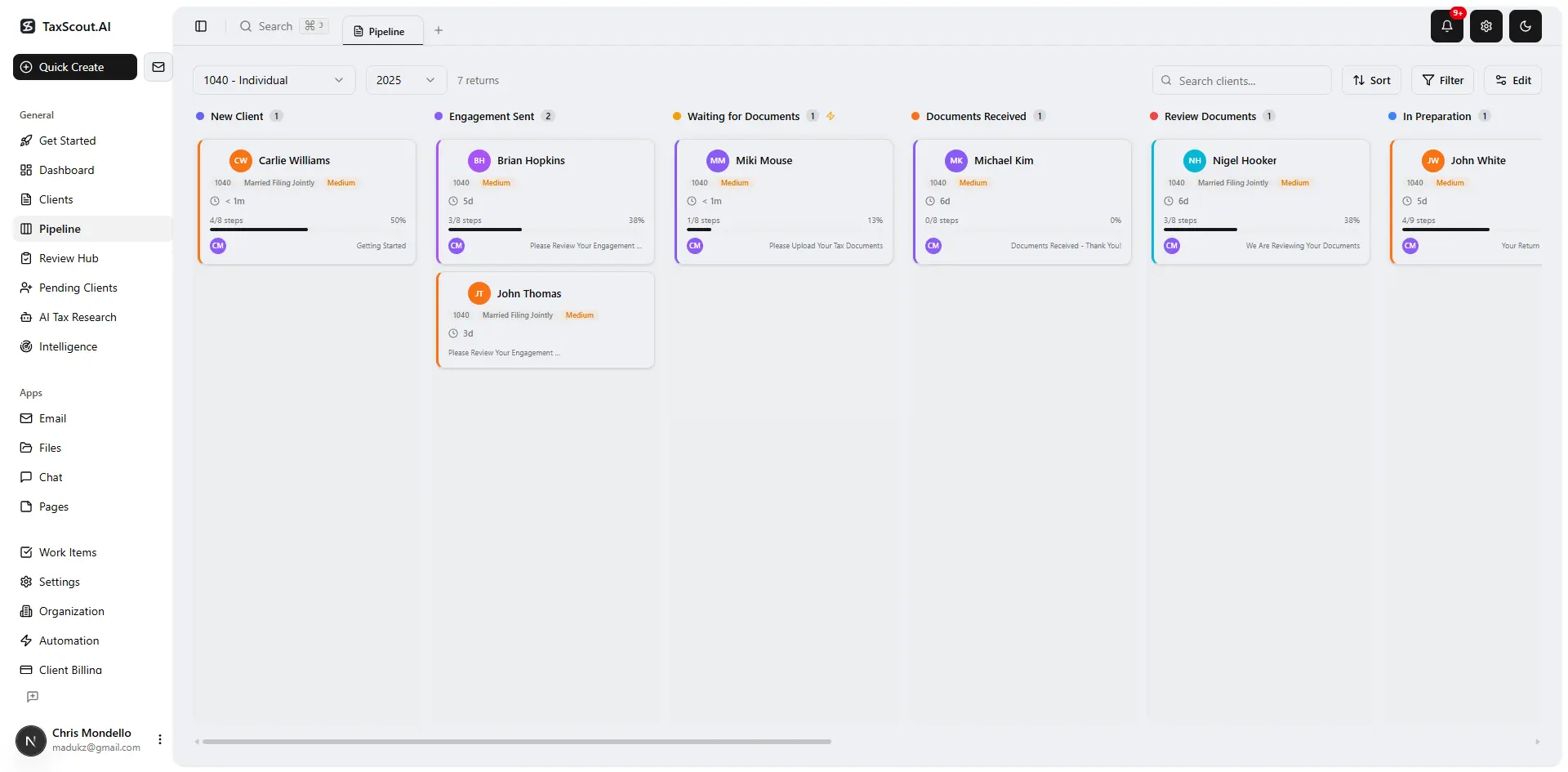
Track every return from intake to filed with drag-and-drop pipeline management
Building a Repeatable W-9 Collection Workflow Before Year-End
The single most common cause of a rushed January is a W-9 collection process that never started until December. A repeatable W-9 collection workflow — part of any serious 1099 vendor verification checklist — treats vendor onboarding as a continuous process, not a year-end scramble. Firms that build their 1099 preparation checklist around this principle early in the year consistently outperform those that treat W-9 collection as an afterthought.
Start by embedding W-9 collection into your client's accounts payable onboarding. Every new vendor relationship should trigger a W-9 request before the first payment is issued — not after. For existing clients, run a vendor audit in October: pull the vendor list from their accounting software, flag every payee that lacks a completed W-9, and generate a request list. Send that list to the client with a firm deadline of November 30, giving you six weeks of buffer before the January 31 filing date. This is precisely where a deliberate 1099 preparation checklist strategy pays off.
For the actual collection mechanics, standardize the W-9 format your clients use and confirm that the name and EIN on the W-9 match what appears in the vendor's accounting record. Name/EIN mismatches are one of the leading causes of IRS CP2100 notices, which trigger backup withholding obligations at 24%. If a vendor refuses to provide a W-9, document the refusal and notify the client that backup withholding applies immediately — the obligation does not wait for a 1099 to be filed. Your 1099 preparation checklist should include a documented backup withholding protocol so this scenario never catches your team off guard.
Use your firm's pipeline management tools to track W-9 status per client. A simple stage — Vendor List Requested / W-9s Outstanding / W-9s Complete — gives your team a live view of which clients are on track and which need escalation before the holiday period compresses your working calendar. When firms revisit their 1099 preparation checklist priorities, the gaps usually surface here.
Tired of rebuilding your 1099 workflow from scratch every January?
TaxScout gives your firm a 12-stage pipeline, branded client portal, and AI-assisted document intake — so W-9 collection and 1099 prep run on a system, not on memory.
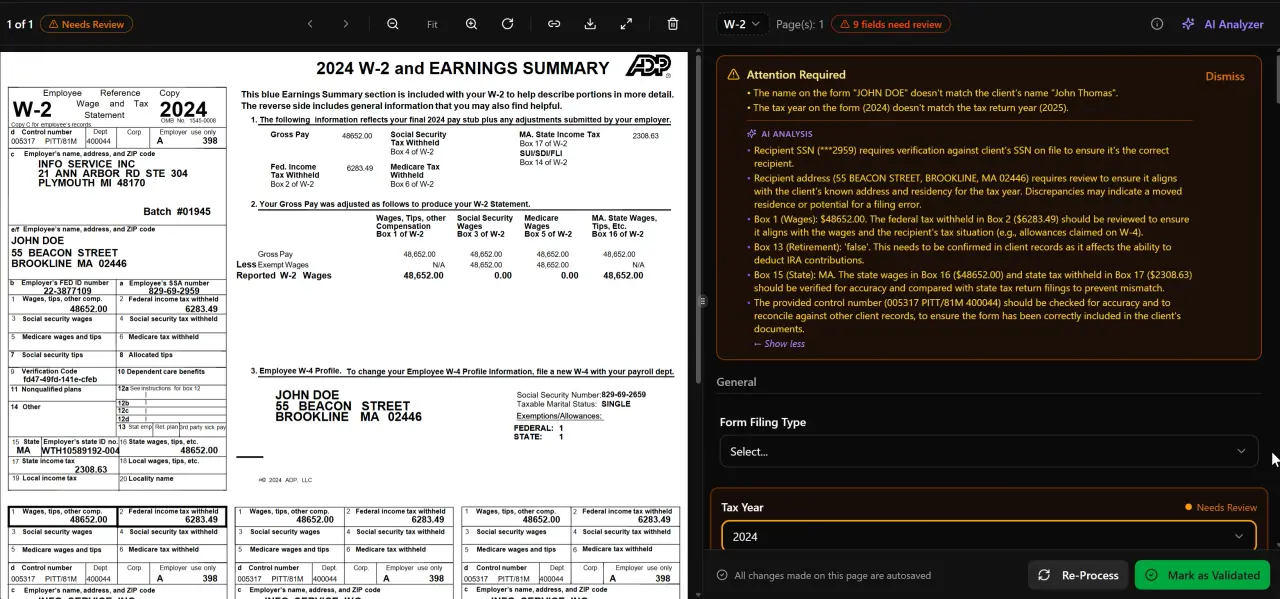
AI classifies, extracts, and validates every document automatically

Click any extracted field to see its source highlighted on the original PDF
1099 Preparation Checklist: Step-by-Step for CPA Firms
The following checklist is organized by phase. Each phase has a natural owner — either the client, the firm's staff, or the reviewing CPA/EA — and a recommended completion window relative to the January 31 deadline.
Phase 1: October — Vendor Data Audit
Pull the full vendor list from the client's accounting system. Flag every vendor paid $600 or more during the year (year-to-date, not just closed months). Cross-reference against your W-9 file. Identify gaps: missing W-9s, W-9s older than three years for high-turnover vendors, name/EIN inconsistencies, and payments to entities that may qualify for the corporate exemption. Send the gap report to the client with a written request for missing W-9s and a November 30 response deadline. A thorough 1099 preparation checklist at this stage prevents the most common errors from compounding later in the cycle.
Phase 2: November — W-9 Chase and Backup Withholding Review
Follow up on outstanding W-9 requests at the two-week and four-week marks after your October send. For vendors still unresponsive by November 30, advise the client on backup withholding obligations and document that advice in writing. Review the client's payment records for any cash or check payments outside the accounting system that might represent unreported contractor payments — this is especially common in construction, landscaping, and restaurant clients.
Phase 3: December — Transaction Data Reconciliation
Reconcile total payments per vendor against the client's general ledger. Confirm that account coding is correct — payments miscoded to supplies rather than contract labor are a frequent source of underreporting. Identify any year-end bonuses, final payments, or accruals that need to be settled before December 31. Confirm state 1099 filing requirements: several states, including California, have their own 1099 filing obligations that run parallel to the federal requirement.
Phase 4: January 1–15 — Draft Preparation and Client Review
Generate draft 1099s from reconciled data. Use the split-screen review capability in TaxScout's document viewer to verify that the payee name, TIN, and payment amount on each draft match the source W-9 and payment records. Send drafts to the client for approval before filing — build a 72-hour review window into your engagement letter so this does not compress against the deadline. Document client approval in writing.
Phase 5: January 15–28 — E-File and Recipient Distribution
E-file the information returns through the IRS IRIS system or an approved transmitter. Distribute recipient copies by January 31 — email distribution via your client portal or the firm's document delivery system satisfies the requirement if recipients have consented in writing. Retain a copy of each filed return and the transmitter confirmation for a minimum of four years per IRS record retention guidance. File any required state information returns on the state-specific schedule.
Phase 6: Post-Filing — Corrections and CP2100 Response Protocol
Build a corrections protocol into your engagement now. If a client discovers a payment was omitted or a TIN was wrong after filing, a corrected 1099 must be filed as soon as possible — the penalty clock on a corrected return is more favorable if the correction is filed within 30 days. When IRS CP2100 or CP2100A notices arrive (typically in fall), have a documented response process: verify the name/TIN combination, solicit an updated W-9 if the mismatch is a vendor issue, and document the resolution. See other guide resources for additional checklists covering related compliance workflows.
IRS Penalty Exposure Per Filing: What the Numbers Actually Mean
Most penalty discussions quote aggregate numbers that obscure the real risk. Here is what the IRS penalty structure under IRC §6721 and §6722 looks like per return, based on the timing of the failure.
For failures to file a correct information return: $60 per return if corrected within 30 days of the January 31 deadline; $130 per return if corrected between 31 days and August 1; $330 per return if not corrected by August 1 or intentionally disregarded. For failures to furnish correct payee statements (§6722), the same tier structure applies — meaning a single unfiled, undelivered 1099-NEC can generate up to $660 in combined penalties ($330 IRS side + $330 payee side) if left uncorrected.
Annual caps apply, but they are sized for large-volume filers: $3,532,500 for the highest tier (2024 inflation-adjusted figures; confirm current amounts at IRS.gov). For a firm whose client files 50 1099s and misses the deadline entirely, the exposure without the small-business cap exception is $16,500 on the filing side alone. Clients that qualify as small businesses (average annual gross receipts of $5 million or less for the three prior years) have a lower annual cap, but the per-return amounts are identical.
The takeaway for your engagement letter: price 1099 work to include the time cost of a corrections cycle, and make explicit in the engagement that the firm's responsibility ends at filing based on data provided by the client. Use your firm's e-signature workflow to get that scope definition signed before the engagement begins — not after a CP2100 arrives.
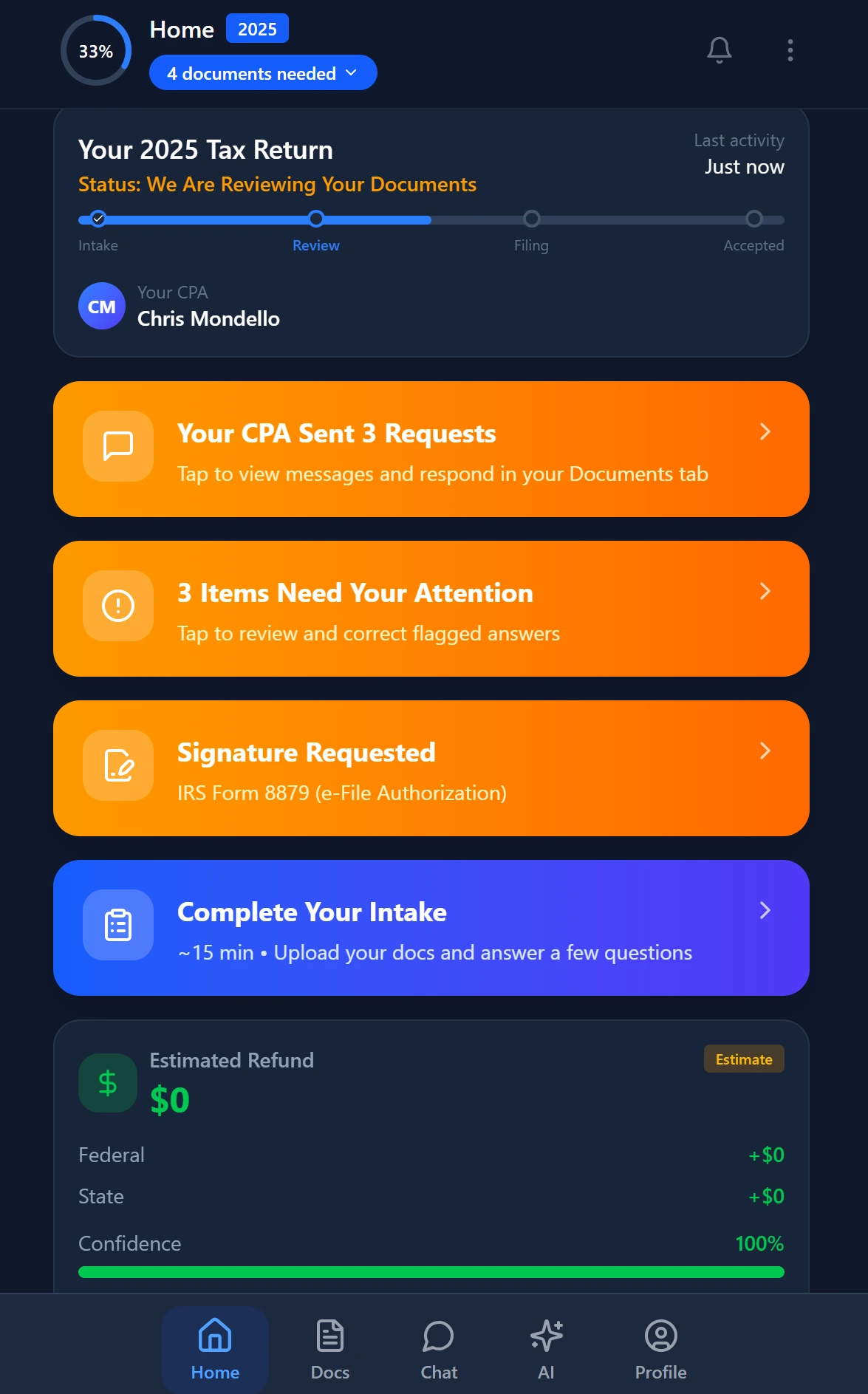
Smart intake auto-fills from uploaded documents and prior-year data
Handling Clients Who Miss Your Data Deadlines
Despite the best W-9 collection workflow, some clients will not deliver complete vendor data until the third week of January. Having a written escalation protocol — documented in the engagement letter and enforced consistently — is what separates firms that control their calendar from those that absorb every client's disorganization. Revisiting your 1099 preparation checklist to include a formal late-data policy is one of the highest-leverage improvements a firm can make heading into January.
Tier your response by days remaining to the deadline. If a client misses your November 30 W-9 deadline, send a formal written notice via your communication hub explaining the penalty exposure and asking for a revised delivery date. If the client misses a January 15 final-data deadline, send a written notice that (a) you will file on the data you have, (b) any incomplete filings may require corrections at additional cost, and (c) the client accepts responsibility for penalties arising from data provided after your cutoff date.
Build a late-data fee into your engagement letter. A flat fee of $50–$150 per 1099 for data received after January 15 is a reasonable proxy for the additional coordination and rush-filing cost. Some firms implement a tiered rush fee schedule: data received January 16–20 at one rate, January 21–28 at a higher rate, and data received after January 28 referred to the client for self-filing or handled only on a best-efforts basis.
For clients who are chronically late with vendor data, consider whether the relationship is priced correctly. The accounting project management guide covers capacity planning frameworks that apply equally well to 1099 season as to tax return season.

Your clients see your brand — OTP login, document upload, and real-time status
1099 Due Diligence: Common Mistakes and How to Prevent Them
The most frequent errors in 1099 preparation fall into three categories: classification errors, TIN errors, and threshold errors. Classification errors occur when a payment type is reported on the wrong form — for example, attorney fees reported on 1099-MISC Box 7 instead of 1099-NEC, or royalties reported as nonemployee compensation. TIN errors occur when the name and EIN on the 1099 do not match IRS records, usually because the W-9 was collected carelessly or the vendor used a DBA name instead of their legal name. Threshold errors occur when a firm applies the $600 threshold without accounting for cumulative payments across multiple payment methods or multiple fiscal years. Each of these error categories is preventable when your 1099 preparation checklist includes an explicit review step for each one.
One error category that generic checklists miss is the foreign payee issue. Payments to foreign individuals and entities are generally exempt from 1099 reporting but may require a Form 1042-S instead. If your client pays any non-US person or entity for services, confirm the correct form before January 31 — the 1042-S deadline is March 15, but the classification decision needs to happen in January.
Use a 1099 due diligence review layer: after drafts are generated and before the client review send, have a second staff member or the reviewing CPA verify (a) each payee's TIN format is correct (9 digits, no dashes in the submission file), (b) box amounts sum correctly to the GL total for each vendor, and (c) no payee appears on both a W-2 and a 1099-NEC for the same tax year — a combination that signals a worker misclassification risk. The IRS SS-8 process is a costly outcome to explain to a client after the fact.
1099 Preparation Workflow: In-House vs. Referral Decision Framework
| Factor | Handle In-House | Consider Referring Out |
|---|---|---|
| Client 1099 count | 1–50 returns across all 1099 clients | 50+ returns or 10+ clients with complex vendor lists |
| Staff capacity in January | Dedicated staff available pre-January 25 | Staff already at capacity on W-2 and extension filings |
| Minimum fee threshold | Client fee covers at least $300 for 1099 work | Fee is under $200 and data is consistently late |
| Corrections history | Client has clean W-9 files and no prior CP2100s | Recurring TIN mismatches and prior-year corrections |
| State filing complexity | Single-state client with no 1099-K volume | Multi-state obligations or high 1099-K transaction volume |
| Client relationship value | Strategic client where 1099 is bundled with broader engagement | One-off or low-margin client with no upsell potential |
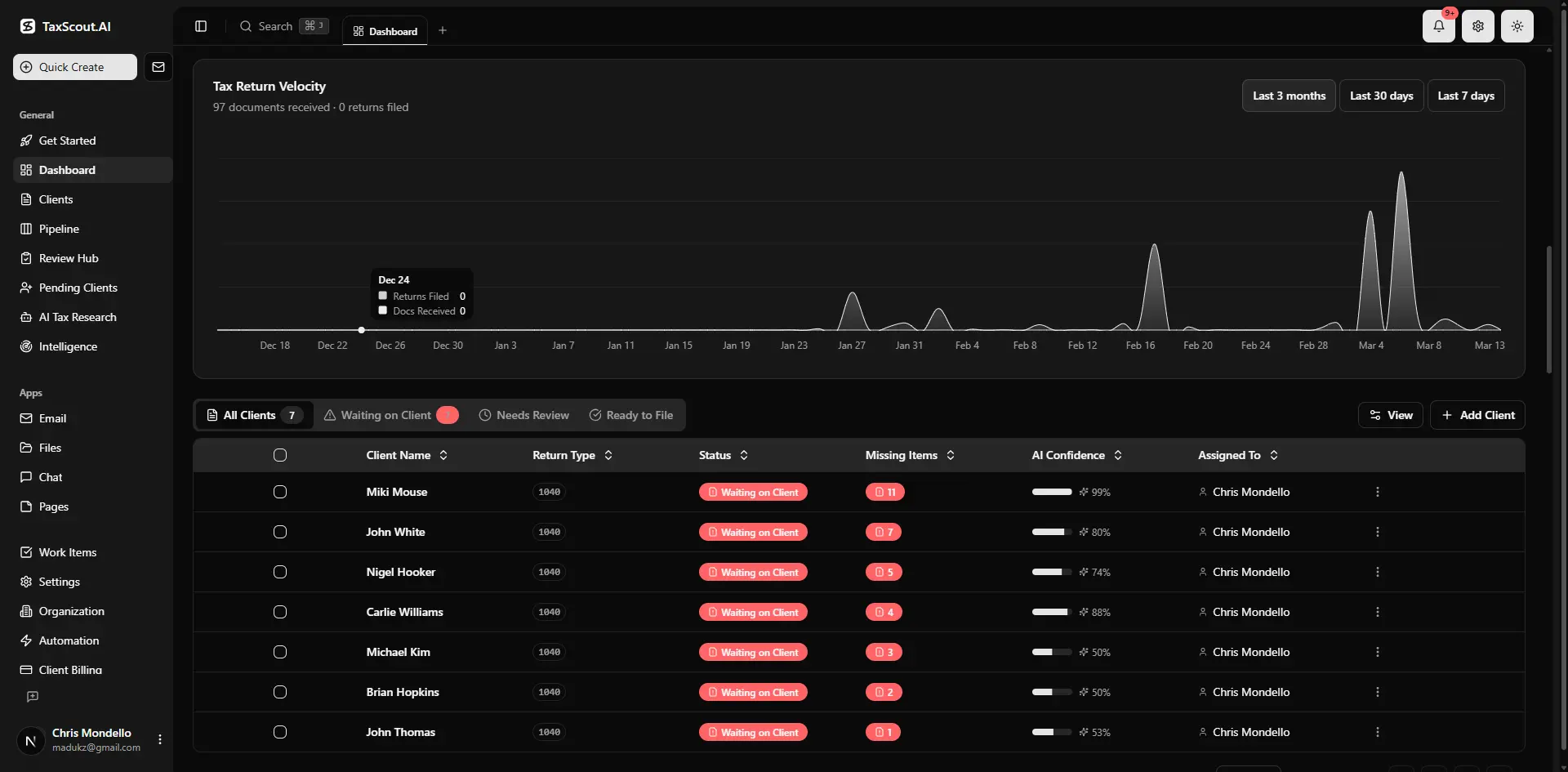
Real-time dashboard showing returns in progress, revenue, and upcoming deadlines
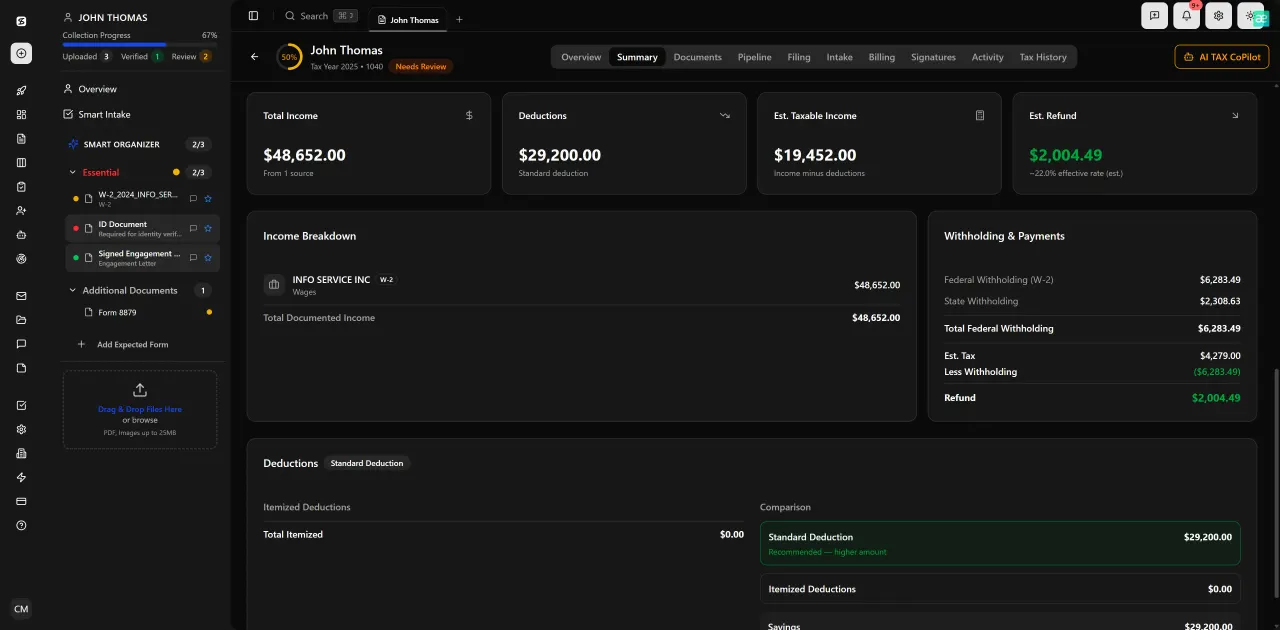
Review with AI assist — AI agents answer questions with full client context
When to Refer Overflow 1099 Volume to Another Preparer
Not every 1099 engagement belongs in your firm. The decision to refer is not a failure — it is a capacity management choice that protects your team's ability to serve higher-value clients during the most compressed period of the year.
The referral decision hinges on three variables: staff capacity in January, minimum fee thresholds, and the client relationship value beyond the 1099 work. If a client's 1099 preparation fee does not cover your loaded cost of delivery — including the time cost of chasing W-9s, reconciling the GL, and handling corrections — the engagement is a margin drain during your highest-demand period. Apply the framework in the table above to each client in your 1099 book before October, and use your 1099 preparation checklist to flag which engagements are candidates for referral before January arrives.
When you do refer, use a directory to identify credentialed preparers who can absorb the volume. The TaxScout preparer directory lists 69,085 US tax preparers matched against the IRS federal preparer directory, including 32,237 CPAs and 11,111 enrolled agents. That depth means you can identify credentialed referral partners in your state or metro area who have capacity for 1099-only engagements — protecting the client relationship without compromising your own throughput. TaxScout's referral program is designed specifically for this workflow.
For firms that want to grow their 1099 practice rather than refer it out, the capacity equation changes: investing in AI document extraction and automated intake can compress the per-client preparation time enough to make 50 or 100 additional 1099 clients viable without adding headcount. See the accounting automation guide for a framework on where automation delivers the highest return in a tax practice.
Ready to run 1099 season on a system instead of a spreadsheet?
TaxScout's pipeline management, branded client portal, and AI intake engine give your firm the infrastructure to handle 1099 season at scale — with flat pricing and no per-user fees.
Frequently Asked Questions
The 1099-NEC deadline is January 31 for both recipient copies and IRS e-filing — there is no extension for paper filing. Firms filing 10 or more information returns of any type are required to e-file under IRS regulations. Missing this deadline triggers penalties starting at $60 per return for corrections within 30 days, rising to $330 per return for failures not corrected by August 1.
Stay up to date
Get the latest tax tech insights delivered to your inbox.