Black Ore Alternatives for CPA Firms: An Honest Comparison
Black Ore has built a following among data-driven CPA firms, but it isn't the right fit for every practice. This guide compares Black Ore against the most credible alternatives on pricing model, AI depth, review workflow, client portal, and migration effort — so you can make a decision based on…
If you've been searching for black ore alternatives, you're likely at a decision point: the platform you're using — or evaluating — doesn't quite match your firm's size, budget, or workflow expectations, and you want to know what else is out there before committing to a contract. That's a reasonable place to be.
Black Ore positions itself as an AI-powered tax intelligence platform, with a focus on research automation and return review for large or sophisticated practices. It has genuine strengths in that lane. But firms that need a full practice management layer — client portal, intake, pipeline, e-signatures, invoicing, and AI document extraction — often find themselves stitching together additional tools to cover the gaps. Understanding where it falls short is exactly why so many firms are actively researching black ore alternatives before committing to a platform.
This comparison covers the most credible options a CPA or EA firm should evaluate alongside Black Ore: TaxScout, TaxDome, Canopy, and Karbon. We've also included SurePrep for context on AI-assisted document prep. Where public pricing exists, we quote it with its source date. Where it doesn't, we say so. Whether your priority is workflow automation, client collaboration, or document management, these black ore alternatives address needs that fall outside its core focus.
What Black Ore Does Well and Who Should Stay With It
Black Ore is built primarily for tax research acceleration and return review intelligence. Its core value proposition targets firms where a senior reviewer needs AI assistance scanning a completed return for risk, inconsistencies, and missed planning opportunities — rather than firms looking to manage the full client lifecycle from intake through filing. Firms with broader operational needs will find that black ore alternatives offer a more complete solution across the full client engagement lifecycle.
Firms that should strongly consider staying with Black Ore include large regional or national practices already using enterprise tax prep software (like CCH Axcess or UltraTax CS) where return review quality and AI-driven research depth are the primary bottleneck. If your practice management, client portal, and document intake are already handled by another platform and you just need a research and review layer on top, Black Ore's focus is an advantage rather than a limitation. For firms evaluating their black ore alternatives approach, this trade-off compounds over time.
Black Ore's pricing is not publicly listed — it is quote-based. If you're a solo practitioner or a small firm evaluating cost relative to output, the lack of published pricing makes an apples-to-apples budget comparison difficult before entering a sales conversation. That opacity is one reason firms begin searching for black ore alternatives in the first place. Each of these factors directly shapes how the evaluation plays out in practice.
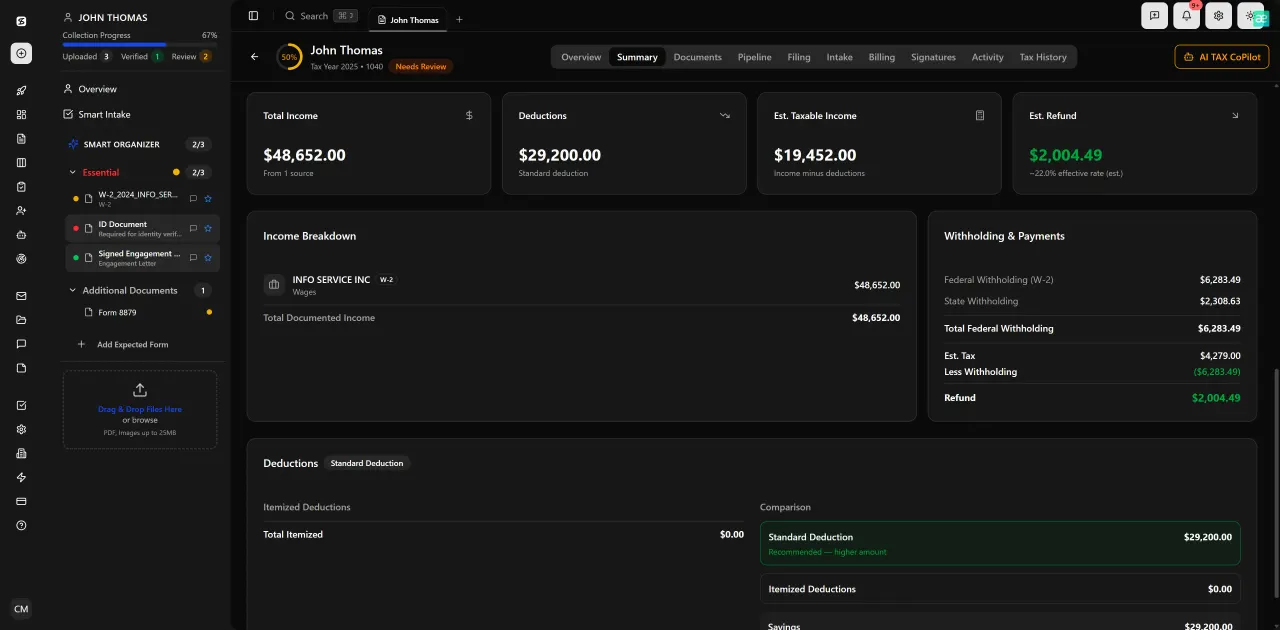
Review with AI assist — 9 agents answer questions with full client context
The Six Dimensions CPA Firms Actually Compare
When firm owners evaluate practice management platforms, six factors drive the final decision more than anything else in the demo: pricing model and total cost, AI depth and document extraction accuracy, return review and research workflow, client portal quality and adoption friction, e-file and e-signature coverage, and migration effort from the current stack. Understanding black ore alternatives in this context is what separates firms that scale from those that stall.
Every platform described below is scored against these six dimensions. For other comparison resources across the broader practice management landscape, the TaxScout blog maintains an updated index of head-to-head analyses. This is precisely where a deliberate black ore alternatives strategy pays off.
It's also worth noting that the right answer depends heavily on firm composition. According to the TaxScout directory, which is matched against the IRS federal preparer directory, 69,089 US tax preparers are currently listed — of whom 32,239 are CPAs and 11,112 are enrolled agents. Solo and small-group practices make up the overwhelming majority of that population, and their software needs differ substantially from a 50-person firm. Choosing among black ore alternatives sits at the center of this decision — get it wrong and the rest unravels.
Tired of paying for platforms that force you to choose between AI depth and full practice management? When firms revisit their black ore alternatives priorities, the gaps usually surface here.
TaxScout combines a 5-layer AI document pipeline, 9 research agents, client portal, pipeline management, and e-signatures — all at a flat monthly rate with no per-user fees.
Black Ore alternatives at a glance — six dimensions that matter to CPA firms (2026)
| Platform | Pricing Model | AI Document Extraction | Client Portal | E-Signatures | Full Practice Management |
|---|---|---|---|---|---|
| Black Ore | Quote-based, not public | Return review / research focus | Not a core feature | Not a core feature | No — review and research layer only |
| TaxScout Solo | $49/mo or $470/yr — unlimited team members, 150 return credits | 5-layer pipeline: W-2, 1099 series, K-1s, 1098/1095, schedules | Branded portal, OTP login | Form 8879, 4868, FBAR, engagement letters | Yes — intake, pipeline, portal, invoicing, PDF tools |
| TaxScout Firm | $149/mo or $1,430/yr — unlimited team members, 500 return credits | Same 5-layer pipeline plus all 9 AI research agents | Branded portal, OTP login | Full e-signature suite via Documenso | Yes — full platform including AI research agents |
| TaxDome | $800–$1,200/seat/yr (1-year term, checked 2026-07-31) | Limited document parsing | Client portal included | Included | Yes — broad practice management |
| Canopy | $74/user/mo billed annually (checked 2026-08-01) | Limited AI extraction | Client portal included | Included | Yes — broad practice management |
| Karbon | $59/user/mo billed annually (checked 2026-08-01) | No AI document extraction | Limited | Third-party integration required | Workflow and CRM focus |
| SurePrep | Quote-based; 1040SCAN ORGANIZE $13/return, PRO $40/return (May 2024 list) | Strong document prep automation | No client portal | No | No — document prep only |

Click any extracted field to see its source highlighted on the original PDF
Pricing Model Comparison
Pricing structure matters as much as the sticker price. A per-user model penalizes growth; a per-return model punishes volume; a flat rate rewards both. Black Ore's pricing is not published and is quote-based — you cannot compare it without entering a sales process, which is a core reason firms explore black ore alternatives before making any commitment.
TaxDome lists $800–$1,200/seat/yr on a 1-year term, as of 2026-07-31. Its entry-level Essentials plan is limited to a single team member, so multi-staff firms must price up. Canopy lists $74/user/mo billed annually, as of 2026-08-01, with tax workflow automation available from $34/client/year as an add-on and KBA verification at $1.25 each. Karbon lists $59/user/mo billed annually, as of 2026-08-01. For a five-person team, those per-seat costs compound quickly.
TaxScout uses a flat-rate model with no per-user fees and unlimited team members at every tier. The Solo plan is $49/month with no commitment (or $470/year prepaid) and includes 150 return credits per term. The Firm plan is $149/month with no commitment (or $1,430/year prepaid) and includes 500 return credits, with additional returns at $4 each on both plans. For a firm with seasonal staff additions or multiple reviewers, the flat structure is a meaningful cost advantage over per-seat competitors. See TaxScout pricing details for the full breakdown.
SurePrep's pricing is quote-based and billed per return per product; the last published list from May 2024 showed 1040SCAN ORGANIZE at $13 per return and PRO at $40 per return, plus a vendor API fee of $0.33–$3.95 per return when used with CCH Axcess Tax. Its pricing is not publicly listed beyond that sheet and may have changed.
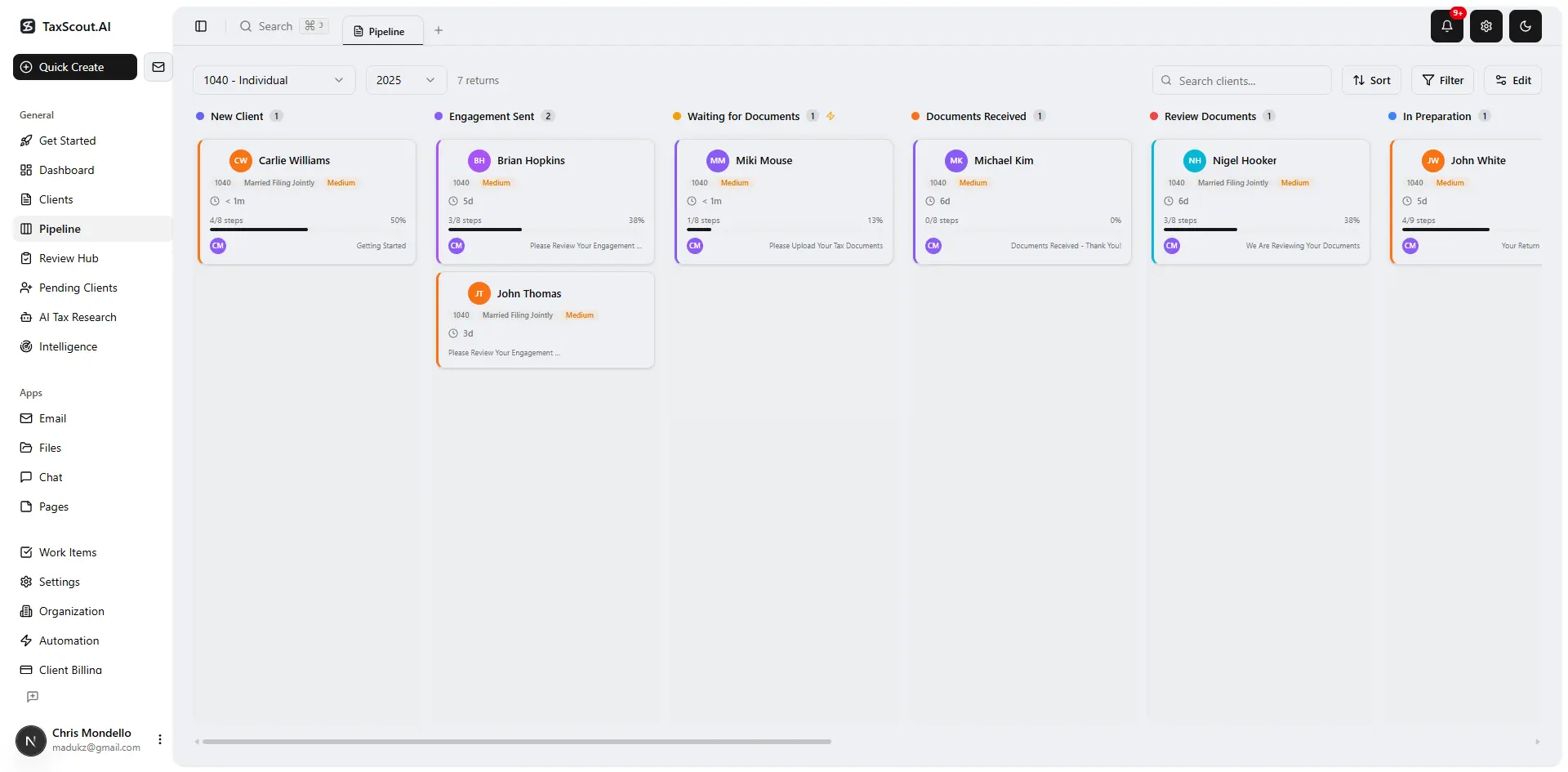
Track every return from intake to filed with drag-and-drop pipeline management
AI Depth and Document Extraction
Black Ore's AI is oriented toward return review and research — analyzing a completed or near-complete return for risk flags and planning opportunities. That's a narrow but valuable function for review-stage work. It is not primarily a document intake and extraction platform, and firms that need that full capability will find the black ore alternatives in this guide offer considerably more depth on the extraction side.
TaxScout's AI document extraction uses a 5-layer validation pipeline: document quality routing, AI extraction with confidence scoring, OCR cross-verification, 15 deterministic math rules, 18 post-extraction rules, and cross-document validation. It processes recognized individual document classes including W-2s, the full 1099 series, K-1s, 1098 and 1095 series, 1040 schedules, and supporting records. The split-screen PDF viewer with click-to-source field highlighting lets reviewers verify any extracted value against its source document in a single click.
Beyond document extraction, TaxScout's Firm plan includes 9 specialized AI research agents that run real-time queries against IRS.gov, Treasury, Cornell Law's LII, SSA, and Congress. These agents maintain client-context memory across entity structures, filing history, and prior returns — meaning research on a returning client starts with context already loaded. See how the AI research agents work in practice.
Canopy and Karbon both offer AI-assisted features, but neither provides a comparable multi-layer document extraction pipeline targeting the full individual return document set. TaxDome includes some document parsing capability but is primarily a practice management platform rather than an AI extraction engine. For a detailed look at how AI is reshaping the accountant's role, our post on whether AI will replace accountants draws on data from over 70,000 preparer profiles.

Your clients see your brand — OTP login, document upload, and real-time status
Review Workflow and Pipeline Management
A return's journey from document receipt to e-file involves multiple handoffs, and the platform's ability to track, assign, and surface bottlenecks determines whether managers actually use it or revert to spreadsheets.
TaxScout's pipeline management uses a 12-stage customizable kanban board with drag-and-drop controls. Each return moves through stages that reflect your firm's actual workflow rather than a vendor-defined template. Combined with a production funnel and deadline tracker visible on the main dashboard, reviewers always know what's waiting, what's overdue, and what's blocked waiting on a client.
Karbon is widely regarded as one of the stronger workflow tools in the accounting space, particularly for firms that do a mix of tax and advisory work. It lists $59/user/mo billed annually, as of 2026-08-01. Its workflow and CRM capabilities are well-regarded, but it lacks native AI document extraction and its client portal is more limited than dedicated portal-first platforms. If workflow management rather than document AI is your primary gap, Karbon deserves evaluation — see our Karbon alternative analysis for a direct comparison.
TaxDome offers a broad practice management suite with its own kanban-style workflow, but its per-seat pricing and the single-member restriction on its entry plan create friction for growing firms. Canopy's workflow automation add-on is priced separately from its base per-seat fee, which can make total cost harder to predict at budget time.
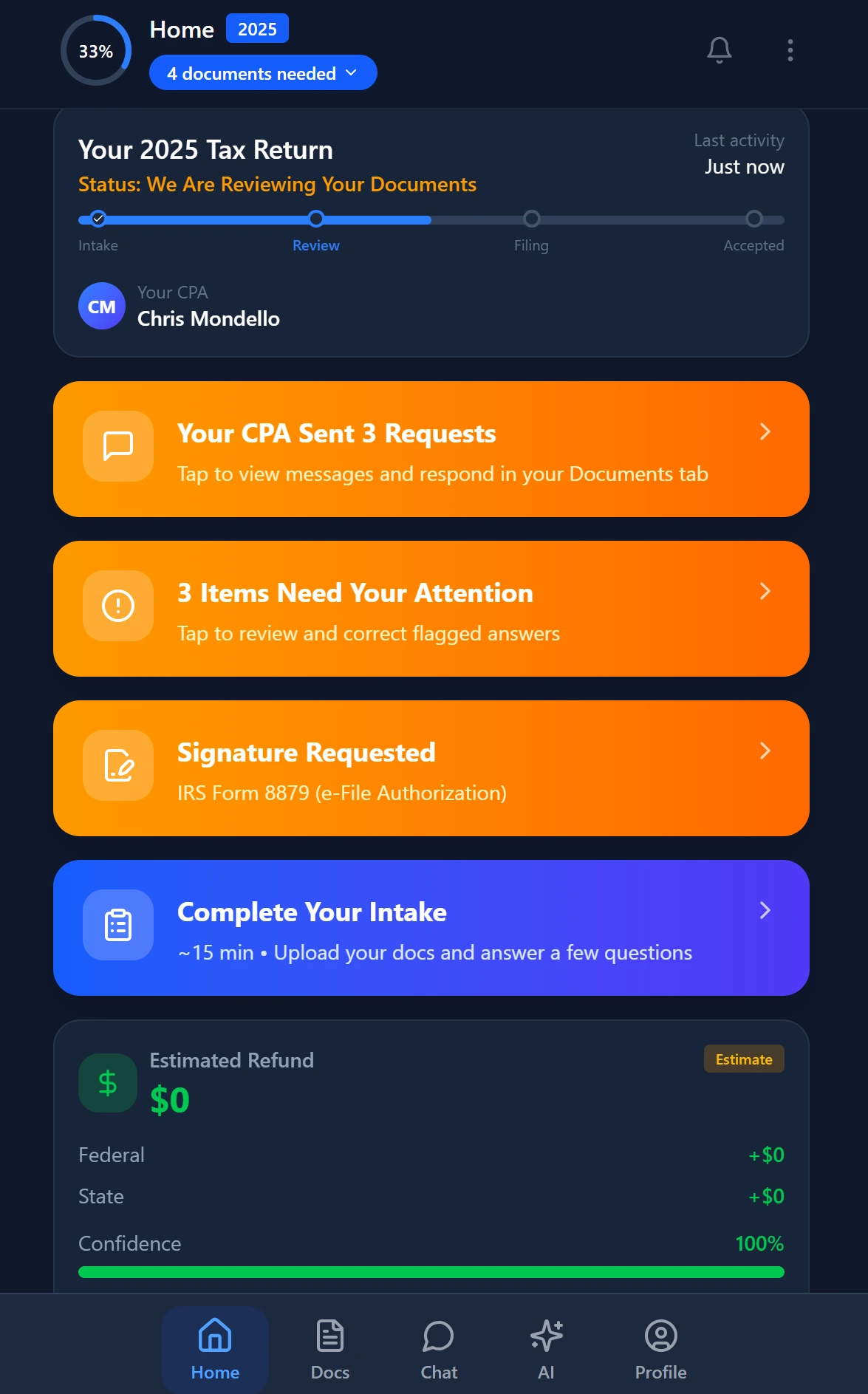
Smart intake auto-fills from uploaded documents and prior-year data
Client Portal and Intake Experience
The client portal is where intake friction either disappears or compounds. A portal that clients refuse to use forces your team to chase documents by email — which is the problem a portal is supposed to solve.
TaxScout's client portal is branded to the firm and uses OTP (one-time password) login — no password creation required from the client, which measurably reduces adoption friction. The smart intake engine is modeled on IRS Form 13614-C and uses a 4-layer prefill approach: document-first extraction, prior-year data, client profile, and AI gap analysis. That means clients are not starting from a blank form; they're confirming and correcting a prefilled draft, which shortens completion time.
TaxDome includes a client portal and has invested in the mobile client experience. Canopy also includes a portal as part of its per-seat fee. Both are mature products with solid portal adoption among their respective customer bases. Neither offers OTP login as a default friction-reducer for less tech-savvy clients.
Black Ore does not position a client portal as a core feature. If your firm needs portal-based document collection and client communication as part of its primary workflow, that's a gap that would require a separate tool alongside Black Ore — adding cost and complexity that many firms avoid by choosing black ore alternatives with built-in portal functionality.
E-Signatures and E-File Coverage
E-signature coverage for tax-specific forms — particularly Form 8879, extensions, FBAR, and state returns — is a compliance requirement, not a nice-to-have. Not all practice management platforms cover the full set.
TaxScout delivers e-signatures via Documenso integration, covering Form 8879, Form 4868 (extension), FBAR, engagement letters, W-9, and state forms. This is the full set that most individual-return practices need without reaching for a separate DocuSign subscription.
TaxDome and Canopy both include e-signature functionality as part of their platforms. Karbon requires a third-party integration for e-signatures and does not cover tax-specific forms natively. Black Ore, as a review and research layer, does not include e-signature capability as a core feature — meaning firms using it for review still need a signing solution elsewhere.
It's worth confirming with any vendor exactly which form types are covered under their e-signature implementation. The IRS has expanded Tax Pro Account functionality for client payments, and integration between signing workflows and IRS account management is an emerging area to watch. For the authoritative e-file requirements, IRS Publication 4164 covers modernized e-file specifications in full.
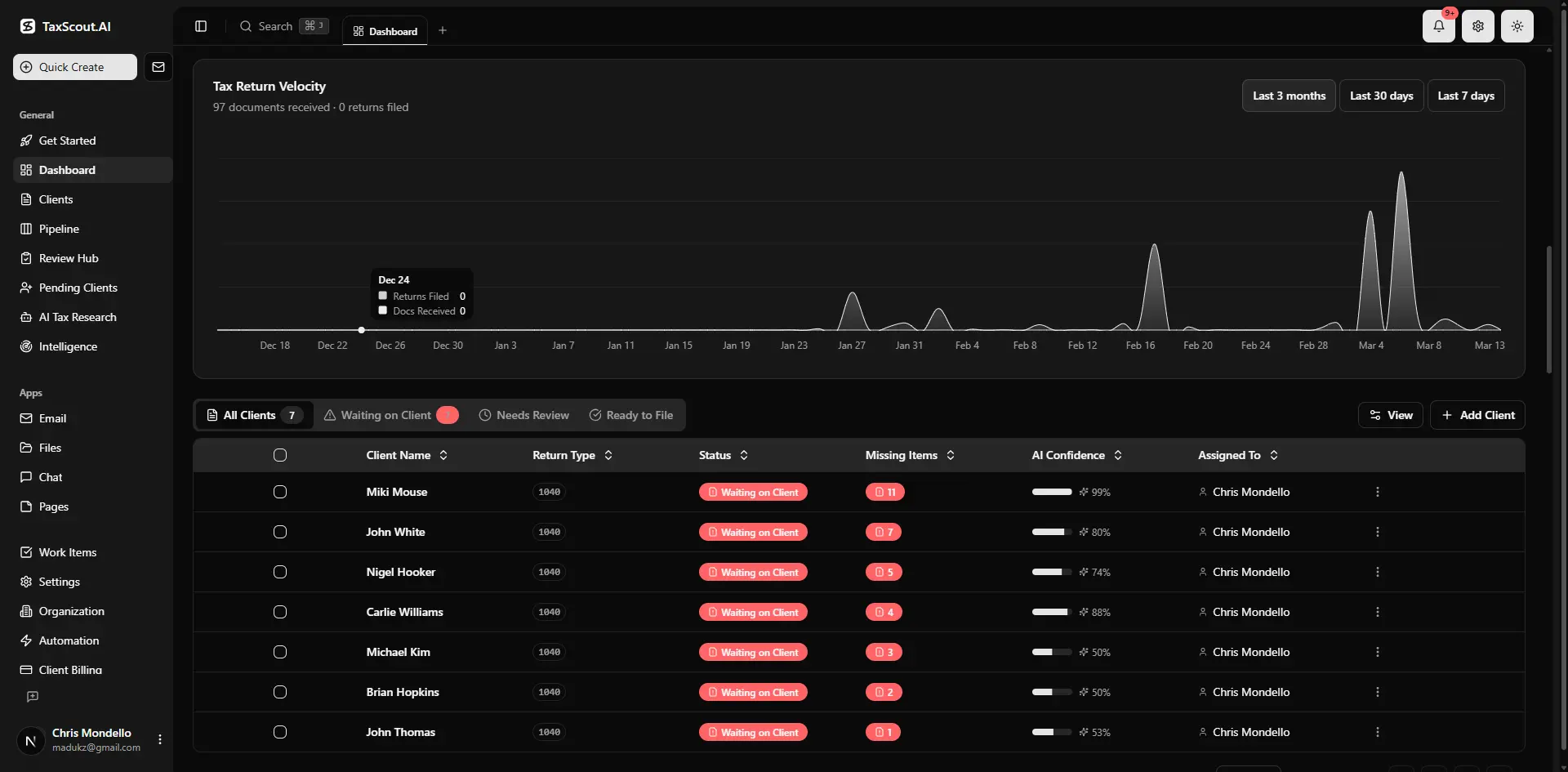
Real-time dashboard showing returns in progress, revenue, and upcoming deadlines
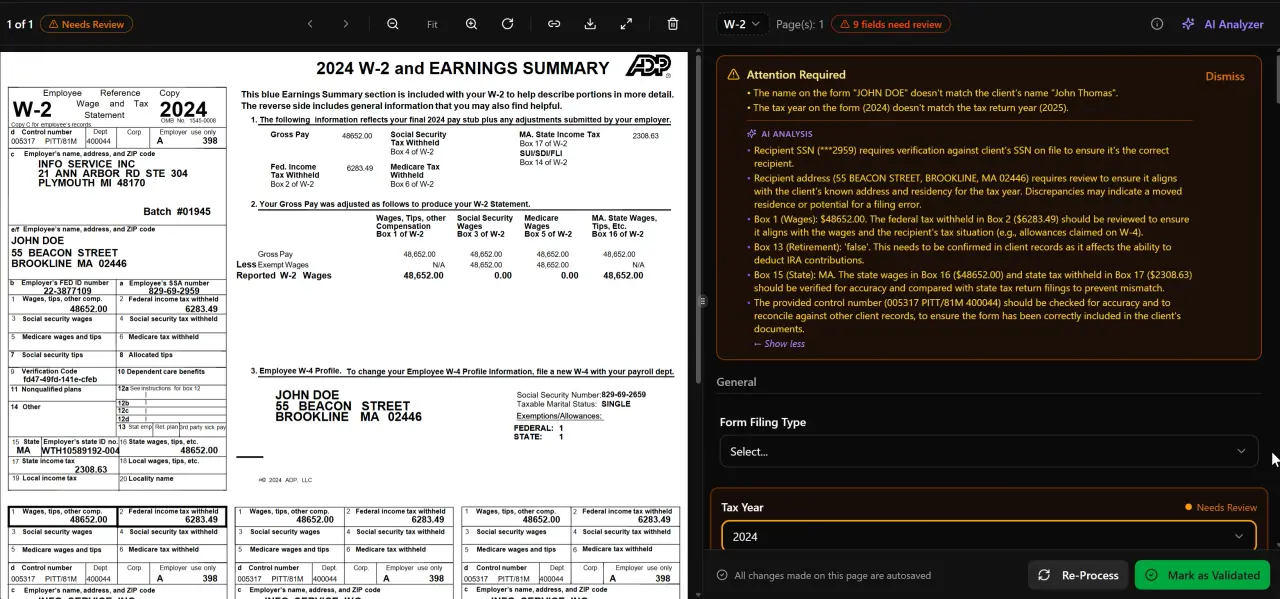
AI classifies, extracts, and validates every document automatically
Migration Effort and Integration With Tax Prep Software
No platform switch is free — the realistic cost is data migration, staff retraining, and the productivity dip during the transition window. The question is whether the gain justifies the friction.
TaxScout is designed to work alongside existing tax preparation software rather than replace it. It integrates with Drake, CCH Axcess, UltraTax CS, Lacerte, ProConnect, and ProSeries — meaning your firm's existing prep workflow stays intact while TaxScout handles intake, extraction, pipeline, portal, and research. This reduces migration scope substantially compared to platforms that require you to move your prep workflow as well.
TaxDome and Canopy are also compatible with major tax prep software and do not require you to change your prep tool. Karbon similarly integrates with tax software via connections rather than replacing it. SurePrep integrates directly with CCH Axcess Tax and charges a vendor API fee of $0.33–$3.95 per return for that integration, as noted on its May 2024 price sheet.
The glossary entry on switching costs is worth reviewing before beginning any vendor evaluation — it covers how to quantify the hidden costs of migration beyond the license fee. For a parallel analysis of another platform in this category, the Instead alternatives guide applies the same framework to a comparable set of tools.
Before committing to a migration, verify which document types each platform supports against the IRS preparer directory for credential verification requirements, and review SSA's employer wage data guidelines if your firm handles payroll-adjacent filings. For state-level compliance considerations, the SBA's state compliance resources are a useful starting reference for multi-state practices.
Ready to see whether TaxScout fits your firm before committing to anything?
Book a live demo — no sales pressure, just a walkthrough of the AI extraction pipeline, portal, and research agents on your actual document types.
Which Platform Fits Which Firm
Black Ore is best suited to larger firms with a dedicated review team, existing enterprise tax prep infrastructure, and a primary need for AI-assisted return review and research depth. If those describe your firm, the quote-based model and narrow focus may be exactly what you need.
TaxScout Solo at $49/month is built for solo practitioners and small firms that want AI document extraction, a client portal, pipeline management, and e-signatures without paying per-user fees or assembling a tool stack. TaxScout Firm at $149/month adds all 9 AI research agents and the full PDF toolbox, making it appropriate for multi-preparer firms processing 500 or more returns per term. Both plans include unlimited team members, which makes staff additions a non-event at budget time.
TaxDome is a reasonable choice for firms that prioritize depth of practice management features and are comfortable with per-seat pricing and a one-year term commitment. Canopy suits firms that want modular add-ons and are willing to pay the per-seat base plus add-on fees for workflow automation. Karbon is strongest for firms where workflow management and CRM are the primary pain points and document extraction is not a priority. See TaxDome alternative and Canopy alternative analyses for deeper head-to-heads on those platforms.
SurePrep occupies a distinct niche as a document preparation layer rather than a full practice management platform. It is worth evaluating only if your firm's primary gap is document organization and your practice management, portal, and workflow are already solved elsewhere — and if you're prepared for per-return billing that scales directly with volume.
Ready to see the difference? TaxScout gives your firm AI extraction, 5-layer validation, and complete practice management — on flat firm pricing with unlimited team members. → Book a 15-Min Demo — See It Live

Every client gets organized documents, status tracking, and a complete history
Ready to try TaxScout.ai?
Free migration assistance. White-glove onboarding included.
Request Early Access