Returns Relating to Sales or Exchanges of Certain Partnership Interests: What CPAs Must Do Now
The IRS published final regulations on May 20, 2026 modifying information reporting obligations for sales or exchanges of certain partnership interests — specifically those holding inventory or unrealized receivables. CPA firms with partnership clients need to review engagement scope, update…
On May 20, 2026, the IRS and Treasury published final regulations governing returns relating to sales or exchanges of certain partnership interests — specifically partnerships that hold inventory items or unrealized receivables, commonly called "hot assets" under IRC Section 751. The rule modifies existing information reporting obligations for both transferors and transferees, and it applies immediately to transactions occurring on or after the publication date.
Most coverage has simply reprinted the Federal Register notice. This brief skips the legalese and focuses on what small and mid-size CPA firms need to do operationally — which client types are in scope, which forms change, and what your team should action this week. Understanding returns relating to sales or exchanges of certain partnership interests is exactly what this brief is designed to help your firm navigate quickly and confidently.
The primary source is the Federal Register notice 2026-10116, published May 20, 2026. Bookmark it — you will need to cite it in any client memo or amended engagement letter. This Federal Register notice is the definitive regulatory authority on returns relating to sales or exchanges of certain partnership interests, and every client-facing memo your firm produces should reference it directly.
What the Final Rule Actually Changes
Prior rules required partnerships to file information returns when a partner sold or exchanged an interest, but the scope of the reporting — particularly around hot assets — had gaps that generated IRS compliance questions and underreported ordinary income. The final regulations close those gaps by tightening the definition of what must be reported, who must report it, and when. The compliance gaps that existed under prior guidance for returns relating to sales or exchanges of certain partnership interests were particularly pronounced when hot assets were involved, leaving ordinary income frequently underreported.
Specifically, the regulations clarify that the partnership itself (not just the selling partner) bears a reporting obligation when the transferred interest includes a proportionate share of inventory items or unrealized receivables. The transferee partner also has new acknowledgment obligations. Both obligations attach to the transaction date, not the filing date, so retroactive coverage for 2026 transactions is already live. For firms evaluating their returns relating to sales or exchanges of certain partnership interests approach, this trade-off compounds over time.
The rule builds on IRC Section 751 hot-asset recharacterization principles and aligns reporting with existing Treasury Regulation 1.751-1 gain allocation rules. The IRS partnership audit regime remains the enforcement backstop, so under-reporting here can trigger a partnership-level examination. Each of these factors directly shapes how returns relating to sales or exchanges of certain partnership interests plays out in practice.
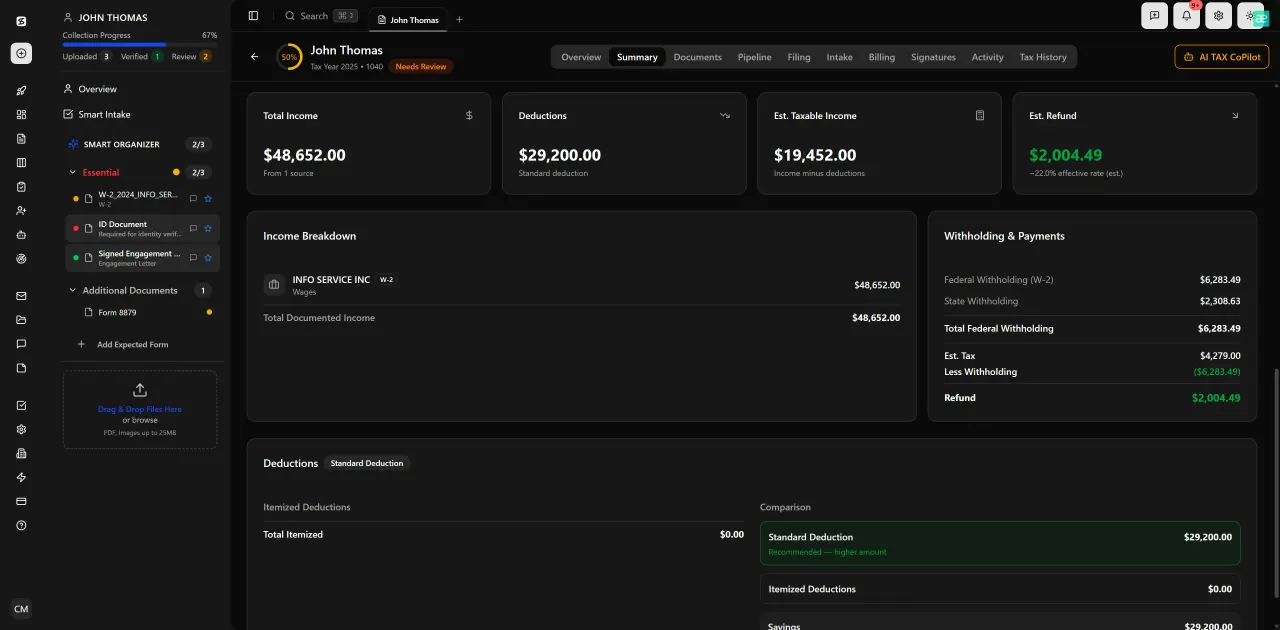
Review with AI assist — 9 agents answer questions with full client context
Which Client Segments and Filing Types Are Affected
This rule does not touch W-2 employees, S-corporations, or nonprofits as primary filers. The affected universe is narrower but often represents high-value clients: Understanding returns relating to sales or exchanges of certain partnership interests in this context is what separates firms that scale from those that stall.
Partnerships (Form 1065) with inventory or accounts receivable. Any partnership — general, limited, or LLC taxed as a partnership — that holds inventory or unrealized receivables at the time of a partner transfer is now a reporting entity. This includes professional service LLCs with large WIP balances, retail or wholesale partnerships, and real estate partnerships with deferred installment receivables. This is precisely where a deliberate returns relating to sales or exchanges of certain partnership interests strategy pays off.
Selling partners (Schedule D / Form 8949 / Schedule K-1). The Schedule K-1 issued to the transferring partner must now reflect the ordinary income component attributable to hot assets separately. Firms preparing 1040s for partners who sold interests in 2026 need to confirm the partnership has filed the required return before finalizing the individual return. Returns relating to sales or exchanges of certain partnership interests sits at the center of this decision — get it wrong and the rest unravels.
Buying partners (new transferee obligation). The acquiring partner must acknowledge receipt of the required disclosures. This is a new procedural step that most engagement letters currently do not contemplate. When firms revisit their returns relating to sales or exchanges of certain partnership interests priorities, the gaps usually surface here.
Tiered partnership structures. Upper-tier partnerships that own interests in lower-tier partnerships with hot assets are also pulled in if a transfer of the upper-tier interest occurs. These situations require tracing through entity layers — a task that benefits directly from AI research agents that can surface the applicable Treasury guidance in seconds.
Managing a dozen partnership clients and not sure which ones hold hot assets?
TaxScout's AI Research Agents search IRS, Treasury, and Cornell Law in real time — so your team can answer Section 751 questions in minutes, not hours.
→ See AI Research Agents in Action
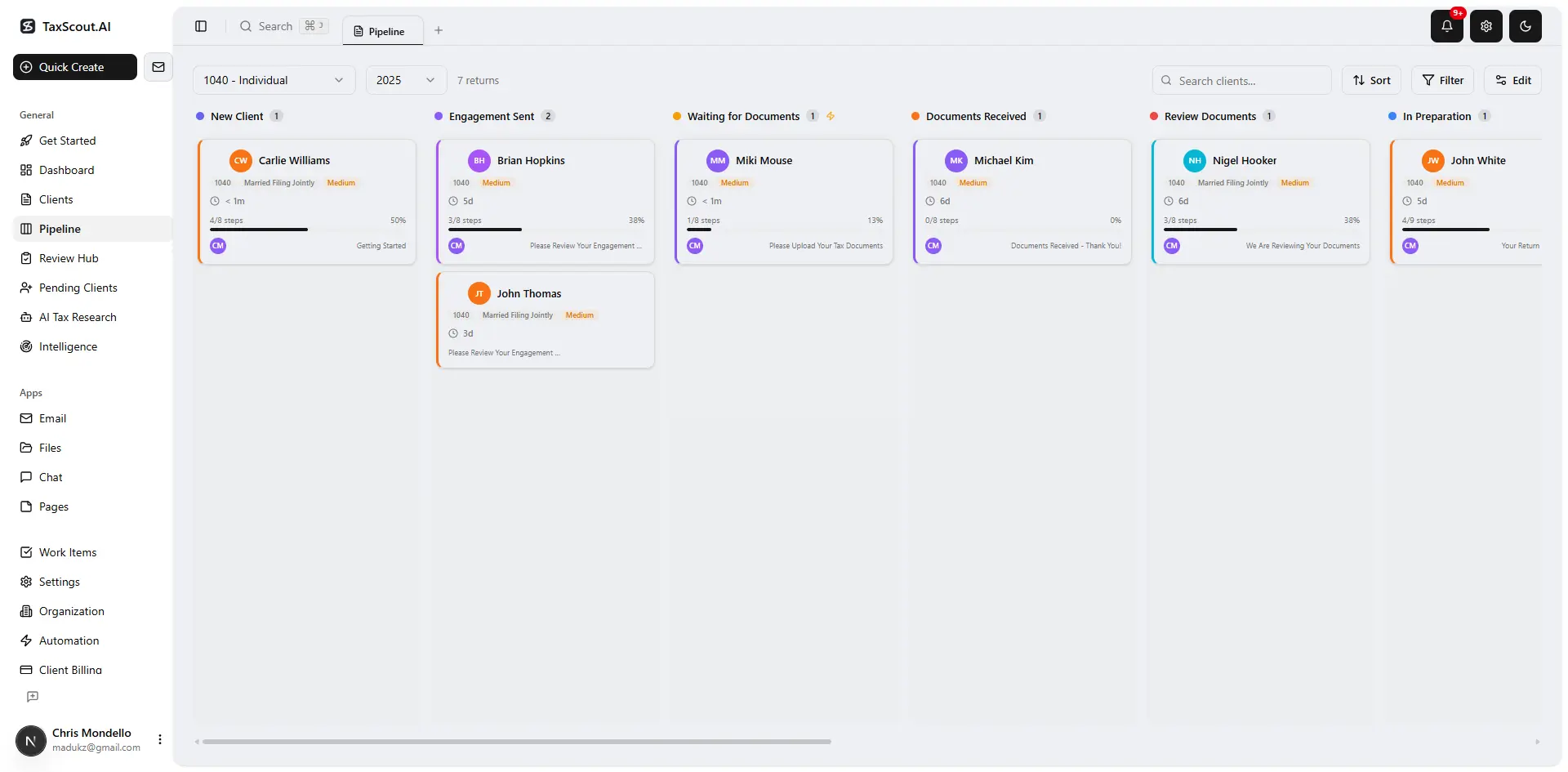
Track every return from intake to filed with drag-and-drop pipeline management
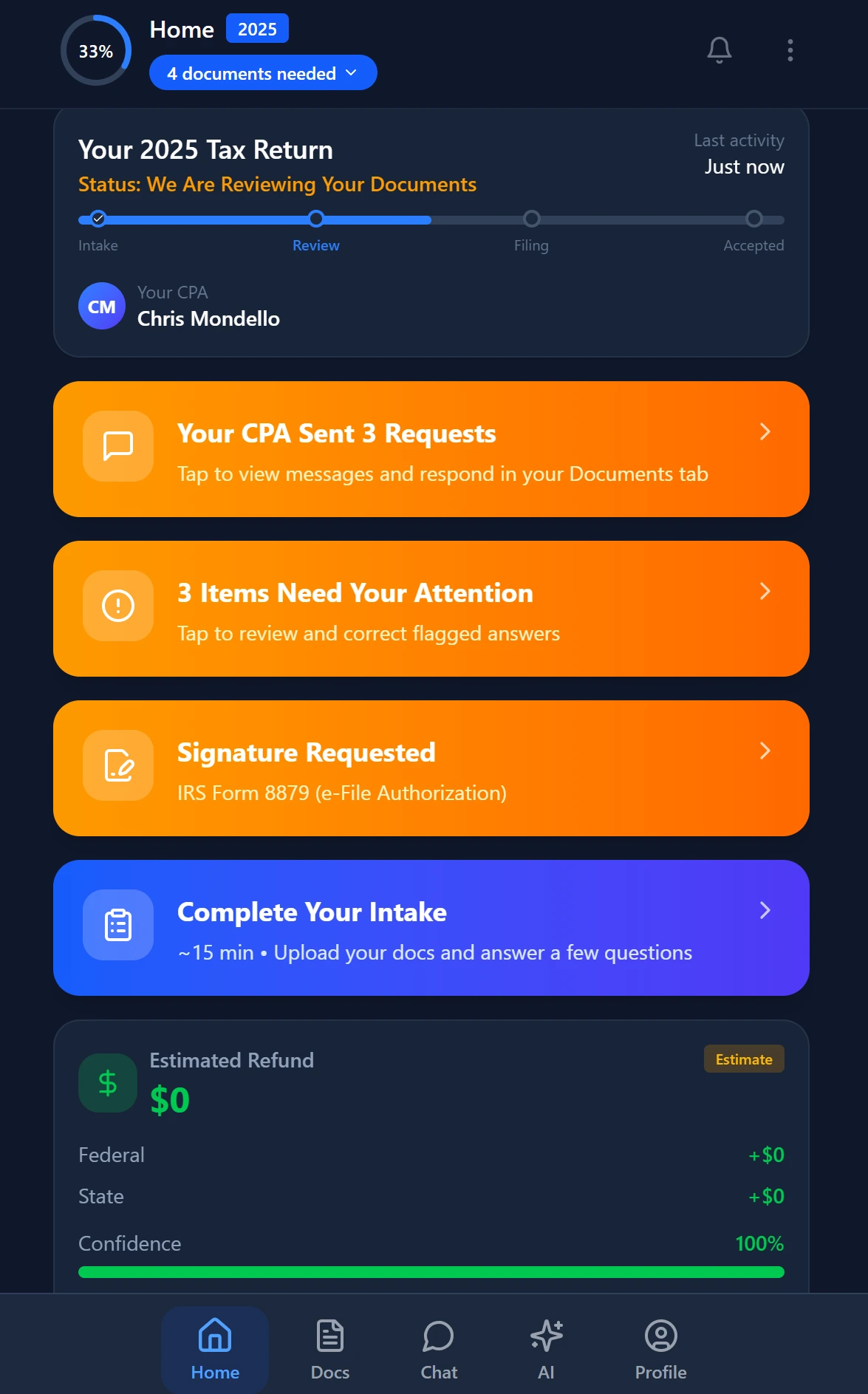
Smart intake auto-fills from uploaded documents and prior-year data
What to Do This Week: A Firm Action List
The following steps are operational priorities, not legal advice. Confirm applicability with your own counsel for complex situations.
1. Identify all active partnership clients. Pull every Form 1065 engagement from your pipeline. Flag any partnership that carries inventory on its balance sheet or has significant accounts receivable or WIP — these are the highest-probability hot-asset situations. If you track this in a pipeline management system, add a custom stage or label for "751 review needed."
2. Review 2026 partner transfer activity. For any partnership where a partner buy-in, buyout, or secondary transfer occurred on or after January 1, 2026, determine whether the transaction date falls under the new rule (May 20, 2026 forward) or prior guidance. Transactions before May 20 use the old rules; transactions on or after that date use the new ones.
3. Update engagement letters for affected clients. The transferee acknowledgment obligation is new scope. If your current engagement letter covers only the partnership return and the selling partner's 1040, you likely need a separate engagement or addendum for the buying partner. Review our guide to electronic signatures for accountants for efficient amendment workflows.
4. Coordinate with the partnership before finalizing individual returns. The selling partner's Schedule K-1 — and by extension their 1040 — cannot be finalized until the partnership has prepared the required Section 751 disclosure. Build a dependency checkpoint in your workflow: 1065 Section 751 statement → K-1 → 1040.
5. Read the primary source. The Federal Register notice 2026-10116 is the authoritative text. Assign one staff member per affected client to read the operative paragraphs (the regulatory text, not just the preamble) and document the firm's interpretation.
6. Watch for IRS forms guidance. The final rule references reporting obligations but the IRS has not yet released a revised form or schedule to carry the new disclosures. Monitor IRS draft forms releases for updates to Form 8308 or any new schedule. For breaking regulatory updates affecting your clients, see other news resources on the TaxScout blog.
Why This Rule Creates Audit Exposure for Unprepared Firms
The IRS has been systematically closing information reporting gaps in partnership transactions since the BBA partnership audit regime took effect. Hot-asset underreporting is a known examination trigger: the Treasury Inspector General has flagged partnership ordinary income mischaracterization as a recurring compliance issue in annual audit priority reports.
From a professional liability standpoint, the new transferee acknowledgment obligation means the buying partner's CPA (who may be a different firm) also has duties. If your firm prepared the partnership return but failed to inform the selling partner's advisor of the Section 751 statement, you may carry partial responsibility for a downstream reporting failure.
The practical defense is documentation: a contemporaneous memo showing you reviewed the final rule, identified hot-asset exposure, and either completed the required disclosures or documented that no transfer occurred. This is standard practice management hygiene — but many firms still handle it ad hoc in email rather than in a structured workflow.

Click any extracted field to see its source highlighted on the original PDF

Every client gets organized documents, status tracking, and a complete history
How TaxScout Helps Firms Handle Partnership Complexity
Partnership returns are among the most document-intensive engagements a CPA firm handles. TaxScout's AI document extraction supports 180+ tax form types including K-1s and all 1065 supporting schedules, with a 5-layer validation pipeline that cross-verifies extracted figures against 15 deterministic math rules and 18 post-extraction rules.
For research-intensive questions like Section 751 hot-asset allocation, the platform's 9 specialized AI research agents search IRS publications, Treasury regulations, Cornell Law's USC database, and SSA guidance in real time — surfacing the relevant regulatory text with citations rather than generic summaries. This is the difference between a junior staff member spending 90 minutes on a research memo and a senior associate reviewing a pre-cited draft in 10 minutes.
Client-context AI memory retains entity structures and prior-year filing history, so when a partner transfer occurs, the system already knows the partnership's balance sheet composition from prior returns — a head start on the hot-asset analysis. Firms managing 50+ partnership clients can track all related return dependencies in a 12-stage customizable pipeline, ensuring the 1065 Section 751 statement is completed before any linked 1040 moves to the review stage.
TaxScout is priced at flat rates with no per-user fees: the Prep Pro plan at $149/month covers 10 seats and 500 returns per year. For a firm with 10 staff, that's roughly $15 per person per month versus TaxDome's per-user pricing of approximately $100 per user per month — a significant difference when compliance workloads like this new partnership rule increase staff research time across the board. See full details at TaxScout pricing.
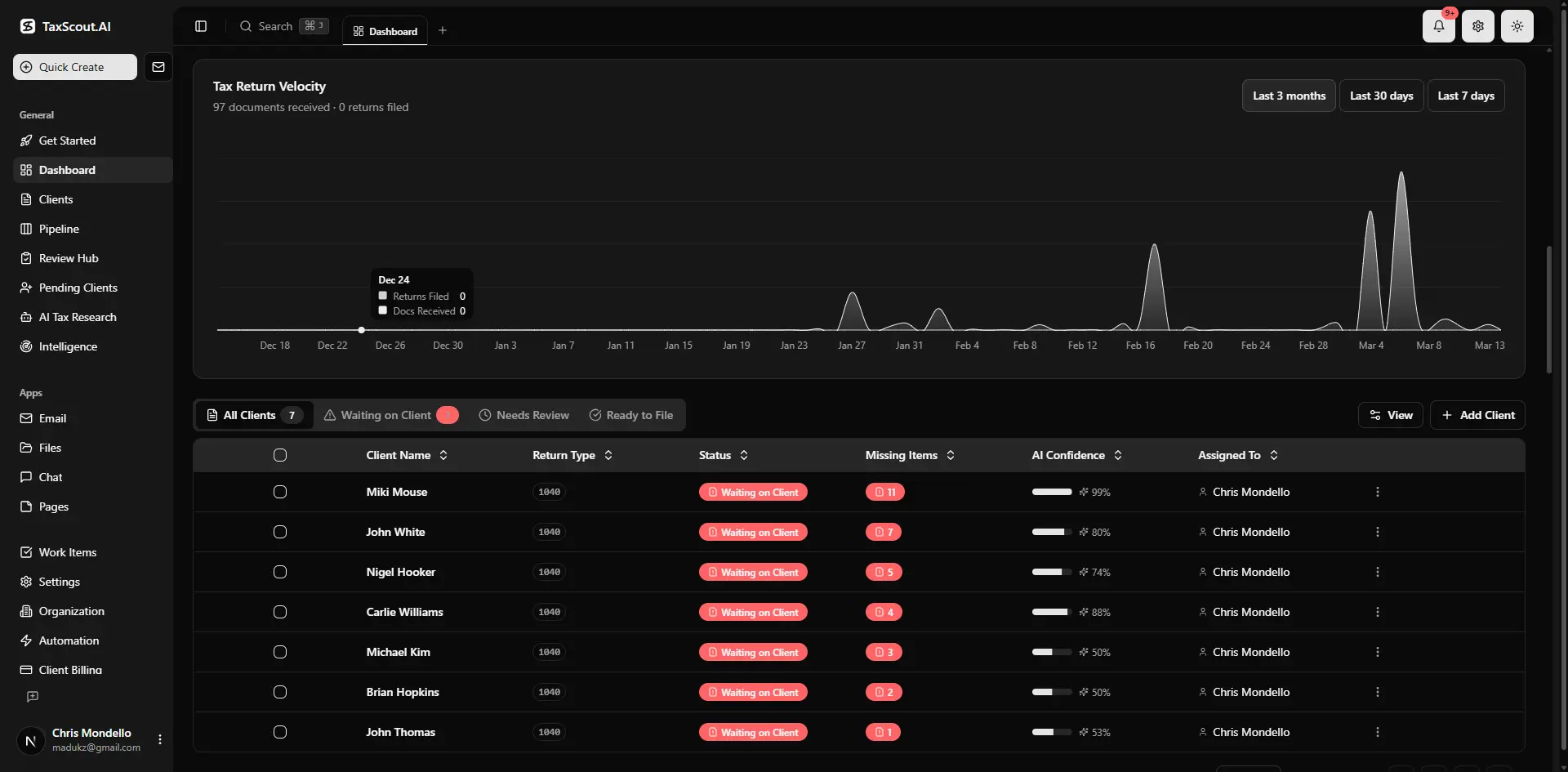
Real-time dashboard showing returns in progress, revenue, and upcoming deadlines
Feature comparison for firms managing partnership compliance (10-person firm, annual cost)
| Capability | TaxScout Prep Pro | TaxDome | Canopy |
|---|---|---|---|
| Annual cost (10 seats) | $1,788/yr ($149/mo) | ||
| AI tax research agents | 9 agents (IRS/Treasury/Cornell) | None | None |
| K-1 and 1065 AI extraction | Included, 5-layer validation | Not available | Not available |
| Pipeline with return dependencies | 12 customizable stages | Basic kanban | Basic kanban |
| Per-user pricing | No (flat fee) | Yes (~$100/user/mo) | Yes (~$45/user/mo per module) |
Key Dates and Monitoring Checklist
Effective date: May 20, 2026 — the regulations apply to transfers occurring on or after this date. Prior-year returns are not retroactively amended under these rules.
Next milestone: Watch for IRS guidance on updated Form 8308 (Return of Partnership Sale or Exchange of Certain Partnership Interests) or any interim instructions. The current Form 8308 predates the new transferee acknowledgment requirement and will likely need revision.
Deadline dependency: If any of your partnership clients have partners who transferred interests between May 20 and the extended 1065 due date (September 15, 2026 for calendar-year partnerships), the Section 751 statement must be ready before you can finalize those K-1s. For firms with many extended returns, this is a September crunch item — add it to your IRS deadlines 2026 tracker now.
Documentation to retain: A copy of the Federal Register final rule, the firm's internal review memo, client notification, updated engagement letter or addendum, and the completed Section 751 statement. Retain under your standard 7-year document retention policy. TaxScout's file management system with AES-256-GCM encrypted storage keeps all of this indexed and retrievable per client.
Does your current software help you research, document, and track partnership compliance obligations in one place?
TaxScout gives CPA firms AI research agents, automated document extraction, and 12-stage pipeline management — all at a flat monthly rate with no per-user fees.

Track firm performance with real-time analytics and client activity monitoring
Frequently Asked Questions
These are information returns required when a partner sells or exchanges an interest in a partnership that holds hot assets — inventory items or unrealized receivables under IRC Section 751. The May 2026 final regulations clarify that both the partnership and the transferee partner have reporting obligations when such assets are present at the time of transfer.
Keep reading
Tangible Property Regulations: How CPAs Apply Capitalization vs Expensing Rules
Oct 15, 2026 · 1 min read
QSBS Exclusion: How CPAs Maximize Section 1202 Gains for Startup Investors
Oct 15, 2026 · 1 min read
Section 1202 QSBS Exclusion: How CPAs Shelter Startup Gains for Founder Clients
Oct 15, 2026 · 1 min read
Stay up to date
Get the latest tax tech insights delivered to your inbox.