The sole proprietor tax strategy conversation rarely happens at most CPA firms. Schedule C clients get their return prepared, sign the e-file authorization, and disappear until the following January — leaving real money on the table for both the client and the firm. Meanwhile, CPAs invest disproportionate advisory energy into S-corps, partnerships, and high-net-worth individuals while the self-employed segment sits quietly in the pipeline, underserved and underpriced.
That asymmetry is a missed opportunity. There are more than 16 million nonfarm sole proprietors filing Schedule C each year according to IRS Statistics of Income data, and the average self-employed person leaves thousands in preventable tax liability unaddressed simply because no advisor built a proactive system around their needs. The freelancer, the consultant, the independent contractor — they aren't too small to advise. They're just not organized in a way that makes advisory feel scalable. A proactive sole proprietor tax strategy can close that gap significantly, making Schedule C clients far more valuable to serve.
This guide is written for CPAs who want to change that. It maps out a practical, repeatable workflow for serving Schedule C clients year-round: the quarterly touchpoints that matter, the deduction categories worth reviewing systematically, the income thresholds that should trigger an entity-upgrade conversation, and the technology infrastructure that makes all of it profitable rather than a drain on staff time. Think of it as a complete sole proprietor tax strategy framework you can adapt to your own client base and firm workflow.
CPA firm economics tend to push attention toward complexity. An S-corp with a reasonable payroll, a buy-sell agreement, and a state nexus question generates billing hours almost naturally. A freelance designer earning $90,000 on Schedule C appears simpler — but simplicity is often just latent complexity that nobody has surfaced yet. Without a deliberate sole proprietor tax strategy in place, that designer is likely overpaying on self-employment tax, missing deductions, and making uninformed entity decisions.
The self-employment tax alone — 15.3% on net earnings up to the Social Security wage base — is a line item most sole proprietors dramatically underestimate when they start out. Add estimated quarterly payments, home office deductions, vehicle expense elections, and the qualified business income deduction under IRC Section 199A, and the planning surface is actually quite wide. The problem is that most CPAs price the engagement as a data-entry exercise rather than an ongoing advisory relationship. For firms evaluating their sole proprietor tax strategy approach, this trade-off compounds over time.
Firms that have cracked this segment typically do two things differently. First, they build recurring touchpoints into the service agreement rather than treating the annual return as the entire product. Second, they use technology to flag anomalies and deduction gaps across their Schedule C book without requiring a staff member to manually review every client folder. Both shifts are addressable with the right process and tools — and they compound quickly when applied across a large client base. You can explore other blog resources on building profitable service lines for underserved client segments. Each of these factors directly shapes how sole proprietor tax strategy plays out in practice.
For more on evolving your firm's pricing structure to match this kind of advisory model, see our guide on CPA firm pricing models. Understanding sole proprietor tax strategy in this context is what separates firms that scale from those that stall.
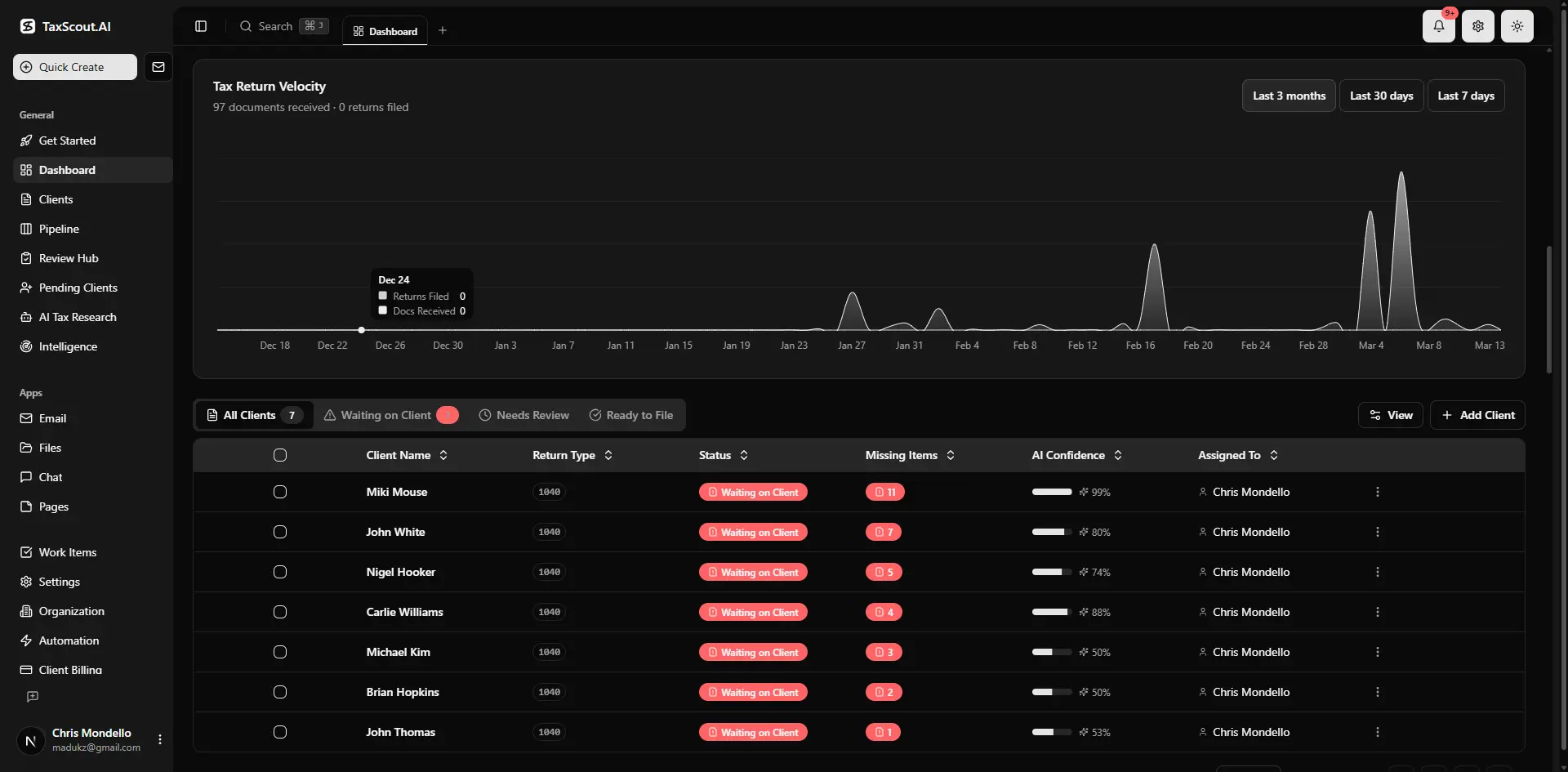
Real-time dashboard showing returns in progress, revenue, and upcoming deadlines
A year-round sole proprietor tax strategy starts with calendar discipline. The goal is four structured touchpoints per year — timed around the IRS estimated tax payment deadlines on April 15, June 15, September 15, and January 15 — that serve double duty as payment reminders and planning conversations.
Each check-in does not need to be a long engagement. A 20-minute video call or a structured async questionnaire can surface what you need: revenue year-to-date, significant new expenses, any change in business structure or home-office use, and any major purchases planned before year-end. The value to the client is not the duration — it's the proactive nature of the contact. Most sole proprietors have never had a CPA reach out to them mid-year unprompted. That alone creates retention. This is precisely where a deliberate sole proprietor tax strategy strategy pays off.
The Q3 touchpoint (August/September) deserves extra weight. It sits far enough from year-end to still implement meaningful tax-reduction strategies — retirement contributions to a Solo 401(k), equipment purchases under Section 179, or prepaying deductible business expenses — while the December check-in is often too late for anything other than documentation. Structure your engagement agreements so Q3 advisory is included in the flat fee, and document the conversation in your pipeline system so nothing falls through the cracks. Sole proprietor tax strategy sits at the center of this decision — get it wrong and the rest unravels.
See our post on avoiding penalties with estimated quarterly tax payments for the exact mechanics you can share with clients during each touchpoint. When firms revisit their sole proprietor tax strategy priorities, the gaps usually surface here.
Q1 (post-filing, May): Debrief on the prior return — deductions claimed, any issues, estimated payment schedule going forward. This is also when you set expectations for the year ahead and confirm the client's bookkeeping system is functional.
Q2 (June): Confirm the June 15 estimated payment. Review revenue vs. prior-year pace. Flag any new contractor payments requiring 1099 tracking. If revenue is running significantly higher than last year, introduce the entity-upgrade conversation early.
Q3 (August/September): The most consequential planning call. Confirm September 15 estimated payment. Review retirement contribution capacity, equipment needs, and any large deductible expenses that can be pulled forward. Run a preliminary tax projection.
Q4 (December): Final sweep before year-end. Confirm the January 15 estimated payment calculation. Verify all 1099-eligible vendors are documented. Collect any remaining documents and set the intake timeline for the coming filing season.
Tired of managing Schedule C clients as one-and-done filers?
TaxScout gives you AI-powered document extraction, client-context memory, and a 12-stage pipeline to turn sole proprietors into year-round advisory relationships — all on one flat-fee platform.
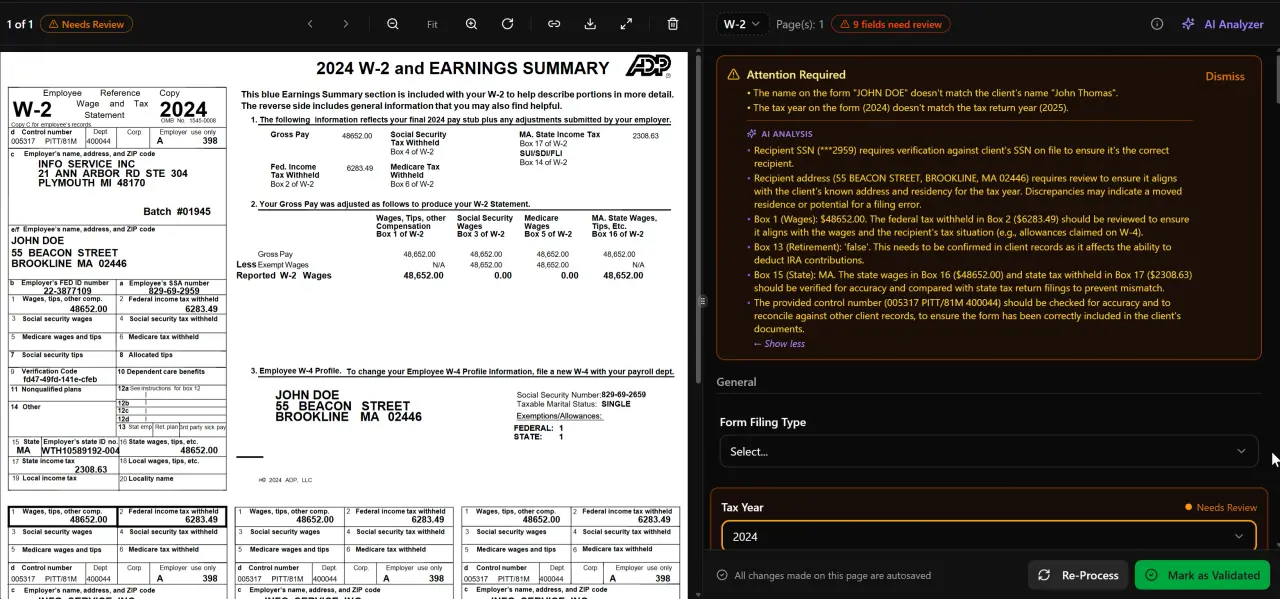
AI classifies, extracts, and validates every document automatically

Click any extracted field to see its source highlighted on the original PDF
Self-employed tax deductions represent the highest-leverage part of any sole proprietor tax strategy, yet deduction reviews at most firms are reactive rather than systematic. The client brings in receipts — or doesn't — and the preparer works with what's provided. A proactive CPA builds a deduction checklist that applies to every Schedule C client and flags gaps before the return is prepared.
The deduction categories with the highest miss rate among sole proprietors include: home office (many clients qualify but don't claim it because they're uncertain of the rules), health insurance premiums (deductible above the line for the self-employed under IRC Section 162(l)), vehicle expenses (the standard mileage rate vs. actual cost election is worth modeling annually), and retirement contributions. The SEP-IRA contribution limit of up to 25% of net self-employment income, for example, is one of the most powerful tools available to sole proprietors and one of the most consistently underutilized.
Business use of a cell phone, professional subscriptions, continuing education, and software tools are all deductible but frequently omitted when clients self-prepare their expense summaries. Building a standardized deduction review into your intake workflow — rather than relying on the client to volunteer the information — is what separates transactional filing from genuine advisory. TaxScout's smart intake engine, modeled on IRS Form 13614-C with four-layer prefill, is designed to surface exactly these gaps before document collection begins.
For CPAs managing a large Schedule C book, the AI document extraction workflow can cross-reference extracted document data against expected deduction categories, flagging clients where home office or vehicle expenses appear absent based on their prior-year pattern. This kind of anomaly detection — applied automatically across the book — is what makes volume advisory viable without proportional headcount growth. Our detailed guide on AI document extraction for CPAs covers the technical workflow in depth.
One of the most valuable conversations a CPA can have with a Schedule C client is the sole proprietor entity upgrade discussion — and most CPAs wait too long to have it, if they have it at all. The right time to introduce this conversation is not when the client asks; it's when specific financial thresholds or behavioral patterns suggest the current structure is costing money.
The primary trigger is net profit relative to self-employment tax exposure. Once a sole proprietor is consistently generating $50,000 or more in annual net profit, the potential savings from electing S-corp status and paying a reasonable salary begins to exceed the additional administrative costs (payroll processing, separate business return, state filing fees). The IRS guidance on S corporation elections outlines the mechanics, but the strategic framing — modeling the actual dollar savings for the specific client — is the CPA's job.
Secondary triggers include: the client beginning to hire independent contractors consistently (suggesting a need for cleaner entity separation), meaningful liability exposure in their industry (where an LLC structure matters beyond tax), or revenue scaling past $150,000 where the QBI deduction limitation analysis becomes more complex. The specified service trade or business rules under Section 199A also become relevant at higher income levels for professionals in law, health, consulting, and financial services.
Build these thresholds into your practice management pipeline so that any Schedule C client who crosses a defined net-profit flag during a quarterly review automatically generates a task for the assigned CPA to schedule an entity-upgrade conversation. This removes the dependency on the preparer's memory and ensures the conversation happens proactively for every qualifying client.
Net profit consistently above $50,000/year: Model the S-corp reasonable salary and estimated self-employment tax savings. Prepare a one-page comparison showing the after-tax impact net of administrative costs.
Gross revenue above $150,000: Reassess the QBI deduction eligibility and phase-out, especially for specified service trades. An entity election can sometimes preserve QBI benefits that phase out at higher income levels.
Consistent contractor payments or employees: A sole proprietor with a growing team is a liability waiting to happen. An LLC with appropriate operating agreements adds a layer of protection that clients in this situation genuinely need.
Significant asset acquisition: If the client is purchasing equipment, vehicles, or real property in their business, entity structure affects depreciation strategy and liability exposure. This is a natural opening for the entity-upgrade conversation.
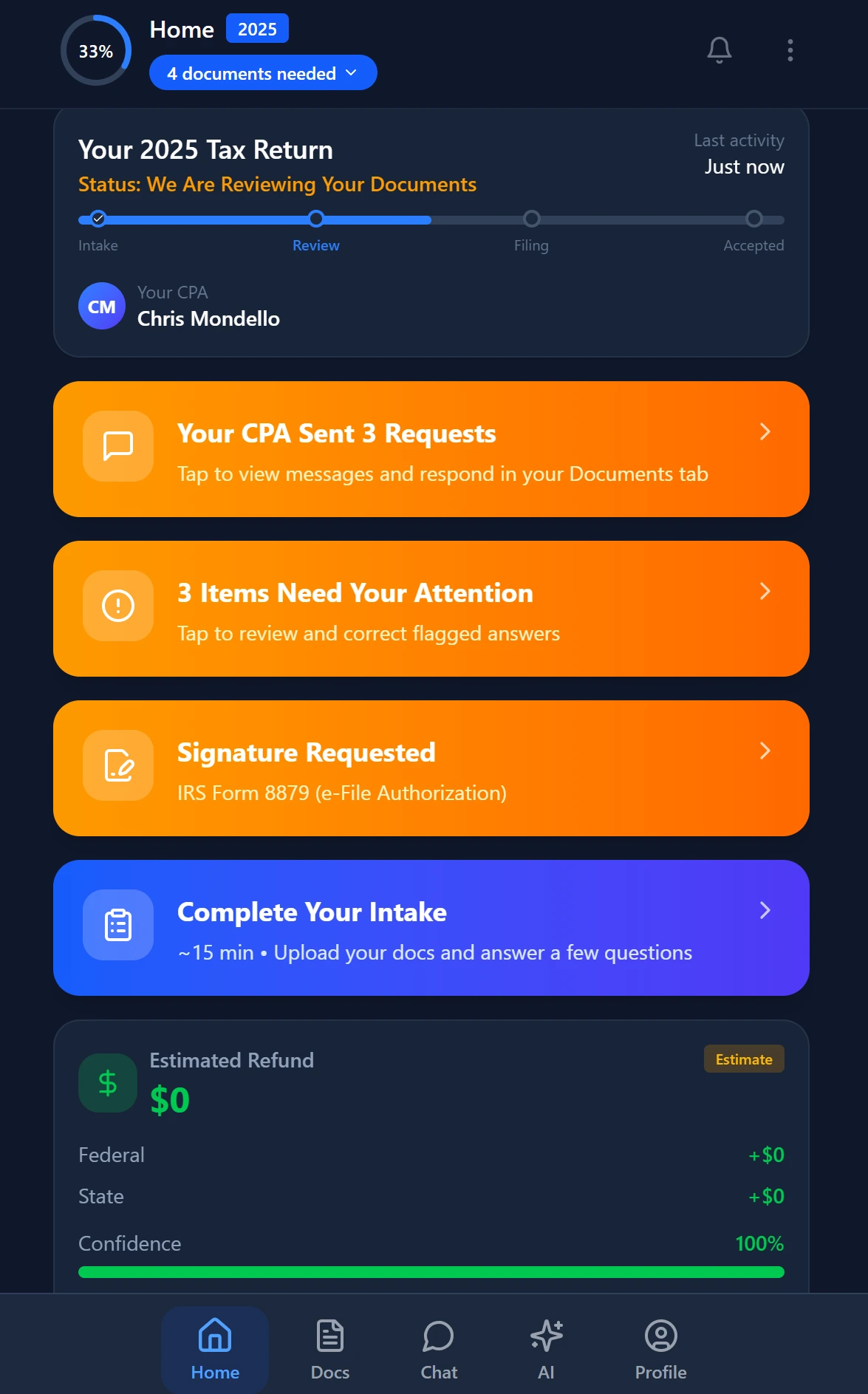
Smart intake auto-fills from uploaded documents and prior-year data
The practical barrier to serving sole proprietors as advisory clients is almost always pricing architecture, not service quality. Most CPA firms price Schedule C returns at a flat fee that covers preparation and nothing else. Layering quarterly check-ins on top of that feels awkward because there's no natural container for the additional value.
The cleanest solution is a tiered engagement model with three Schedule C packages: a filing-only tier (return preparation, e-file, and document storage), a standard advisory tier (return plus two check-ins per year and a deduction review), and a premium advisory tier (return plus all four quarterly check-ins, entity-upgrade modeling, retirement contribution analysis, and priority response). Pricing will vary by market, but a premium advisory package for a sole proprietor at $150–$250 per month on an annual engagement is defensible when the CPA can demonstrate documented tax savings. See our detailed analysis of flat fee billing for CPAs for the mechanics of structuring these agreements.
The key to making this profitable at volume is reducing the per-client touch time on administrative tasks. If quarterly check-ins require a staff member to manually pull documents, chase signatures, and compile deduction summaries by hand, the margin disappears. The firms making this work have automated the administrative layer — document collection through a branded client portal, e-signatures via integrated tools for engagement letters and authorization forms, and recurring invoicing through Stripe-integrated billing — so the CPA's time goes into the actual advisory conversation, not logistics.
For a broader look at niche pricing strategies that support premium positioning in specialized client segments, see our guide on niche pricing strategy for CPAs.
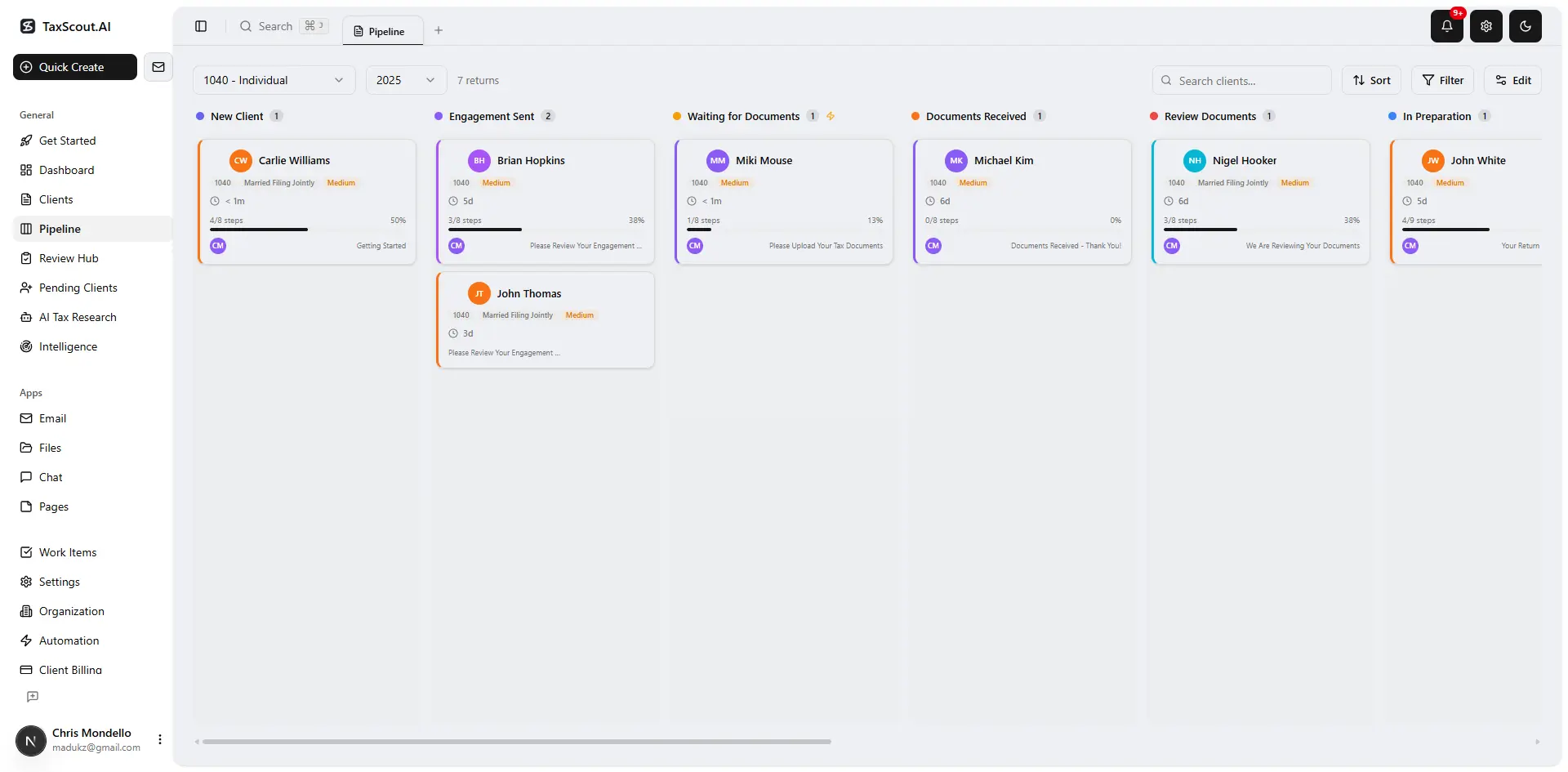
Track every return from intake to filed with drag-and-drop pipeline management
Schedule C Advisory Engagement Tiers: What to Include at Each Level
| Service Component | Filing Only | Standard Advisory | Premium Advisory |
|---|---|---|---|
| Annual return preparation (Schedule C) | Yes | Yes | Yes |
| E-file and client portal document delivery | Yes | Yes | Yes |
| Deduction review checklist | No | Yes | Yes |
| Quarterly estimated payment reminders | No | Yes | Yes |
| Two mid-year check-in calls | No | Yes | Yes |
| Four quarterly planning calls | No | No | Yes |
| Entity-upgrade analysis and modeling | No | No | Yes |
| Retirement contribution optimization | No | No | Yes |
| Priority email/portal response (48 hrs) | No | No | Yes |
Once a CPA firm has more than 40–50 Schedule C clients, manually reviewing each one for deduction gaps or planning opportunities becomes impractical. This is where AI-powered practice management creates a genuine operational advantage — not by replacing the CPA's judgment, but by doing the pattern recognition work that surfaces which clients need attention and why.
TaxScout's AI document extraction processes W-2s, 1099-NEC forms, 1099-MISCs, 1099-Ks, and supporting Schedule C documentation through a 5-layer validation pipeline — document quality routing, AI extraction with confidence scoring, OCR cross-verification, 15 deterministic math rules, and 18 post-extraction rules, followed by cross-document validation. When that extracted data is matched against prior-year patterns stored in client-context AI memory, the system can flag clients where income has increased significantly (suggesting an entity-upgrade conversation), where previously claimed deductions are absent (suggesting a documentation gap), or where estimated payments appear misaligned with year-to-date income.
The AI research agents add another layer: nine specialized agents with real-time access to IRS, Treasury, Cornell Law, SSA, and Congressional sources can answer the edge-case questions that come up in Schedule C advisory — the home office deduction rules for a client who moved mid-year, the vehicle depreciation method election deadline, or the self-employed health insurance deduction interaction with marketplace coverage. Having those answers available in the context of the client's file, rather than requiring a separate research task, compresses the time cost of each advisory conversation significantly.
For firms managing their Schedule C book through a pipeline management system with 12 customizable stages, it becomes possible to see at a glance which clients are in quarterly review, which need entity-upgrade conversations, and which have outstanding estimated payment tasks — without relying on individual preparers to track those touchpoints manually. That visibility is what makes the recurring advisory model scale. The AI automation features in TaxScout support task triggers based on client data changes, so the pipeline updates automatically as documents arrive and extracted figures cross defined thresholds.
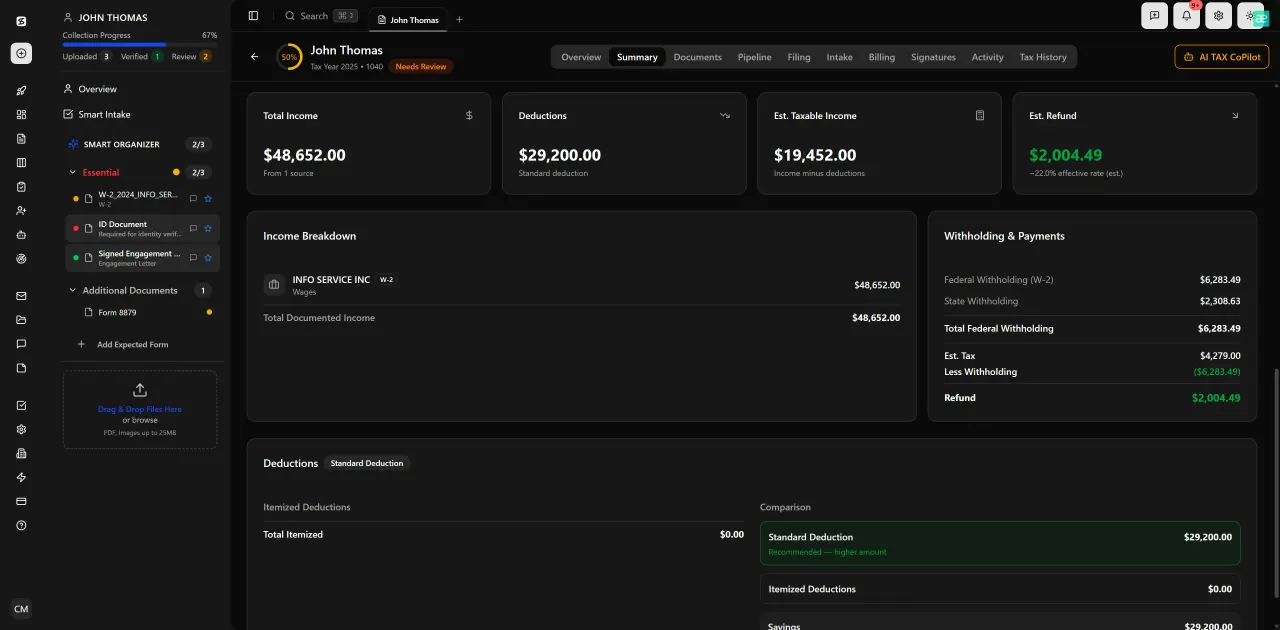
Review with AI assist — 9 agents answer questions with full client context

Your clients see your brand — OTP login, document upload, and real-time status
The operational infrastructure for a year-round sole proprietor tax strategy is not complicated, but it does require deliberate setup. The following workflow components need to exist in your practice management system before you can deliver recurring advisory at scale.
First, standardize your intake process. Every Schedule C client should go through the same structured onboarding that captures business type, revenue range, expense categories, home office use, vehicle use, retirement account status, and prior-year return data. TaxScout's smart intake engine handles this with a 4-layer prefill system — document-first, prior-year, profile, and AI gap analysis — so returning clients don't re-enter data they've already provided. This alone cuts intake time significantly for the second year of an advisory engagement.
Second, build your pipeline stages around the advisory calendar. A 12-stage customizable kanban pipeline should include stages for quarterly check-in scheduled, check-in completed, entity-upgrade conversation triggered, and year-end document collection open. When each stage has a defined owner and a deadline, no client falls through the cracks between filing seasons.
Third, automate your client communication cadence. Quarterly reminder emails, document request follow-ups, and estimated payment alerts should go out automatically based on calendar triggers — not because a staff member remembered to send them. TaxScout's communication hub supports Gmail OAuth, Outlook Graph, and IMAP/POP3 with AI classification, so firm-to-client messages stay organized and trackable. Pair that with the client portal for OTP-based secure document exchange and you have a professional, low-friction client experience that sole proprietors — who are often juggling their business without dedicated admin support — will genuinely appreciate.
See our guide on how to run a paperless accounting firm for the full infrastructure checklist that supports this kind of automated workflow.
Ready to turn your Schedule C book into a recurring advisory revenue stream?
TaxScout's flat-fee platform — starting at $49/month for unlimited team members — gives you the AI extraction, pipeline management, and client portal infrastructure to serve sole proprietors profitably year-round.