Section 1244 Stock Loss: How CPAs Turn Failed Startup Investments Into Ordinary Deductions
Most startup tax coverage focuses on Section 1202 QSBS gains, but CPAs also need a sharp playbook for when startups fail. This guide covers how to identify qualifying Section 1244 stock at issuance, apply the $50K/$100K ordinary loss limits, handle multi-round basis adjustments, and coordinate…
For every startup that produces a Section 1202 windfall, dozens more quietly collapse — leaving angel investors and founder-shareholders with worthless stock and a tax question their CPA must answer precisely. A section 1244 stock loss can convert what would otherwise be a capital loss, subject to the $3,000 annual deduction limit, into an ordinary loss that offsets wages, business income, and other high-bracket income dollar for dollar. The difference between a $50,000 capital loss carryforward and a $50,000 ordinary deduction in the current year can be worth tens of thousands of dollars in real tax savings.
Yet Section 1244 planning is largely orphaned in CPA literature. Most coverage rushes past the failure scenario to dwell on Section 1202's gain exclusion. That gap matters operationally: the qualifying conditions for Section 1244 must be satisfied at the time stock is issued, not at the time it becomes worthless. CPAs who review the facts retroactively — often only when a client reports a loss — frequently discover that critical requirements were never met, or that basis from later funding rounds dilutes the deductible amount. Understanding the precise timing requirements is what separates CPAs who successfully claim a section 1244 stock loss from those who discover the opportunity only after it has slipped away.
This guide gives you the complete CPA workflow: how to identify qualifying stock before the loss event, apply the married-filing-jointly $100K cap versus the single filer $50K cap, document basis through multiple investment rounds, and integrate the ordinary loss with capital loss carryforward planning. We also show how AI-powered tax research tools can surface the relevant authorities in real time so your team spends its time advising, not searching. Each step in this workflow is designed to maximize the chance that a section 1244 stock loss qualifies for ordinary treatment when a startup ultimately fails.
What Section 1244 Actually Requires
Section 1244 of the Internal Revenue Code allows individual shareholders — not trusts or corporations — to treat a loss on the sale, exchange, or worthlessness of qualifying small business stock as an ordinary loss rather than a capital loss. The statutory framework is codified at 26 U.S.C. § 1244, and the IRS regulations under Treas. Reg. § 1.1244(a)-1 through 1.1244(e)-1 fill in the operational details. When the requirements are met, a section 1244 stock loss can convert what would otherwise be a capital loss — often of limited immediate use — into a fully deductible ordinary loss against the taxpayer's regular income.
The core requirements are: (1) the stock must be stock of a domestic corporation; (2) the corporation must be a "small business corporation" at the time the stock was issued, meaning the aggregate amount of money and other property received for stock (including contributions to capital and paid-in surplus) did not exceed $1,000,000; (3) the stock must have been issued to the taxpayer in exchange for money or property — not services; (4) during the five most recent tax years ending before the loss year, the corporation must have derived more than 50% of its gross receipts from sources other than royalties, rents, dividends, interest, annuities, and gains from sales of stock or securities; and (5) the stock must be common stock or, for losses after 1978, certain preferred stock. For firms evaluating their section 1244 stock loss approach, this trade-off compounds over time.
Notice that none of these conditions are tested at the time the stock becomes worthless — they are tested at issuance. This is the most common trap CPAs encounter. A startup that passed the $1,000,000 capitalization limit during a Series A raise issued stock that simply cannot qualify under Section 1244, regardless of how much the client ultimately loses. Verify these facts when the client first acquires shares, not when they call to report the loss. Each of these factors directly shapes how a section 1244 stock loss plays out in practice.
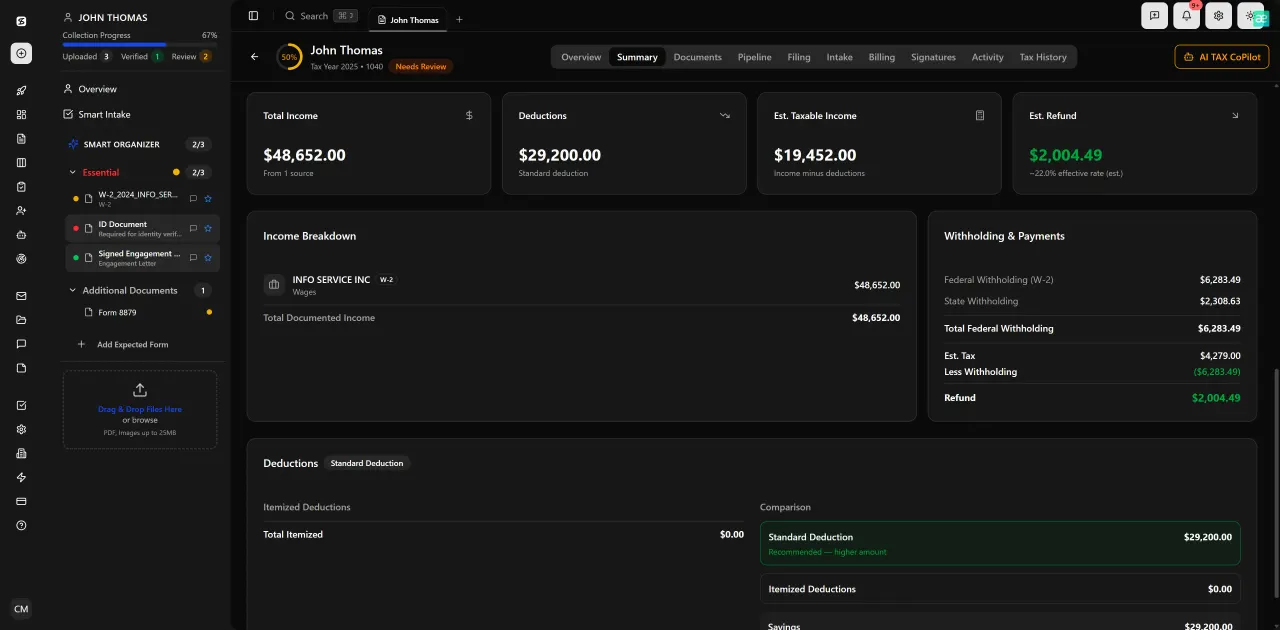
Review with AI assist — 9 agents answer questions with full client context
The $50,000 and $100,000 Ordinary Loss Caps
Tired of manual workflows slowing your firm down? See how TaxScout handles this with AI-powered automation. → Book a 15-Min Demo Understanding section 1244 stock loss in this context is what separates firms that scale from those that stall.
The ordinary loss benefit is capped. Under IRC § 1244(b), the maximum ordinary loss a taxpayer can claim in any single tax year is $50,000 — or $100,000 for a married couple filing jointly. Losses in excess of these thresholds retain capital loss character and are subject to the standard $3,000 annual net capital loss deduction limit with carryforward to future years. This is precisely where a deliberate section 1244 stock loss strategy pays off, particularly for clients whose startup portfolios span multiple investment rounds.
The married-filing-jointly (MFJ) $100,000 cap applies to the couple as a unit, not per spouse. If each spouse individually holds Section 1244 stock that becomes worthless in the same year and the combined losses exceed $100,000, the excess converts to capital loss. Conversely, a couple whose combined Section 1244 losses are exactly $100,000 can use the full amount as ordinary regardless of which spouse technically held the shares — provided both conditions (MFJ status in the loss year and qualifying stock) are met. A section 1244 stock loss sits at the center of this decision — get it wrong and the rest unravels.
This creates a real filing-status planning opportunity. A high-income client who is legally separated or considering filing separately in the loss year should model both scenarios carefully. Filing separately limits each spouse to the $50,000 cap, potentially doubling the capital loss carryforward compared to a joint return that absorbs the full $100,000. On the other hand, if the loss is below $100,000, the joint cap is fully utilized either way. For clients with substantial other capital gains in the loss year, the capital loss character of the excess is less punishing — but for clients with ordinary income and no offsetting capital gains, maximizing ordinary loss treatment should be the priority. Our guide on Section 1231 gain planning covers adjacent ordinary-versus-capital analysis that CPAs can apply alongside Section 1244 strategy. When firms revisit their section 1244 stock loss priorities, the gaps usually surface here.
Tired of spending hours hunting down statutory authorities when a client calls about a failed startup investment?
TaxScout.ai's 9 AI research agents search IRS, Treasury, Cornell Law, and Congress in real time — so you surface Section 1244 authorities, basis rules, and carryforward mechanics in minutes, not hours.
Multi-Round Basis Adjustments and the Dilution Problem
Startups rarely raise money once. An angel investor who participates in a seed round, a Series A, and a bridge note will hold stock with layers of basis — and not all of it qualifies for Section 1244 ordinary loss treatment. The $1,000,000 capitalization ceiling is a lifetime test applied at each issuance, so shares issued after the corporation's aggregate equity contributions cross $1,000,000 do not qualify, even if the earlier shares did. Recognizing which tranches can support a section 1244 stock loss is essential before any loss event occurs.
Consider a practical example: A corporation issues common stock in a seed round when cumulative equity contributions are $400,000. The shares qualify. The corporation later closes a Series A that brings cumulative contributions to $1,500,000. The Series A shares do not qualify under Section 1244 because the test is breached at issuance. The original seed-round shares retain their Section 1244 character regardless of the later round — the disqualification is prospective, not retroactive.
Where it gets complicated is basis tracking. If the startup uses a stock split, recapitalization, or conversion of convertible notes into equity, the original qualifying shares may be exchanged for new shares, and the new shares take their own issuance-date test. A conversion of a SAFE note into preferred shares, for example, may disqualify the resulting stock if the corporation's capitalization has exceeded $1,000,000 by the conversion date. CPAs should pull the cap table, stock purchase agreements, and board resolutions for every round when computing the Section 1244-eligible portion of a client's basis.
From a documentation standpoint, AI document extraction can systematically pull financial figures from multiple issuance-period documents — term sheets, capitalization statements, 83(b) elections, and K-1s — reducing the manual effort of reconstructing contribution history across a five-year startup life cycle.
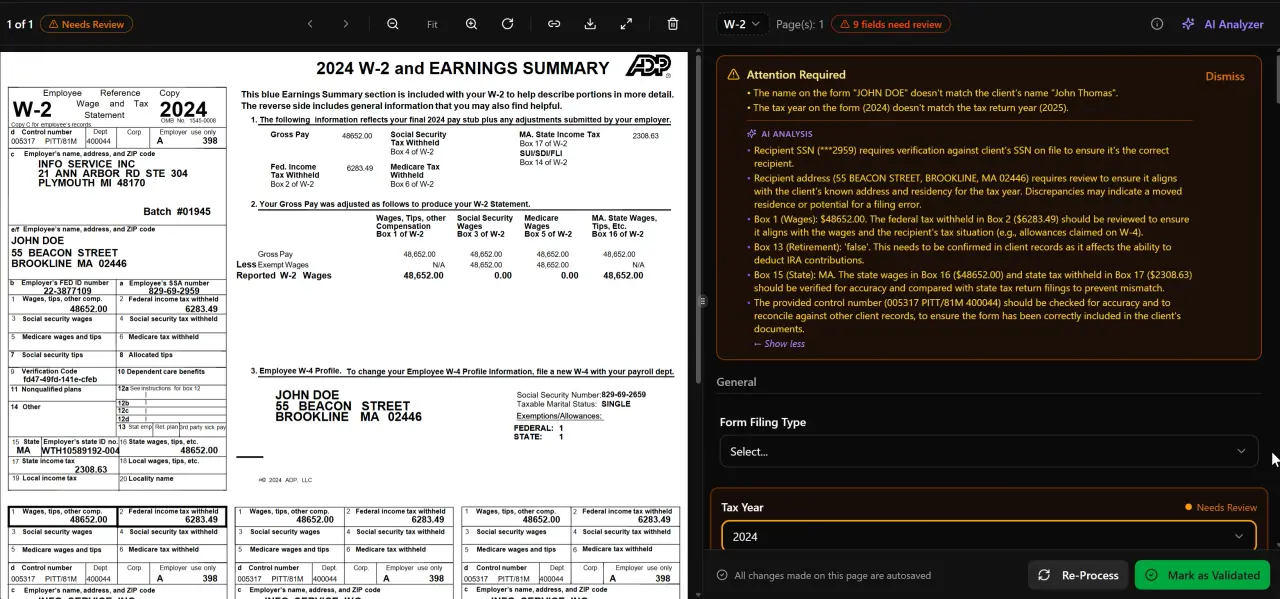
AI classifies, extracts, and validates every document automatically
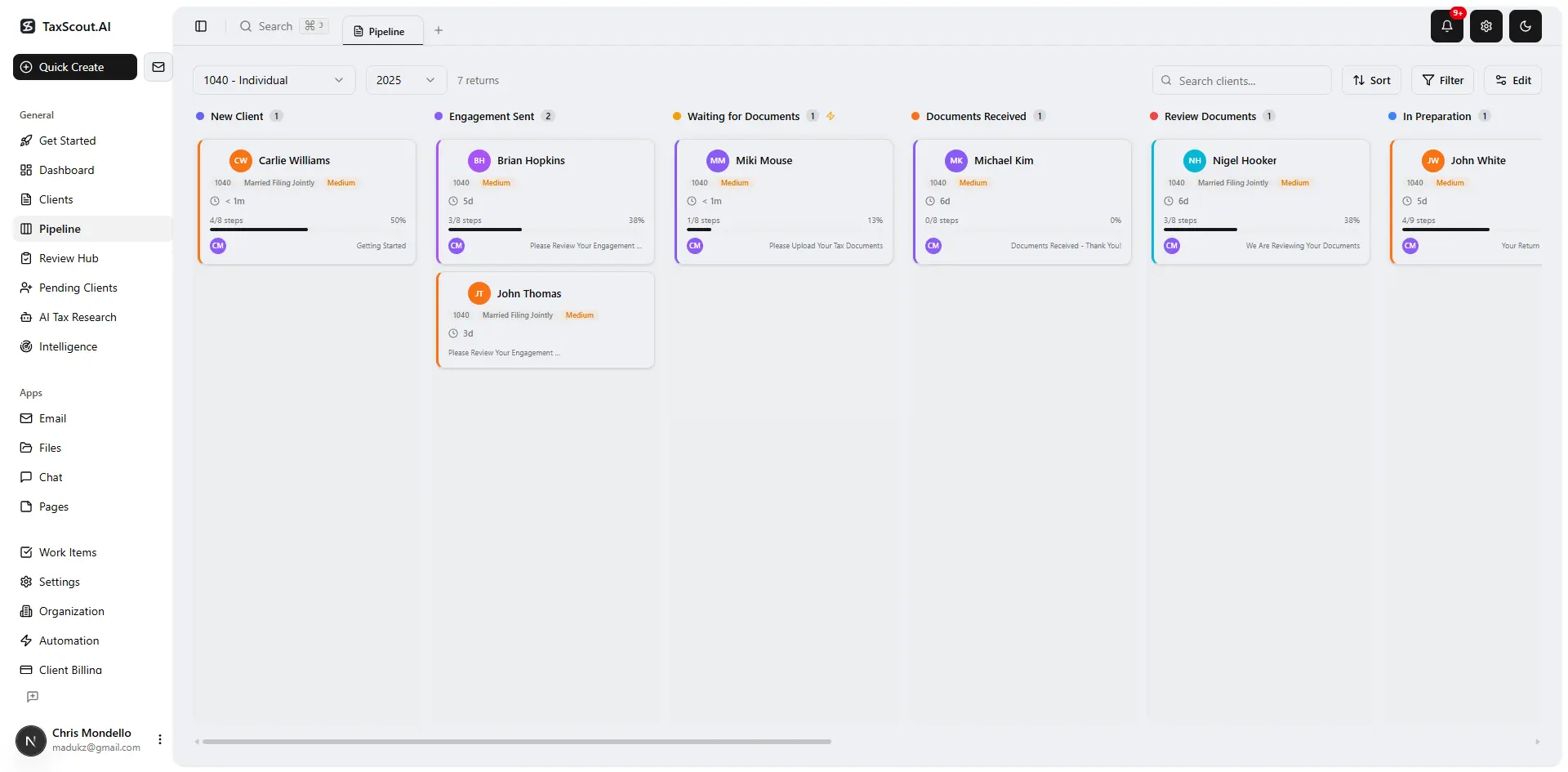
Track every return from intake to filed with drag-and-drop pipeline management
Proving Worthlessness vs. Sale or Exchange
Section 1244 losses are triggered by a sale, exchange, or worthlessness. For startups that formally dissolve or file for bankruptcy, worthlessness is typically straightforward: a state dissolution certificate or a bankruptcy court order establishes the event. For startups that simply stop operating without a formal legal event, the IRS requires the taxpayer to establish that the stock became objectively worthless — meaning the corporation had no going-concern value and there was no reasonable expectation of future recovery.
The IRS guidance on stock worthlessness under Publication 550 notes that the taxpayer bears the burden of proving the year in which the stock became worthless. This is consequential for Section 1244 because the ordinary loss caps apply per year. A taxpayer who misjudges the worthlessness year by claiming it one year too early or too late may lose the ordinary loss character entirely if the statute of limitations has run on the correct year. CPAs should calendar the date all assets were disposed and the last date the corporation conducted any activity, and preserve evidence contemporaneously. Establishing the correct worthlessness year is just as critical to a valid section 1244 stock loss claim as meeting the original issuance requirements.
When stock is sold to a third party for nominal consideration — common in distressed transactions where the investor accepts $1 in exchange for shares to generate a definitive loss event — the sale is treated as a sale or exchange, and Section 1244 applies to the recognized loss up to the applicable cap. This approach can be preferable to claiming worthlessness because it eliminates the timing dispute entirely.
Coordination With Capital Loss Carryforward Rules
After applying the $50K or $100K ordinary loss cap, any remaining Section 1244 loss becomes a capital loss. That capital loss enters the standard netting process under IRC § 1211 and § 1212. Short-term and long-term capital losses offset gains of the same character first, then net against each other, and any remaining net capital loss is deductible against ordinary income up to $3,000 per year with indefinite carryforward.
For a client who has held startup shares for more than one year, the excess capital loss will be long-term, which is the less favorable of the two buckets when there are short-term capital gains to shelter. CPAs should model the netting in the year of loss to determine whether the client also has unrealized short-term capital losses elsewhere in the portfolio that could be harvested to create a more favorable net position.
One interaction that practitioners often miss: if the client has an existing capital loss carryforward from prior years, that carryforward does not reduce the Section 1244 ordinary loss. The ordinary portion is computed first, based on the actual loss recognized on the qualifying shares up to the cap, without reduction by any prior-year carryforward. The carryforward only enters the analysis when computing the residual capital loss. Our companion articles on QSBS exclusion planning and Section 1031 boot tax mechanics cover related basis and character issues CPAs frequently encounter alongside Section 1244 situations.
For clients who also have passive activity losses, note that a section 1244 stock loss is treated as an ordinary loss — it is not a passive loss and is not subject to the passive activity loss rules under IRC § 469, provided the shareholder materially participated in the startup's operations at the relevant time. Confirming material participation is therefore not just a Section 469 issue; it can influence how the loss interacts with the rest of the return.
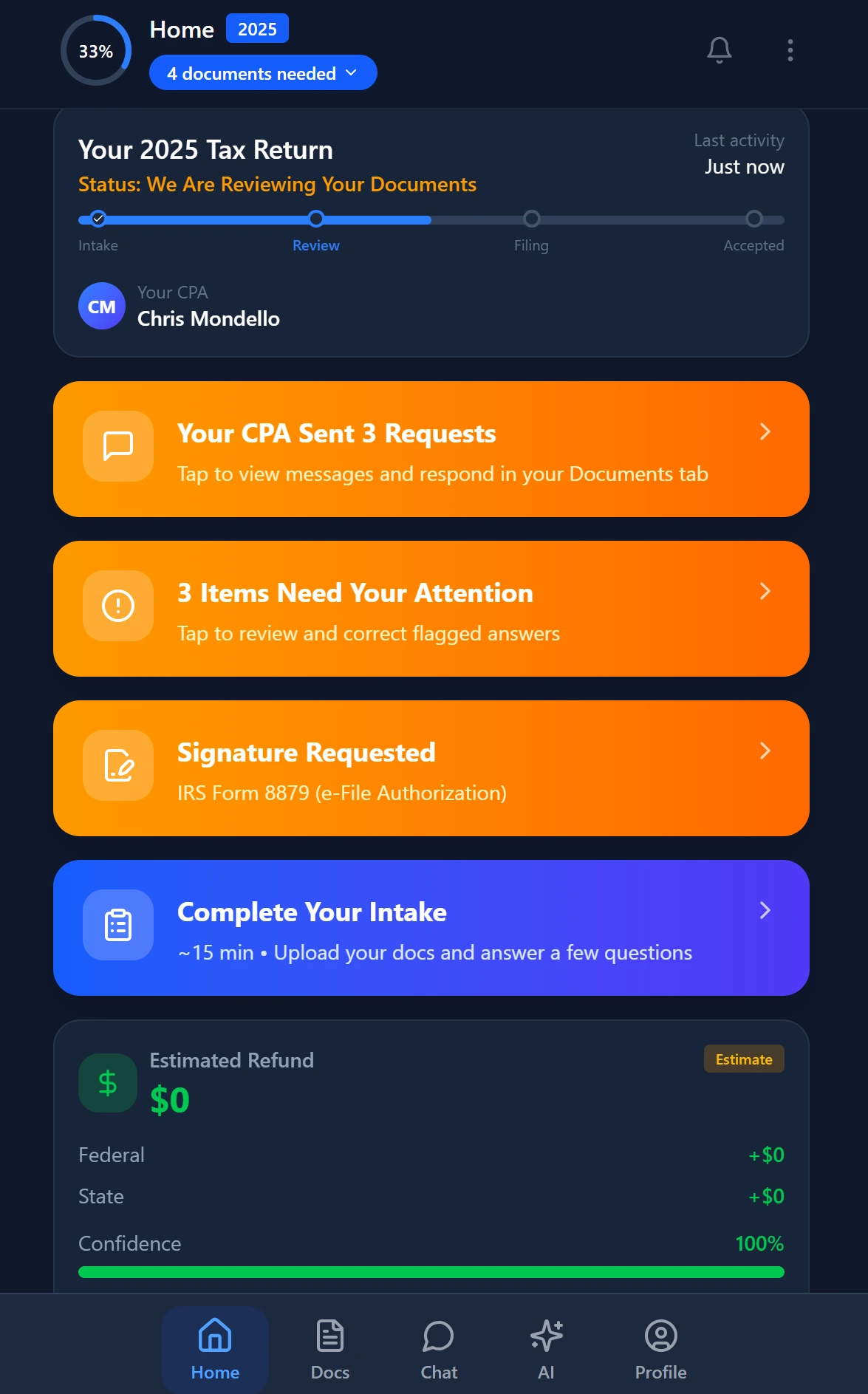
Smart intake auto-fills from uploaded documents and prior-year data
The No-Election Trap and Documentation Best Practices
Unlike Section 1202, Section 1244 does not require a formal election filed with the IRS. The ordinary loss treatment is automatic, provided the requirements are met. However, that does not mean documentation is optional. The IRS may challenge the character of the loss on audit, and the taxpayer must be able to demonstrate that the stock satisfied each qualifying condition at issuance.
Best-practice documentation for a Section 1244 position includes: (a) the original stock purchase agreement showing the consideration paid and the form of consideration (money or property, not services); (b) the corporation's capitalization records at the date of each issuance, typically drawn from the cap table and financial statements; (c) evidence of the corporation's gross receipts composition for the five most recent tax years preceding the loss year, to satisfy the active business income test; and (d) the loss event documentation — dissolution certificate, bankruptcy filing, or sale agreement.
For CPA firms managing multiple clients with startup investments, maintaining a systematic document intake process is essential. TaxScout.ai's client portal and AI intake engine allow firms to collect and classify these documents from the moment a client relationship begins — so that by the time a section 1244 stock loss occurs, the qualifying-stock evidence is already organized and retrievable. CPAs who try to reconstruct a startup's capitalization history years after the fact often discover that records are unavailable or that former founders are unresponsive.
One practical tip: when a client first brings in a startup investment for review, add a Section 1244 checklist item to the engagement — even if there is no current loss. Confirm the capitalization at each issuance date and note whether each tranche qualifies. If the stock does not qualify, document that determination so you are not revisiting it under time pressure when the client calls to say the startup has failed.

Every client gets organized documents, status tracking, and a complete history
Reporting Section 1244 Losses on Form 4797 and Schedule D
Section 1244 ordinary losses are reported on IRS Form 4797, Sales of Business Property — specifically Part II, which covers ordinary gains and losses. The loss flows from Form 4797 to Schedule 1, line 4, and ultimately to Form 1040 as an above-the-line adjustment to gross income. This is what makes the ordinary character so valuable: it reduces AGI, which in turn can affect phase-outs for the QBI deduction, SALT cap calculations, and income-based surcharges such as the net investment income tax.
The capital loss portion — the excess above the $50K or $100K cap — is reported on Schedule D in the normal manner, with the appropriate short-term or long-term classification based on the holding period. Because the ordinary and capital portions of the same investment appear on different forms, CPAs should prepare a reconciliation workpaper showing the total loss, the Section 1244-eligible portion, the ordinary loss applied, and the capital loss balance. This workpaper protects against audit misunderstanding and helps the client understand why only part of their loss generated immediate tax relief.
For taxpayers who are also founders and received stock for services rather than cash, Section 1244 does not apply to that portion of their shares. If a founder received 1,000,000 shares for services and later purchased an additional 200,000 shares for cash, only the 200,000 purchased shares can generate a section 1244 stock loss with ordinary treatment. The service-based shares will produce capital loss only. CPAs should bifurcate the basis and the loss accordingly. For more context on the broader landscape of startup tax issues CPAs handle, other blog resources on our platform cover related planning topics in depth.
Section 1244 Ordinary Loss vs. Standard Capital Loss: Key Differences for CPA Planning
| Factor | Section 1244 Ordinary Loss | Standard Capital Loss |
|---|---|---|
| Annual deduction limit | $50,000 single / $100,000 MFJ | $3,000 against ordinary income |
| Carryforward | No carryforward of the ordinary portion | Indefinite carryforward |
| AGI impact | Reduces AGI directly | Does not reduce AGI beyond $3,000/year |
| Reporting form | Form 4797, Part II | Schedule D |
| Eligible holders | Individuals only (not trusts or corporations) | All taxpayers |
| Stock acquired for services | Does not qualify | Qualifies as capital loss |
| Capitalization limit test | Corporation must be under $1M at issuance | No limit |
| Election required | No formal election needed | N/A |
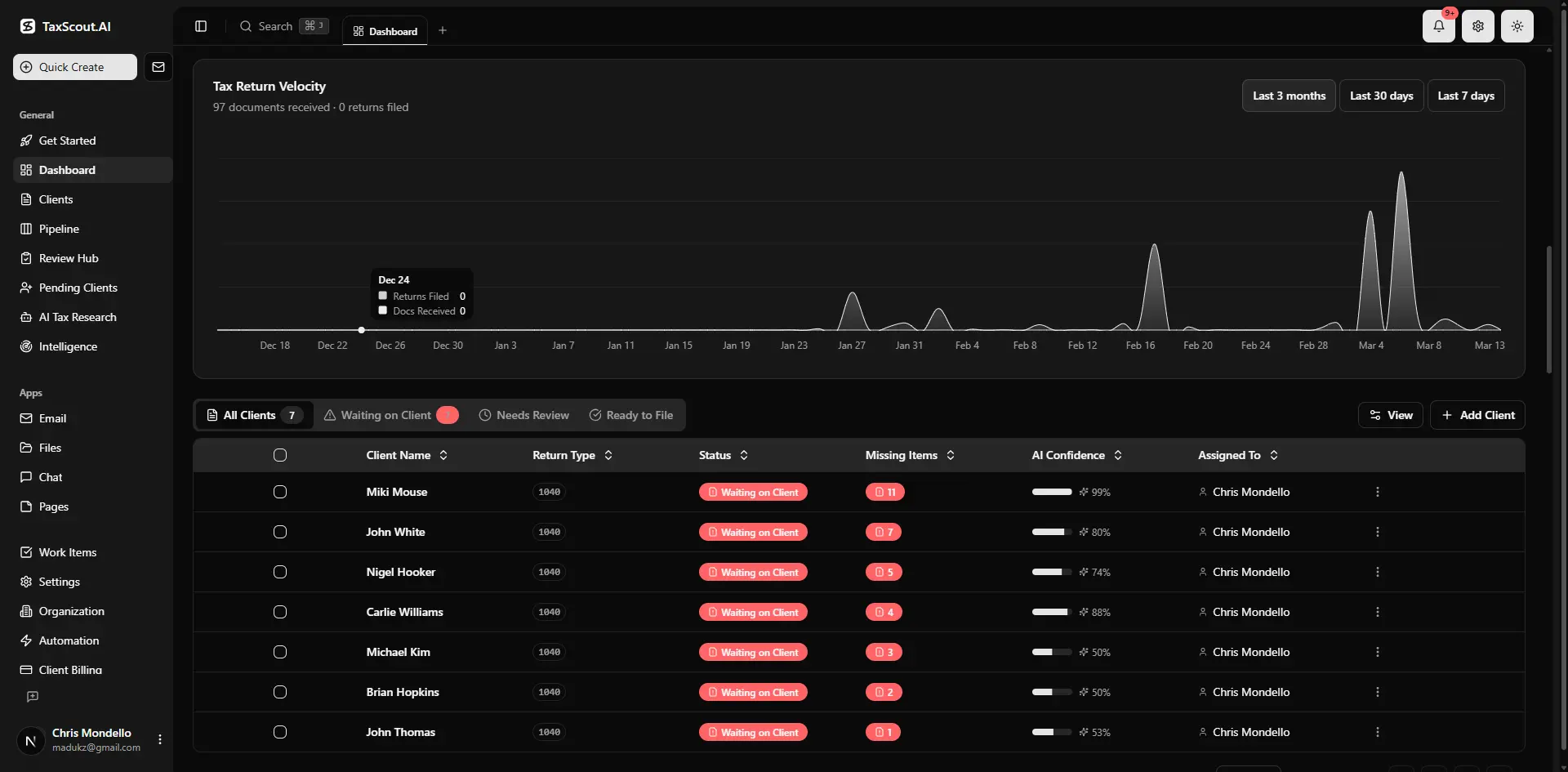
Real-time dashboard showing returns in progress, revenue, and upcoming deadlines

Click any extracted field to see its source highlighted on the original PDF
Filing Status Optimization Around the Ordinary Loss Caps
The MFJ $100,000 cap versus the married-filing-separately (MFS) $50,000 per-spouse cap creates a filing-status optimization question that most clients will never raise on their own — but that a proactive CPA should model. The analysis depends on (a) the total Section 1244 loss, (b) each spouse's individual income and tax bracket, (c) other itemized deductions affected by filing status (particularly the SALT deduction cap, which is $40,000 MFJ versus $20,000 MFS in 2025), and (d) whether the spouses have offsetting capital gains.
For a couple with a combined Section 1244 loss of $80,000 and no capital gains, filing jointly allows the full $80,000 ordinary deduction. Filing separately, each spouse could claim $40,000 ordinary (assuming the shares are allocated equally), producing the same aggregate result. But if one spouse has substantial W-2 income and the other does not, concentrating the section 1244 stock loss on the higher-bracket spouse's separate return — even at the cost of capping the other at $50,000 — may yield more after-tax benefit. Conversely, if the total loss exceeds $100,000, the excess must become a capital loss regardless of filing status, and the MFS election doubles the per-spouse ordinary cap only if each spouse individually holds qualifying shares.
Note that MFS status triggers its own penalties: loss of the student loan interest deduction, phase-out of the IRA deduction, and disqualification from certain credits. The filing-status optimization must therefore be a whole-return analysis, not a Section 1244-only calculation. IRS Publication 504 covers the filing status rules in detail and is a useful reference to share with clients when explaining the trade-offs.
Section 1244 and the Broader Startup Tax Planning Framework
Section 1244 does not exist in isolation. CPAs advising angel investors and founders operate in a framework that includes Section 1202 QSBS gain exclusion, Section 83(b) elections for restricted stock, Section 1045 rollover of QSBS, at-risk rules under IRC § 465, passive activity rules under IRC § 469, and state conformity issues that vary significantly by jurisdiction. State conformity to federal loss provisions is not assumed — several states do not follow Section 1244, meaning the ordinary loss treatment on the federal return does not automatically flow through to the state return. CPAs working across multiple state jurisdictions should verify conformity before advising a client that a section 1244 stock loss will reduce their state taxable income as well.
For clients who hold both qualifying and non-qualifying startup shares, CPAs should also consider whether a Ponzi-style fraud loss under Revenue Procedure 2009-20 or a theft loss under IRC § 165 might apply if the startup failure involved fraud — topics covered in our Ponzi scheme loss deductions guide. Coordinating multiple loss regimes requires a structured research process, and TaxScout.ai's AI research agents are designed to search across IRS.gov, Treasury, Cornell Law, and Congress simultaneously, surfacing the relevant authorities for each regime without requiring separate manual searches.
When the startup was organized as an S corporation rather than a C corporation, Section 1244 can still apply — S corporation shares qualify provided the other conditions are met. However, the S corporation context adds a basis complexity: under the at-risk rules and the shareholder basis rules of IRC § 1367, the shareholder's stock basis may already be reduced by prior-year loss pass-throughs. The section 1244 stock loss is computed on the adjusted basis at the time of the loss event, so tracking annual basis adjustments on S corporation returns is a prerequisite to computing the correct Section 1244 deduction.
Still tracking startup basis adjustments and Section 1244 eligibility in spreadsheets?
TaxScout.ai gives CPA firms AI document extraction, real-time tax research, and a structured client file system — so every angel investor and founder client has a defensible Section 1244 workpaper ready before the loss year arrives.

Track firm performance with real-time analytics and client activity monitoring
Frequently Asked Questions
No. Section 1244 does not require a formal election filed with the IRS. The ordinary loss treatment is automatic if all qualifying conditions are met at the time of stock issuance. However, taxpayers must be able to document those conditions on audit, so maintaining capitalization records, stock purchase agreements, and gross receipts data from the relevant years is essential even without a filing requirement.
Keep reading
Agency Information Collection Activities Requesting Comment
Oct 26, 2026 · 1 min read
Divorce Tax Planning for CPAs: How to Split Assets Without Triggering Unexpected Liability
Oct 25, 2026 · 1 min read
Ponzi Scheme Loss Deductions: How CPAs Claim Theft Losses for Defrauded Clients
Oct 24, 2026 · 1 min read
Stay up to date
Get the latest tax tech insights delivered to your inbox.