Agency Information Collection Activities Requesting Comment
On October 21, 2026, the IRS opened a Paperwork Reduction Act comment window on information collection for qualified contributions to scholarship granting organizations under new IRC Section 25F. The notice is low-priority for most firms but is directly relevant to practices serving individual…
The IRS published an agency information collection activities requesting comment notice in the Federal Register on October 21, 2026, covering the reporting requirements for qualified contributions to a scholarship granting organization (SGO) under newly enacted IRC Section 25F. The notice formally invites public comment under the Paperwork Reduction Act of 1995 before the IRS submits the information collection to the Office of Management and Budget for approval.
For most general-practice CPA firms, this notice is background noise — but for firms with clients who donate to state-authorized SGOs, operate as SGOs, or claim the new scholarship tax credit on their individual returns, it is a signal to update intake workflows and client communications now. The comment period is open, and the underlying credit mechanics will affect Form 1040 filings for tax year 2026 and beyond. Firms tracking regulatory developments should note that this falls under the broader category of agency information collection activities requesting comment, meaning practitioners have a limited window to influence how the final requirements are shaped.
This brief extracts the operational impact. For the full regulatory text, see the Agency Information Collection Activities; Requesting Comment on Qualified Contributions to a Scholarship Granting Organization Under Section 25F notice published at FederalRegister.gov. Understanding the scope of agency information collection activities requesting comment on this topic will help firms determine which clients need immediate guidance and which workflows require updating.
What the Notice Actually Says
Under the Paperwork Reduction Act of 1995, the IRS is required to publish notice and solicit comments before renewing or establishing any information collection requirement. This particular notice covers IRC Section 25F, which provides a nonrefundable individual income tax credit for qualified contributions made to state-certified scholarship granting organizations. The IRS is inventorying the recordkeeping and reporting burden that donors, SGOs, and return preparers will face when the credit is claimed. This process, formalized through agency information collection activities requesting comment, ensures that tax professionals and affected taxpayers have an opportunity to weigh in before the IRS finalizes its documentation and reporting expectations under Section 25F.
The information collection covers: (1) documentation that a contribution qualifies under state law and Section 25F, (2) the written acknowledgment the SGO must provide to the donor, and (3) any associated return schedules or statements the IRS will require on Form 1040. The IRS is specifically asking practitioners and affected parties to comment on whether the collection is necessary, whether its burden estimates are accurate, and whether the agency can reduce the burden through better technology or form design. For firms evaluating their agency information collection activities requesting comment approach, this trade-off compounds over time.
The notice carries a low operational priority signal for firms that do not yet have SGO-connected clients — but that could change quickly as state-level scholarship tax credit programs expand to meet the federal credit. You can follow additional regulatory updates in our complete Federal Register news coverage. Each of these factors directly shapes how agency information collection activities requesting comment plays out in practice.
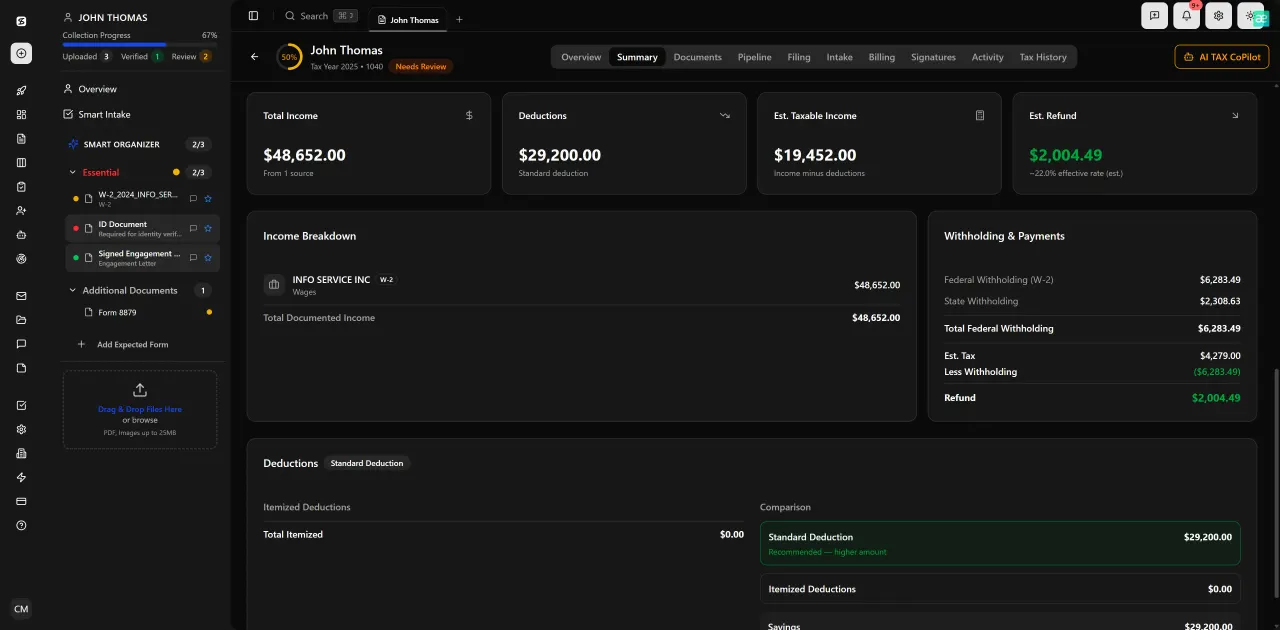
Review with AI assist — 9 agents answer questions with full client context
Which Entity Types and Client Segments Are Affected
Tired of manual workflows slowing your firm down? See how TaxScout handles this with AI-powered automation. → Book a 15-Min Demo Understanding agency information collection activities requesting comment in this context is what separates firms that scale from those that stall.
The Section 25F credit is an individual income tax credit, so the primary filing impact lands on Form 1040 filers — specifically, individuals who make qualified contributions to an SGO in a state that has an authorized program. High-income donors who have been using state PTET elections or SALT workarounds to optimize deductions (see our SALT deduction cap workarounds guide) should be evaluated for whether an SGO contribution now fits their charitable planning stack alongside the enhanced SALT cap of $40,400 for 2026. This is precisely where a deliberate agency information collection activities requesting comment strategy pays off.
Pass-through owners are an important secondary group. An S-corporation or partnership that encourages or facilitates owner contributions to SGOs does not itself claim the credit — it flows to the individual return — but the K-1 package and client communications need to account for the documentation chain. The credit is nonrefundable, so tax liability positioning matters. Agency information collection activities requesting comment sits at the center of this decision — get it wrong and the rest unravels.
Nonprofit organizations that operate as SGOs face the other side of the equation: they must issue compliant written acknowledgments to donors and maintain records sufficient to verify state certification. CPA firms that serve nonprofit clients under advisory services engagements should confirm whether any client qualifies as an SGO and whether their recordkeeping policies are adequate. For a deeper look at how charitable-giving mechanics interact with individual planning, see our charitable giving strategies guide.
Are regulatory notices stacking up faster than your team can process them?
TaxScout's AI Research Agents monitor IRS, Treasury, and Federal Register sources continuously — so your firm flags client-relevant changes before the comment deadline, not after.
→ See AI Research Agents in Action
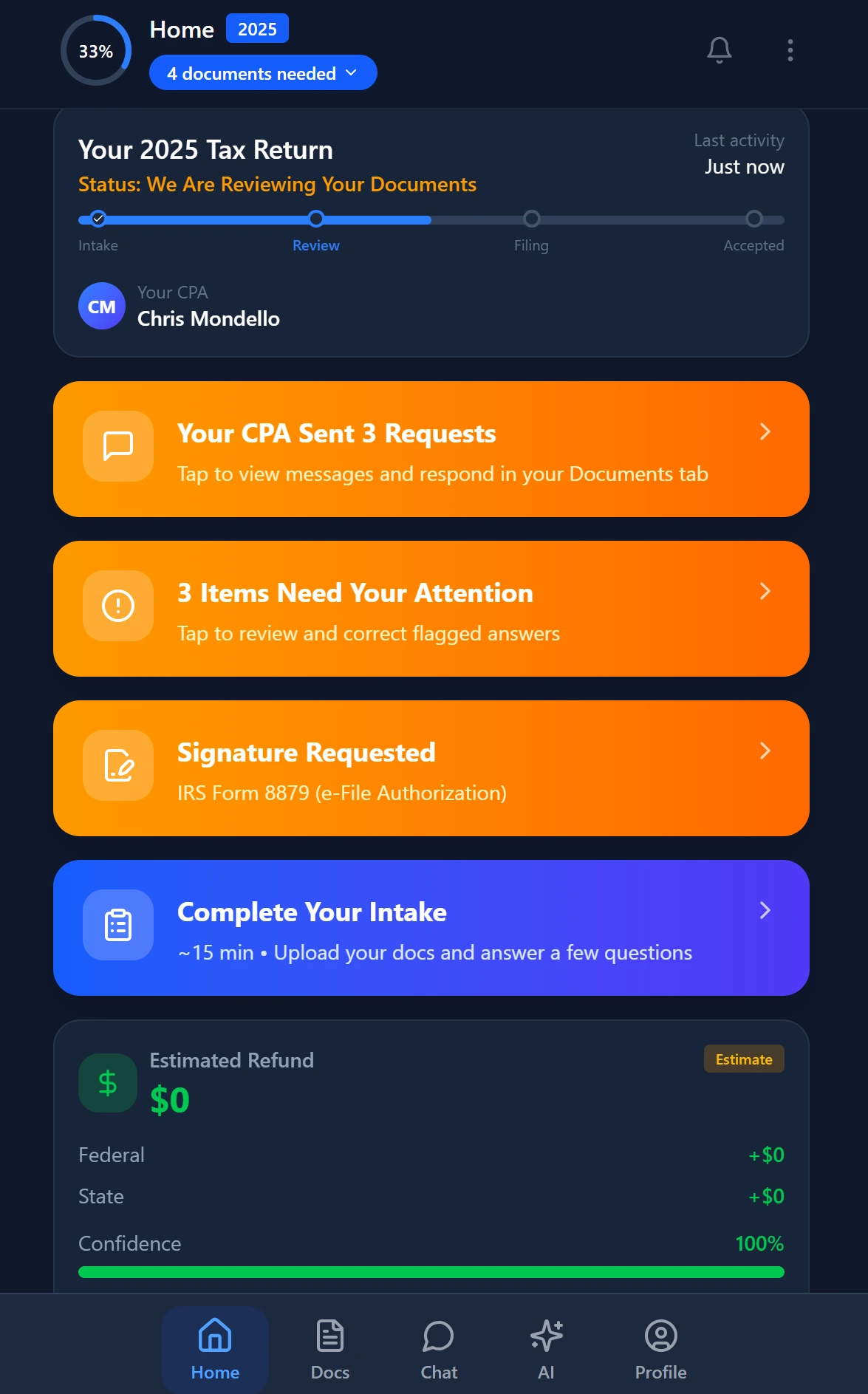
Smart intake auto-fills from uploaded documents and prior-year data
What to Do This Week: Action List for CPA Firms
This notice does not create an immediate filing obligation, but it does open a comment window and signals that IRS forms and instructions for Section 25F are in active development. Here is a prioritized action list for the week of October 21, 2026:
1. Identify affected clients now. Run a quick scan of your client list for (a) high-income individual filers in states with active SGO programs, (b) nonprofit clients that operate or are considering SGO status, and (c) pass-through owners whose charitable giving plans have not been reviewed for 2026. Use client management tools or pipeline tags to flag these households.
2. Update your 2026 tax organizer. Add a question about qualified SGO contributions to your intake process. TaxScout's smart intake engine lets you push targeted questions to clients based on prior-year data, so you are not adding noise for the 90% of clients for whom this is irrelevant.
3. Review acknowledgment requirements with nonprofit clients. Section 25F requires the SGO to provide a written acknowledgment to the donor. If you serve an SGO as a client, confirm they have a compliant acknowledgment template in place before year-end giving season. The e-signatures feature can streamline acknowledgment delivery and create a timestamped audit trail.
4. Consider filing a comment. If your firm has clients who will be materially affected by the burden of this information collection, the comment window is your opportunity to influence the final form design and burden estimates. Comments should be submitted before the deadline stated in the Federal Register notice. The IRS comment submission portal accepts practitioner input. Referencing your specific experience with recordkeeping burden is more persuasive than general objections.
5. Watch for draft forms. After the comment period closes, the IRS will publish a revised or final notice before OMB approval, typically followed by draft instructions or a new/revised Form 1040 schedule. Monitor IRS.gov draft forms and set a calendar alert for Q1 2027 to check whether the credit has a dedicated line or flows through Schedule 3.
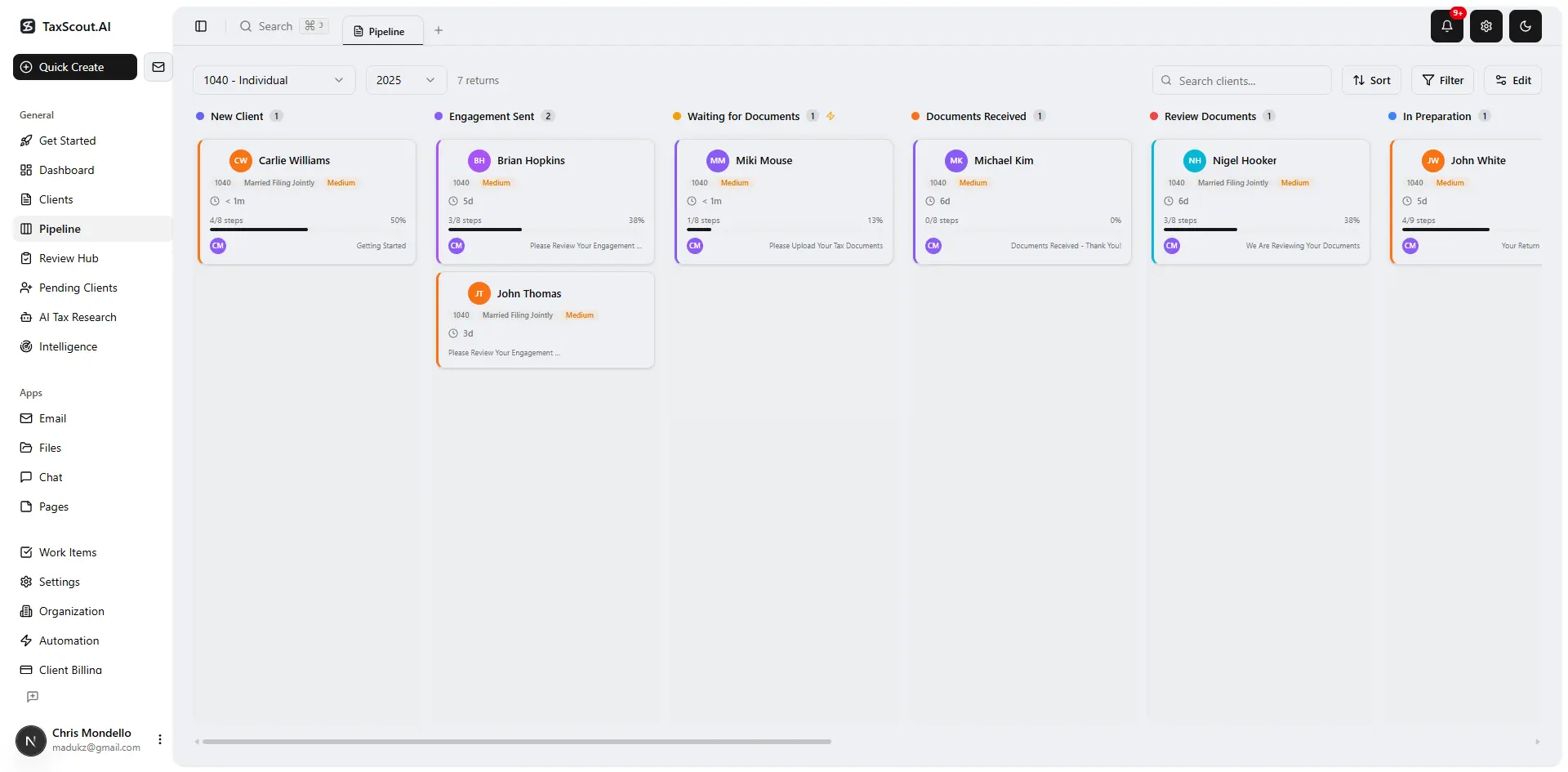
Track every return from intake to filed with drag-and-drop pipeline management
How Section 25F Interacts With Existing Charitable Deduction Planning
The Section 25F credit is structurally different from a charitable deduction. A credit reduces tax liability dollar for dollar, while a deduction reduces taxable income at the marginal rate. For a client in the 32% or 35% bracket, a nonrefundable credit is generally more valuable per dollar contributed than an itemized deduction — but the interaction with the standard deduction, AGI phase-outs, and state tax treatment requires a full planning analysis rather than a rule of thumb.
The standard deduction for 2026 is $16,100 for single filers and $32,200 for married filing jointly under IRS Rev. Proc. 2025-32. Many clients who contribute to SGOs will not have enough total itemized deductions to exceed the standard deduction, which means the Section 25F credit may be their primary federal tax benefit from the contribution. That planning insight should be part of any client advisory conversation this fall.
State conformity is a live question. Not all states that have authorized SGO programs will automatically conform to the federal credit computation or the federal acknowledgment requirements. Practitioners should check state conformity rules before assuming the federal and state treatment are aligned. The SSA and Treasury have not yet issued coordinated guidance on state interaction as of the publication of this notice.
Why the Paperwork Reduction Act Comment Process Matters for Practitioners
The Paperwork Reduction Act, codified at 44 U.S.C. § 3501 et seq., requires federal agencies to justify every information collection burden they impose on the public. When the IRS opens a comment window, practitioner input genuinely shapes the final burden estimate and can influence whether a new form is a single checkbox or a multi-page schedule.
Recent examples where practitioner comments reduced compliance burden include the streamlined Form 1099-K threshold guidance and modifications to Schedule K-2/K-3 filing relief. For background on how K-3 reporting has evolved in response to practitioner input, see our Schedule K-3 reporting guide. The Section 25F comment process is an earlier-stage opportunity to shape a credit that is still being operationalized.
The Journal of Accountancy and state CPA societies periodically aggregate practitioner comment letters on high-impact collections — coordinating with your state society before the deadline can amplify your firm's input.
Want your firm to stop reacting to IRS notices and start anticipating them?
TaxScout.ai gives CPA firms AI-powered regulatory intelligence, smart client intake, and a full pipeline — all at a flat rate with no per-user fees.

Your clients see your brand — OTP login, document upload, and real-time status
Frequently Asked Questions
IRC Section 25F provides a nonrefundable individual income tax credit for qualified contributions made to state-certified scholarship granting organizations (SGOs). The credit reduces federal income tax liability dollar for dollar for eligible donors and is reported on Form 1040. The IRS is currently developing the information collection requirements for this credit through a Paperwork Reduction Act comment process.
Keep reading
Section 1244 Stock Loss: How CPAs Turn Failed Startup Investments Into Ordinary Deductions
Oct 26, 2026 · 1 min read
Divorce Tax Planning for CPAs: How to Split Assets Without Triggering Unexpected Liability
Oct 25, 2026 · 1 min read
Ponzi Scheme Loss Deductions: How CPAs Claim Theft Losses for Defrauded Clients
Oct 24, 2026 · 1 min read
Stay up to date
Get the latest tax tech insights delivered to your inbox.