Ponzi Scheme Loss Deductions: How CPAs Claim Theft Losses for Defrauded Clients
When a client discovers they were victimized by a fraudulent investment arrangement, the IRS safe harbor under Revenue Procedure 2009-20 can turn a devastating loss into a meaningful deduction — but the mechanics are exacting. This guide walks CPAs through the qualified investment loss election…
Ponzi scheme loss deductions sit at the intersection of criminal law, securities regulation, and tax code — a convergence that leaves many CPA firms scrambling for guidance the moment a client calls in distress. When the Madoff scandal broke in 2008, the IRS responded with Revenue Procedure 2009-20, creating a safe harbor that transformed what could have been a chaotic, taxpayer-by-taxpayer interpretive exercise into a structured election process. That framework remains the primary vehicle for CPAs today.
The core issue is timing and characterization. A theft loss under IRC § 165 is deductible in the year of discovery — not the year the fraud began, and not the year a receiver is appointed. The deduction flows through Schedule A as an itemized deduction for individuals, bypassing capital loss limitations entirely. That distinction — theft loss versus capital loss — is the single most consequential determination in the analysis, and it is one that competitor resources almost universally gloss over. Understanding ponzi scheme loss deductions starts with getting this characterization right, as the timing and treatment differ fundamentally from ordinary capital losses.
This guide is written for practitioners who already understand the basics of investment fraud and need a technically precise, filing-ready walkthrough of Rev Proc 2009-20, the qualified investor loss election, the percentage-of-recovery elections, how SIPC claims interact with those percentages, and exactly which year a deduction belongs in when clients discover fraud years after it began. Practitioners navigating ponzi scheme loss deductions will find that Rev Proc 2009-20 provides a safe harbor framework that simplifies many of these complex determinations.
Why Ponzi Losses Are Not Capital Losses
The first question every CPA must answer is whether the client's loss is a theft loss or a capital loss. The answer drives everything from AGI impact to carryforward rules to itemized deduction treatment. For clients caught in fraudulent investment arrangements, correctly classifying the loss as a theft loss is the essential first step toward maximizing available ponzi scheme loss deductions under IRC § 165.
A capital loss arises when a taxpayer sells or exchanges a capital asset at a loss. It is subject to the $3,000 annual deduction limit against ordinary income and generates a carryforward if unused. By contrast, a theft loss under IRC § 165(c)(3) is an ordinary loss — fully deductible in the year of discovery to the extent it exceeds any insurance or other recovery. There is no annual dollar ceiling on a theft loss deduction, and it can generate a net operating loss that carries back or forward under normal NOL rules. For firms evaluating their ponzi scheme loss deductions approach, this trade-off compounds over time.
For Ponzi scheme victims, the IRS has consistently held — and Tax Court has affirmed — that the loss is a theft, not a failed investment. The fraudster never legitimately invested the funds; the 'account statements' were fabrications; and the 'returns' paid to early investors were funded by later investors' principal. Under those facts, the IRS Chief Counsel characterizes the loss as theft under IRC § 165(e), which keys the deduction to the year of discovery rather than the year of loss. This matters enormously for clients who held 'accounts' with a fraudster for years: the entire economic loss is recognized in a single discovery year, not spread across the investment period. Each of these factors directly shapes how ponzi scheme loss deductions plays out in practice.
For additional context on how ordinary versus capital loss characterization plays out across asset classes, see our guide on Section 1231 gain planning. Understanding ponzi scheme loss deductions in this context is what separates firms that scale from those that stall.

Review with AI assist — 9 agents answer questions with full client context
Revenue Procedure 2009-20 Safe Harbor: Structure and Eligibility
Revenue Procedure 2009-20 provides a safe harbor that allows qualifying taxpayers to deduct a specified percentage of their qualified investment loss without having to prove each element of a theft under state law. Using the safe harbor is an election — it is not mandatory — but it eliminates significant documentation and litigation risk. Practitioners should default to it unless the client's specific facts produce a better outcome outside the safe harbor. This is precisely where a deliberate ponzi scheme loss deductions strategy pays off.
To qualify, the taxpayer must be a 'qualified investor,' meaning they invested in a 'qualified investment arrangement' — a fraudulent arrangement in which the operator (a) received cash or property from investors, (b) purported to earn income on their behalf, (c) made payments to investors funded by other investors' principal rather than actual income, and (d) is subject to a criminal charge, criminal information, or civil complaint by a government authority alleging fraud, embezzlement, or similar conduct. The requirement that a government charge exist is critical: the safe harbor does not apply to suspected fraud that has not yet prompted official action. Ponzi scheme loss deductions sits at the center of this decision — get it wrong and the rest unravels.
The qualified investor must also have no actual or constructive knowledge of the fraudulent nature of the arrangement at the time of investment, and must not be a 'related party' to the operator as defined under §§ 267 and 707. Investors who had reason to know the arrangement was fraudulent — for example, because they received promised returns far exceeding any plausible market rate and never questioned it — may face challenges on this element. When firms revisit their ponzi scheme loss deductions priorities, the gaps usually surface here.
The safe harbor is elected by attaching a completed statement (described in Section 6 of Rev Proc 2009-20) to the return for the discovery year. The statement must identify the qualified investment arrangement, the operator, and the amounts invested and recovered. Many practitioners fail to attach this statement because the client's year-of-discovery return was already filed; we address the amended return mechanics below.
Managing complex theft loss engagements across multiple clients while keeping track of discovery years, amended returns, and recovery claim updates?
TaxScout.ai gives your firm AI-powered document extraction, 9 specialized research agents with live IRS and Treasury search, and a full pipeline management system — all on one flat monthly fee with unlimited team members.

Track every return from intake to filed with drag-and-drop pipeline management
Calculating the Qualified Investment Loss: The 95% and 75% Elections
The heart of Rev Proc 2009-20 is the percentage election. Once a taxpayer qualifies as a qualified investor, the deductible theft loss equals either 95% or 75% of the 'qualified investment loss,' which is calculated as follows: net amount invested (total deposits less total withdrawals) minus the fair market value of any assets actually received from the arrangement minus any potential third-party recovery. For practitioners working through ponzi scheme loss deductions, the percentage election is often the single largest determinant of the client's tax outcome in the discovery year.
The 95% election is available to investors who do not have a potential third-party recovery claim — most commonly, investors who are not covered by SIPC, do not have a pending civil suit against third parties such as feeder funds or auditors, and have no insurance covering the loss. Under the 95% election, the deductible loss is 95% of the qualified investment loss. The remaining 5% is reserved against the possibility of any future unexpected recovery.
The 75% election applies when the taxpayer has a 'potential third-party recovery' — meaning a viable claim against SIPC, a lawsuit against an enabling party, or insurance coverage. Under the 75% election, the deductible loss is 75% of the qualified investment loss, with the remaining 25% reserved against actual or potential recoveries from those third parties.
The choice between 95% and 75% is not merely arithmetic. A taxpayer who incorrectly uses the 95% election when a SIPC claim exists has understated the deferred-recovery reserve, which can produce income recognition when the recovery actually arrives. Practitioners must review all relevant third-party recovery avenues before making this election. See other tax research resources for additional coverage of complex deduction elections.
One mechanic that surprises practitioners: the 'potential third-party recovery' does not have to be large or certain. If the client has filed, or intends to file, a SIPC claim — even a modest one — the 75% election is required. If a SIPC determination has already been made and the recovery amount is known, the known recovery amount is simply subtracted from the qualified investment loss calculation before applying the percentage, rather than being treated as a deferred reserve. Firms that handle ponzi scheme loss deductions regularly should build a checklist for third-party recovery screening into every new engagement intake.

Every client gets organized documents, status tracking, and a complete history
How SIPC Claims Interact With the Theft Loss Election
The Securities Investor Protection Corporation (SIPC) provides limited protection to investors at failed brokerage firms — generally up to $500,000 per customer account, including up to $250,000 for cash. SIPC protection does not cover losses from fraud at entities that were not registered broker-dealers, which is why many Ponzi victims receive nothing from SIPC. However, when the fraudulent arrangement was operated through or in connection with a registered broker-dealer (as was the case with Madoff's broker-dealer subsidiary), SIPC claims become relevant.
When a SIPC claim is pending at the time the return for the discovery year is filed, the taxpayer must use the 75% election — the existence of the potential recovery claim is sufficient, regardless of likelihood of actual recovery. The deductible loss is 75% of (net invested minus known SIPC distributions already received).
When a SIPC distribution is subsequently received in a later year, the taxpayer recognizes income to the extent the recovery reduces the previously deducted loss. This is not a capital gain — it is ordinary income, reducing the original ordinary theft loss deduction. The IRS addresses this recovery income rule in Rev Proc 2009-20 Section 5.04: any recovery in a subsequent year is included in gross income to the extent of the previously allowed deduction. Practitioners must flag recovery years for these clients and confirm whether additional ponzi scheme loss deductions are available for the remaining 5% or 25% reserve in the same year the recovery amount becomes final.
FINRA arbitration awards and civil lawsuit settlements against third parties (feeder fund managers, auditors, custodians) are treated identically — they are third-party recovery amounts that reduce the deductible loss or produce subsequent-year income, depending on timing.
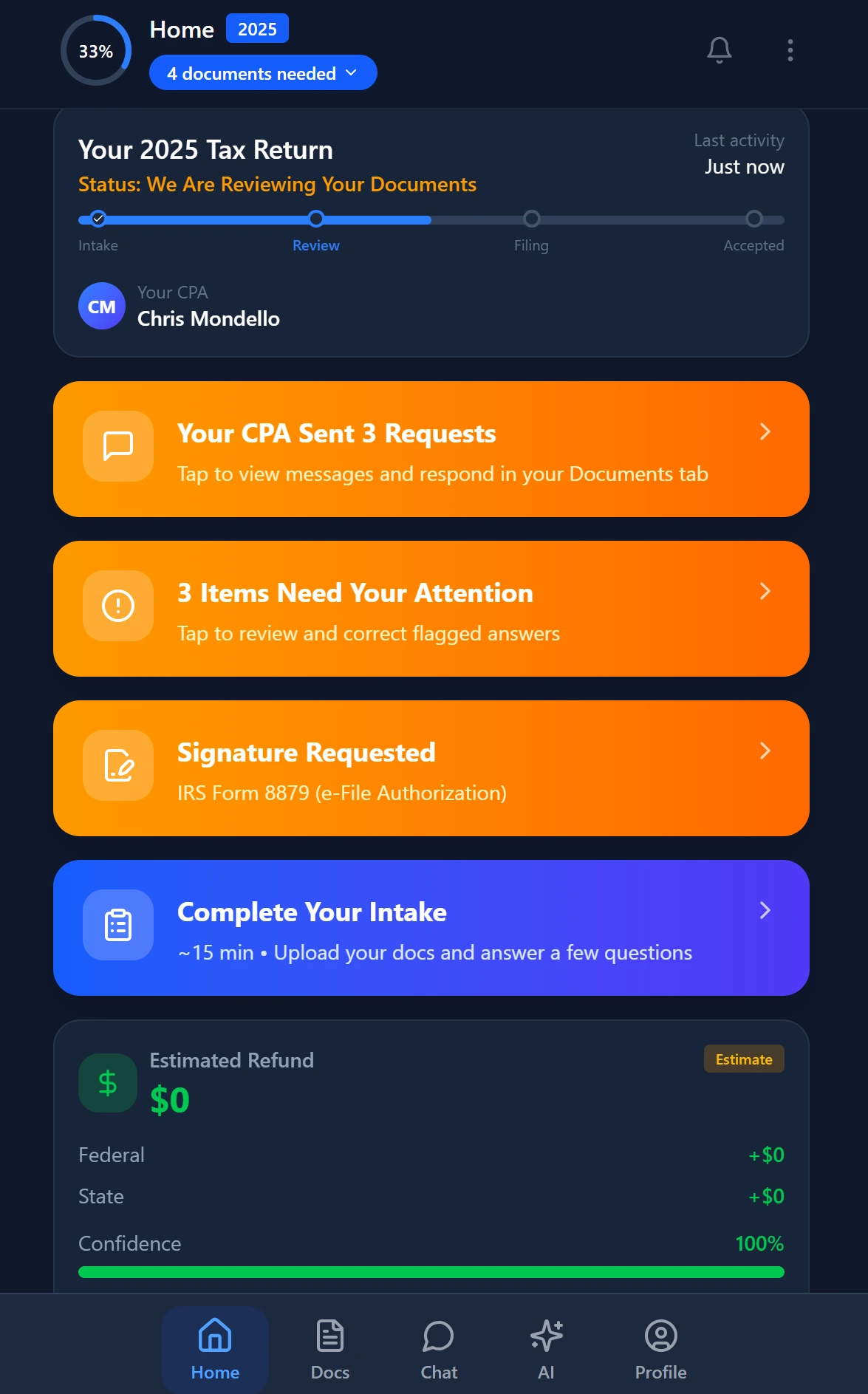
Smart intake auto-fills from uploaded documents and prior-year data
Year-of-Discovery Filing Mechanics and Amended Returns
The year-of-discovery rule under IRC § 165(e) sounds simple: deduct the theft loss in the year the taxpayer discovered the theft. In practice, 'discovery' is a fact-intensive determination, and clients often come to their CPA a year or two after the true discovery year has passed.
Discovery does not require certainty. Treasury Regulation § 1.165-8(a)(2) provides that a theft loss is sustained in the taxable year in which the taxpayer discovers the loss, unless in that year there exists a reasonable prospect of recovery. 'Discovery' has been interpreted broadly: if the client received notice of a criminal complaint against the operator, saw news coverage identifying the scheme, or received a letter from a receiver, that is the discovery year even if the client did not yet engage a CPA or attorney.
When the discovery year has already passed and no return election was made, the practitioner must file an amended return (Form 1040-X) for the correct discovery year. The three-year statute of limitations under IRC § 6511 applies, but § 6511(d)(1) provides a special seven-year period for bad debt and worthless security losses — and the IRS has applied the seven-year rule to theft losses as well in certain circumstances. Practitioners should file the amended return as promptly as possible once the discovery year is confirmed, attaching the Rev Proc 2009-20 statement and a narrative explaining why the discovery year was not originally identified. Properly claiming ponzi scheme loss deductions on an amended return requires the same election statement and documentation standards as an original filing. For related amended return procedure issues, see our guide on amended FBAR procedures.
An important nuance: if the client discovered the fraud in Year 1 but had a 'reasonable prospect of recovery' in Year 1 — meaning they genuinely believed they might recover the full amount through litigation or SIPC — then the deduction is deferred to the year in which the prospect of recovery becomes ascertainable with reasonable certainty. This exception is frequently misunderstood as allowing indefinite deferral; it does not. Once the prospect of recovery is reasonably determinable, the loss must be taken. Prolonged delay in claiming the deduction invites IRS scrutiny on both the discovery year and the recovery prospect question.
For clients who filed returns claiming the loss in a year other than the correct discovery year, the IRS can assert that the deduction was improper in the filed year and disallow it, leaving the taxpayer with an amended return obligation for the correct year. Statute of limitations analysis is essential before filing any amended return in these situations.
Theft Loss vs. Capital Loss: Key Treatment Differences for Ponzi Victims
| Feature | Theft Loss (IRC §165) | Capital Loss |
|---|---|---|
| Deduction type | Ordinary loss, Schedule A (itemized) | Capital loss, Schedule D |
| Annual deduction limit | No dollar ceiling (subject to 10% AGI floor if personal, but §165(c)(3) losses may bypass depending on facts) | $3,000 per year against ordinary income |
| Carryforward | Can generate NOL with carryforward/back | Unlimited carryforward, but only against capital gains + $3,000 |
| AGI impact | Reduces AGI directly (ordinary deduction) | Does not reduce AGI beyond the $3,000 annual cap |
| Year deductible | Year of discovery | Year of sale or exchange |
| Filing vehicle | Form 4684 (Casualties and Thefts), Section B | Schedule D / Form 8949 |
| Rev Proc 2009-20 safe harbor | Applies | Does not apply |
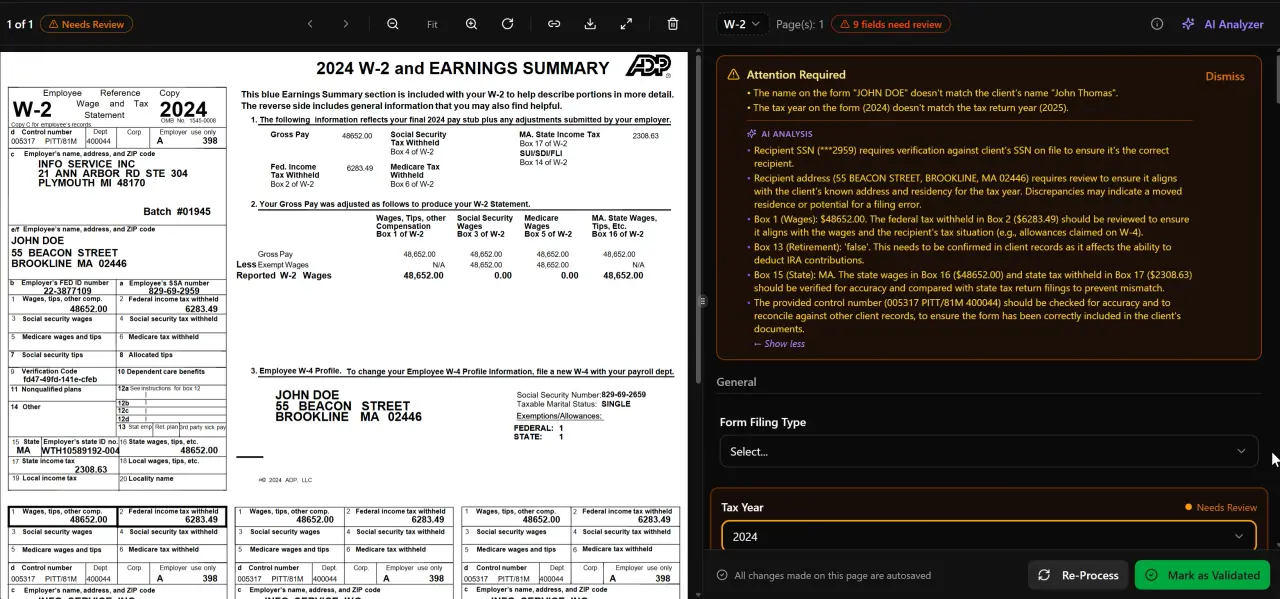
AI classifies, extracts, and validates every document automatically
Completing Form 4684 for Investment Theft Losses
Investment theft losses are reported on IRS Form 4684, Section B (Casualties and Thefts — Business and Income-Producing Property), not Section A (Personal Property). The distinction matters: Section A losses are subject to a $100 per-event floor and a 10% of AGI threshold; Section B losses are not subject to those floors for income-producing property losses.
The completed Form 4684, Section B, Part II requires the taxpayer to report: (1) a description of the arrangement; (2) the cost or adjusted basis of the investment; (3) insurance or other reimbursement received; (4) the gain or loss after reimbursement. For Rev Proc 2009-20 elections, the 'amount of theft loss' line reflects the percentage-adjusted qualified investment loss — either 95% or 75% of the net calculated amount.
Practitioners should also review whether the client received any fictitious 'income' reportable in prior years. Many Ponzi operators issued 1099s to investors reflecting fabricated earnings. Those phantom income amounts were taxed in prior years and may be recoverable through amended returns, but the recovery of previously taxed phantom income interacts with the theft loss calculation in ways that require careful workpaper documentation. The IRS Chief Counsel has addressed phantom income in the context of Madoff-related claims, confirming that amounts included in income in prior years that were never actually received can be added back to the theft loss calculation. This phantom income add-back is one of the more frequently overlooked components of ponzi scheme loss deductions and can meaningfully increase the final deductible amount.
The AI research agents in TaxScout.ai can search current IRS guidance, Treasury regulations, and Cornell Law's IRC text in real time, helping practitioners cross-reference Rev Proc 2009-20 mechanics against the specific facts of each client's situation without leaving the platform.

Click any extracted field to see its source highlighted on the original PDF
Substantiation Requirements and Workpaper Standards
The IRS audit risk on theft loss deductions is elevated, and substantiation must be airtight. At a minimum, the workpaper package for a Rev Proc 2009-20 election should include: (1) copies of all account statements received from the fraudulent operator; (2) proof of all deposits (wire transfer records, canceled checks, brokerage transfer confirmations); (3) records of all withdrawals or distributions; (4) the criminal complaint, information, or civil filing by a government authority against the operator; (5) SIPC claim filings and any correspondence; (6) a narrative describing how and when the client discovered the fraud; and (7) the completed Rev Proc 2009-20 election statement.
Many clients arrive at their CPA's office with incomplete records — account statements were fabricated and may not be available, or clients discarded them in distress. In these situations, the practitioner should request account records directly from the receiver or trustee appointed by a federal court, obtain copies of the criminal complaint from the Department of Justice or SEC, and reconstruct deposit records from bank statements. The SEC maintains a list of active receivers and trustees for enforcement actions that can help practitioners identify the correct contact for records requests.
For ongoing engagements where recovery claims are pending with SIPC or through litigation, practitioners should document the status of each recovery avenue in the workpapers annually. When a recovery is received, the income recognition calculation must be performed and a workpaper trail must connect the recovery to the original theft loss deduction year. TaxScout.ai's client management tools and file management system make it straightforward to maintain a persistent record of multi-year theft loss engagements — including attaching receiver correspondence, tracking recovery claim status, and flagging income recognition in subsequent years.
For engagements involving investment fraud at the partnership or trust level, practitioners should also review Schedule K-1 reporting for the fraudulent entity. Investors in feeder funds that themselves invested with a fraudster may have received K-1s reflecting phantom income, and the theft loss analysis at the investor level requires tracing the economic reality through the entity structure. See our Schedule K-3 reporting guide for related pass-through complexity.
Common Filing Errors and How to Avoid Them
The most common error practitioners make is filing the theft loss in the wrong year — typically the year a receiver was appointed or the year criminal charges were filed, rather than the year the client first discovered the fraud. The receiver appointment and the criminal charges are evidence that a theft occurred, but they are not the discovery event for the client who already had reason to know earlier. Year-of-discovery analysis must focus on the client's subjective knowledge, tempered by an objective 'should have known' standard.
The second most common error is failing to reduce the deductible loss for prior tax benefits. If the client deducted management fees, interest, or other expenses attributable to the fraudulent investment in prior years, those amounts produced tax benefits that must be evaluated under the tax benefit rule. Similarly, if the client received a tax deduction for a charitable contribution of 'appreciated' securities held in the fraudulent account, those deductions may require recapture analysis. Firms that handle ponzi scheme loss deductions across multiple clients often build a standardized prior-benefit review step into their engagement workflow to avoid missing these adjustments.
A third frequent error is treating the Rev Proc 2009-20 election as if it were automatic. The election requires an affirmative statement attached to the return. If the practitioner simply reports the loss on Form 4684 without attaching the statement, the safe harbor does not apply, and the deduction remains subject to full proof-of-theft requirements under state law. This is an easily avoidable error that creates significant audit exposure.
Finally, practitioners sometimes overlook the interaction between the theft loss deduction and the alternative minimum tax. While theft losses on income-producing property are generally deductible for AMT purposes, the calculation must be verified for clients who are AMT-exposed in the discovery year. For a comprehensive treatment of AMT planning considerations, see our AMT planning guide for CPAs.
Spending hours manually researching IRS revenue procedures and tracking multi-year recovery claim statuses for defrauded clients?
TaxScout.ai's 9 AI research agents deliver real-time IRS, Treasury, and Cornell Law search inside your workflow — so you can advise clients on theft loss elections and recovery mechanics without switching tabs or subscription databases.
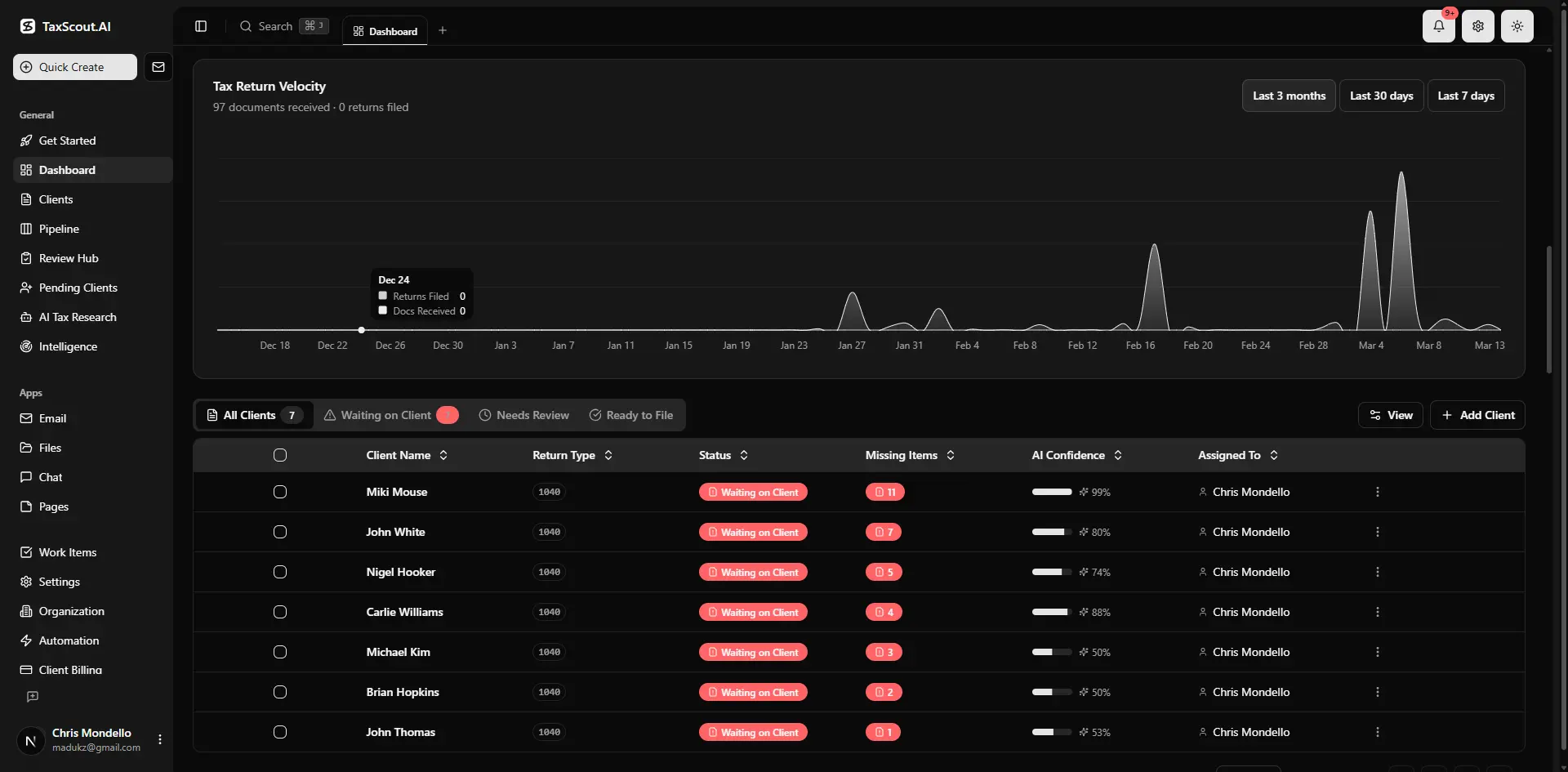
Real-time dashboard showing returns in progress, revenue, and upcoming deadlines
Frequently Asked Questions
The 95% election is for qualified investors with no potential third-party recovery claims — meaning no SIPC coverage, no pending civil litigation against third parties, and no insurance. It allows a deduction of 95% of the qualified investment loss. The 75% election applies when the investor has a potential third-party recovery, such as a SIPC claim or a lawsuit against a feeder fund manager. It allows a deduction of 75% of the qualified investment loss, reserving 25% against actual recoveries. Choosing the wrong election — particularly using 95% when a SIPC claim exists — can result in income recognition problems when the recovery arrives.
Keep reading
Stay up to date
Get the latest tax tech insights delivered to your inbox.