R&D Tax Credit for CPAs: How to Identify and Claim It for Clients
Most R&D tax credit articles are written for business owners, not the CPAs serving them. This guide flips that — covering how to identify eligible clients across your book, apply the four-part qualified research test, build airtight documentation, and file Form 6765 correctly. Plus: how…
The R&D tax credit for CPAs represents one of the most underutilized advisory revenue lines in practice today. The Section 41 tax credit was permanently extended by the PATH Act in 2015, yet surveys consistently show that fewer than 10% of eligible small and mid-size businesses ever claim it — largely because their CPA never brought it up. That is a missed conversation happening thousands of times per tax season.
Unlike many tax incentives that require exotic structures or aggressive positions, the research and development tax credit is grounded in real business activity. Software development, product engineering, formulation work, process improvement — these are things your clients are already doing. Your job as the practitioner is to recognize the pattern, document it correctly, and file Form 6765 in a way that survives IRS scrutiny. Understanding the r&d tax credit for cpas starts with recognizing that it rewards ordinary business activity your clients are already conducting.
This guide is written entirely from the practitioner's seat. You will learn how to scan your existing book of business for R&D candidates, walk clients through the four-part test for qualified research activities, build the documentation file that supports a credit claim, understand the payroll tax offset election that makes the credit valuable even for pre-profit startups, and use AI-assisted tools to scale this service without proportionally scaling your hours. Navigating the r&d tax credit for cpas requires a practitioner-focused approach, which is exactly what this guide delivers.
Why R&D Credit Advisory Is a High-Value Service Line
The research and development tax credit directly reduces federal income tax liability dollar-for-dollar, not merely as a deduction. Under IRC Section 41, the regular credit rate is 20% of qualified research expenses (QREs) above a base amount, and the simplified Alternative Simplified Credit (ASC) — used by most small businesses — is 14% of QREs exceeding 50% of the average QREs from the prior three years. For a small manufacturer spending $400,000 a year on eligible wages and supplies, that often translates to $40,000–$70,000 in annual federal tax savings. Mastering the r&d tax credit for cpas means understanding its mechanics, starting with the fact that it reduces federal income tax liability dollar-for-dollar under IRC Section 41.
From a practice economics standpoint, R&D credit engagements typically command value-based or contingency-adjacent fees. Many firms charge a percentage of the credit identified — commonly 15%–25% — or a flat project fee in the range of $3,000–$15,000 depending on complexity. Either way, the revenue per engagement substantially exceeds standard tax preparation billing. For a firm managing 200 business returns, even identifying five qualifying clients per season adds meaningful revenue. For firms evaluating their r&d tax credit for cpas approach, this trade-off compounds over time.
The advisory nature of R&D work also deepens client relationships. When you proactively surface a credit the client did not know they had, you shift from being a compliance vendor to being a strategic partner. That positioning reduces price sensitivity, improves retention, and generates referrals — exactly the growth dynamic described in building a stronger accounting firm referral program. Each of these factors directly shapes how r&d tax credit for cpas plays out in practice.
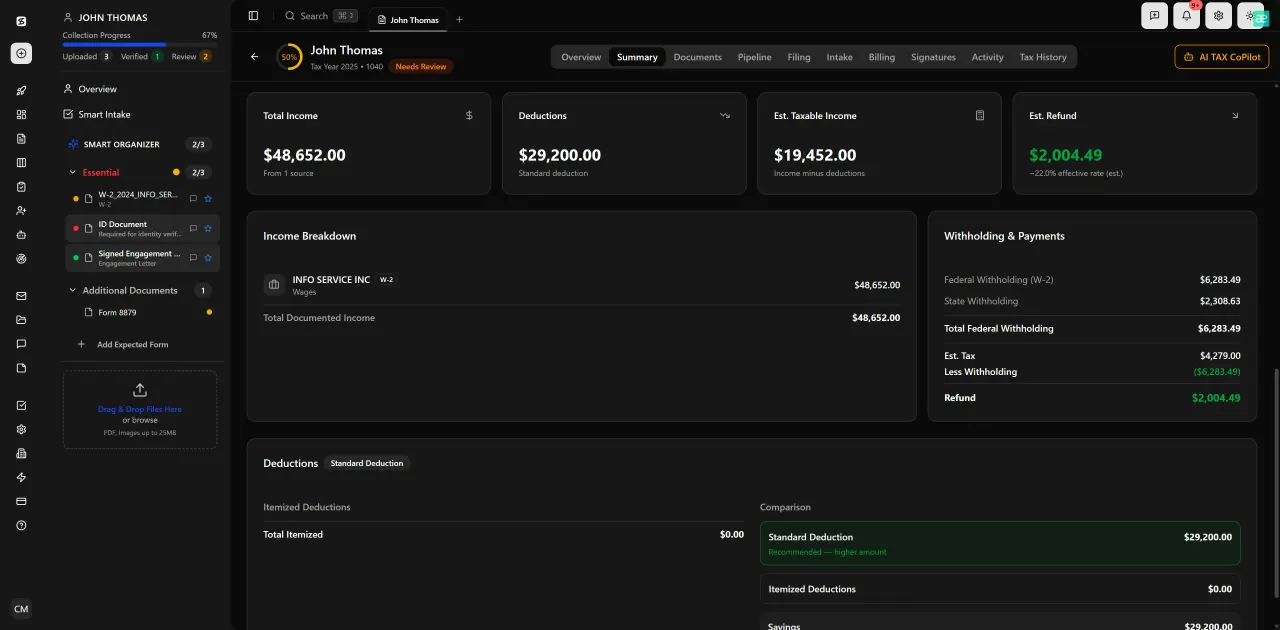
Review with AI assist — 9 agents answer questions with full client context
Scanning Your Book of Business for R&D Eligible Clients
The first bottleneck for most CPA firms is not executing an R&D study — it is identifying which clients to pursue in the first place. Doing this manually across hundreds of returns is impractical. The right approach combines industry filtering with document-level signals. Understanding r&d tax credit for cpas in this context is what separates firms that scale from those that stall.
Start with NAICS codes. Industries with historically high R&D credit claim rates include software and technology (NAICS 5112, 5415), manufacturing (NAICS 31–33), aerospace and defense (NAICS 3364), pharmaceuticals and medical devices (NAICS 3254, 3391), and agriculture technology (NAICS 1110 combined with software spend). If your practice management system tags clients by industry, you can filter down to a shortlist in minutes. This is precisely where a deliberate r&d tax credit for cpas strategy pays off.
Beyond industry, look for these signals in documents you already have: payroll records showing engineers, developers, scientists, or lab technicians; depreciation schedules with significant equipment in production, lab, or testing categories; contractor payments to software developers or technical consultants; and cost-of-goods-sold breakdowns with materials allocated to prototyping or testing. The AI document extraction layer in TaxScout.ai can surface these indicators across your client document library automatically — flagging returns that warrant a deeper R&D conversation before you invest review time. R&d tax credit for cpas sits at the center of this decision — get it wrong and the rest unravels.
When in doubt about an industry, the IRS published audit technique guides include industry-specific R&D guidance for software, food and beverage, and aerospace sectors. These are the same frameworks IRS examiners use, and they are invaluable for setting client expectations about what qualifies. When firms revisit their r&d tax credit for cpas priorities, the gaps usually surface here.
Tired of leaving R&D credits on the table because identifying eligible clients takes too long?
TaxScout.ai's AI research agents and document extraction tools help CPA firms spot R&D candidates across their entire book of business — and build the documentation trail to support the claim.
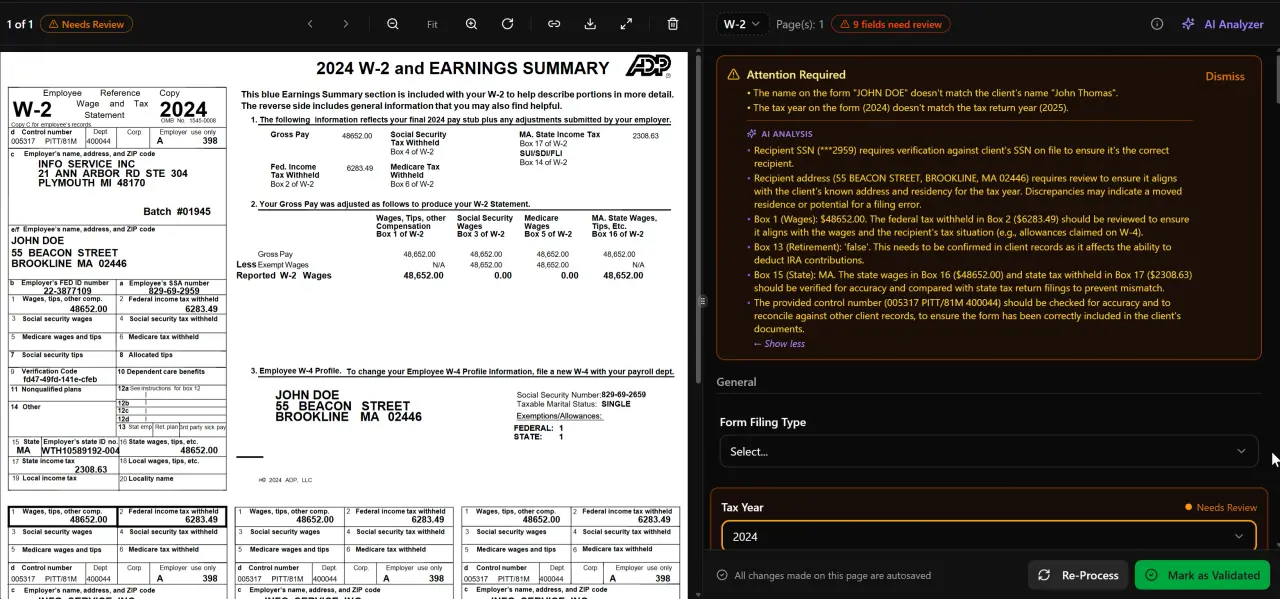
AI classifies, extracts, and validates every document automatically

Click any extracted field to see its source highlighted on the original PDF
The Four-Part Test for Qualified Research Activities
The R&D credit qualified research activities determination is governed by a four-part test under Section 41(d). All four prongs must be satisfied for an activity to generate qualifying research expenses. Walking clients through this test in plain language — rather than statutory citations — is how you turn a compliance conversation into an advisory one. For practitioners building out the r&d tax credit for cpas as a repeatable service, this four-part test is the analytical backbone of every engagement.
Part one is the technological information requirement. The activity must rely on principles of physical, biological, computer, or engineering science. Empirical market research, social science studies, and survey-based work do not qualify. Software development almost always satisfies this prong; customer surveys do not.
Part two is the business component requirement. The research must be intended to create or improve a product, process, formula, invention, technique, or software that is used in the client's trade or business. Internal-use software has additional hurdles under the high-threshold-of-innovation test established in the Treasury regulations at Treas. Reg. § 1.41-4, but customer-facing software development generally clears part two without controversy.
Part three is the uncertainty requirement. The client must have been attempting to eliminate technical uncertainty at the outset — uncertainty about capability, methodology, or appropriate design. If the outcome was already known or the client was merely customizing an existing solution with no technical risk, the activity likely fails here.
Part four is the process of experimentation requirement. The client must have used a process of experimentation — modeling, simulation, systematic trial and error, or hypothesis testing — to overcome the uncertainty. This is where contemporaneous documentation becomes critical. Time logs, design documents, version histories, test results, and engineering meeting notes are the evidence that part four is satisfied.
When all four prongs are met, the expenses attributable to that activity — primarily wages paid to qualifying employees, certain contractor costs at 65%, and supplies consumed in the research — become qualified research expenses feeding into the Form 6765 calculation.
R&D Credit Documentation Requirements CPAs Must Build
IRS examiners approach R&D credit claims with a documentation-first mentality. The Cohan rule — which allows estimation of some expenses when records are incomplete — has been expressly excluded for research credit purposes. If the client cannot substantiate the nexus between a wage dollar and a qualifying activity, that dollar is out of the QRE pool. This is one of the most consequential compliance details in the r&d tax credit for cpas workflow, and it is where underprepared claims most often fall apart under examination.
The documentation file you build for each client should contain three layers. The first layer is activity-level evidence: project descriptions, research plans, design specifications, test protocols, and meeting notes that establish what technical uncertainty existed and how it was investigated. The second layer is employee-level time allocation: contemporaneous time logs or, if unavailable, reconstructed estimates supported by project assignments, calendar records, and manager sign-off. The third layer is financial tie-out: payroll records, W-2 data, contractor invoices, and supply receipts mapped to specific qualifying projects.
For clients without existing time-tracking systems, the reconstruction conversation is delicate but manageable. Work backward from project lists and organizational charts to estimate the percentage of time engineers and developers spent on qualifying activities versus maintenance, production support, or administrative work. The IRS accepts reasonable percentage estimates when supported by corroborating evidence — just document your methodology thoroughly. You may find it helpful to review the approach outlined in our AI document extraction guide for CPAs to understand how automated document classification can accelerate this evidence-gathering process.
Maintain a durable documentation package — PDF-formatted, version-controlled, and indexed. The 14-plus PDF tools in TaxScout.ai including OCR, Bates numbering, and PII masking are well-suited for organizing the exhibits that support a credit study into a reviewable audit-ready package.

Every client gets organized documents, status tracking, and a complete history
Form 6765 Instructions: Filing the Credit Correctly
Form 6765, Credit for Increasing Research Activities, is the vehicle for claiming the Section 41 credit on the client's federal return. The form has four sections, and choosing the right calculation method — Regular Credit in Section A versus the Alternative Simplified Credit in Section B — is the first decision point. Getting this choice right is a foundational skill in the r&d tax credit for cpas, and the wrong selection can cost clients tens of thousands of dollars in foregone credits.
The Regular Credit requires computing a base amount using a fixed-base percentage derived from QREs and gross receipts from 1984–1988. For most clients without those historical records, the Regular Credit is impractical. The ASC in Section B is almost always the right choice: 14% of QREs exceeding 50% of the average QREs from the three preceding tax years. For clients with no QREs in the prior three years — often true for startups — the ASC rate drops to 6% of current-year QREs with no subtraction.
Section C of Form 6765 handles the payroll tax offset election for qualified small businesses (covered in detail below). Section D covers pass-through entity reporting. For S-corporations and partnerships, the credit passes through to shareholders and partners via Schedule K-1, where it appears on line 13 (S-corp) or line 15 (partnership) with code B.
One frequently missed step: when the client claims the research credit, they must reduce the deduction for research expenditures under Section 174 by the credit amount, or elect to reduce the credit by the corporate tax rate equivalent. On most small business returns, the gross-up election under Section 280C(c)(3) — electing a reduced credit in exchange for keeping the full Section 174 deduction — simplifies the calculation and avoids an amended-return scenario if the credit is later adjusted. The IRS Form 6765 instructions explain this election in detail and should be your primary reference for line-by-line completion.
Always attach a detailed statement to the return identifying each research project by name, the technical uncertainty addressed, the qualifying employees involved, and the QREs allocated. IRS Large Business and International (LB&I) examiners specifically look for this attachment as an indicator of a well-supported claim.
The Payroll Tax Offset Election for Startup Clients
The payroll tax offset is arguably the most advisor-forward conversation a CPA can initiate with an early-stage client, and it is almost entirely absent from competitor content. Under Section 41(h), a qualified small business — defined as one with gross receipts under $5 million and no gross receipts prior to the five-tax-year period ending with the current year — may elect to apply up to $500,000 of its research credit against the employer's 6.2% share of Social Security payroll tax rather than against income tax liability.
This matters enormously for pre-profit startups. A company burning cash on developer salaries has no income tax to offset. Without the payroll tax election, the research credit would simply carry forward — useful eventually but not immediately. With the election, the same company can reduce its quarterly payroll tax deposits, improving cash flow in the quarters when growth-stage businesses need it most. The IRS guidance on the payroll tax offset confirms the $500,000 annual cap per tax year and the mechanics for making the election on a timely filed return. For CPAs advising pre-revenue clients, this is one of the most immediately impactful applications of the r&d tax credit for cpas in their entire practice.
The election is made on Form 6765 Section C and then claimed on the employer's quarterly Form 941. For S-corporations and partnerships, the election is made at the entity level, not at the partner or shareholder level. Timing is critical: the election must be made on the original return, including extensions, for the tax year in which the credit is generated. Amended returns cannot retroactively make the payroll tax offset election — a fact that makes the proactive identification of startup clients before year-end filing essential.
For CPA firms with startup-heavy books — tech founders, SaaS companies, biotech pre-revenue entities — the payroll tax offset conversation is a differentiated advisory offering. Pair it with a projected cash-flow analysis and you have a compelling reason for the client to expand their engagement scope. See also our overview of advisory services capabilities that firm owners are building into recurring engagements.
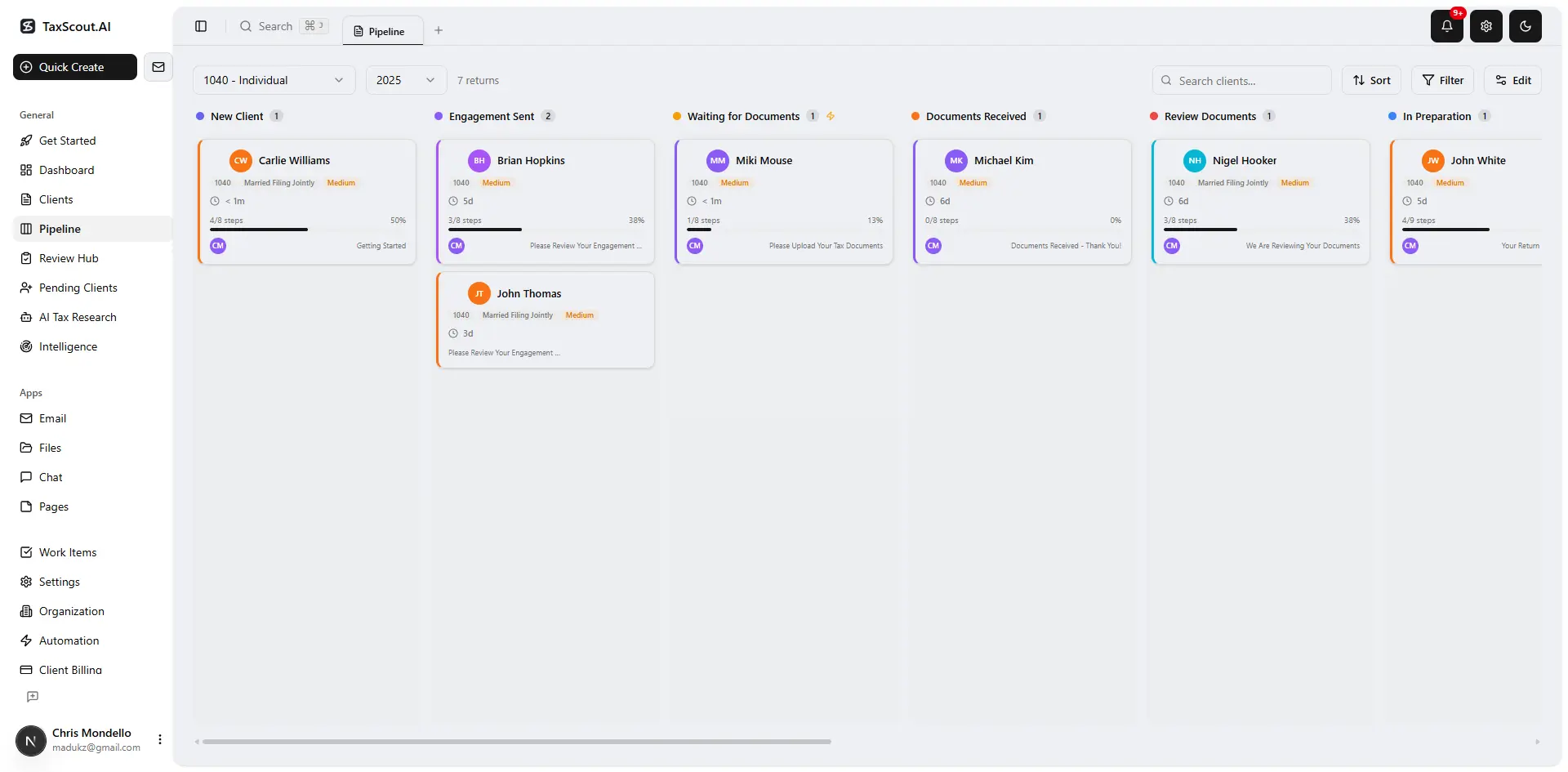
Track every return from intake to filed with drag-and-drop pipeline management

Track firm performance with real-time analytics and client activity monitoring
Using AI Research Agents to Scale R&D Advisory Services
Scaling R&D credit services in a CPA firm historically meant hiring specialized staff or relying on third-party R&D credit boutiques that commoditize the engagement and take the majority of the fee. AI-assisted research tools are shifting that calculus by compressing the research-and-documentation phase that previously made these engagements labor-intensive. Firms that treat the r&d tax credit for cpas as a scalable service line — rather than a bespoke project — are the ones best positioned to capture this shift.
TaxScout.ai's AI research agents include nine specialized agents with real-time search across IRS, Treasury, Cornell Law, SSA, and Congress sources. For R&D credit work, this means you can query current IRS audit technique guide provisions, retrieve the latest Treasury regulation amendments to Section 41, check recent Tax Court opinions on specific industry qualification disputes, and confirm payroll tax offset thresholds — all from a single interface without tabbing between government databases. The agents maintain client-context memory, so when you are researching a manufacturing client's specific process improvement claim, the agent retains the entity structure and prior filing history to frame its answers contextually.
On the document side, AI document extraction processing payroll records, contractor invoices, and prior-year returns surfaces the raw QRE data before you have done a single manual calculation. The 5-layer validation pipeline — including OCR cross-verification and cross-document validation — reduces the risk of transposing wage figures across multiple W-2s or misallocating contractor payments between qualifying and non-qualifying activities.
From a workflow perspective, consider building a dedicated R&D credit pipeline stage in your practice management board. TaxScout.ai's pipeline management supports 12 customizable stages with drag-and-drop kanban, so you can create a discrete R&D Advisory lane — from initial eligibility screen, to documentation intake, to credit calculation review, to Form 6765 preparation — that is visible to your entire team and trackable against deadlines. This also makes it easier to monitor capacity and avoid the bottlenecks that derail advisory work during peak season, which connects directly to the capacity planning framework discussed in our accounting firm capacity planning guide.
R&D Credit Eligibility Signals: Quick Reference for CPA Client Screening
| Client Signal | Likely Qualifying Activity | QRE Category |
|---|---|---|
| Engineers or developers on payroll | New product or software development | Qualifying wages (100%) |
| Significant contractor tech spend | Outsourced software development or R&D testing | Contractor costs (65%) |
| Prototype or test materials in COGS | Product formulation or process development | Qualifying supplies (100%) |
| Pre-revenue startup with tech payroll | Platform or product build-out | Wages + payroll tax offset eligible |
| Process improvement projects in manufacturing | Uncertainty-driven efficiency redesign | Wages + supplies |
| Failed product attempts or pivots | Experimentation with technical uncertainty | All QRE categories |
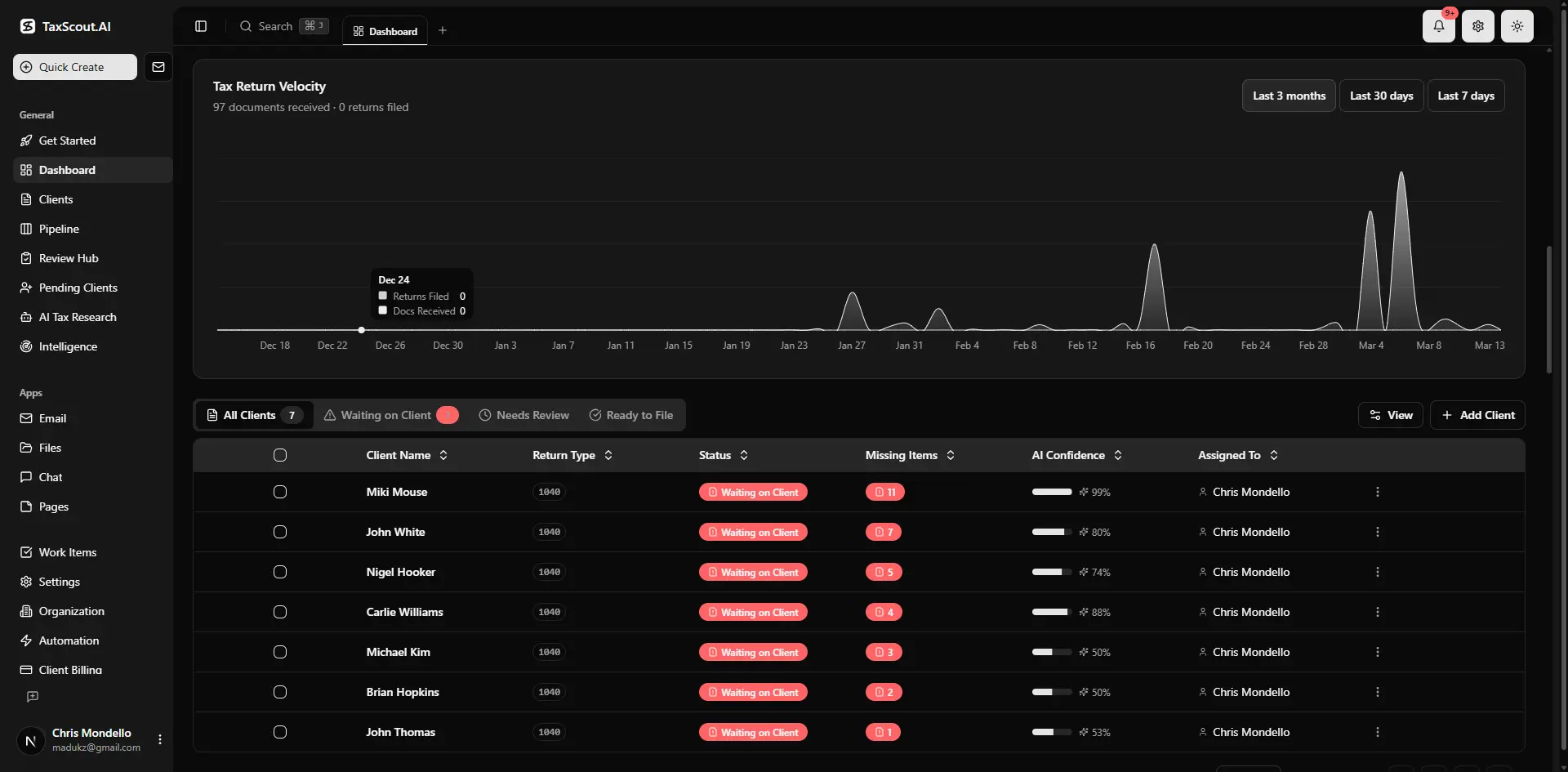
Real-time dashboard showing returns in progress, revenue, and upcoming deadlines
Common Errors and Professional Liability Considerations
R&D credit engagements carry professional liability exposure proportionate to their value. The most common errors fall into three categories: overinclusion of non-qualifying activities, inadequate wage allocation documentation, and failure to make required elections on time. Each of these errors is more likely when a firm attempts to offer the r&d tax credit for cpas without a structured review process and clear documentation standards in place.
Overinclusion often happens when practitioners apply the four-part test loosely. Reverse engineering a competitor's product, adapting an existing process to a new geography without technical uncertainty, or performing market research do not qualify — even if they involve technical staff. The IRS has consistently litigated overinclusion cases, particularly in the software sector, where the internal-use software regulations create a bright-line distinction between customer-facing applications and back-office tools.
Wage allocation errors are the second major exposure area. Employees who split time between qualifying and non-qualifying activities must have their wages apportioned. Allocating 100% of an engineer's salary to QREs when that engineer spent 30% of their time on customer support or production maintenance is the type of overstatement that surfaces in examination and can result in penalty exposure for both the client and the preparer under Section 6694.
Finally, state R&D credits add a layer of complexity. Approximately 37 states offer their own research credit, but the definitions of qualifying activities, the credit rates, and the carryforward periods vary materially. For example, California's R&D credit mirrors the federal structure but has its own gross receipts test and applies only against California income tax. Always verify state-level conformity with the federal Section 41 definition before applying federal qualification analysis to a state claim.
Ready to make R&D tax credit advisory a consistent revenue line instead of a one-off project?
TaxScout.ai gives CPA firms the AI research agents, document extraction, and pipeline tools to identify, document, and file R&D credits at scale — without adding headcount.

Smart intake auto-fills from uploaded documents and prior-year data
Keep reading
Stay up to date
Get the latest tax tech insights delivered to your inbox.