Florida LLC Annual Report Filing: Step-by-Step for Accountants
Every May 1, Florida LLCs face a compliance deadline that has nothing to do with tax season — and everything to do with your reputation as their accountant. Missing the Florida LLC annual report triggers a $400 late fee and risks administrative dissolution. This step-by-step guide walks you…
Managing a portfolio of Florida LLC clients means one recurring deadline can quietly become your biggest liability: the florida llc annual report due every year by May 1.
Miss it for one client and they pay a $400 late penalty on top of the $138.75 filing fee. Miss it for twenty clients and you have an inbox full of angry calls, a credibility problem, and potential exposure for E&O claims. The Florida annual report isn't a tax filing — it's a state compliance obligation managed entirely through sunbiz.org, and it operates on a completely different calendar from the April 15 rhythm most CPAs run their practices around.
This guide covers the exact filing steps accountants use to process Florida LLC annual reports, the fee structure for 2026, the late penalty mechanics, and how AI-native practice management tools can automate deadline tracking and client reminders so nothing slips through the cracks during your post-tax-season downtime.
What Is the Florida LLC Annual Report (and Why Accountants Own It)
The Florida LLC annual report is a mandatory filing submitted to the Florida Division of Corporations through sunbiz.org. It is not a financial statement and does not include tax information. Its purpose is to confirm or update the LLC's registered agent, principal office address, mailing address, and authorized member/manager information on file with the state.
Despite being simple in scope, it carries serious consequences for non-compliance. Under Florida Statute § 605.0212, an LLC that fails to file by the May 1 deadline is assessed a $400 late fee, and LLCs that remain delinquent through the third Friday of September face administrative dissolution.
For accountants managing Florida LLC clients, this creates a distinct workflow obligation that sits outside the normal tax calendar. The deadline is May 1 — not May 15, not April 15 — and it catches firms off guard every year precisely because it lands in the middle of post-tax-season recovery mode.
Florida LLC Annual Report: Key Dates and Fee Structure for 2026
Before covering the step-by-step filing process, every accountant managing Florida LLC clients needs these numbers memorized:
| Item | Detail |
|---|---|
| Filing Window Opens | January 1, 2026 |
| Due Date (No Late Fee) | May 1, 2026 |
| Late Fee Assessed | May 2, 2026 |
| Standard Filing Fee | $138.75 |
| Late Penalty | $400.00 (in addition to the $138.75 fee) |
| Administrative Dissolution Risk | Third Friday of September 2026 |
| Filing Platform | sunbiz.org |
| Payment Methods | Credit card, debit card |
The $138.75 fee is flat and non-negotiable. There is no expedited processing tier for annual reports — the standard fee is the only fee. The $400 late penalty is also flat, meaning an LLC that files one day late pays the same penalty as one that files three months late (though the latter also risks dissolution).
This asymmetry matters for client conversations: a reminder email that prompts a client to file on April 28 saves them $400. A missed reminder that results in an August filing costs the client $538.75 instead of $138.75 — and costs you a conversation you don't want to have.
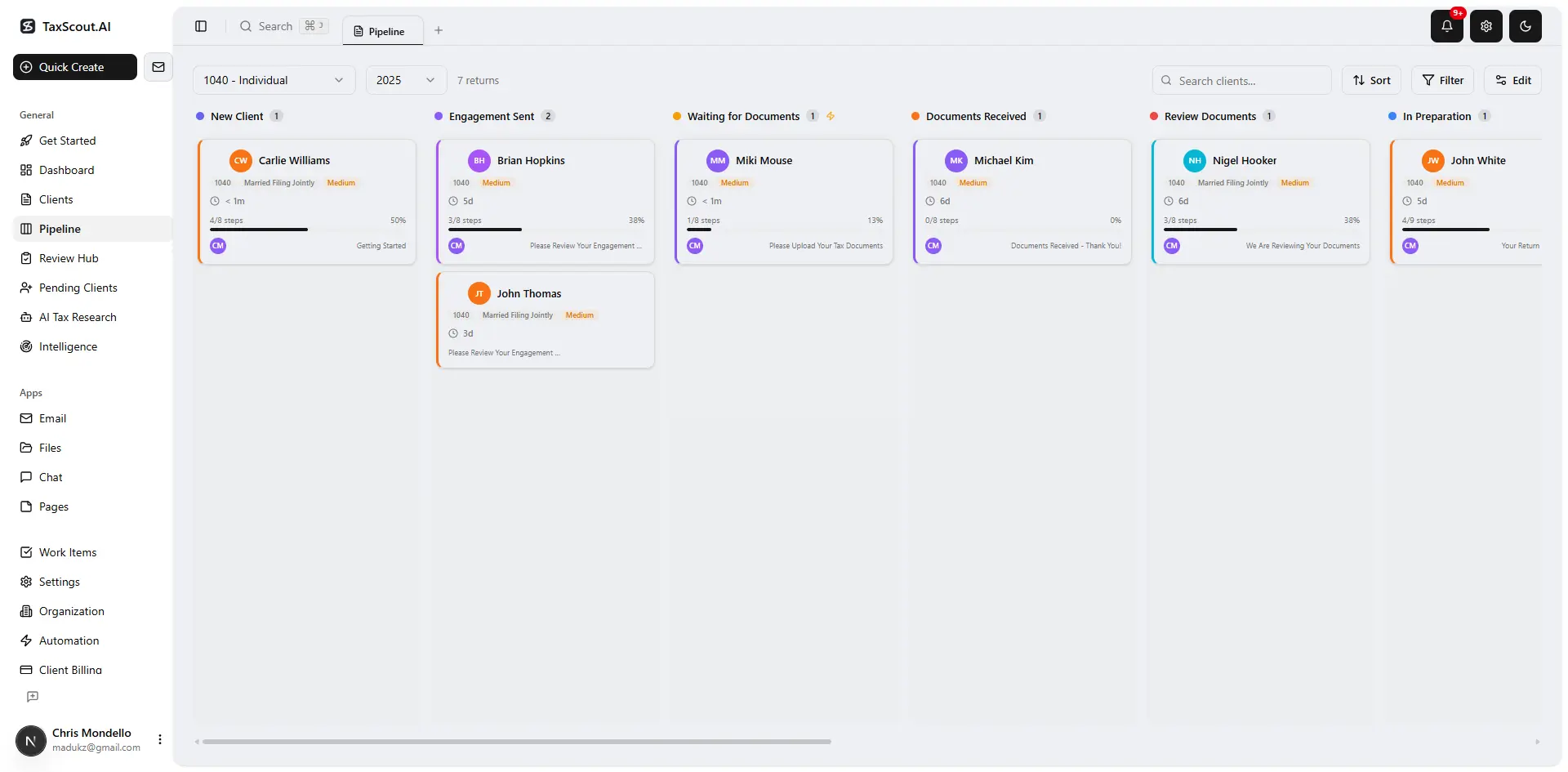
Track every return from intake to filed with drag-and-drop pipeline management
Step-by-Step: Filing a Florida LLC Annual Report on Sunbiz.org
Here is the exact process for filing a Florida LLC annual report through the state's online portal.
Step 1: Navigate to the Annual Report Filing Portal
Go to dos.myflorida.com/sunbiz/ and click "File Annual Report" in the main navigation or use the direct filing URL. You'll need the LLC's Document Number — the unique identifier assigned by the Florida Division of Corporations when the LLC was formed.
If you don't have the Document Number, use the entity search function on sunbiz.org. Search by the LLC name, confirm the entity type and status, and retrieve the Document Number from the entity detail page.
Step 2: Pull Up the Entity and Verify Current Data
Enter the Document Number and confirm the entity name and current registered agent information displayed. Review what's currently on file before making any changes — this is your opportunity to catch outdated addresses or former registered agents.
Step 3: Update Registered Agent Information (If Needed)
Florida requires every LLC to maintain a registered agent with a physical street address in Florida. If your client has changed registered agents since last year, update the name and address here. If you're acting as the registered agent for the client (common for accountants who offer registered agent services), confirm your address is current.
This step has compliance implications beyond the annual report. An LLC with an incorrect registered agent address may miss service of process, regulatory notices, or correspondence from the Florida Department of Revenue — a risk that can create serious downstream problems for your client.
Step 4: Confirm or Update Principal Office and Mailing Address
Enter the LLC's current principal office address (physical location) and mailing address. These can differ if the LLC uses a PO Box or your firm's address for correspondence.
Step 5: Confirm or Update Authorized Members/Managers
For member-managed LLCs, confirm the names and addresses of all authorized members. For manager-managed LLCs, confirm the managers. This section must accurately reflect the current ownership and management structure. If there has been a membership change, this is where it gets updated — though significant ownership changes may require a separate amendment filing.
Step 6: Pay the $138.75 Filing Fee
Payment is processed via credit card or debit card. No check or ACH option is available on sunbiz.org. Most accountants either bill this through a client credit card on file or pay from their firm card and invoice the client. Build your firm's preferred reimbursement workflow into your engagement letter if you're processing payments on behalf of clients.
Step 7: Save the Confirmation Number
After payment, sunbiz.org generates a confirmation page and sends a confirmation email. Save both. The confirmation number is proof of timely filing if any dispute arises about the submission date. File it in the client's permanent folder.
Tracking May 1 deadlines across a Florida LLC client roster manually is how things fall through the cracks. See how TaxScout automates deadline tracking, client reminders, and pipeline management for annual report workflows. → Book a 15-Min Demo — See It Live
Batch-Processing Florida LLC Annual Reports: How Accountants Scale This
If you manage 10, 50, or 200 Florida LLC clients, filing one-by-one in March through April is the wrong approach. Here is how high-volume accounting practices handle Florida annual report season efficiently.
Build a Florida LLC Compliance Master List
Maintain a dedicated roster of all Florida LLC clients with their Document Numbers, registered agent info, and point-of-contact email addresses. This list should be queryable — not buried in a spreadsheet tab you update once a year.
For each client, record:
- Entity name as registered on sunbiz.org
- Florida Document Number
- Registered agent name and address (yours or theirs)
- Principal office address
- Authorized members/managers currently on file
- Last year's confirmation number and filing date
- Billing preference (client pays directly vs. firm pays and invoices)
Sequence Your Outreach Across February–April
The filing window opens January 1, but the smartest firms don't start filing immediately — they use February to collect updated information from clients, March to file the straightforward ones, and April to chase the stragglers.
A practical reminder sequence:
- Late January: Email all Florida LLC clients explaining the May 1 deadline and requesting any address/member updates
- Mid-February: Follow up with clients who haven't responded
- March 1–31: File reports for clients whose information is confirmed
- April 10: Final reminder to any clients not yet processed
- April 25: Emergency outreach to any remaining unfiled LLCs
This rhythm prevents the last-week-of-April crunch that causes late penalties on what should have been routine filings.
Standardize Your Registered Agent Documentation
If your firm serves as registered agent for multiple Florida LLCs, you need a clear internal process for accepting service of process and routing it to the correct client. The annual report renewal is a natural time to audit which clients list your firm's address and ensure those engagement agreements are current. As we explored in our client onboarding checklist for accounting firms, capturing registered agent details during onboarding prevents this kind of retroactive scramble.

Your clients see your brand — OTP login, document upload, and real-time status
How AI-Native Practice Management Automates Florida LLC Annual Report Compliance
The manual approach above works — until your Florida LLC client count grows past 20 or 30. At that point, spreadsheet-based deadline tracking becomes a liability rather than a system. This is where pipeline management built for accounting firms changes the operational math.
TaxScout's pipeline management uses 12 customizable workflow stages with auto-advance triggers and reminder logic. For Florida annual report season, a firm would configure a dedicated pipeline that fires automatically for every client tagged as "Florida LLC":
- January 1 — Pipeline auto-creates an "Annual Report Due" task for each tagged client
- Late January — Automated client portal message requesting address/member confirmation
- February — Task assigned to preparer with Document Number pre-populated
- Filing complete — Confirmation number logged, client notified via portal
- Invoice generated — $138.75 (plus firm fee) invoiced automatically through Stripe Connect
This isn't a hypothetical workflow — it reflects how TaxScout's pipeline automation operates across compliance deadlines. The system can track deadline status across your entire Florida LLC roster in a single kanban view, so you can see at a glance which clients are filed, which are pending information, and which are approaching the May 1 deadline.
The client portal eliminates the back-and-forth email chain that typically slows this process. Clients receive OTP-authenticated access to a branded portal where they confirm address updates directly — no account creation, no password resets, no 48-hour email chains about whether the LLC is still at the same address.
For firms that have grown past the point where manual annual report tracking is viable, this kind of automation is the difference between a smooth February–April workflow and an April 30 fire drill. The broader productivity case is covered in our CPA firm workflow automation guide.
Common Errors That Delay or Invalidate Florida LLC Annual Reports
Even experienced accountants encounter filing issues on sunbiz.org. Watch for these:
Wrong Document Number: Searching by name returns multiple entities — especially common with generic LLC names. Always confirm the Document Number matches your client's EIN, formation date, and current status before filing.
Dissolved or Inactive Status: If a client's LLC shows "Inactive" on sunbiz.org, they may have already been administratively dissolved for a prior missed annual report. Reinstatement requires a different filing process and a $100 reinstatement fee plus all past-due annual report fees. Check status before attempting to file.
Registered Agent Address Issues: A PO Box is not acceptable as a registered agent address in Florida. The registered agent must have a physical street address. If your client's registered agent address is a PO Box, this needs to be corrected — and a correction mid-report may require an amendment rather than just an annual report update.
Payment Processing Failures: Sunbiz.org does not guarantee real-time processing confirmation. If a payment appears to fail, wait 24 hours before re-attempting to avoid duplicate charges. Always save the confirmation email as proof of submission date.
Florida Registered Agent Requirements: What Accountants Need to Know
Florida's registered agent requirements under Florida Statute § 605.0114 require every LLC to continuously maintain a registered agent and registered office in the state. The registered agent must:
- Be an individual Florida resident, or a business entity authorized to do business in Florida
- Have a physical street address in Florida (PO Boxes not permitted)
- Consent to serve in that role (consent is typically documented in the LLC's operating agreement or a separate registered agent consent form)
CPA firms that serve as registered agent for clients should understand the liability implications: as registered agent, your firm's address receives service of process and official state notices. If you're not set up to handle that reliably — with documented intake procedures and client notification protocols — you're taking on operational risk that can become a professional liability issue.
Many Florida LLC clients prefer to use a commercial registered agent service (ranging from $50–$150/year) for this reason. If your firm offers registered agent services, price it appropriately and build the compliance workflow into your annual report process.
Florida vs. Other State Annual Report Requirements
If you're tracking Florida LLC compliance, you likely have clients in other states too. It's worth noting that Florida's structure differs from many states:
- Texas has no annual report for LLCs but has the Franchise Tax "No Tax Due" report — covered in our Texas Franchise Tax guide for CPAs
- California has the biennial Statement of Information (Form LLC-12) plus a mandatory $800 annual franchise tax minimum
- Delaware LLCs pay an annual $300 franchise tax fee but do not file a public information report
- New York requires a biennial Statement filed with the Department of State
Florida's $138.75 annual fee and May 1 deadline are relatively straightforward compared to California's requirements. The key differentiator for accountants is building the Florida-specific deadline into a compliance calendar that doesn't default to the April 15 tax season rhythm.
As covered in our IRS deadlines guide for 2026, the most dangerous compliance gaps are the ones that fall outside the primary tax calendar — and the Florida LLC annual report is exactly that kind of deadline.
The Real Cost of Missing Florida LLC Annual Report Deadlines
One missed Florida LLC annual report costs your client $400 in late fees. Across a portfolio of 50 Florida LLC clients, even a 10% miss rate costs clients a combined $2,000 in preventable penalties. It costs you something harder to quantify: client trust and firm credibility.
The per-user pricing models of legacy practice management tools make deadline automation feel expensive. TaxScout pricing starts at $49/month flat for your entire team — not $49 per user. For a 10-person firm, that's approximately $49/month versus ~$1,000/month for TaxDome or ~$660/month for Canopy, with the automated compliance tracking features that prevent exactly this kind of deadline miss.
Building a Florida LLC annual report workflow that runs automatically — client reminders, pipeline progression, invoicing — is an afternoon of setup in TaxScout. The alternative is rebuilding a manual calendar-and-spreadsheet system every January that depends entirely on someone remembering to check it.
Ready to Automate Florida LLC Compliance Tracking?
TaxScout gives your firm automated deadline management, client reminders, and pipeline tracking for Florida LLC annual reports and every other recurring compliance obligation — for $49/month flat.
Frequently Asked Questions
The Florida LLC annual report is due every year by May 1. If the deadline is missed, the LLC faces a $400 late penalty on top of the standard $138.75 filing fee, bringing the total to $538.75. For accountants managing multiple Florida LLC clients, a single missed deadline can trigger E&O exposure and client relationship damage. TaxScout.ai tracks May 1 deadlines across your entire Florida LLC portfolio and sends automated client reminders starting 60 days out, so late penalties become a non-issue even during post-tax-season downtime.
Stay up to date
Get the latest tax tech insights delivered to your inbox.