Deferred Revenue Recognition: How CPAs Handle Prepaid Income for Accrual Clients
Deferred revenue recognition sits at the intersection of GAAP and tax law — and for accrual-basis clients under $10M, the gap between ASC 606 treatment and IRC Section 451 rules is where IRS examination risk lives. This guide walks CPAs through the five-step model applied to small business engagements, the most common timing errors that trigger scrutiny, and how AI-native workflow tools catch recognition mismatches before the return goes out.
Deferred revenue recognition is one of the most mishandled areas in small business tax compliance — not because CPAs lack the technical knowledge, but because the workflow rarely catches timing mismatches until after the return is filed. When an accrual-basis client receives advance payments for services or goods in December, the question of whether that cash belongs in the current year or the next is simultaneously a GAAP question, a tax question, and an IRS examination risk question.
For most large-company engagements, revenue recognition gets resolved by an internal accounting team months before the auditors or tax preparers ever see the books. For solo practitioners and small firms managing accrual-basis clients under $10M in annual revenue, that upstream gatekeeping doesn't exist. The CPA often receives the books with deferred revenue already misclassified — or worse, with no liability account at all — and must reconstruct the correct treatment before preparing the return. This upstream gap means the CPA often becomes the first and only professional responsible for applying deferred revenue recognition principles correctly before the return is filed.
The divergence between ASC 606 for financial reporting and IRC Section 451 for tax purposes creates a practical tension that competitor content largely ignores. This guide covers both frameworks, the IRS examination triggers that flow from recognition errors, and how modern AI-assisted practice tools help CPAs identify problems at the document-review stage — not after the extension is filed. Understanding where deferred revenue recognition rules diverge between these two frameworks is essential for avoiding mismatches that can trigger IRS scrutiny.
ASC 606 and the Five-Step Model Applied to Small Business Clients
The Financial Accounting Standards Board's ASC 606 framework replaced legacy revenue recognition guidance and established a single five-step model: (1) identify the contract with a customer, (2) identify the performance obligations, (3) determine the transaction price, (4) allocate the transaction price to the performance obligations, and (5) recognize revenue when — or as — each obligation is satisfied. Each step in this model has direct implications for deferred revenue recognition, particularly when performance obligations span multiple reporting periods or fiscal years.
For large enterprises, this model is applied by dedicated accounting teams with detailed contract review processes. For small business clients, CPAs are frequently the first person to actually apply ASC 606 rigorously. A landscaping company that collects a $12,000 annual maintenance contract in January has one performance obligation (ongoing service delivery) that is satisfied over time — meaning $1,000 per month should be recognized, and the remaining balance sits in deferred revenue on the balance sheet. For firms evaluating their deferred revenue recognition approach, this trade-off compounds over time.
The practical challenge is that many small business owners record the full $12,000 as revenue in January because that is when the cash arrived. When the CPA receives the general ledger for year-end work, the deferred revenue liability account may be missing entirely, or may reflect an amount that was never reconciled to the underlying contracts. Understanding the five-step model well enough to reconstruct correct GAAP treatment is a prerequisite to handling the tax side — and that reconstruction work belongs in the engagement before the return is prepared, not during a potential IRS examination. Each of these factors directly shapes how deferred revenue recognition plays out in practice.
 Click any extracted field to see its source highlighted on the original PDF
IRC Section 451 and the Tax Treatment of Advance Payments
The tax treatment of advance payments does not mirror GAAP treatment — and this divergence is where IRS scrutiny most often originates. Under IRC Section 451, the general rule for accrual-basis taxpayers is that income is recognized when all events have occurred to fix the right to receive the income and the amount can be determined with reasonable accuracy. The IRS has consistently argued that advance payments are taxable in the year received under this rule. Understanding deferred revenue recognition in this context is what separates firms that scale from those that stall.
However, Revenue Procedure 2004-34 provides a one-year deferral method that allows accrual-basis taxpayers to defer advance payments to the extent they are recognized in revenues for financial reporting purposes under the taxpayer's accounting method. The Tax Cuts and Jobs Act codified and expanded this approach in Section 451(c), permitting a one-year deferral for many categories of advance payments — but not all. Prepaid subscriptions, service contracts, and gift cards have different treatment profiles, and the CPA must apply the correct rule for each revenue stream. This is precisely where a deliberate deferred revenue recognition strategy pays off.
The compliance risk is concentrated in two places: clients who are not using any deferral method (recognizing everything on cash receipt without a valid accelerated method election) and clients who are attempting to defer income beyond the one-year window without qualifying for an exception. Both patterns can trigger adjustments under an IRS examination. For CPAs managing accrual-basis clients, reviewing the revenue recognition method election — and ensuring it is properly documented in the workpaper package — is not optional. See our related post on AI document extraction for CPAs for how automated document review intersects with these workpaper requirements. Deferred revenue recognition sits at the center of this decision — get it wrong and the rest unravels.
Tired of catching deferred revenue errors after the return is already filed?
TaxScout's 5-layer validation pipeline flags recognition mismatches at the document review stage — before they become IRS examination issues. When firms revisit their deferred revenue recognition priorities, the gaps usually surface here.
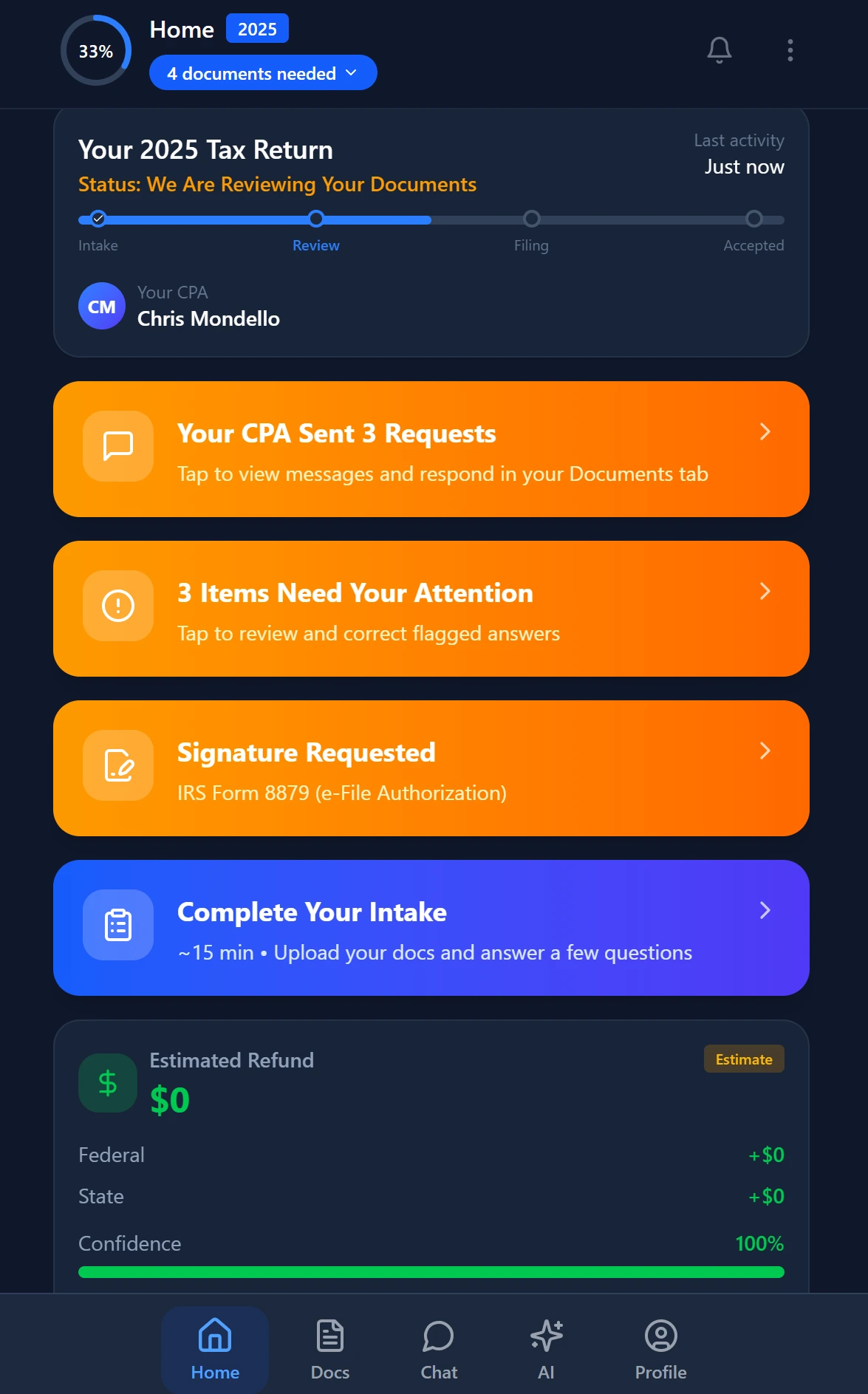 Smart intake auto-fills from uploaded documents and prior-year data
Common Deferred Revenue Errors That Trigger IRS Scrutiny
Certain fact patterns recur frequently in small business accrual-basis engagements and carry elevated examination risk. The first is the absent deferred revenue liability: the client has collected advance payments and recorded them entirely as current-period revenue, with no corresponding liability on the balance sheet. This mismatch is detectable when the tax return shows revenue materially higher than the financial statements, or when a Schedule M-1 or M-3 reconciliation item exists but is not adequately explained.
The second common error is inconsistent method application. A client who deferred advance payments in Year 1 using Rev. Proc. 2004-34 but failed to maintain the deferral in Year 2 has effectively changed accounting methods without filing Form 3115. Inconsistent deferred revenue recognition across years, without a properly filed method change, is one of the clearest signals that draws IRS scrutiny. A change in accounting method without IRS consent under IRC Section 446 can result in a Section 481(a) adjustment, penalties, and in some cases, examination of prior years.
The third pattern — and the one least likely to be caught without systematic document review — is revenue stream commingling. A client with subscription revenue, project-based advance billings, and retail gift cards may be entitled to deferral on some streams but not others. If a single deferred revenue balance is maintained in the books without breakout by revenue type, the CPA cannot verify that the correct deferral rule was applied to each stream. For accrual-basis clients, this kind of revenue classification work should be part of the year-end close process, not reconstructed at the return preparation stage. You can explore other blog resources covering small business tax compliance to see how similar issues arise across entity types.
The IRS Large Business and International Division's Transfer Pricing and Financial Transactions practice unit has published internal guidance on revenue recognition method examination techniques, which reflects the sophistication the agency now applies even to smaller taxpayers.
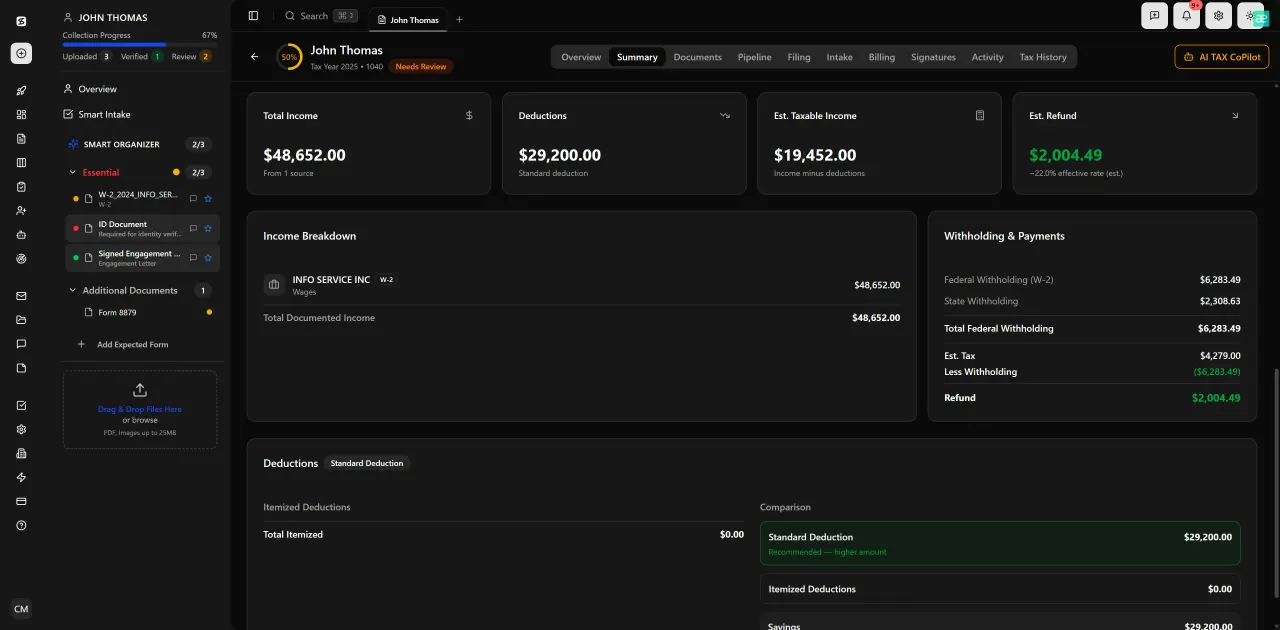 Review with AI assist — 9 agents answer questions with full client context
The GAAP-to-Tax Reconciliation Process for Accrual-Basis Returns
For most small business accrual-basis clients, the CPA must perform a GAAP-to-tax book reconciliation that specifically addresses deferred revenue recognition. On the financial statements, deferred revenue is a liability; on the tax return, it may be fully includible in income, partially deferred under Section 451(c), or subject to a prior-year method election with a Section 481(a) adjustment still flowing through.
A disciplined reconciliation process starts with obtaining a complete trial balance and reviewing the deferred revenue balance for changes year-over-year. If the balance decreased, revenue was recognized — the CPA should verify it was recognized in the correct period and on the correct performance obligation. If the balance increased, new advance payments were collected — the CPA should verify the deferral method election is still in effect and that the amounts qualify under the applicable rule.
The deferred income journal entry that converts the GAAP liability into the correct tax position should be documented in the tax workpaper package with a narrative explanation of the method applied, the revenue streams affected, and the authority relied upon. This documentation serves two purposes: it supports the return position under Circular 230 standards and it creates the institutional memory needed if a different preparer handles the account the following year. For accrual-basis clients with multiple revenue streams, a simple reconciliation table — showing opening balance, amounts recognized during the year, new deferrals, and closing balance by revenue category — is the most defensible workpaper format for supporting each deferred revenue recognition position taken on the return.
Documenting Method Elections and Section 481 Adjustments
If a client is changing their revenue recognition method — either adopting Section 451(c) deferral for the first time or correcting an impermissible prior method — the change must be made through the Form 3115 process. Automatic consent procedures under Revenue Procedure 2019-43 cover many common revenue recognition method changes, which means the client does not need to wait for IRS approval before filing — but the Form 3115 must be attached to a timely filed return and a copy sent to the IRS National Office.
The Section 481(a) adjustment that results from a method change spreads the cumulative catch-up over one year (unfavorable) or four years (favorable), and must be tracked separately in the workpapers and on the return. CPAs who skip this step and simply adjust the current year's deferred revenue recognition without filing Form 3115 expose the client to accuracy-related penalties under IRC Section 6662, which carry a 20% assessment on the underpayment attributable to the incorrect method.
 Every client gets organized documents, status tracking, and a complete history
How AI-Native Tools Flag Recognition Mismatches Before Filing
The fundamental problem with catching deferred revenue errors at the workpaper stage is that it requires comparing information across multiple documents simultaneously — the trial balance, the prior-year return, any Form 3115 filed in prior years, the financial statements, and the source contracts or invoices that establish when performance obligations are satisfied. Without systematic cross-document validation, these comparisons are performed inconsistently, depend on preparer memory, and are frequently skipped under deadline pressure.
AI-native practice platforms like TaxScout apply cross-document validation that compares extracted financial data across document classes — identifying when a balance sheet deferred revenue liability does not reconcile with the Schedule L on the prior-year return, or when the income reported on the return materially exceeds what the financial statements support without a corresponding Schedule M-1 explanation. The platform's 5-layer validation pipeline applies 18 post-extraction rules and 15 deterministic math checks that surface these discrepancies in the review queue rather than leaving them to be caught manually.
The AI research agents available in TaxScout Firm can query IRS guidance on advance payment treatment in real time — pulling current Rev. Proc. guidance, Section 451(c) regulations, and relevant Tax Court decisions — so the preparer can verify the correct deferred revenue recognition method without leaving the platform. When the engagement involves a revenue recognition method change, the pipeline management tools allow the firm to track the Form 3115 preparation as a separate stage in the workflow, with completion checkpoints before the return stage is unlocked.
For firms managing multiple accrual-basis clients simultaneously, the ability to see which engagements have open deferred revenue reconciliation items — without relying on individual preparer notes — is the operational difference between catching errors before filing and discovering them during an IRS correspondence audit. See how this integrates with your existing compliance workflow on our features overview.
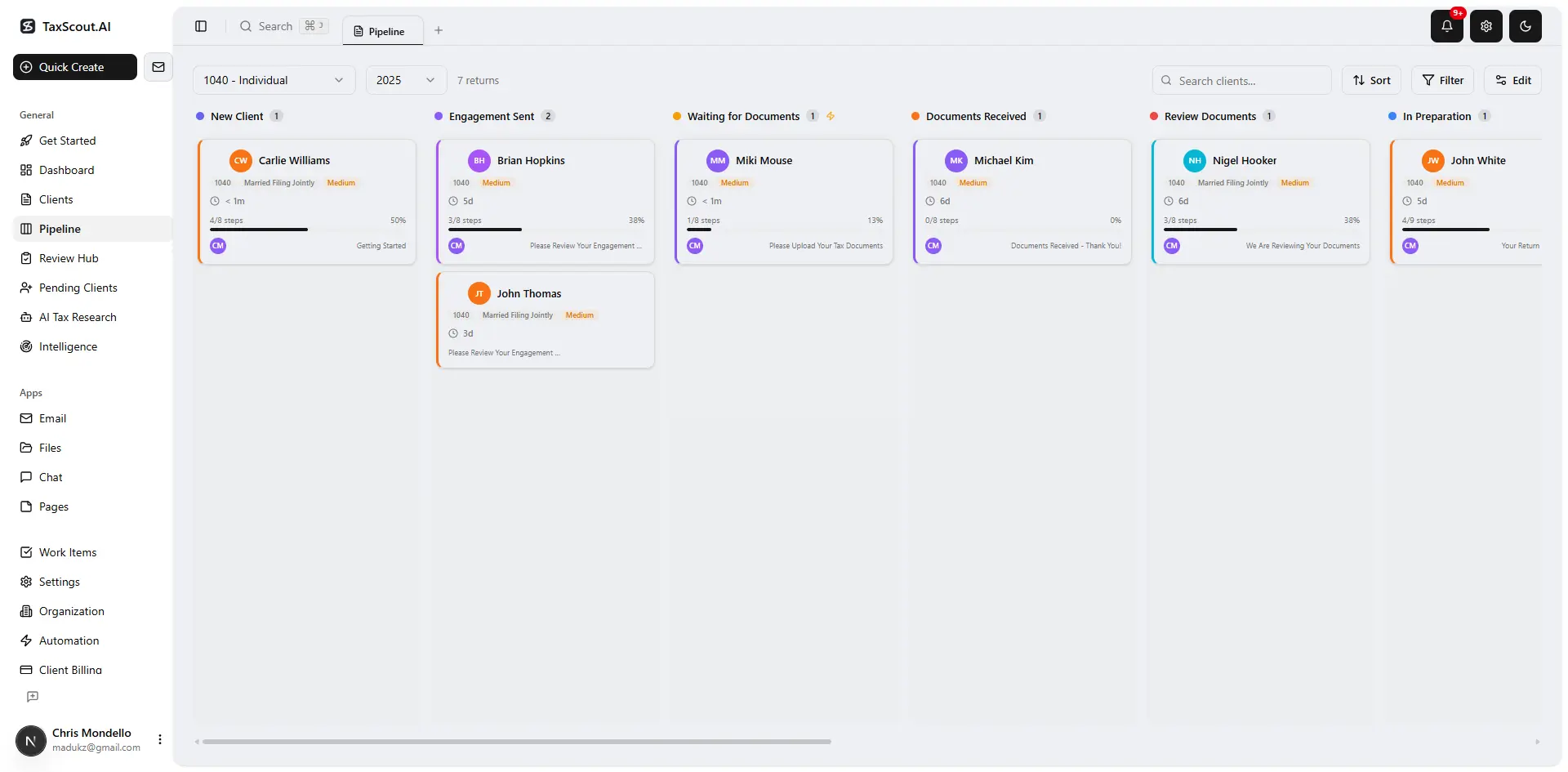 Track every return from intake to filed with drag-and-drop pipeline management
GAAP vs. Tax Treatment of Common Advance Payment Types
| Revenue Type | ASC 606 GAAP Treatment | IRC Section 451 Tax Treatment | Common Error Pattern |
|---|---|---|---|
| Annual service contract | Recognize ratably over service period | One-year deferral available under 451(c) if deferred for GAAP | Full amount recognized in year received — no GAAP deferral maintained |
| Prepaid subscriptions | Recognize as access is provided | One-year deferral if included in AFS revenue next year | Multi-year subscriptions deferred beyond one year without exception qualification |
| Gift cards / stored value | Recognize on redemption; breakage on pattern | Recognize when redeemed; Rev. Proc. 2004-34 may apply | Liability never recorded; full amount taxed at collection |
| Project milestone advance | Recognize when milestone performance obligation satisfied | Income fixed when right to receive is established | Cash-basis recording on receipt; no milestone tracking in books |
| Retainer with refund clause | Constrained variable consideration; may not recognize until refund period lapses | Claim of right doctrine may accelerate recognition | GAAP deferral applied to tax return without claim-of-right analysis |
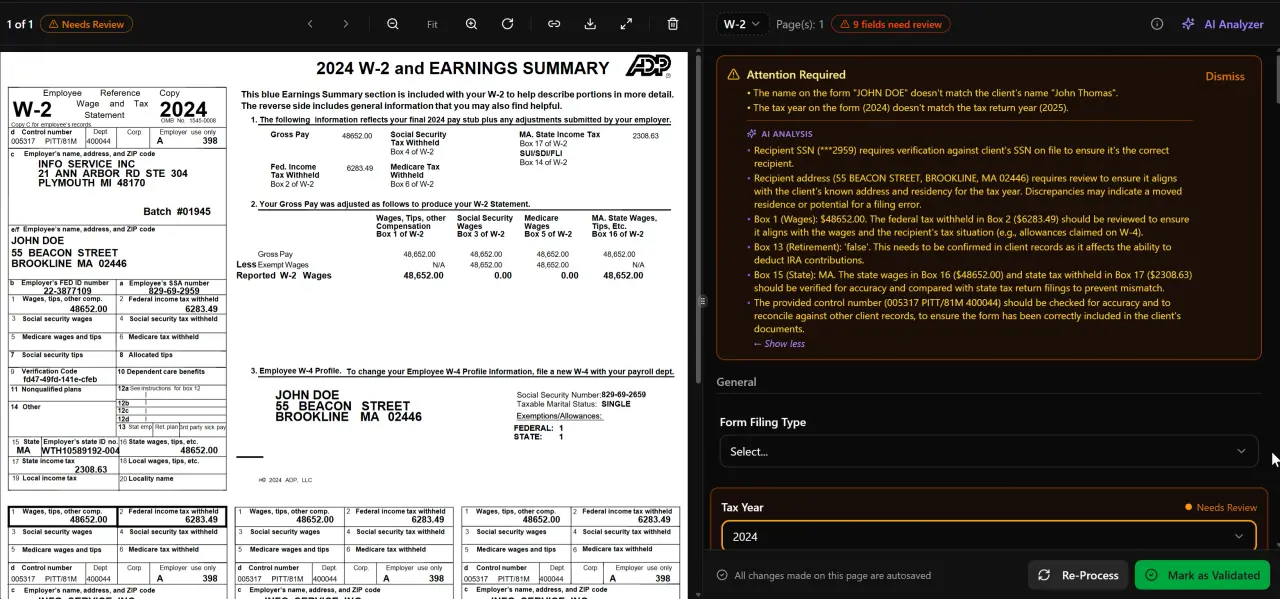 AI classifies, extracts, and validates every document automatically
Building a Deferred Revenue Review Into Your Accrual Client Workflow
The most reliable way to prevent deferred revenue errors is to make the review a structured, repeatable step in the engagement workflow — not a judgment call made under deadline pressure. For accrual-basis clients with recurring advance payment patterns, the deferred revenue account should be on the standard year-end close checklist, with a requirement to produce a rollforward schedule before the trial balance is imported into the tax software.
Firms using a platform like TaxScout can build this into their 12-stage pipeline as a dedicated document-verification stage. The split-screen PDF viewer with click-to-source field highlighting allows preparers to cross-reference contract terms with the general ledger balance in a single window — reducing the time required for the reconciliation without reducing the rigor of the review. Client-context AI memory retains the deferred revenue recognition method elected in prior years, which means the system can flag a year-over-year change even if a different staff member is handling the engagement.
For firms managing high-volume accrual-basis client loads during tax season, the AI intake engine can request the deferred revenue rollforward as part of the structured document collection process — prompting clients to provide the schedule before the engagement formally opens, rather than waiting until the preparer is already working on the return. This front-loading of document collection is particularly valuable for clients with seasonal revenue patterns, where the deferred revenue balance is highest at year-end and changes most significantly between Q3 and Q4.
The advisory opportunity embedded in deferred revenue reviews should not be overlooked. A client who is properly applying Section 451(c) deferral is recognizing income one year later than they otherwise would — a timing benefit with real cash flow value. Explaining that benefit quantitatively, and showing how it interacts with estimated quarterly payment planning (see our guide on avoiding underpayment penalties), positions the CPA as a proactive advisor rather than a compliance processor. The IRS Small Business and Self-Employed Tax Center maintains updated guidance on accounting method options that can inform this advisory conversation.
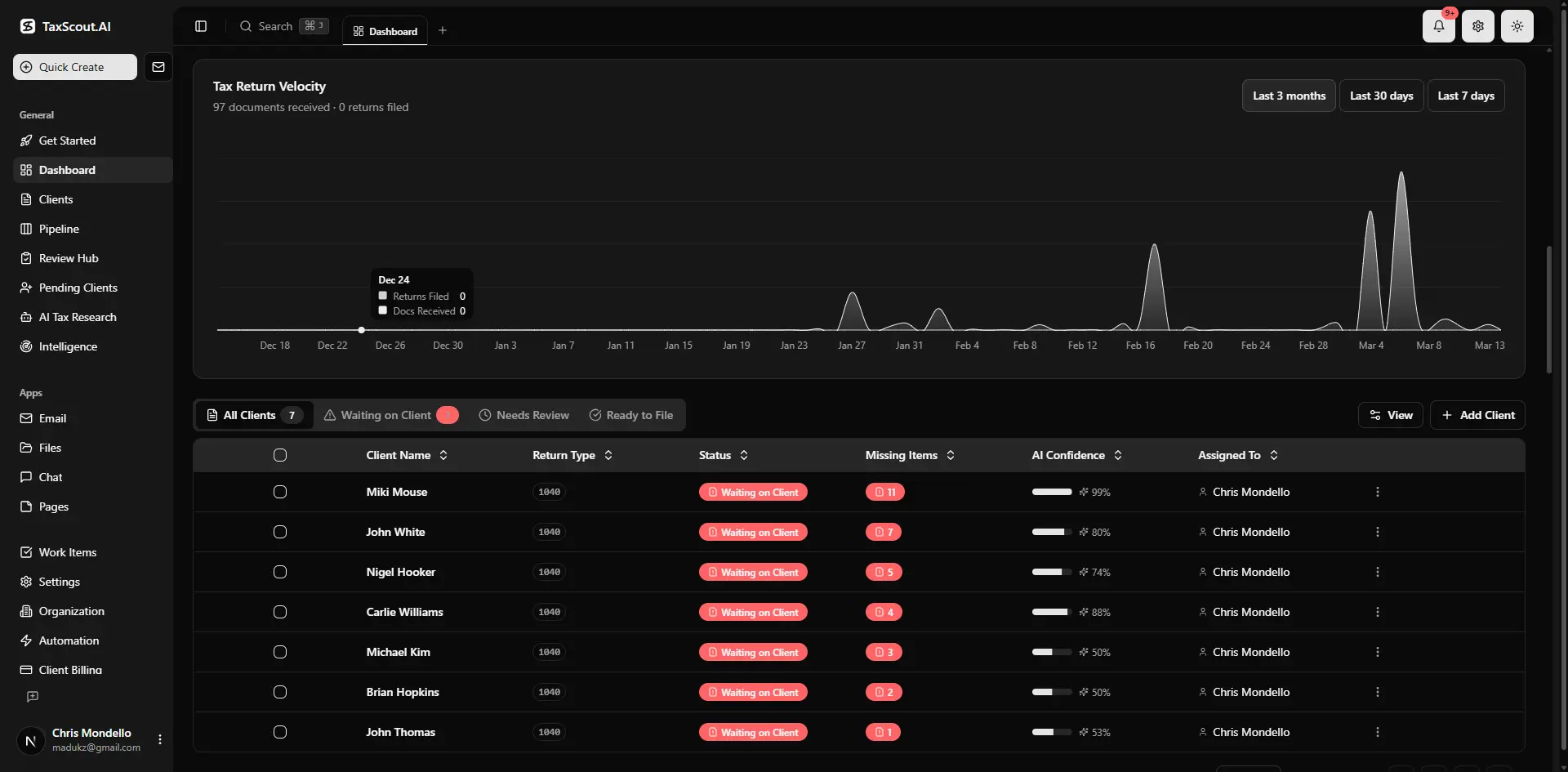 Real-time dashboard showing returns in progress, revenue, and upcoming deadlines
State Conformity Issues in Deferred Revenue Recognition
Federal Section 451(c) treatment does not automatically carry through to state returns. Many states have not conformed to the TCJA amendments to Section 451, which means a client who is properly applying deferred revenue recognition for federal purposes may be required to recognize the full amount in the year received for state tax purposes — creating a state-specific addition adjustment on the return.
California, for example, has historically had selective conformity to federal tax code changes and CPAs serving California accrual-basis clients should verify the current conformity position for each revenue recognition rule applied. See our detailed breakdown of California tax changes CPAs must know for the current conformity landscape. Similar issues arise in New York, where state-specific timing rules have diverged from federal treatment in several areas — review our New York State tax updates guide for current details.
State conformity differences mean that for multi-state accrual-basis clients, the deferred revenue workpaper must track not just the federal treatment but the state-by-state position for each revenue stream. This complexity is compounding: a client with three revenue streams operating in four states may have twelve distinct deferred revenue recognition positions to document. Maintaining that documentation in a structured, searchable workpaper system — rather than in scattered email threads and spreadsheets — is a material risk management consideration for the firm. The state conformity rules vary significantly by jurisdiction and should be verified annually against current state tax authority guidance and the applicable state revenue department publications.
Are deferred revenue reconciliations adding hours to every accrual-basis engagement?
TaxScout's AI-native platform brings cross-document validation, method-election tracking, and real-time IRS research into a single workflow — built for CPA firms at flat, unlimited-user pricing.
Frequently Asked Questions
ASC 606 requires revenue recognition based on satisfaction of performance obligations — meaning advance payments are deferred until the underlying service or product is delivered. IRC Section 451 generally requires accrual-basis taxpayers to include income when all events fix the right to receive it, which for advance payments can mean the year of receipt. Section 451(c), enacted by the TCJA, provides a one-year deferral for eligible advance payments to the extent deferred for financial reporting purposes, narrowing but not eliminating the gap between the two frameworks.
Keep reading
Information Reporting Regarding Qualified Opportunity Zones: What CPA Firms Must Do Now
Sep 14, 2026 · 9 min read
1040 Review Checklist: How CPAs Catch Errors Before E-File
Sep 14, 2026 · 12 min read
Allocation and Apportionment of Deductions to Foreign Source Income: New IRS Proposed Rules
Sep 14, 2026 · 8 min read
Stay up to date
Get the latest tax tech insights delivered to your inbox.