ChatGPT Prompts for CPAs: 25 That Actually Save Time
Most CPAs using ChatGPT are leaving serious time on the table — because generic prompts produce generic results. This guide delivers 25 field-tested ChatGPT prompts for CPAs, organized by workflow stage with realistic time savings for each. Plus, discover why prompts alone have a ceiling and what…
Your client uploads a stack of documents at 11 PM during tax season — and if you've ever searched for ChatGPT prompts for CPAs, you already know this is exactly the moment they're supposed to save you. By 9 AM, you need a summary memo, a list of follow-up questions, a draft email to the client, and preliminary research on their new rental property. You open ChatGPT, stare at the blank prompt box, and type: "Help me with tax stuff."
That's not a productivity system. That's a lost opportunity — and it's why most CPAs who "use AI" are still spending 4–6 hours per client on tasks that should take 45 minutes. The CPAs who are actually reclaiming those hours aren't just using AI — they're using ChatGPT prompts for CPAs that are built around real client context, not generic one-liners.
This guide gives you 25 ChatGPT prompts for CPAs organized by workflow stage, with realistic time savings for each. More importantly, it shows you why prompts alone are a ceiling — and why AI-native practice management takes you past it.
Why Most ChatGPT Prompts for CPAs Fall Flat
The problem isn't that CPAs aren't using AI prompts. It's that generic AI prompts for accountants treat every question as if it exists in a vacuum. You paste a question into ChatGPT without client context, without the actual documents, without prior-year history — and you get a generic answer that still requires 20 minutes of manual adaptation. Truly effective ChatGPT prompts for CPAs close that gap by embedding client-specific details, document references, and workflow stage directly into the prompt itself.
Before we get to the 25 prompts, understand this framework: a prompt is only as good as the context you feed it. The prompts below are built around real CPA workflows — client onboarding, document review, tax research, client communication, and advisory — and each one includes the context injection that makes it actually useful. That's the core design principle behind these ChatGPT prompts for CPAs — context-first prompting that mirrors the way you actually work, not the way a generic AI tutorial assumes you do.
We've also noted which workflows are better handled inside an AI-native practice management platform vs. a standalone ChatGPT window.
Stage 1: Client Onboarding Prompts (5 Prompts)
Client onboarding is where most firms hemorrhage time on administrative back-and-forth. These prompts cut that waste — and they're among the most immediately useful ChatGPT prompts for CPAs you can add to your workflow today.
Prompt 1 — New Client Intake Checklist Generator "I'm onboarding a new individual tax client. They are married filing jointly, have W-2 income, one rental property in [state], and a 25% ownership stake in an S-corporation. Generate a complete document request checklist organized by category with specific form names and common missing items I should flag upfront."
⏱ Time saved: ~45 minutes vs. building this manually per client. Before: You draft the list from memory. After: A complete, categorized checklist in under 60 seconds.
Prompt 2 — Engagement Letter Draft "Draft a professional tax engagement letter for a CPA firm engaging a new S-corporation client for annual federal and [state] tax compliance. Include scope of services, client responsibilities, limitation of liability clause, fee structure placeholder, and signature block. Use clear, plain-English language appropriate for a business owner."
⏱ Time saved: ~60 minutes. Most CPAs spend an hour customizing a template. This gives you a solid first draft in 90 seconds.
Prompt 3 — Client Questionnaire Gap Identifier "A new client submitted an intake questionnaire. They checked 'yes' to foreign bank accounts but provided no FBAR details. They listed a Schedule K-1 from a partnership but didn't provide the EIN. They also indicated a home sale in the current year. Generate a prioritized follow-up question list for each gap, including why each item matters for their return."
⏱ Time saved: ~30 minutes per client.
Prompt 4 — Prior-Year Return Review Summary "I'm reviewing a new client's prior-year 1040. Key items: AGI $285,000, business income $140,000 Schedule C, depreciation claimed $22,000, rental loss suspended $18,500, QBI deduction $28,000. Summarize the items I should verify carried forward correctly, flag any potential missed elections or deductions, and list questions I should ask the client."
⏱ Time saved: ~90 minutes. This is the "new client catch-up" task that used to eat an afternoon.
Prompt 5 — Scope Expansion Identifier "Based on this client profile [paste profile summary], identify any tax situations that might be outside a standard 1040 scope and would require additional fees or specialized services: [list their situation details]."
⏱ Time saved: ~20 minutes per new client. Better scope protection means fewer scope creep write-offs.
As we covered in our guide to AI client onboarding for CPA firms, intake is the highest-leverage place to apply automation — because errors at intake cascade through the entire return preparation workflow.
Tired of building intake checklists and engagement letters from scratch for every new client? See how TaxScout's smart intake engine auto-generates follow-up questions and prefills client data from uploaded documents — no prompting required. → Book a 15-Min Demo — See It Live

Click any extracted field to see its source highlighted on the original PDF
Stage 2: Document Review Prompts (5 Prompts)
These prompts help CPAs make sense of client documents faster — though they come with an important caveat we'll address at the end of this section. When used consistently, ChatGPT prompts for CPAs at this stage can compress hours of document review into minutes.
Prompt 6 — W-2 Anomaly Review "I've extracted the following data from a client's W-2: Box 1 wages $87,400, Box 3 SS wages $87,400, Box 5 Medicare wages $87,400, Box 12 Code DD $8,200, Box 16 state wages $87,400, Box 17 state income tax $3,100. Identify any mathematical inconsistencies, unusual items, or follow-up questions I should ask the client or their employer."
⏱ Time saved: ~20 minutes per W-2 review.
Prompt 7 — K-1 Income Classification Helper "A client received a Schedule K-1 from an S-corporation with the following boxes checked: Box 1 ordinary business income $45,000, Box 2 net rental real estate income $8,000, Box 17 code V UBIA $120,000. Explain what each item means for their 1040, which schedules they flow to, and whether the rental income triggers QBI treatment."
⏱ Time saved: ~40 minutes on K-1 interpretation, especially for multi-activity K-1s.
Prompt 8 — 1099 Reconciliation Checklist "A self-employed client earned income from 12 different payers. They've provided 9 Form 1099-NECs. Generate a process for reconciling their bank deposits against the 1099s, identifying unreported income, and documenting my reconciliation workpaper."
⏱ Time saved: ~45 minutes.
Prompt 9 — Depreciation Schedule Reviewer "Review this depreciation schedule summary [paste data]. Identify: assets that may be fully depreciated but still on the books, any listed property requiring usage logs, Section 179 elections and their carryover status, bonus depreciation elections, and assets that should be reviewed for disposal or retirement."
⏱ Time saved: ~60 minutes per complex return.
Prompt 10 — Missing Document Tracker "Based on this client's prior-year return summary [paste summary], generate a complete list of documents I should expect for the current year. Flag anything that would be unusual if missing."
⏱ Time saved: ~25 minutes.
Important note on document review prompts: When you paste extracted document data into ChatGPT manually, you're re-creating context that should already live in your practice management system. TaxScout's AI document extraction handles 180+ tax form types with a 5-layer validation pipeline — including per-field confidence scoring and cross-document reconciliation. The AI has already flagged the anomalies before you open ChatGPT. That's the difference between a prompt workflow and an integrated AI system.
Stage 3: Tax Research Prompts (6 Prompts)
This is where ChatGPT prompts for CPAs genuinely shine — but only with the right structure. Generic research queries return generic answers; the prompts below are engineered to pull out issue-specific analysis you can actually use.
Prompt 11 — Issue Spotter "A client sold a rental property they had converted from a primary residence 18 months ago. They owned it for 8 years total as a primary residence before converting. Identify all federal tax issues triggered by this sale, including Section 121 exclusion analysis, depreciation recapture under Section 1250, unrecaptured Section 1250 gain rate, and any installment sale considerations if they seller-financed."
⏱ Time saved: ~90 minutes vs. starting research from scratch.
Prompt 12 — Multi-State Nexus Analysis "A client operates a Delaware LLC but has employees in Texas, California, and New York, and derives revenue from customers in 15 states. Describe the state tax nexus implications, which states most likely require income tax filings, and what economic nexus thresholds I should investigate for sales tax purposes."
⏱ Time saved: ~2 hours on initial nexus mapping.
Prompt 13 — Penalty Abatement Research "My client received an [IRS CP2000 notice / failure-to-file penalty / underpayment penalty]. They have a clean compliance history for the prior 3 years. Draft a first-time abatement request letter and identify any additional administrative waiver arguments I should include based on [specific circumstances]."
⏱ Time saved: ~75 minutes per abatement request.
Prompt 14 — Entity Selection Analyzer "A client is starting a digital marketing agency with projected Year 1 net income of $180,000. They are single, no employees initially. Compare sole proprietorship, single-member LLC, and S-corporation taxation for this specific profile, including self-employment tax calculations, QBI deduction implications, and the break-even point for S-corp election based on reasonable compensation."
⏱ Time saved: ~90 minutes vs. building this analysis in a spreadsheet.
Prompt 15 — Estimated Tax Planner "A client had W-2 income of $120,000 in the prior year. In the current year they've also started a consulting business with projected net income of $85,000. Calculate their required estimated tax payments for each quarter using both the 100% prior-year safe harbor and the 90% current-year method, noting which method minimizes underpayment risk given their situation."
⏱ Time saved: ~40 minutes.
Prompt 16 — Tax Law Change Impact Brief "Summarize the most significant changes affecting individual 1040 filers for [tax year] compared to the prior year. Focus specifically on changes to: standard deduction, capital gains rates, QBI deduction thresholds, SALT cap status, retirement contribution limits, and any expiring provisions. Format as a one-page client advisory brief."
⏱ Time saved: ~60 minutes of research consolidation.
Critical limitation: ChatGPT's training data has a cutoff. For IRS guidance issued in the last 6–12 months, IRS.gov is your authoritative source. TaxScout's research agents query IRS.gov, law.cornell.edu, treasury.gov, and congress.gov in real time — not from a cached knowledge base. That distinction matters enormously when you're relying on the answer for a client's return. For more on this, see our deep dive on AI tax research agents for CPAs.
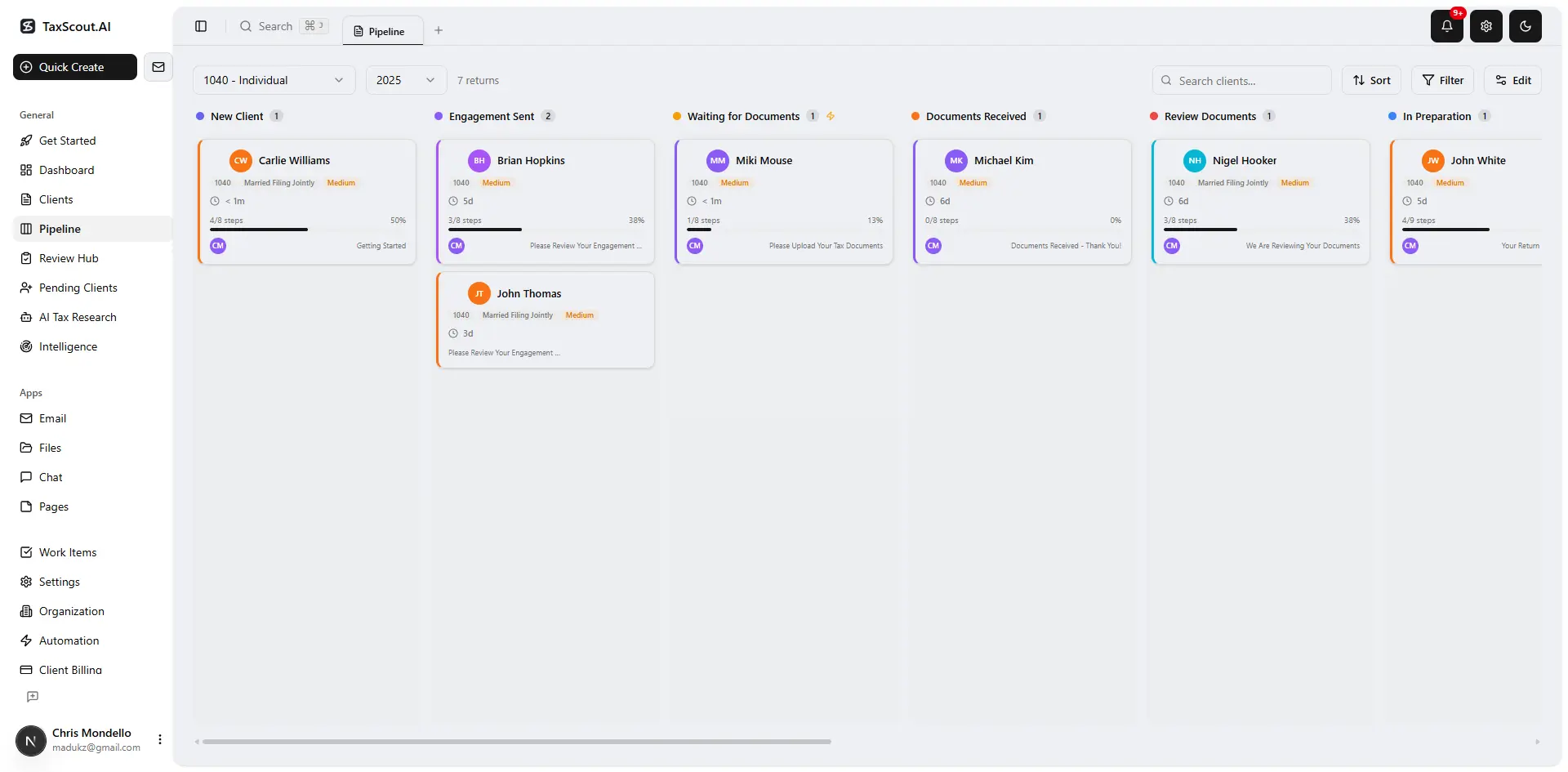
Track every return from intake to filed with drag-and-drop pipeline management
Stage 4: Client Communication Prompts (5 Prompts)
These prompts alone can save a CPA firm 3–5 hours per week during tax season. Well-crafted ChatGPT prompts for CPAs in this category are especially valuable because client communication is time-intensive but highly templatable.
Prompt 17 — Client Update Email "Write a professional but warm email to a client explaining that their return is on extension because we are still waiting for their Schedule K-1 from their partnership. Include: what an extension means (not an extension to pay), the October deadline, whether they owe estimated taxes, and what action they need to take. Tone: clear and reassuring, not technical."
⏱ Time saved: ~20 minutes per client communication.
Prompt 18 — Complex Tax Situation Explainer "My client has a large capital gain this year from a stock sale and is concerned about their tax liability. Write a plain-English explanation of how capital gains are taxed at federal and [state] level, what their approximate liability will be based on these numbers [insert], and three strategies we should discuss: installment sale (if applicable), opportunity zone investment, and charitable giving."
⏱ Time saved: ~45 minutes.
Prompt 19 — IRS Notice Response Cover Letter "My client received [describe notice]. Draft a cover letter responding to this IRS notice that: identifies the client, references the notice number and tax year, clearly states our response position, attaches supporting documentation [list docs], and requests a 30-day acknowledgment. Professional, factual, no emotional language."
⏱ Time saved: ~60 minutes per IRS correspondence matter.
Prompt 20 — Year-End Tax Planning Summary "Write a year-end tax planning summary email for a client with these financial facts: [paste key numbers]. Include three specific action items they should complete before December 31, explain the tax impact of each in dollar terms, and set a deadline for them to respond. Format: short, scannable, action-oriented."
⏱ Time saved: ~40 minutes per planning communication.
Prompt 21 — New Tax Law Client Alert "Write a client-facing alert about [specific tax law change] that explains: what changed, who it affects, what the dollar impact could be for a typical client, and what they should do now. Keep it under 300 words, no jargon, and end with a clear call to action to schedule a planning call."
⏱ Time saved: ~45 minutes per client alert.
For context on the state-level changes worth alerting clients about, our articles on California Tax Changes 2026 and IRS Deadlines Every CPA Must Know in 2026 are useful source material to feed into these prompts.
Stage 5: Advisory Service Prompts (4 Prompts)
These prompts help CPAs move from compliance to advisory — which is where margin lives. Used consistently, ChatGPT prompts for CPAs in the advisory stage can transform how you prepare for and deliver client planning meetings.
Prompt 22 — Business Financial Health Assessment "Review these financial metrics for a client's S-corporation: revenue $2.1M, gross margin 38%, owner compensation $85,000, net income before owner comp $320,000, current ratio 1.4, accounts receivable days 52. Identify 5 specific advisory conversation points I should raise, including tax optimization, compensation strategy, and operational benchmarks for their industry."
⏱ Time saved: ~2 hours of prep time for an advisory meeting.
Prompt 23 — Retirement Plan Comparison "A self-employed client earns $280,000 net from their Schedule C. Compare SEP-IRA, Solo 401(k), and SIMPLE IRA for their situation. Show maximum contribution amounts for the current year, deadline for establishment, administrative complexity, and the effective tax savings at their marginal rate. Recommend the optimal structure with reasoning."
⏱ Time saved: ~75 minutes.
Prompt 24 — Business Sale Tax Modeling "A client is considering selling their S-corporation for $3.2M asset purchase price. They have inside basis of $180,000, $240,000 in accumulated depreciation, goodwill allocated at $1.8M, and $40,000 in personal property. Model the federal tax impact including ordinary income from depreciation recapture, capital gains on goodwill, and net investment income tax. Identify any structuring strategies to reduce the tax hit."
⏱ Time saved: ~3 hours of manual modeling.
Prompt 25 — Proactive Planning Calendar "Build a 12-month tax planning calendar for a client who owns an S-corporation and has rental properties. Include: quarterly estimated tax deadlines, optimal timing for bonus depreciation elections, retirement plan contribution windows, year-end compensation planning, and annual compliance tasks. Format as a month-by-month action list."
⏱ Time saved: ~90 minutes per advisory client setup.
Why AI-Native Practice Management Goes Beyond Copy-Paste Prompting
These 25 prompts will genuinely save your firm time. But they have a hard ceiling — and understanding that ceiling helps you make a smarter decision about your technology stack.
Problem 1: No client context. Every time you paste a prompt into ChatGPT, you're starting fresh. You manually re-enter client data that already exists somewhere in your systems. TaxScout maintains client-context AI memory across every session — entity structures, filing history, extracted documents, prior-year returns. You ask a question about a client, and the AI already knows who they are.
Problem 2: No document integration. Prompts 6–10 above require you to manually extract data from PDFs and paste it into ChatGPT. TaxScout's AI document extraction processes 180+ form types automatically with a 5-layer validation pipeline. The data is already extracted, validated, and cross-referenced before you open a research window.
Problem 3: No real-time IRS data. ChatGPT's knowledge has a cutoff date. When you need to know whether a piece of IRS guidance issued last month affects a client's return, a stale training dataset is a liability. TaxScout's 9 specialized AI research agents query live sources — IRS.gov, law.cornell.edu, treasury.gov, congress.gov — in real time.
Problem 4: No workflow integration. A great prompt answer sitting in a ChatGPT window still has to be copy-pasted into your workflow, emailed to the client, logged somewhere. TaxScout's pipeline management with 12 customizable stages means AI outputs flow directly into your practice workflow — triggering tasks, updating client records, generating documents.
The math on copy-paste prompting vs. integrated AI: A 10-person CPA firm manually prompting ChatGPT for these 25 use cases might save 8–12 hours per week per preparer during tax season. An integrated platform like TaxScout eliminates additional hours in document handling, client communication, pipeline tracking, and billing — while doing it at $49/month flat for the entire team, compared to ~$1,000/month for TaxDome with 10 users.
As we explored in How to Reduce CPA Burnout During Tax Season with AI, the compound effect of removing friction across every workflow stage — not just inserting ChatGPT prompts for CPAs at one stage — is what actually changes how tax season feels for your team.
The CPAs saving the most time aren't the ones with the best prompt library. They're the ones who built a system where AI is embedded in every stage of the workflow, not bolted on as an afterthought.
Ready to Move Beyond Copy-Paste Prompting?
TaxScout gives your firm AI-embedded practice management — document extraction, real-time tax research, client-context AI memory, and pipeline automation — for $49/mo flat for your entire team.
Frequently Asked Questions
The most effective ChatGPT prompts for CPAs during document review are specific and context-rich — for example: 'Review this client's Schedule K-1 and list every item that requires follow-up, organized by urgency.' Generic prompts like 'help me with tax stuff' waste time because ChatGPT has no client context. TaxScout.ai solves this by connecting AI directly to your client's uploaded documents, prior-year returns, and engagement history, so every AI output is pre-contextualized — reducing per-client review time from 4–6 hours to under 45 minutes without manual prompt engineering.
Keep reading
Ponzi Scheme Loss Deductions: How CPAs Claim Theft Losses for Defrauded Clients
Oct 24, 2026 · 1 min read
Energy Tax Credits for CPAs: How to Claim IRA Incentives for Business Clients
Oct 23, 2026 · 1 min read
Partnership Guaranteed Payments: How CPAs Handle SE Tax and Deductibility
Oct 22, 2026 · 1 min read
Stay up to date
Get the latest tax tech insights delivered to your inbox.