Wash Sale Rules: How CPAs Protect Clients From Disallowed Loss Traps
Wash sale rules trip up even experienced CPAs when clients trade frequently, use robo-advisors, or hold crypto. This practitioner guide covers the 30-day mechanics, substantially identical securities tests, post-2025 crypto ambiguity, and how to adjust cost basis on Schedule D without drawing IRS…
Wash sale rules rank among the most frequently mishandled items on the individual return — not because the statute is obscure, but because the detection workflow requires cross-referencing transaction data that rarely arrives in a clean format. For a CPA reviewing a brokerage 1099-B with hundreds of lines, spotting every disallowed loss within a 61-day window demands a systematic process that most review checklists do not provide.
The stakes are higher than they appear. A missed wash sale loss disallowed entry does not just produce an understatement — it distorts the deferred basis adjustment that carries forward, compounding the error into future years. Clients who use robo-advisors face particular exposure because automatic tax-loss harvesting can trigger wash sales across accounts the advisor does not see, and those clients rarely know a violation occurred until the 1099-B arrives. Understanding wash sale rules is essential here, because a missed wash sale loss disallowed entry does not just produce an understatement — it distorts the deferred basis adjustment that carries forward, compounding the error into future years.
This guide is written for the practitioner, not the investor. It covers how to build a detection workflow, apply the substantially identical securities test at review time, evaluate the unresolved crypto wash sale question entering 2026, and document the Schedule D wash sale adjustment in a way that holds up to IRS scrutiny. Along the way, we will identify where practice management tooling — specifically AI-assisted document extraction and research agents — can reduce the manual burden of the review. Navigating wash sale rules requires more than investor awareness — this guide is written for the practitioner, covering how to build a detection workflow, apply the substantially identical securities test at review time, evaluate the unresolved crypto wash sale question entering 2026, and document the Schedule D wash sale adjustment in a way that withstands scrutiny.
The 30-Day Window Mechanics Every CPA Must Internalize
Under IRC § 1091, a loss on the sale of stock or securities is disallowed if the taxpayer acquires substantially identical stock or securities within a period beginning 30 days before the sale and ending 30 days after the sale — a 61-day window in total. The rule applies to purchases made in a taxable account, an IRA, a Roth IRA, or any account controlled by the taxpayer or their spouse. The wash sale rules, codified under IRC § 1091, disallow a loss on the sale of stock or securities if the taxpayer acquires substantially identical stock or securities within a period beginning 30 days before the sale and ending 30 days after the sale — a 61-day window in total.
The window is often misread as 30 days after the sale only. In practice, the pre-sale leg catches clients who bought additional shares before harvesting the loss — a common pattern in volatile markets where an investor averages down, then sells the oldest lot at a loss within 30 days of the new purchase. CPAs reviewing 1099-Bs should sort transactions by security and scan both directions from each loss sale, not just forward. For firms evaluating their wash sale rules approach, this trade-off compounds over time.
Brokerage firms are required to report wash sales on Form 1099-B in Box 1g, but their reporting has a critical limitation: custodians only track wash sales within their own system. Cross-account wash sales — the same security sold in a taxable account and repurchased in an IRA at another institution — are invisible to the broker and do not appear in Box 1g. The CPA bears full responsibility for detecting these. For active traders, requesting a consolidated transaction export covering all accounts for the tax year, including IRAs, is a non-negotiable step in the engagement. Each of these factors directly shapes how wash sale rules plays out in practice.
A practical detection workflow begins by isolating all loss transactions from the 1099-B, then querying a 30-day window in each direction for each security. For clients with multiple custodians, the query must span all exported data in a combined spreadsheet or workpaper before any of those transactions are mapped to Schedule D. The IRS wash sale rule guidance in Publication 550 provides the foundational framework, though it does not address cross-account detection mechanics at a practitioner level. Understanding wash sale rules in this context is what separates firms that scale from those that stall.

Click any extracted field to see its source highlighted on the original PDF
Substantially Identical Securities: Applying the IRS Test at Review Time
Tired of manual workflows slowing your firm down? See how TaxScout handles this with AI-powered automation. → Book a 15-Min Demo This is precisely where a deliberate wash sale rules strategy pays off.
The IRS wash sale rule substantially identical test is the most judgment-intensive part of the analysis. The term is not defined precisely in the statute, and the IRS has addressed it through rulings and guidance rather than a bright-line regulation. For CPAs, the practical standard is whether the securities are so similar that they cannot be distinguished for investment purposes. Wash sale rules sits at the center of this decision — get it wrong and the rest unravels.
Stocks of the same company are substantially identical. Preferred and common shares of the same issuer can be substantially identical if the preferred is convertible into the common. Options to acquire substantially identical stock are themselves substantially identical. Two different mutual funds holding similar indexes, however, are generally not substantially identical — a distinction that is central to tax-loss harvesting strategies and one the IRS has not challenged in most cases involving broad-market index fund swaps. When firms revisit their wash sale rules priorities, the gaps usually surface here.
The substantially identical analysis becomes more difficult with ETFs. Swapping from one S&P 500 ETF to a total-market ETF is generally safe, but swapping between two funds tracking the same index from different providers is a gray area that the IRS has not definitively resolved. For clients who receive a 1099-B showing a wash sale flag on an ETF pair, the CPA should document the underlying index differences in the workpaper and be prepared to defend the position if challenged. Cross-referencing the fund prospectus and documenting portfolio composition differences is the standard of care here.
For a deeper review of how capital gain and loss netting interacts with wash sale adjustments at the portfolio level, our net investment income tax guide covers the NIIT implications that compound when disallowed losses shift net investment income above the threshold.
Tired of manually cross-referencing 1099-Bs across accounts to catch wash sales your clients' brokers missed?
TaxScout.ai extracts 1099-B data with 5-layer validation and flags cross-document inconsistencies before they reach Schedule D review.
Robo-Advisor Wash Sales: The Inadvertent Violation Pattern
Robo-advisors represent a significant and underappreciated source of wash sale exposure for CPA clients. Services like automated tax-loss harvesting are marketed as a benefit, but they create violations when a client holds the same or substantially identical security in any account outside the robo-advisor's visibility — a taxable brokerage account at another firm, a 401(k), or a spousal IRA.
The typical scenario: the robo-advisor sells a position at a loss and immediately purchases a replacement fund to maintain market exposure. If the client also holds that original fund in a 401(k) and the plan makes a regular contribution purchase within the 30-day window, a wash sale has occurred — one that neither the robo-advisor nor the 401(k) administrator will report. The 1099-B from the robo-advisor will not show a wash sale flag because the triggering purchase was at a different institution.
CPAs serving clients with robo-advisor accounts should add a standard engagement question: 'Do you hold any of the same funds in a retirement account, spousal account, or account at another brokerage?' This should be part of the intake process for every client who reports robo-advisor activity. The TaxScout.ai smart intake engine can be configured to surface this question automatically as part of the prefill gap analysis, ensuring it appears on the client questionnaire without requiring the preparer to remember to add it.
When a cross-account wash sale is identified, the disallowed loss is added to the basis of the replacement shares — but because the replacement purchase was made inside a retirement account, the basis adjustment is permanently lost. The taxpayer cannot recover the deferred basis because IRA and 401(k) assets are not tracked for individual tax purposes in the same way taxable account shares are. This is one of the harsher outcomes of the wash sale rule, and clients should be advised before year-end, not after the fact at filing.
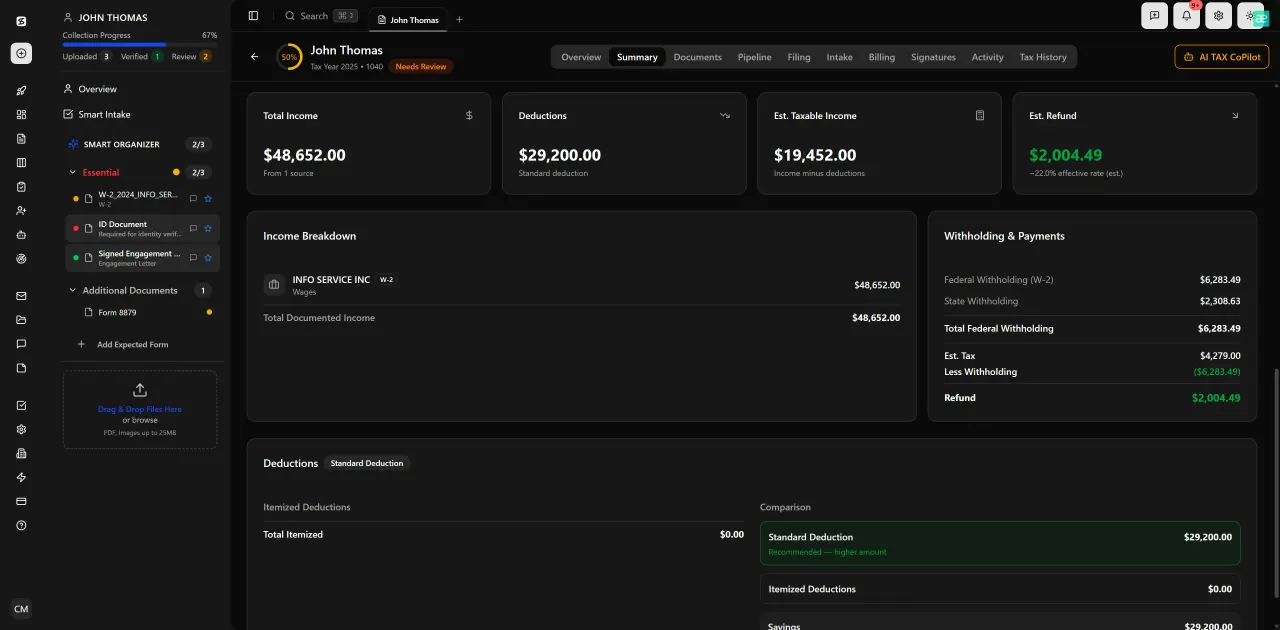
Review with AI assist — 9 agents answer questions with full client context
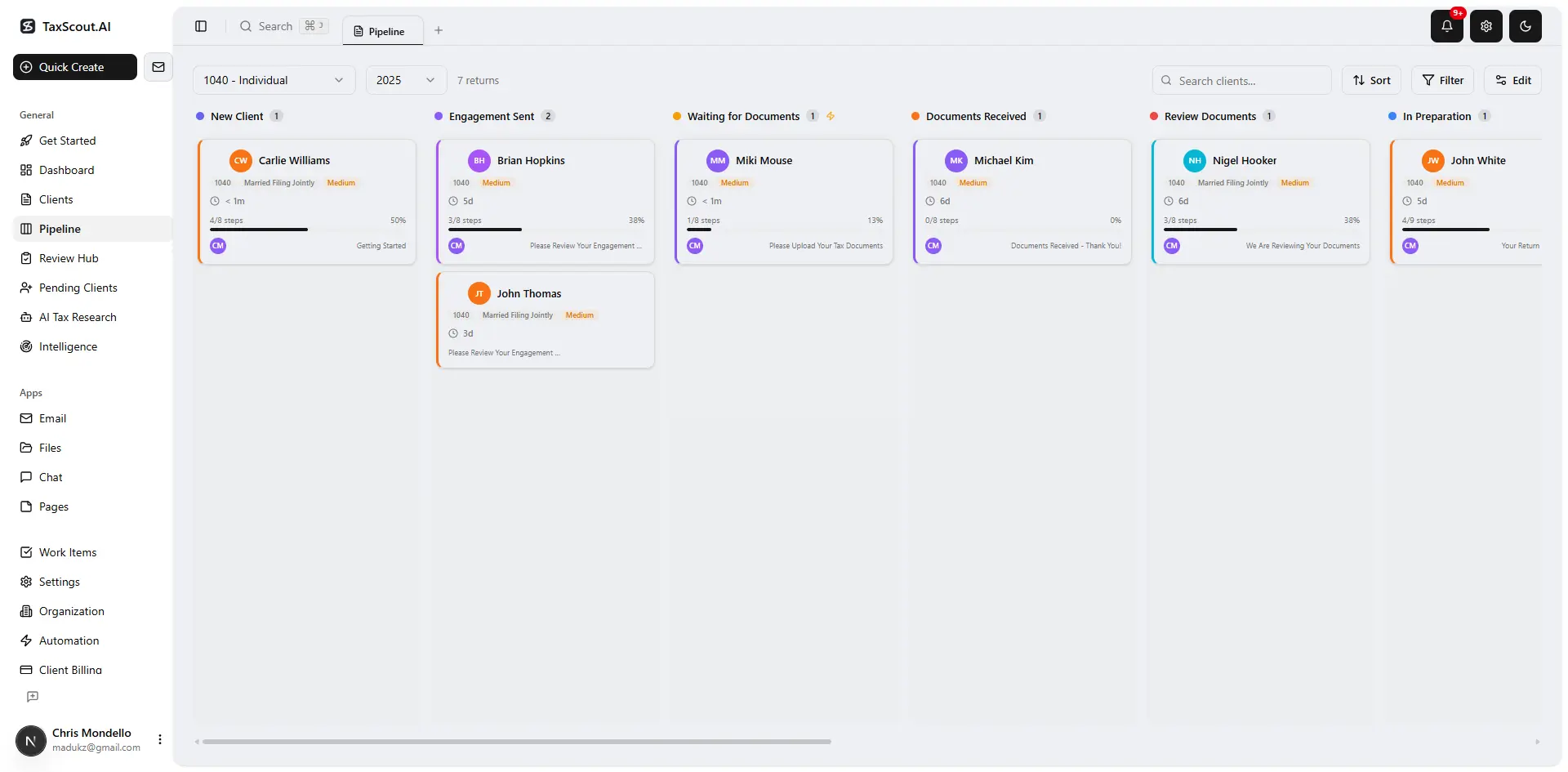
Track every return from intake to filed with drag-and-drop pipeline management
Crypto Wash Sale Ambiguity After 2025 Legislation
The wash sale crypto 2026 question remains one of the most actively litigated interpretation issues in individual tax practice. Under current law, IRC § 1091 applies to 'stock or securities,' and the IRS has long taken the position that cryptocurrency is property, not a security, for purposes of the wash sale rules. This means that under pre-2026 law, a taxpayer can sell Bitcoin at a loss on December 31 and repurchase it on January 1 without triggering a wash sale disallowance — a feature of crypto investing that many clients exploit deliberately.
Legislation passed in late 2025 as part of broader digital asset reporting reforms directed Treasury to issue regulations bringing certain digital assets within the wash sale framework, but as of the 2026 filing season, final regulations have not been published and no effective date has been formally established. Treasury's regulatory agenda lists digital asset wash sale guidance as a priority project, but the absence of final rules means CPAs must track guidance developments closely while advising clients to plan conservatively.
The safest practitioner posture entering the 2026 filing season is to document the current statutory position clearly in client workpapers — cryptocurrency is not currently subject to the wash sale rules absent final Treasury regulations — while flagging that this position may change for tax years after the effective date of any forthcoming guidance. For clients who engaged in deliberate year-end crypto loss harvesting with same-asset repurchase, document the transaction detail and the legal basis for the loss deduction, and flag the file for monitoring if regulations are finalized before the return is filed.
The interaction between staking rewards, hard fork distributions, and wash sales adds another layer of complexity. Even if the underlying asset is not a security for wash sale purposes, the character and basis of staking rewards received within the window could affect the substantially identical analysis once regulations apply. For more on how digital asset income layers into the broader return, our staking rewards glossary entry provides a baseline framework. CPAs handling active crypto traders should also review the Journal of Accountancy's digital asset guidance coverage for updates as regulations develop.
Schedule D Wash Sale Adjustment: The Basis Mechanics
When a wash sale loss disallowed is identified, the disallowed amount is not simply lost — it is deferred into the basis of the replacement shares. This basis adjustment is the part of the wash sale rule that is most frequently mishandled at the return preparation level, because many preparers simply enter the adjustment shown on the 1099-B without verifying that the replacement shares are still held and that the basis roll has been properly applied.
The mechanics work as follows. Suppose a client sells 100 shares of a fund at a $2,000 loss, and repurchases 100 shares of the same fund 15 days later at $18 per share. The $2,000 loss is disallowed. The replacement shares' basis is increased by $2,000, giving them an adjusted cost basis of $20 per share rather than $18 per share. When those replacement shares are eventually sold — in a period that does not trigger another wash sale — the deferred $2,000 loss is recovered.
On Schedule D and Form 8949, the wash sale adjustment is entered in column (g) as a positive number equal to the disallowed loss. The net proceeds minus the adjusted basis then reflect the corrected gain or loss. The IRS cross-checks the 1099-B reported amounts against Form 8949, so the adjustment must be explicitly reported with code W in column (f). Entries that omit the code or enter the adjustment in the wrong direction are a common source of CP2000 notices.
For clients whose 1099-B shows broker-reported basis adjustments that do not match the CPA's independent calculation — a common occurrence when cross-account wash sales are involved — the correct approach is to override the broker basis on Form 8949 using the 'E' code to indicate the basis has been corrected, and to attach a brief explanatory statement to the return. The 1040 review checklist guide covers this and other 1099-B reconciliation steps in the context of the broader return review workflow.
Holding period is also affected by the wash sale adjustment. The holding period of the replacement shares includes the holding period of the shares sold at a disallowed loss. This matters for determining whether a subsequent sale produces a short-term or long-term gain, and it is another item that preparers often miss when the position is entered manually without reference to the original trade date.
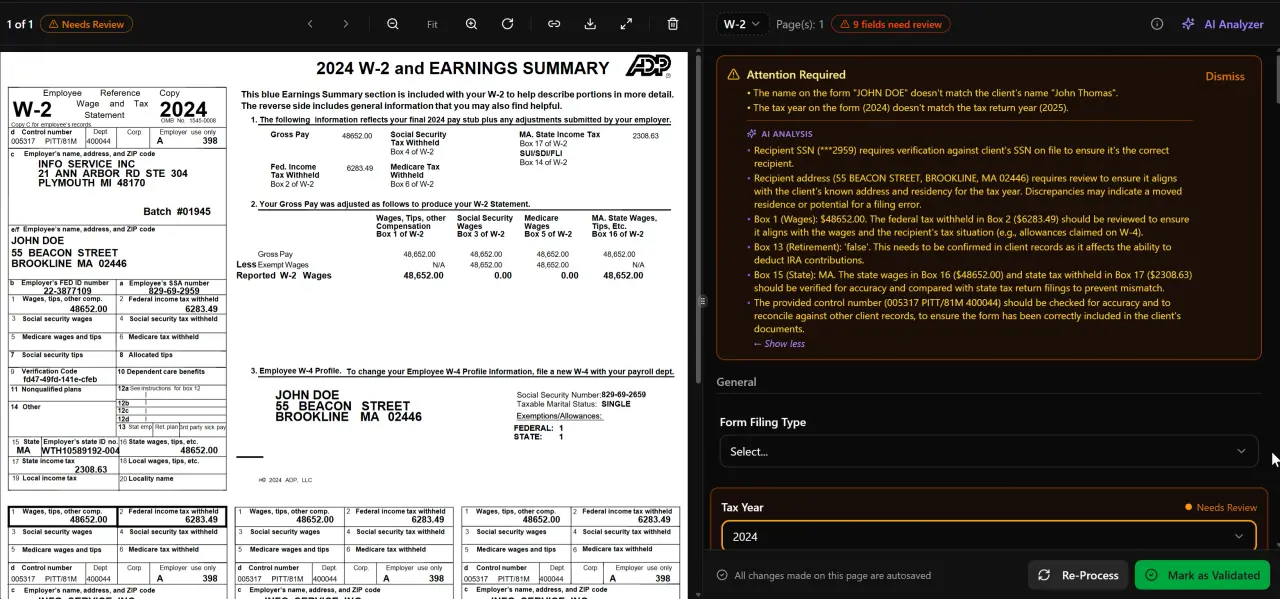
AI classifies, extracts, and validates every document automatically
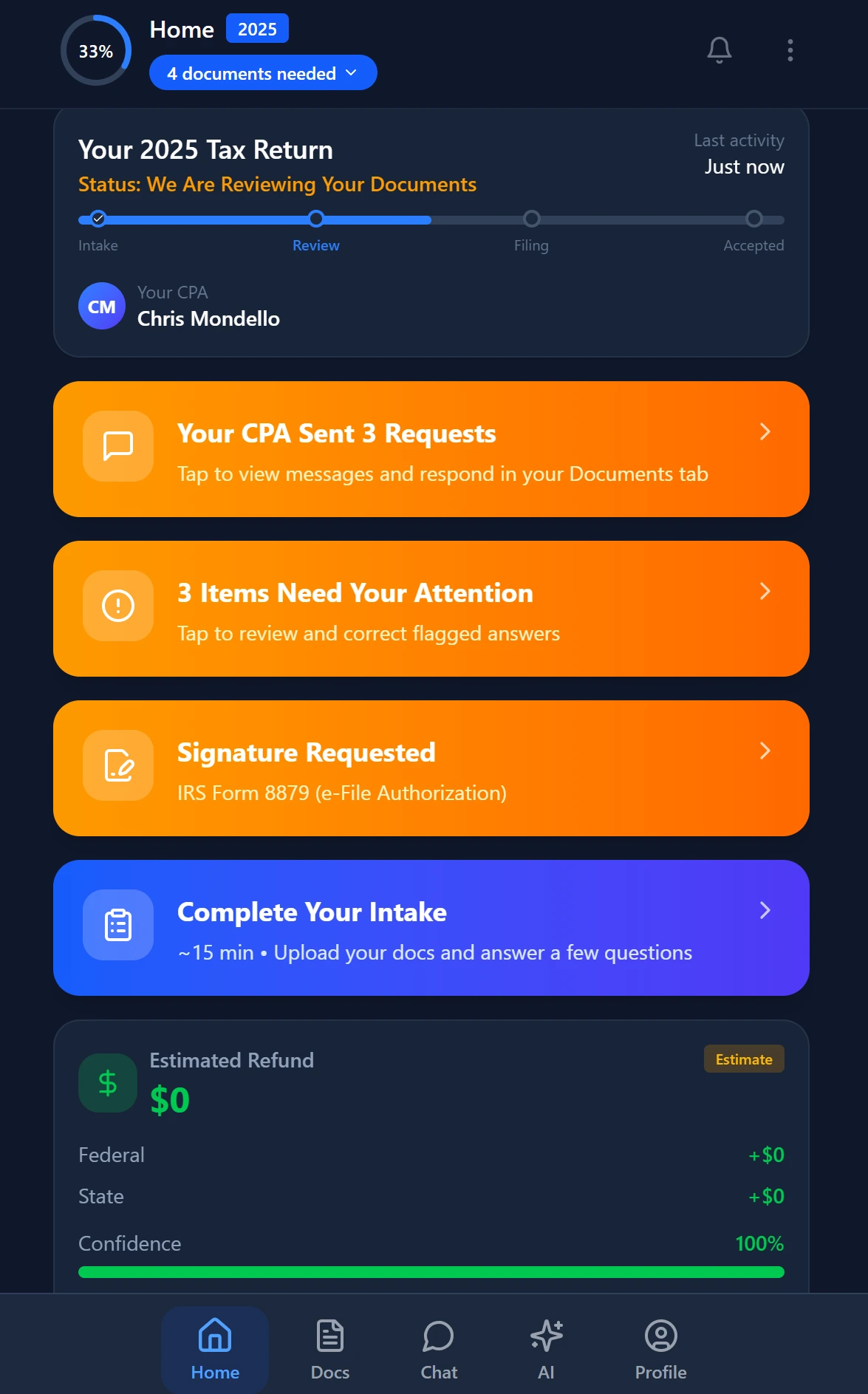
Smart intake auto-fills from uploaded documents and prior-year data
Building a Detection Workflow for Active Trader Clients
Active trader clients — defined here as those with more than 50 distinct sell transactions in the tax year — require a structured detection workflow rather than a transaction-by-transaction review. The workflow should be documented in the firm's standard operating procedures so any preparer can execute it consistently. For guidance on building out those procedures, our CPA firm standard operating procedures guide covers the SOP library framework that supports this kind of systematic review.
Step one is data collection: obtain transaction exports from every custodian, IRA, and retirement account. Combine them into a single workpaper sorted by security ticker or CUSIP, then by date. Step two is loss isolation: filter for all transactions with a negative realized gain. Step three is window scanning: for each loss transaction, query the combined workpaper for any purchases of the same security (and substantially identical securities) within 30 days before and 30 days after the sale date. Step four is flagging: mark each violation with the disallowed amount and the replacement purchase date. Step five is basis adjustment: calculate the adjusted basis of the replacement shares for each flagged position.
AI-assisted document processing can accelerate steps one and two significantly. TaxScout.ai's AI document extraction processes 1099-B forms across the recognized document classes with confidence scoring and cross-document validation, reducing the manual data entry required to build the combined workpaper. The 5-layer validation pipeline — which includes OCR cross-verification and 18 post-extraction rules — catches common data quality issues in brokerage statements before they propagate into the transaction analysis.
For complex cases involving ETF substantially identical questions or cross-account retirement account violations, TaxScout.ai's AI research agents can query current IRS guidance, Treasury positions, and relevant case law in real time, surfacing the authority needed to document the technical position in the workpaper without requiring the preparer to conduct independent research from scratch. This is especially valuable during the 2026 filing season, when crypto wash sale rules remain in flux and guidance updates can arrive mid-season. You can also find additional practitioner-level resources on related topics across our complete guide to tax and practice blog posts.
Wash Sale Rule: Key Detection Checkpoints at Return Review
| Review Checkpoint | Common Miss | Correct Practitioner Action |
|---|---|---|
| Cross-account purchases (IRA, spousal) | Broker 1099-B does not flag — no box 1g entry | Collect all account transaction data; manually scan 61-day window across accounts |
| Robo-advisor tax-loss harvesting | Replacement fund appears safe; 401(k) purchase triggers violation | Add standard intake question; document all accounts before year-end |
| ETF substantially identical determination | Same-index different-provider swap assumed safe without analysis | Document underlying index, portfolio composition differences in workpaper |
| Crypto loss harvesting (pre-regulation) | Loss disallowed under anticipated future rules applied prematurely | Document current statutory position; flag for monitoring if regulations finalized mid-season |
| Schedule D basis adjustment direction | Disallowed loss entered as negative or omitted from column (g) | Enter disallowed amount as positive in column (g); use code W in column (f) |
| Holding period of replacement shares | Replacement shares dated from repurchase; short/long determination wrong | Tack original holding period to replacement shares per IRC § 1091(d) |

Every client gets organized documents, status tracking, and a complete history
Documentation Standards to Avoid IRS Scrutiny
The IRS matches Form 8949 entries against 1099-B data using automated matching. Any variance between what the broker reported and what appears on the return triggers a potential CP2000 unless the return includes the required codes and, where appropriate, an explanatory statement. For wash sales, the documentation standard is straightforward but must be followed precisely.
For broker-reported wash sales (Box 1g is populated), transcribe the disallowed amount to column (g) of Form 8949 and enter code W in column (f). The net gain or loss in column (h) will reflect the basis-adjusted figure, which should match what the broker reported as the adjusted basis in Box 1e. If those figures match, no further documentation is required on the return itself.
For wash sales the CPA identified independently — cross-account violations not reported by the broker — the procedure is more involved. Override the broker-reported basis to reflect the corrected adjusted basis, use code B (basis not reported to IRS) or code E (incorrect basis reported) as appropriate in column (f), and attach a statement to the return explaining the cross-account wash sale, the disallowed loss amount, and the adjusted basis calculation. For clients with complex multi-account situations, this statement can run to several paragraphs and should be retained in the workpaper file.
The IRS resource on reporting sales and exchanges and the SSA/IRS Publication 550 investment income guidance together constitute the primary authority support for Form 8949 disclosures. Citing both in the explanatory statement signals to any examiner that the position was researched and applied deliberately, which substantially reduces the likelihood of a penalty assertion under IRC § 6662 even if the examiner disagrees with the characterization.
Retaining the transaction-level workpaper that supports the detection analysis is equally important. Under the statute of limitations for assessment, the IRS has three years from the filing date for most returns, extended to six years where omitted income exceeds 25 percent of gross income. A well-documented wash sale workpaper protects both the client and the preparer within that window.
Reviewing wash sales across multiple brokerage accounts and retirement plans without a structured workflow?
TaxScout.ai gives your firm AI document extraction, 9 specialized research agents, and a 5-layer validation pipeline — so wash sale detection becomes a workflow step, not a fire drill.

Track firm performance with real-time analytics and client activity monitoring
Frequently Asked Questions
Yes. Under IRC § 1091, a wash sale is triggered if the taxpayer or their spouse purchases substantially identical securities in any account — including a traditional IRA, Roth IRA, or employer-sponsored retirement plan — within the 61-day window. When the replacement purchase is made inside a retirement account, the disallowed loss cannot be recovered as a basis adjustment because IRA and 401(k) assets do not carry individual tax basis in the same way. The loss is permanently lost, making pre-year-end detection critical.
Keep reading
Multistate Payroll Tax Compliance: How CPAs Keep Distributed Clients Out of Trouble
Oct 4, 2026 · 1 min read
Multistate Payroll Tax Compliance: How CPAs Handle Remote Employees for Business Clients
Oct 4, 2026 · 1 min read
Federal Scholarship Tax Credit: What CPA Firms Must Do Now
Oct 4, 2026 · 1 min read
Stay up to date
Get the latest tax tech insights delivered to your inbox.