Passive Activity Rules: What CPAs Must Know to Protect Client Deductions
IRC Section 469 passive activity rules are among the most commonly misapplied provisions in individual and business tax returns — especially for real estate investors, limited partners, and multi-entity business owners. This guide walks CPAs through the seven material participation tests, real…
Passive activity rules under IRC Section 469 represent one of the most technically demanding areas CPAs navigate during tax season. For clients who own rental properties, hold limited partnership interests, or operate multiple pass-through entities, a single misclassification between passive and non-passive income or loss can mean thousands of dollars in denied deductions — or worse, an IRS audit that exposes prior-year errors.
The stakes are especially high because passive activity loss rules interact with a web of related provisions: the at-risk rules under IRC Section 465, the net investment income tax under Section 1411, modified adjusted gross income phase-outs, and the Section 199A QBI deduction framework. A CPA who misapplies even one material participation test can trigger a cascade of errors across an entire return. Understanding how passive activity rules interact with these overlapping provisions is essential for avoiding costly errors on complex returns.
This guide is designed for CPAs who prepare returns for real estate investors, business owners with passive interests, and clients with complex entity structures. We cover the seven material participation tests in detail, walk through the most common client scenarios where passive activity deductions are lost, and show how AI-assisted research and validation tools — like those built into TaxScout.ai — surface these issues before they cost clients money or create liability for your firm. Mastering passive activity rules is no longer optional for practitioners serving clients with real estate holdings or multi-entity structures.
What Passive Activity Rules Actually Govern: IRC Section 469 Fundamentals
Congress enacted IRC Section 469 as part of the Tax Reform Act of 1986 specifically to prevent high-income taxpayers from sheltering ordinary income with paper losses from activities in which they played little or no real economic role. The statute creates a straightforward but technically loaded rule: losses from passive activities can only offset income from passive activities. Passive losses that exceed passive income in a given year are suspended — they become a passive loss carryforward available to offset future passive income or to be released upon a fully taxable disposition of the activity. The passive activity rules that emerged from this legislation fundamentally changed tax planning strategies for investors and business owners alike.
The IRS defines a passive activity as any trade or business in which the taxpayer does not materially participate, plus — with a narrow exception — all rental activities regardless of participation level. Treasury Regulation § 1.469-5T provides the seven tests that determine whether a taxpayer has materially participated in an activity for the tax year. Passing even one test is sufficient; failing all seven means the activity is passive for that year. For firms evaluating their passive activity rules approach, this trade-off compounds over time.
For CPAs, the practical challenge is that the material participation determination must be made activity by activity, year by year. A client who qualified as a real estate professional last year may not qualify this year if their time allocation shifted. A limited partner who actively managed operations may still be treated as passive under the default statutory rule unless they can satisfy the narrower tests available to limited partners under Temp. Treas. Reg. § 1.469-5T(e). Each of these factors directly shapes how passive activity rules plays out in practice.
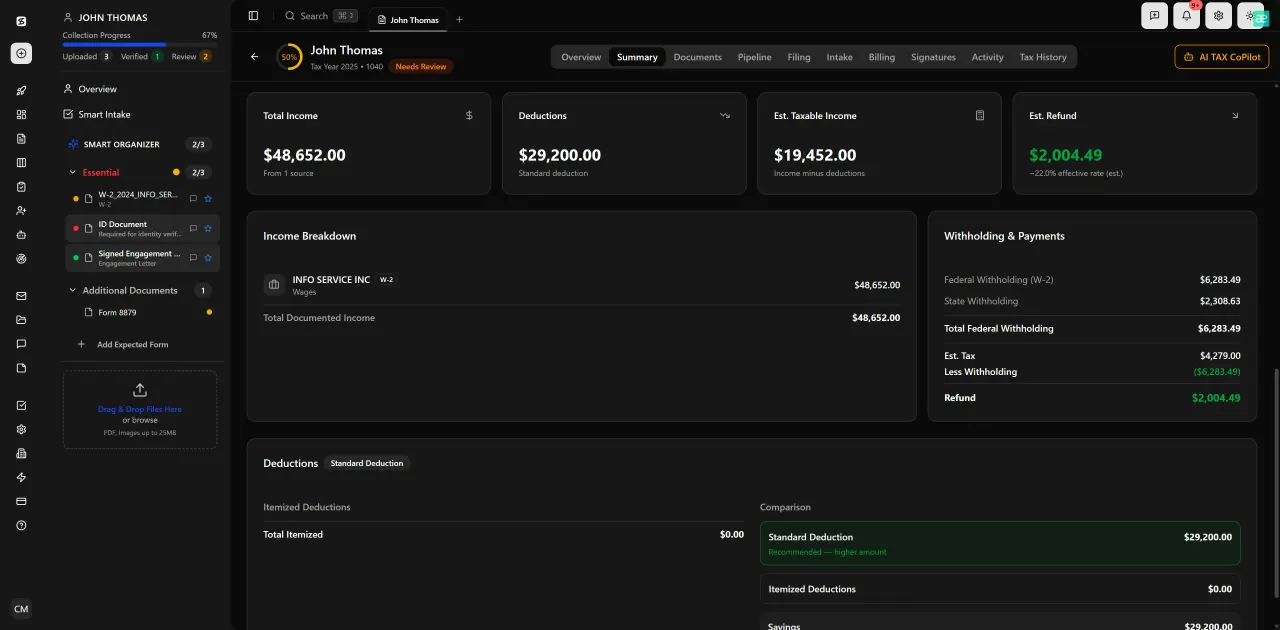
Review with AI assist — 9 agents answer questions with full client context
The Seven Material Participation Tests CPAs Must Apply
The seven material participation tests under Temporary Treasury Regulation § 1.469-5T are the gating mechanism for the entire passive activity analysis. CPAs who understand each test — and its evidentiary requirements — can both maximize legitimate deductions and defend client positions under audit. Understanding passive activity rules in this context is what separates firms that scale from those that stall.
Test 1 is the most commonly used: the taxpayer participated in the activity for more than 500 hours during the year. For a client who runs a small business or actively manages a rental portfolio, contemporaneous time logs are the gold-standard evidence. The IRS has disallowed deductions in audit when taxpayers reconstructed hours from memory without supporting documentation. This is precisely where a deliberate passive activity rules strategy pays off.
Test 2 applies when the taxpayer's participation constitutes substantially all participation by all individuals during the year — including employees. This test is useful for sole-owner businesses where no one else substantively works in the activity. Test 3 covers taxpayers who participated more than 100 hours and whose participation was not less than any other individual's participation in the activity. Test 4 is the significant participation activity (SPA) aggregation rule: if the taxpayer participates more than 100 hours in multiple SPAs and the aggregate exceeds 500 hours, they are treated as materially participating across those SPAs. Passive activity rules sits at the center of this decision — get it wrong and the rest unravels.
Tests 5, 6, and 7 are historical and special-circumstance tests. Test 5 applies if the taxpayer materially participated in the activity for any 5 of the prior 10 tax years — important for clients who step back from an active business. Test 6 covers personal service activities (law, accounting, consulting, health, engineering, architecture, or performing arts) in which the taxpayer materially participated for any 3 prior tax years. Test 7 is the facts-and-circumstances test: participation for more than 100 hours during the year, not less than any other individual's, plus regular, continuous, and substantial involvement based on all facts. When firms revisit their passive activity rules priorities, the gaps usually surface here.
For CPAs managing clients with multiple activities, tracking which test applies to which entity for which year is a documentation problem as much as a legal one. TaxScout's AI research agents can pull the current regulatory text directly from law.cornell.edu and Treasury sources in real time, ensuring the analysis reflects current regulations rather than a CPA's memory of a prior-year training session.
Limited Partners and the Narrower Participation Tests
Limited partners face a statutory presumption of passivity. Under IRC Section 469(h)(2), a limited partner's interest is treated as passive per se unless the limited partner satisfies one of only three of the seven tests: Test 1 (500 hours), Test 5 (5 of 10 prior years), or Test 6 (personal service activity, 3 prior years). Tests 2, 3, 4, and 7 are categorically unavailable to limited partners.
This distinction matters enormously for clients who hold interests in real estate limited partnerships, private equity fund structures, or historic tax credit partnerships. Under passive activity rules, a client who genuinely participates in operations but holds a limited partnership interest may be denied non-passive treatment even with documented hours, unless those hours exceed 500. CPAs reviewing K-1 packages from limited partnerships should flag the partner's classification on Schedule K-1, Box 2 and verify it aligns with the client's actual role before reflecting the income or loss as non-passive.
Tired of manually cross-checking passive activity classifications across dozens of K-1s and rental schedules?
TaxScout's AI research agents and 5-layer validation pipeline surface IRC Section 469 misclassifications before they reach the IRS — protecting your clients and your firm.

Click any extracted field to see its source highlighted on the original PDF
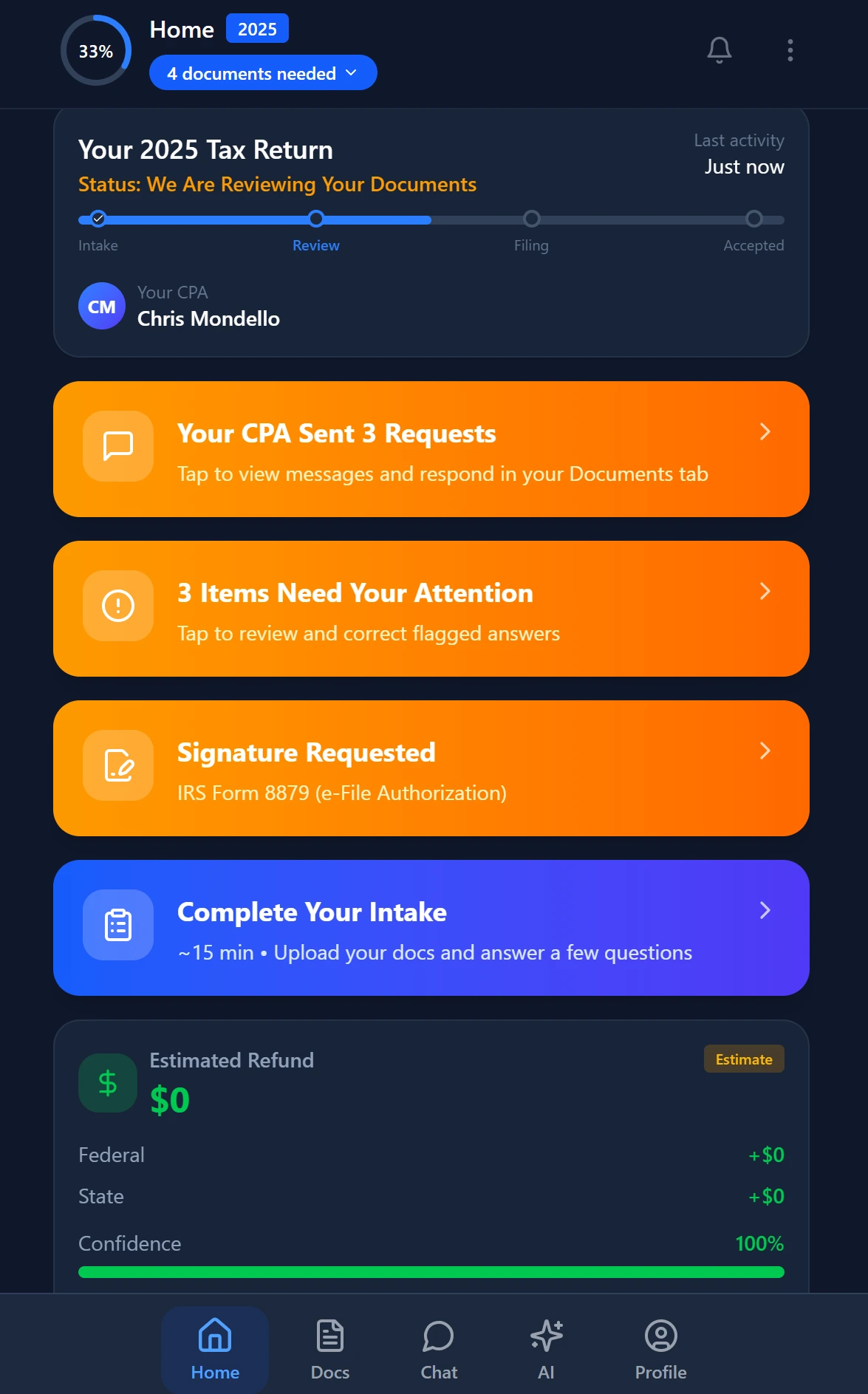
Smart intake auto-fills from uploaded documents and prior-year data
Real Estate Professional Tax Status: The Most Misapplied Exception
The real estate professional exception under IRC Section 469(c)(7) is the most valuable and most frequently misapplied provision in the entire passive activity framework. When a taxpayer qualifies as a real estate professional, their rental activities are removed from the per se passive category and analyzed under the general material participation tests — meaning rental losses can potentially offset ordinary income without limitation.
To qualify, a taxpayer must satisfy two independent requirements. First, more than half of the personal services they perform in trades or businesses during the year must be performed in real property trades or businesses in which they materially participate. Second, they must perform more than 750 hours of services during the year in those real property trades or businesses. Both tests must be met; neither alone is sufficient.
For CPAs working with real estate investor clients, the documentation burden is substantial. The IRS scrutinizes real estate professional claims heavily — the IRS Audit Techniques Guide for Passive Activity Losses specifically identifies real estate professional status as a high-audit-risk area. CPAs should obtain contemporaneous time logs before the return is filed, not after, because reconstructed logs carry significantly less weight in examination. Properly applying passive activity rules to these determinations requires both technical precision and thorough documentation.
A married couple presents an additional complexity: each spouse's hours are evaluated separately. A couple cannot combine hours to meet the 750-hour threshold unless both spouses jointly own the property and both perform services. This frequently surprises clients who assume their household's collective real estate work counts as one unit for tax purposes.
Once real estate professional status is established, each rental property is treated as a separate activity unless the taxpayer makes the grouping election under Temp. Treas. Reg. § 1.469-9(g). Without the election, the taxpayer must independently demonstrate material participation in each property — a nearly impossible standard for clients with large rental portfolios. With the election, all rental activities are treated as a single activity, and the 500-hour test can be met across the portfolio. TaxScout's AI document extraction can identify all Schedule E properties reported on prior-year returns, helping CPAs spot whether a grouping election was previously made and whether it should be revisited.
The $25,000 Rental Real Estate Allowance and Phase-Out Mechanics
For taxpayers who do not qualify as real estate professionals, IRC Section 469(i) provides a narrow relief provision: up to $25,000 of rental real estate losses may be deducted against non-passive income if the taxpayer actively participates in the rental activity and their adjusted gross income (AGI) does not exceed $100,000. The allowance phases out ratably between $100,000 and $150,000 of AGI, disappearing entirely at $150,000.
Active participation is a lower bar than material participation — the taxpayer must participate in management decisions (approving tenants, setting rental terms, authorizing repairs) but need not meet any hourly threshold. However, the active participation standard is unavailable to limited partners and to taxpayers who own less than a 10% interest in the rental.
For a rental real estate CPA serving middle-income clients, this provision is often the primary vehicle for deducting rental losses. The common mistake is failing to track AGI across the return holistically before applying the allowance. A client whose W-2 income, 1099 distributions, and other income sources push AGI above $150,000 gets zero benefit from the $25,000 allowance — all rental losses become suspended passive losses carried forward. When passive activity rules are applied correctly, CPAs should calculate this figure early in the return preparation process, not after all schedules are complete.
TaxScout's 5-layer validation pipeline includes cross-document validation that checks income figures across W-2s, 1099s, Schedule E, and Schedule K-1s before the return is finalized. This kind of automated cross-check — described in more detail in our post on AI document extraction for CPAs — catches the AGI overshoot that silently eliminates the Section 469(i) allowance.

Every client gets organized documents, status tracking, and a complete history
Passive Loss Carryforward: Tracking, Releasing, and Disposing
Suspended passive losses do not disappear — they accumulate as passive loss carryforwards on Form 8582 and are released in two circumstances: when the taxpayer generates sufficient passive income in a future year to absorb them, or upon a fully taxable disposition of the passive activity that generated them.
The disposition rule under IRC Section 469(g) is powerful but riddled with technical requirements. A 'fully taxable disposition' requires a sale to an unrelated third party in a transaction where all gain or loss is recognized. Installment sales, gifting, like-kind exchanges under Section 1031, and contributions to a partnership do not trigger release of suspended passive losses — they are either partially delayed or permanently disallowed depending on the transaction structure.
For CPAs, the highest-risk scenario is a client who disposes of a rental property in a 1031 exchange and incorrectly expects to release years of suspended passive losses in the exchange year. Under Treasury Regulation § 1.469-2(f), the suspended losses from the relinquished property are carried over to the replacement property and remain suspended — they do not become deductible at the exchange. Failing to explain this to clients before a 1031 exchange closes is both a tax error and a client expectation problem. Advisors who have a firm command of passive activity rules can anticipate this issue during planning conversations rather than discovering it after the transaction closes.
Another high-frequency error involves partial dispositions. If a client sells one of three rental properties and all three were grouped under the Section 469(i) grouping election, the suspended losses from all three remain suspended unless the CPA identifies that the disposed property can be ungrouped — which requires meeting specific requirements and filing a statement with the return. Reviewing our complete CPA blog resources turns up additional scenarios where grouping elections create unintended consequences at disposition.
Tracking carryforwards accurately across tax years requires reliable prior-year return data. TaxScout's client-context AI memory retains entity structures, prior-year filing history, and Form 8582 carryforward amounts, giving preparers instant access to suspended loss histories without manually pulling prior-year PDF returns. For firms that serve clients with decade-long rental portfolios, this continuity is operationally significant.
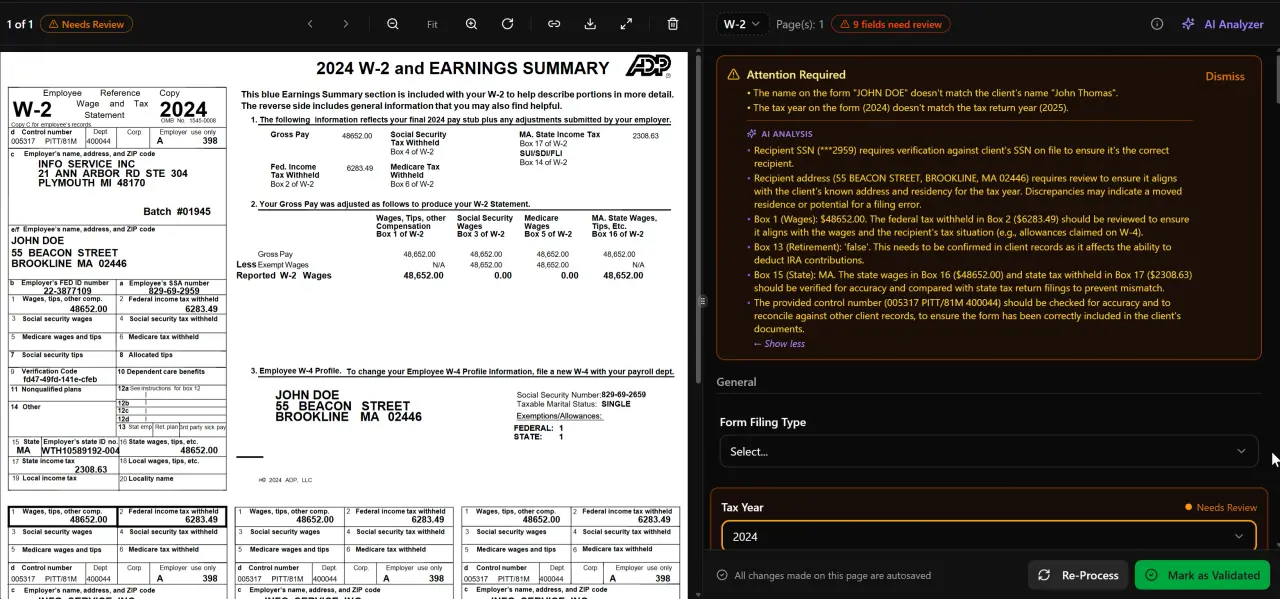
AI classifies, extracts, and validates every document automatically
Common Passive Activity Errors: What Goes Wrong and How AI Validation Catches It
| Error Scenario | Tax Impact | How TaxScout AI Catches It |
|---|---|---|
| Rental loss deducted without checking AGI against $25,000 allowance phase-out | Overstated deduction; potential understatement penalty | Cross-document AGI validation flags income exceeding $100K threshold before Schedule E flows |
| Client claims real estate professional status without 750-hour documentation | Audit risk; reclassification of all rental losses as suspended | AI research agents surface IRS audit technique guidelines; checklist prompts time log collection at intake |
| Limited partner treated as materially participating under Test 2 or Test 7 | Improper non-passive classification; denied deductions on IRS exam | K-1 partner type extraction flags LP status; validation rule checks applicable participation tests |
| 1031 exchange year shows suspended passive losses released on Form 8582 | Incorrect deduction; 1031 nonrecognition overrides disposition release rule | 5-layer validation cross-references exchange proceeds with passive loss release triggers |
| Grouped rental properties not ungrouped before partial disposition | Suspended losses remain trapped; client loses deduction permanently | Prior-year grouping election data in AI memory flags grouped activities on disposition events |
How AI-Assisted Research and Validation Reduces Passive Activity Errors
Most practice management platforms in the CPA software space focus exclusively on workflow automation, client onboarding, and document storage. None have built technical tax research directly into the return preparation workflow — which is why passive activity misapplication remains one of the most common sources of CPA malpractice claims.
TaxScout takes a different approach. The platform's AI research agents include nine specialized agents that query IRS.gov, Treasury.gov, law.cornell.edu, SSA.gov, and congressional sources in real time. A preparer who encounters an unusual passive activity scenario — say, a client who partially disposed of a grouped rental activity and also triggered the net investment income tax — can query the research agent directly from within the return workflow and receive a cited, current answer referencing actual code sections and regulations rather than a generic CPE summary.
On the document side, TaxScout's AI document extraction processes 180+ form types including all Schedule E variants, K-1s from partnerships and S corporations, and Form 8582. The 5-layer validation pipeline applies 18 post-extraction rules and cross-document validation that specifically checks for AGI-based phase-outs, passive income offset requirements, and year-over-year carryforward consistency. This is particularly valuable for firms that acquired new clients mid-year whose prior-year Form 8582 data lives in a competitor platform — TaxScout's file management tools allow CPAs to ingest and extract data from prior-year PDFs to seed the carryforward analysis.
For firms comparing platforms, it is worth noting that tools like TaxDome and Canopy offer workflow management but no AI-assisted tax research or passive activity validation. TaxScout's comparison with TaxDome and comparison with Canopy both show the gap clearly. The difference is not a workflow feature — it is whether the software actively helps CPAs apply the tax law correctly, or simply organizes documents after the fact.
Beyond individual return accuracy, the audit trail matters. When a client's real estate professional status claim is eventually questioned by the IRS, the CPA who documented the analysis — 750-hour test, greater-than-half-of-services test, contemporaneous time logs attached to the return file — is in a fundamentally different position than the CPA who relied on the client's verbal assurance. TaxScout's pipeline management with 12 customizable stages lets firms build a dedicated passive activity review checkpoint into the return workflow, ensuring that IRC Section 469 analysis happens before filing, not during an IRS correspondence audit two years later.
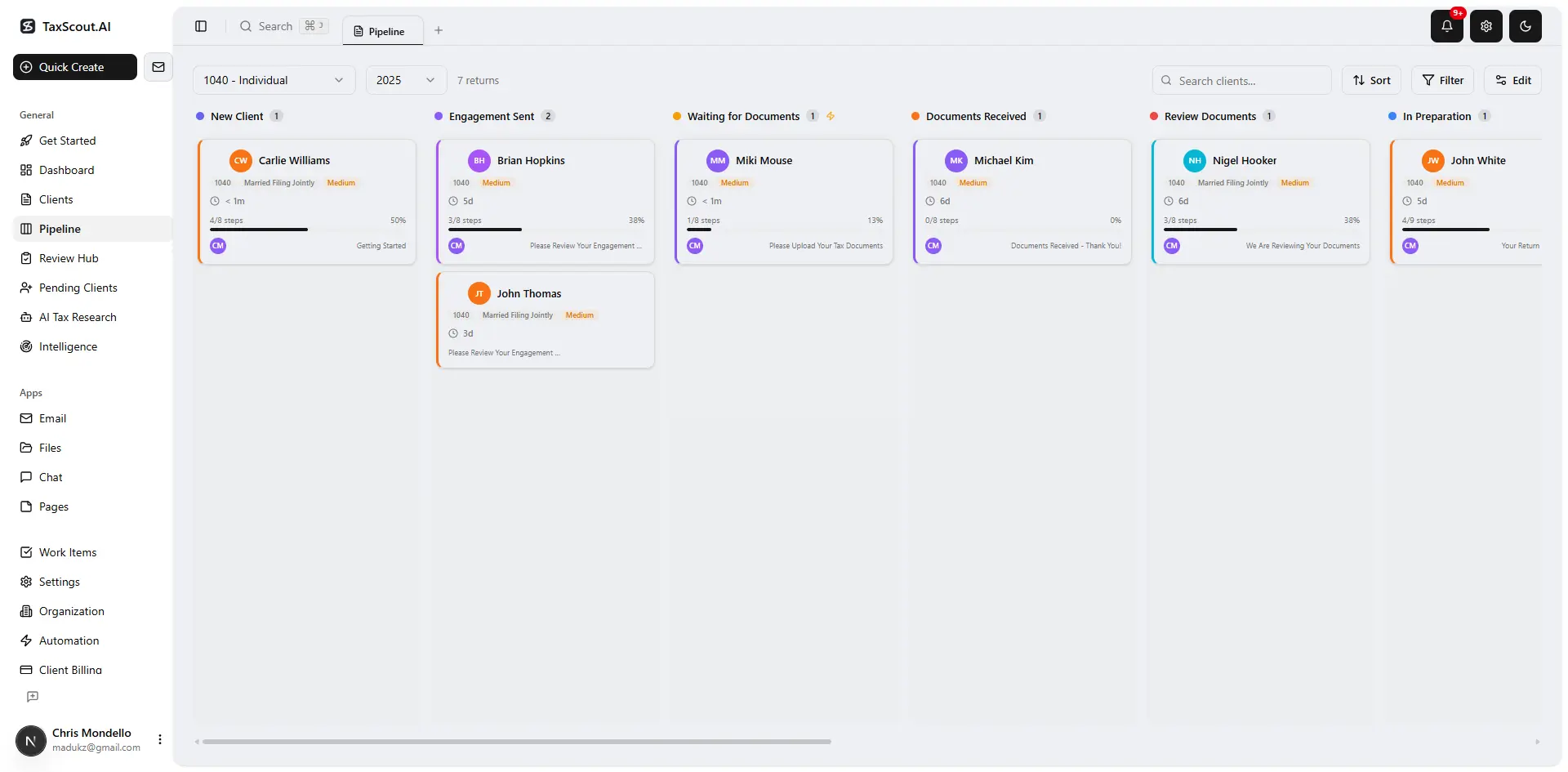
Track every return from intake to filed with drag-and-drop pipeline management

Track firm performance with real-time analytics and client activity monitoring
Grouping Elections, Self-Charged Interest, and Other Advanced Scenarios
Beyond the core passive activity rules, several advanced provisions trip up even experienced CPAs. The grouping rules under Treas. Reg. § 1.469-4 allow taxpayers to treat multiple activities as a single activity for material participation purposes — a powerful planning tool that also creates traps at disposition. Once activities are grouped, they generally must remain grouped (with limited exceptions), and a disposition of less than substantially all of a grouped activity does not trigger the Section 469(g) loss release.
Self-charged interest is another frequently overlooked provision. Under Treas. Reg. § 1.469-7, when a taxpayer lends money to a pass-through entity in which they hold a passive interest, the interest income they receive on that loan can be recharacterized as passive income — offsetting passive losses from the same entity. This creates a planning opportunity that many CPAs miss because the self-charged interest rules require the taxpayer to affirmatively identify the relationship between the loan and the entity on the return. Advisors well-versed in passive activity rules are more likely to spot and leverage this recharacterization for their clients.
The net investment income tax (NIIT) under IRC Section 1411 adds another layer. Passive activity income — including rental income from non-real-estate-professional rentals — is generally subject to the 3.8% NIIT on net investment income above applicable threshold amounts. However, income from activities in which the taxpayer materially participates is excluded from NIIT. This means the passive versus non-passive determination simultaneously affects both the deductibility of losses and the NIIT exposure of income — doubling the stakes of getting it right.
For clients with S corporation interests, the S corporation election itself does not determine passive or active treatment — the shareholder's material participation in the S corporation's activities does. A shareholder-employee who receives reasonable compensation as a W-2 employee of the S corp but has shifted day-to-day management to others may no longer meet the 500-hour material participation test in a given year, converting previously non-passive S corp income into passive income and potentially making it subject to NIIT for the first time. CPAs should flag this scenario during engagement planning for clients who are transitioning toward retirement or reduced involvement in their businesses. See also our guide on IRS deadlines CPAs must track in 2026 for timing considerations around passive activity elections that must be made on a timely filed return.
Want to stop relying on memory to catch IRC Section 469 errors across a full client roster?
TaxScout's AI research agents, 5-layer validation pipeline, and client-context memory give your firm a systematic defense against passive activity misclassification — at a flat rate with no per-user fees.
Frequently Asked Questions
Passive activity rules under IRC Section 469 limit the deductibility of losses from activities in which the taxpayer does not materially participate, suspending excess losses until future passive income or a taxable disposition. At-risk rules under IRC Section 465 are a separate, prior limitation that restricts loss deductions to the amount the taxpayer has economically at risk in the activity — including cash contributed, debt for which the taxpayer is personally liable, and certain nonrecourse financing on real property. Both limitations apply independently; a loss must clear the at-risk hurdle before it can even reach the passive activity analysis.
Keep reading
Section 1202 QSBS Exclusion: How CPAs Shelter Startup Gains for Founder Clients
Oct 15, 2026 · 1 min read
SALT Deduction Cap Workarounds: How CPAs Reduce State Tax Burden for High-Income Clients
Oct 12, 2026 · 1 min read
Wash Sale Rules: How CPAs Protect Clients From Disallowed Loss Traps
Oct 4, 2026 · 1 min read
Stay up to date
Get the latest tax tech insights delivered to your inbox.