Lease Accounting for CPAs: ASC 842 Client Workflows That Scale
Every guide to ASC 842 is written for controllers and CFOs inside the company — almost none address the CPA firm practitioner managing dozens of client lease schedules simultaneously. This guide covers what lease data to capture at intake, how to build repeatable right-of-use asset and…
Lease accounting for CPAs presents a workflow challenge that almost no published guide addresses head-on. The mountain of content on ASC 842 is written for the controller at a single company — not for the external practitioner who juggles 40, 60, or 100 client entities, each with their own lease portfolios, incremental borrowing rates, renewal options, and mid-year modifications. The gap between "understand the standard" and "run a scalable client service" is enormous, and most firms are bridging it with spreadsheets and calendar reminders.
That approach breaks down quickly. A missed lease modification restatement, a stale discount rate carried forward from adoption year, or a disclosure omitted from the notes can expose your firm to professional liability and your client to audit adjustments. ASC 842 has been effective for public companies since 2019 and for private companies since fiscal years beginning after December 15, 2021 — which means the adoption window has closed and the ongoing compliance burden is now permanent. These are exactly the pitfalls that make lease accounting for CPAs a discipline requiring rigorous, standardized workflows rather than ad hoc spreadsheets.
This guide is written entirely from the practitioner side: what data to collect at client intake, how to structure repeatable right-of-use asset and lease liability amortization workflows, what an ASC 842 disclosure checklist should contain, and how AI-native practice management tools let a small CPA team manage lease accounting compliance at scale without adding headcount. Everything covered here is designed to make lease accounting for CPAs more systematic, defensible, and scalable across your entire client portfolio.
Why ASC 842 Compliance Is a Recurring Practice Management Problem
Under ASC 842, virtually every lease with a term exceeding 12 months must be recognized on the balance sheet as a right-of-use (ROU) asset and a corresponding lease liability. That sounds like a one-time transition task, but in practice it generates ongoing obligations: remeasurement events when clients modify lease terms, reassessment of the incremental borrowing rate on certain modifications, re-calculation of amortization schedules when renewal options become reasonably certain, and updated footnote disclosures every reporting period. Understanding these ongoing obligations is fundamental to lease accounting for CPAs who want to serve clients accurately beyond the initial adoption date.
For a CPA firm, each of those triggers requires timely action across every client simultaneously. A retail client may have 15 location leases. A medical practice may add a new equipment lease mid-year. A nonprofit may have a lease that crosses into GASB 87 territory if they file governmental financial statements. Managing these moving parts reactively — waiting for the client to call with a lease amendment — is a liability. Managing them proactively with a structured intake and reminder system is the differentiator that advisory-minded firms use to justify premium fees. For firms evaluating their lease accounting for CPAs approach, this trade-off compounds over time.
The compounding problem is documentation. If your client faces an audit or a bank covenant review, you need a traceable audit trail: when was the lease first recognized, what IBR was used at commencement, when was the modification identified, and how was the remeasurement calculated? Firms relying on emailed spreadsheet versions and shared folders frequently cannot reconstruct that trail without hours of archaeology. That is the workflow problem this article solves. Each of these factors directly shapes how lease accounting for CPAs plays out in practice.
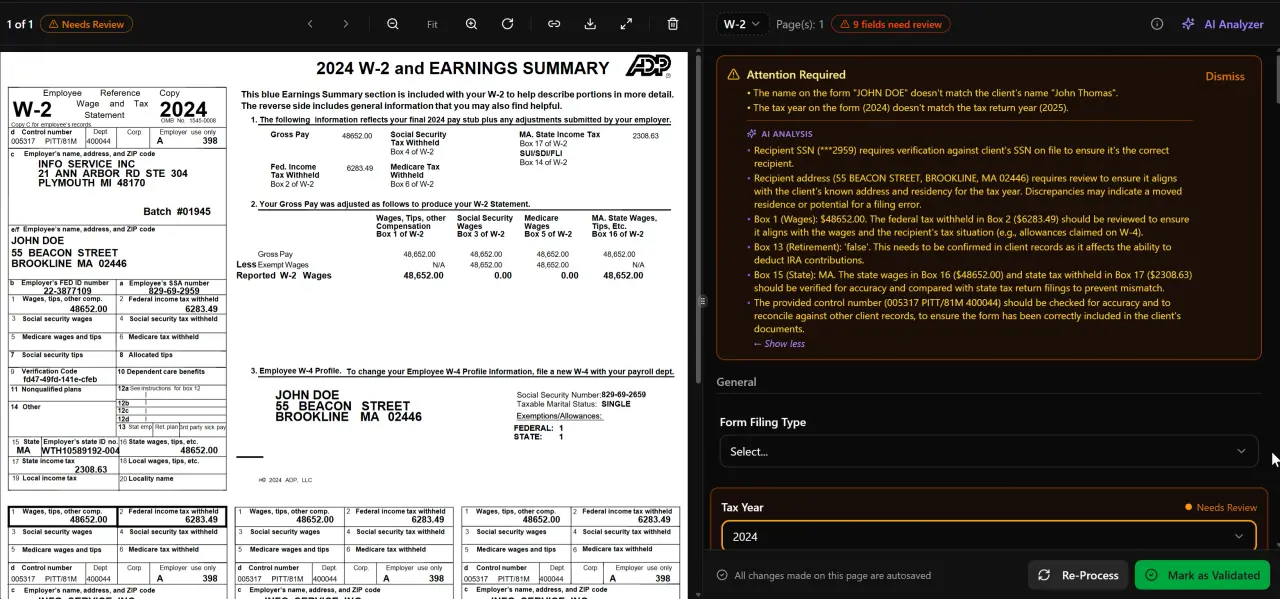
AI classifies, extracts, and validates every document automatically
Lease Data to Collect at Client Intake
The single highest-leverage moment in ASC 842 compliance is the initial data collection. Capturing everything you need at onboarding — rather than chasing it through email threads later — is what separates firms that deliver clean financials from firms that file extensions and restate prior periods. Your client onboarding checklist should treat lease schedules as a first-class document category, not an afterthought. Understanding lease accounting for CPAs in this context is what separates firms that scale from those that stall.
For each lease in scope, you need: the original signed lease agreement and any amendments, commencement date and original lease term, contractual payment schedule (including stepped rent provisions and variable components), renewal and purchase option language with your professional assessment of whether options are reasonably certain to be exercised, the implicit rate in the lease if ascertainable, and the client's incremental borrowing rate (IBR) as of commencement. The IBR is often the most contentious input — you will typically need to request recent loan statements or work with the client's banker to derive a supportable rate consistent with Federal Reserve benchmark guidance. This is precisely where a deliberate lease accounting for CPAs strategy pays off.
Beyond the core lease terms, you need the client's accounting policy elections: have they elected the practical expedient to not separate lease and non-lease components? Have they elected the short-term lease exemption for leases under 12 months? These elections must be documented, consistent, and applied uniformly across the portfolio. Building a standardized intake form that captures all of this — and flags missing fields before the file lands on your desk — is the foundation of scalable lease accounting for CPAs.
TaxScout's AI intake engine is modeled on IRS Form 13614-C logic with four-layer prefill: document-first extraction, prior-year carry-forward, profile data, and AI gap analysis. You can extend those intake questionnaires to include lease-specific fields so that every new engagement automatically surfaces the data points your team needs before work begins. For a deeper look at how structured document intake works, see our guide on AI document extraction for CPAs. Lease accounting for CPAs sits at the center of this decision — get it wrong and the rest unravels.
Tired of chasing lease amendment emails and reconciling five versions of the same amortization spreadsheet? When firms revisit their lease accounting for CPAs priorities, the gaps usually surface here.
TaxScout centralizes every lease document, automates reminders at modification triggers, and gives your whole team a single audit-ready source of truth — for a flat fee with no per-user pricing.
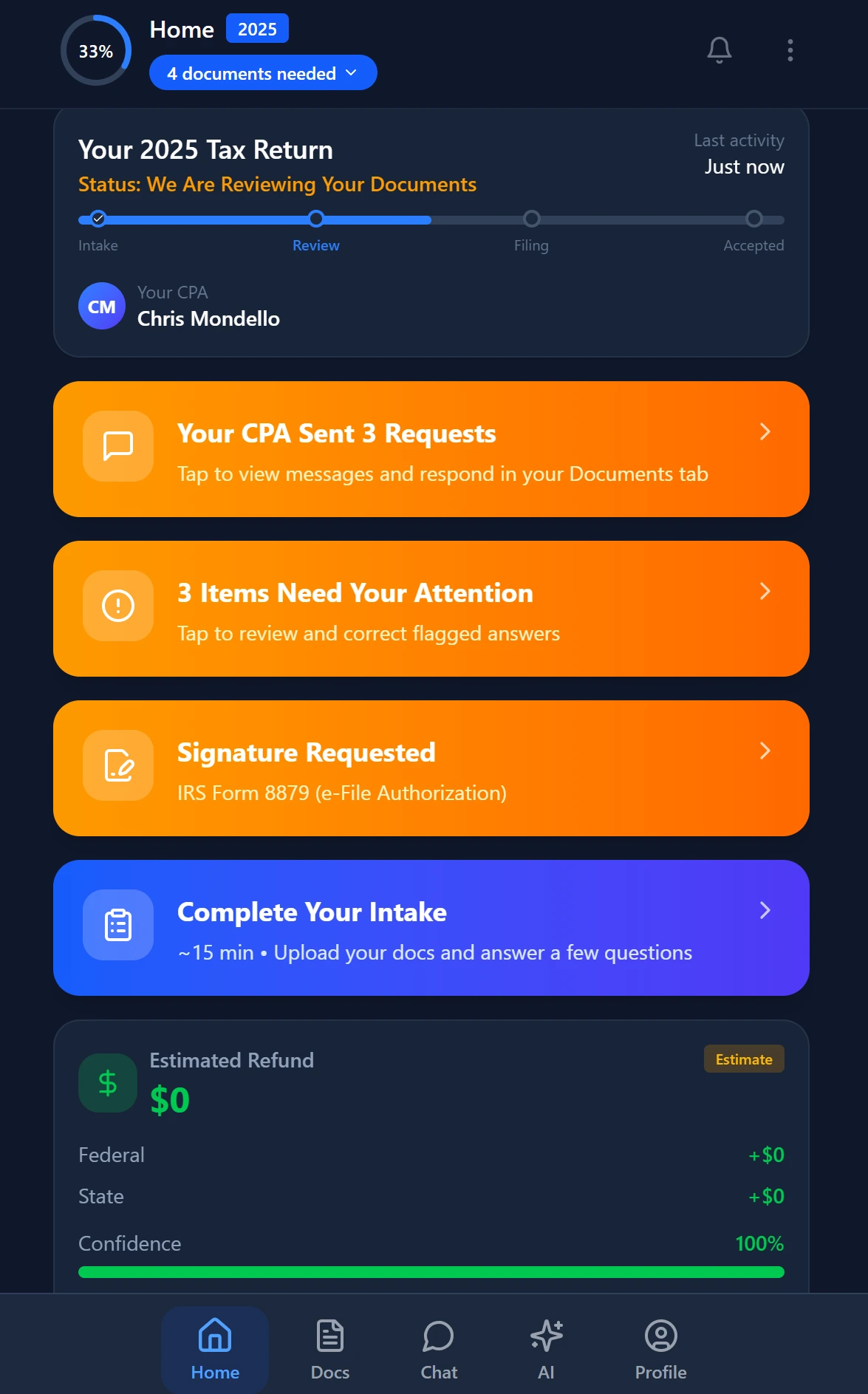
Smart intake auto-fills from uploaded documents and prior-year data

Click any extracted field to see its source highlighted on the original PDF
Operating Lease vs Finance Lease: Classification Workflows
One of the first decisions your team makes on every new lease file is classification: operating lease or finance lease. Under ASC 842, the lessee applies five criteria (transfer of ownership, purchase option reasonably certain, lease term covering major part of economic life, present value of payments representing substantially all fair value, and specialized nature of asset). If any criterion is met, the lease is classified as a finance lease; otherwise it is an operating lease.
The practical difference matters for your client's income statement and your disclosure workpapers. A finance lease front-loads expense recognition — interest on the liability accrues separately from amortization of the ROU asset, producing higher total expense in early periods. An operating lease presents a single straight-line lease cost. For clients with debt covenants based on EBITDA or net income ratios, this classification distinction can have real economic consequences, which is why documenting the classification rationale contemporaneously is critical.
Build a classification decision tree into your engagement template. For each lease, require your preparer to document which criteria were evaluated, whether any criterion was met, and the conclusion. That documentation lives in the client file — not in someone's personal spreadsheet — so that when a lease is modified and reclassification is considered, the original rationale is immediately accessible. The SSA's guidance on present value calculations is useful for benchmarking discount rate assumptions in long-duration leases.
Building the Right-of-Use Asset Journal Entry and Amortization Schedule
The right-of-use asset journal entry at commencement is deceptively straightforward: debit ROU Asset, credit Lease Liability, both measured at the present value of remaining lease payments discounted at the IBR (or implicit rate if known). Adjustments for prepaid rent, lease incentives received, and initial direct costs layer on top. The complexity accumulates when you multiply this across dozens of clients, each with a different commencement date, a different IBR, and different payment structures.
Your lease liability amortization schedule must track the opening balance, interest accrual at the IBR, cash payment, and closing balance for each period. For operating leases, the ROU asset amortization is calculated as the plug that produces straight-line expense recognition — which means the amortization charge is not simply the principal reduction. For finance leases, the ROU asset amortizes on a straight-line basis (or units of production if appropriate) independently of the liability schedule. Both calculations need to reconcile precisely to the balance sheet and the maturity analysis disclosure.
The FASB's implementation guidance on ASC 842 provides illustrative examples for both lease types. Maintaining a master template with locked formula logic — auditable by a reviewer who did not prepare it — is table stakes for firms servicing audit clients. TaxScout's Excel 1040 calculator demonstrates what formula-level rigor looks like at scale (66 sheets, approximately 36,000 formulas), and the same discipline applies to any client-facing financial schedule your team maintains. You can also explore our other blog resources for guides on managing complex multi-client workflows.

Your clients see your brand — OTP login, document upload, and real-time status
ASC 842 Disclosure Checklist for CPA Firm Practitioners
Footnote disclosures under ASC 842 are extensive and must be updated every reporting period. A practitioner-facing ASC 842 disclosure checklist should include the following elements for each client engagement.
First, qualitative disclosures: a general description of leasing arrangements, the basis and terms of variable lease payments, renewal and purchase option terms and whether options are included in the measurement, residual value guarantees, and restrictions or covenants imposed by leases. Second, quantitative disclosures for lessees: the components of lease cost (operating lease cost, finance lease amortization, finance lease interest, short-term lease cost, variable lease cost, sublease income), the weighted-average remaining lease term and weighted-average discount rate for both operating and finance leases, and cash flow information including operating and financing cash outflows.
Third, the maturity analysis: a rollforward of undiscounted future lease payments by year for the next five years and thereafter, reconciled to the lease liability on the balance sheet (with the undiscounted-to-discounted difference shown separately). This reconciliation is a frequent audit focus point and must match your amortization schedule to the penny. Fourth, transition disclosures if the client is in the first comparative period after adoption — including the practical expedients elected and their effect.
Building this checklist into a standardized workflow stage — rather than relying on each preparer's memory — ensures nothing is omitted. TaxScout's pipeline management supports 12 customizable stages with checklist tasks, so an ASC 842 disclosure review can be a mandatory gate before any financial statement engagement moves to partner sign-off. For broader document workflows, see our guide on document management for CPA firms.
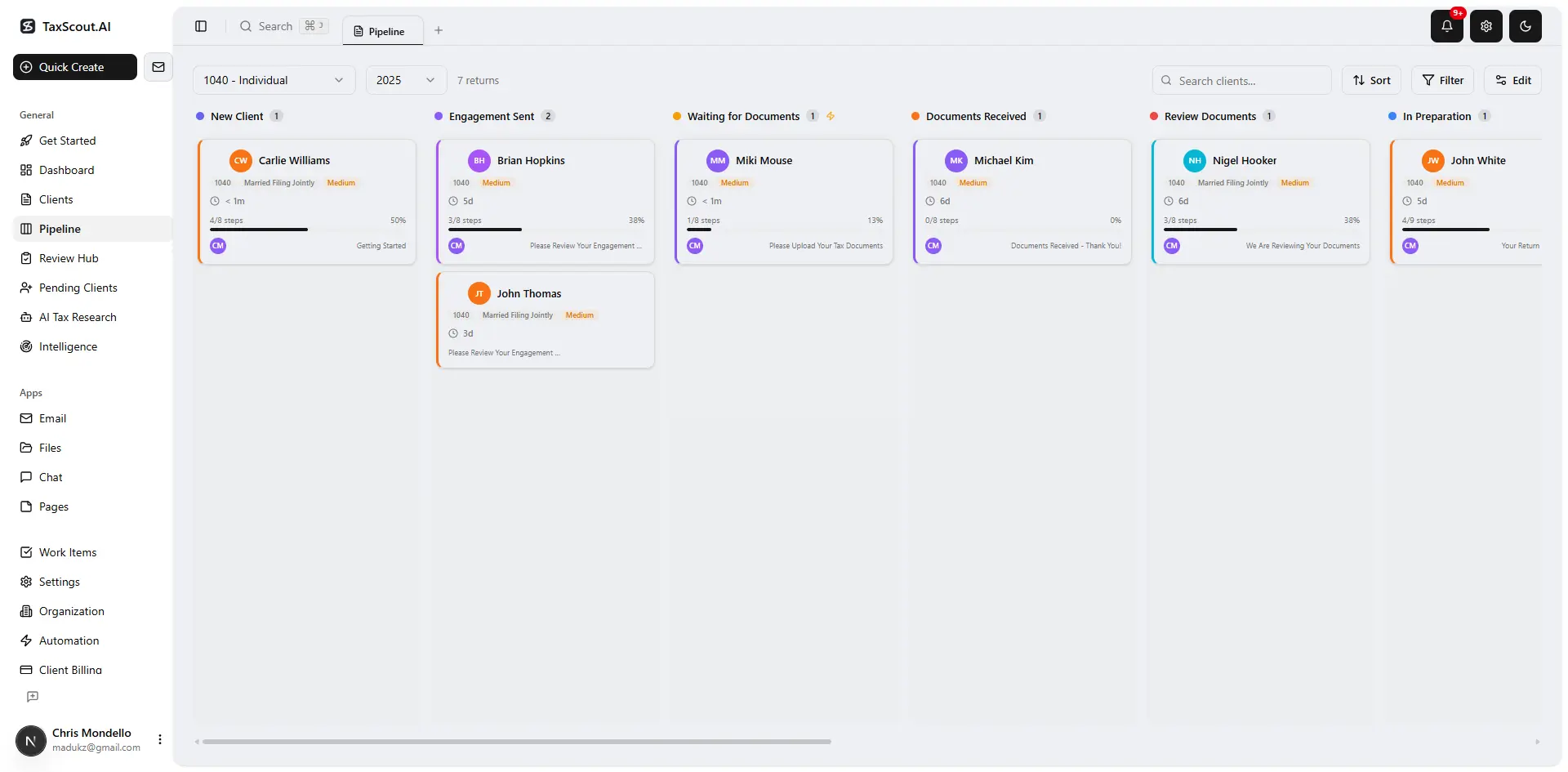
Track every return from intake to filed with drag-and-drop pipeline management
Scaling Lease Accounting Across 50 or More Clients
The workflow design that works for five clients breaks under the weight of fifty. When every client has different lease commencement dates, different fiscal years, different modification histories, and different disclosure requirements, the coordination overhead overwhelms any system built on folder-per-client email threads and manually maintained spreadsheet versions.
The firms that scale lease accounting for CPAs successfully share three structural characteristics. First, they standardize inputs: every client uses the same intake questionnaire, every lease file contains the same required fields, and every amortization schedule follows the same template structure. Deviation from the template requires a documented exception, not just a different file name. Second, they automate reminders: lease modifications, annual IBR reassessments, renewal option reassessment dates, and disclosure deadlines are tracked in the practice management system, not in a partner's personal calendar. Third, they centralize documentation: every version of every lease schedule, every email thread about a lease amendment, and every disclosure workpaper lives in a single client record — accessible to any team member at any time.
TaxScout's client management and automation features are designed exactly for this structure. The AI research agents — nine specialized agents with real-time IRS, Treasury, Cornell Law, and Congress search — can surface updates to lease accounting guidance, flag recent FASB technical corrections, or pull the current applicable federal rate when you need to benchmark an IBR. That is the kind of ambient intelligence that prevents the "I didn't know ASC 842 was amended" conversation with your client's auditor.
For governmental entity clients, note that GASB 87 applies a broadly similar right-of-use model but with distinct terminology (lease receivable for lessors, right-to-use lease asset for lessees) and different effective dates by government type. If you serve municipalities, school districts, or other governmental units, your intake and disclosure checklists need a parallel GASB 87 track — and your practice management system needs to route those files through a different review path.
Practice management platforms and lease accounting workflow support for CPA firms
| Feature | TaxScout | TaxDome | Canopy | Karbon |
|---|---|---|---|---|
| AI document extraction (leases, amendments) | Yes — 180+ form types | No | No | No |
| Customizable pipeline stages with checklist tasks | Yes — 12 stages, drag-and-drop | Limited | Yes (add-on cost) | Yes |
| AI research agents (FASB, IRS, Treasury) | Yes — 9 specialized agents | No | No | No |
| Client intake engine with gap analysis | Yes — 4-layer prefill | No | Smart Intake +$11/client | No |
| Flat-fee pricing (no per-user fees) | Yes — $149/mo for 10 seats | ~$500/mo for 10 users | ~$660/mo for 10 users | ~$590/mo for 10 users |
| Audit-trail document versioning | Yes | Partial | Yes | Partial |
| E-signatures for engagement letters | Yes — via Documenso | Yes | Yes | Limited |
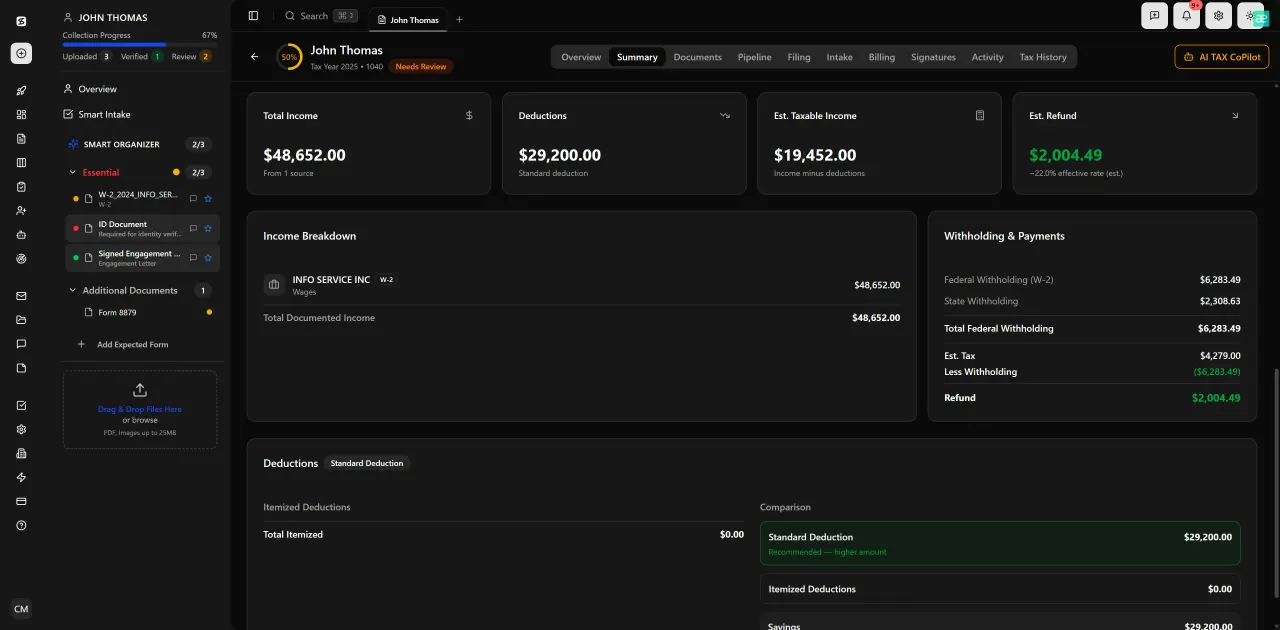
Review with AI assist — 9 agents answer questions with full client context
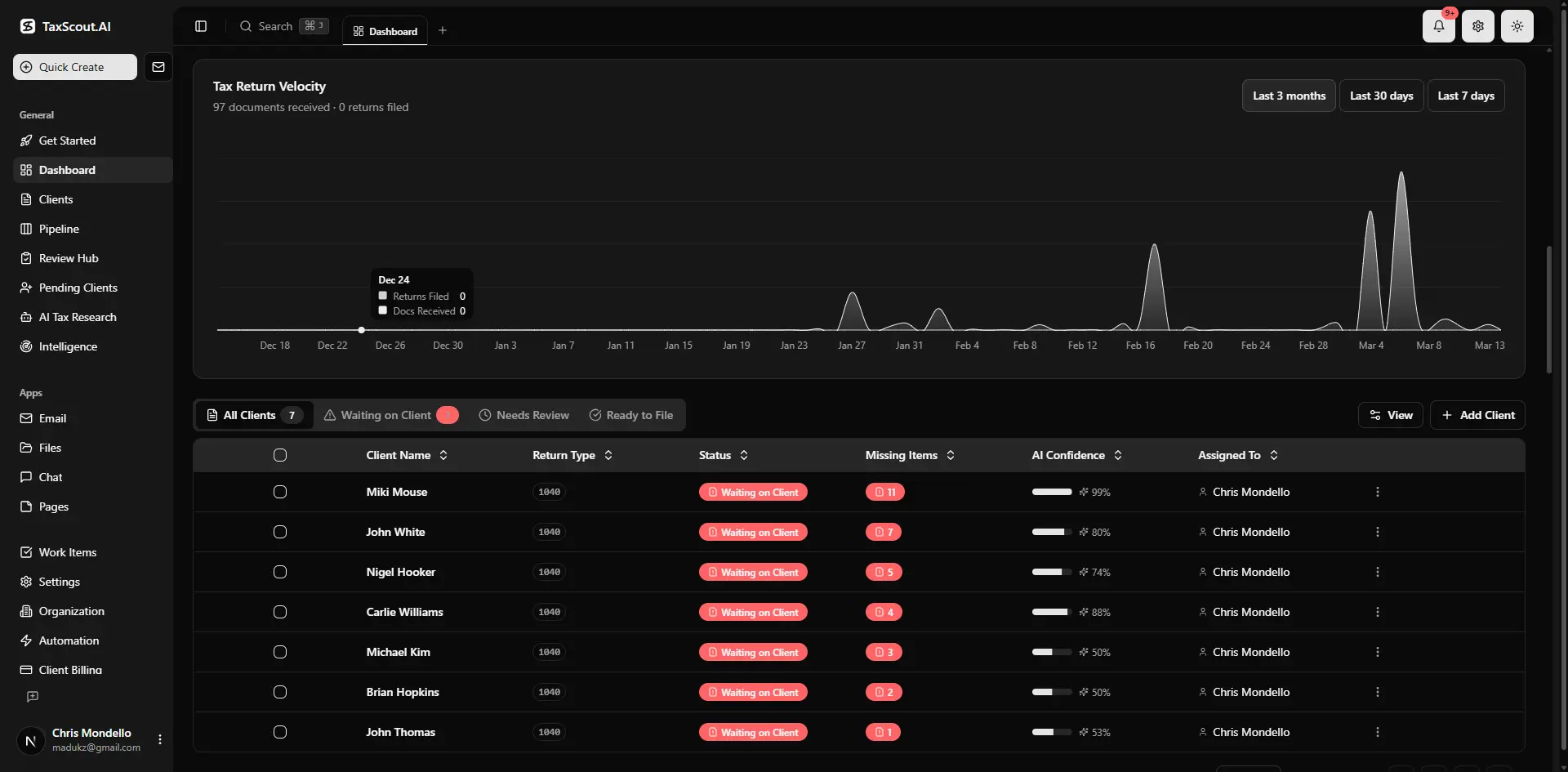
Real-time dashboard showing returns in progress, revenue, and upcoming deadlines
Documenting Lease Modifications and Audit Trail Evidence
A lease modification — any change to the scope or consideration of a lease that was not part of the original terms — triggers a reassessment workflow under ASC 842. Depending on whether the modification grants an additional right of use and whether the consideration is commensurate with the standalone price, the modification may be accounted for as a separate new lease or as a remeasurement of the existing lease. The accounting treatment diverges materially, and the contemporaneous documentation of that assessment is what your client's auditor will request first.
Your modification workflow should capture: the date the amendment was executed, the nature of the change (extension, reduction, addition of space, rent concession), whether the modification qualifies as a separate contract, the remeasurement date (which resets the measurement of the liability at the modified terms using a revised IBR if required), and the journal entries recorded. That documentation should be version-controlled so the pre-modification and post-modification schedules are both preserved — not overwritten.
TaxScout's file management and PDF tools — including OCR, Bates numbering, and PII masking — give your team the infrastructure to maintain a clean audit file for each lease. All documents are stored with AES-256-GCM encryption and a 13-step DSAR anonymization process. When the auditor requests the modification history for a client's five-location retail portfolio, you can produce a Bates-numbered package in minutes rather than reconstructing it from email archives. For firms thinking about broader data hygiene, see our guide on running a paperless accounting firm.
The Journal of Accountancy's coverage of ASC 842 implementation notes that modification accounting is consistently identified as the area where private company implementers struggle most — both at transition and in subsequent periods. Building a formal modification log into your engagement template, with a required sign-off step before the client's books are updated, is the procedural control that turns a recurring risk into a manageable process.
Pricing Lease Accounting Services as a CPA Advisory Offering
Lease accounting under ASC 842 is an area where value-based pricing is clearly justified. The technical complexity, the ongoing compliance obligation, the professional liability implications, and the measurable financial statement impact all support fees well above what a commodity tax prep rate would suggest. Firms that price this work as a recurring advisory retainer — rather than a one-time project — capture the full economic value of the ongoing remeasurement, disclosure, and modification services that extend indefinitely after adoption.
A reasonable pricing structure for an ASC 842 engagement includes three components: an initial scoping and portfolio census fee (identifying all leases in scope, applying the practical expedients, and documenting the accounting policy elections), a transition or adoption engagement fee covering the initial recognition and disclosure package, and an annual maintenance retainer covering remeasurement events, disclosure updates, modification accounting, and coordination with the audit team. The maintenance retainer is where the recurring revenue lives, and it is justified by the fact that the work repeats every year as long as the client holds leases.
TaxScout's flat-fee, unlimited-client pricing model means your firm does not pay more per client as you grow your lease accounting practice. At $149 per month for the Prep Pro plan with 10 seats, you have access to all nine AI research agents, the full PDF toolbox, and unlimited client records — making the economics of building a dedicated ASC 842 service line straightforward. See our flat-fee billing guide for a framework on structuring recurring advisory fees.
Ready to stop managing ASC 842 across dozens of clients with disconnected spreadsheets and calendar alerts?
TaxScout gives your firm a single AI-native platform for lease intake, document storage, automated reminders, and disclosure checklists — at a flat fee that scales with your roster, not your headcount.
Frequently Asked Questions
At minimum, collect the signed lease agreement and all amendments, commencement date, original and remaining lease term, full payment schedule including any stepped rent, renewal and purchase option language, the implicit rate if disclosed, the client's incremental borrowing rate supported by recent borrowing documentation, and the accounting policy elections (short-term lease exemption, non-separation of components). Capturing these fields in a structured intake questionnaire before work begins eliminates the email chase that delays schedule preparation.
Keep reading
Uniform Capitalization Rules: How CPAs Apply UNICAP to Inventory and Self-Constructed Assets
Oct 17, 2026 · 1 min read
Non-Applicability of Section 357(c) to Consolidated Groups: What CPA Firms Must Do Now
Oct 17, 2026 · 1 min read
Reasonable Basis Defense: How CPAs Shield Clients From Accuracy-Related Penalties
Oct 17, 2026 · 1 min read
Stay up to date
Get the latest tax tech insights delivered to your inbox.