Health Insurance Deduction for S Corp Owners: What CPAs Must Get Right
The health insurance deduction for S corp owners involves a precise chain of steps — payroll add-back, W-2 Box 1 inclusion, and a 1040 deduction — that most payroll platforms get wrong by default. This guide gives CPAs a staff-ready workflow to execute the deduction correctly on every return…
The health insurance deduction for S corp owners is one of the most frequently mishandled items in small-business tax preparation — not because the rule is obscure, but because it requires perfect coordination between payroll setup, W-2 reporting, and the shareholder's individual return. A single misconfiguration in Gusto, ADP, or QuickBooks Payroll can silently break the deduction for every year the client is on that payroll platform, and the error is invisible unless someone cross-checks the W-2 against payroll records at tax time.
Under IRC § 162(l), a self-employed individual — including a more-than-2% S corporation shareholder — may deduct health insurance premiums paid for themselves, their spouse, and dependents from gross income. But the S corp route adds a procedural layer that trips up even experienced preparers: the corporation must first pay or reimburse the premium, add the amount to the shareholder-employee's W-2 Box 1 wages, and then the shareholder claims the above-the-line deduction on their Form 1040. Skip any step and the deduction either vanishes or becomes a phantom — claimed on the 1040 but unsupported by the W-2, which invites IRS scrutiny. Getting this procedural layer right is precisely what makes the health insurance deduction for S corp owners more complex than it appears on the surface.
This guide is written for CPAs and staff who handle S corp shareholder returns regularly. It covers the exact payroll configuration required, how to identify and correct prior-year errors inherited from a previous accountant, the under-documented interaction with the Section 199A qualified business income deduction, and a repeatable workflow your staff can run without escalating every return to a senior partner. Whether you are setting up payroll for the first time or cleaning up a prior accountant's mistakes, understanding every requirement of the health insurance deduction for S corp shareholders is essential to avoiding costly errors.
The Statutory Framework Every CPA Must Internalize
A shareholder who owns more than 2% of an S corporation is treated as a partner, not an employee, for fringe benefit purposes under IRC § 1372. That single rule changes how health insurance premiums are taxed. While a regular employee can receive employer-paid health insurance tax-free under IRC § 106, a 2% S corp shareholder cannot — the premiums must be included in gross income. This distinction under IRC § 1372 is the foundation of why the health insurance deduction for S corp owners follows a different set of rules than those that apply to regular W-2 employees.
The IRS lays out the mechanics in Notice 2008-1: the S corporation either pays the premiums directly to the insurer or reimburses the shareholder, then reports the total as wages in Box 1 of the W-2. Critically, the premium amount is NOT subject to Social Security and Medicare (FICA) taxes — it goes in Box 1 only. This is the single most common payroll software configuration error: platforms often default to adding compensation to all boxes, making the premium FICA-taxable and incorrect. For firms evaluating their health insurance deduction for S corp approach, this trade-off compounds over time.
Once the amount is properly included in Box 1, the shareholder-employee deducts it on Schedule 1, Line 17 of Form 1040 as a self-employed health insurance deduction — not on Schedule A as an itemized deduction. The deduction is above-the-line, which makes it available regardless of whether the taxpayer itemizes. The practical takeaway: three documents must align for every S corp shareholder health insurance claim — the S corp payroll records, the W-2, and the 1040. Your review checklist should verify all three simultaneously. Each of these factors directly shapes how health insurance deduction for S corp plays out in practice.

Click any extracted field to see its source highlighted on the original PDF
Payroll Software Configuration: Gusto, ADP, and QuickBooks Payroll
Tired of manual workflows slowing your firm down? See how TaxScout handles this with AI-powered automation. → Book a 15-Min Demo Understanding health insurance deduction for S corp in this context is what separates firms that scale from those that stall.
Most payroll software errors stem from treating S corp health insurance like ordinary compensation. Here is the correct setup for each major platform CPAs encounter. This is precisely where a deliberate health insurance deduction for S corp strategy pays off.
Gusto: Navigate to the company's benefits settings and add a "S-Corp Owner's Health Insurance" pay type. Gusto labels this as a non-cash fringe benefit. The amount should be set to appear in Box 1 of the W-2 but with FICA exemption toggled on. If your client's account instead uses the generic "Health Insurance" deduction bucket — which Gusto treats as a pre-tax employee benefit — the Box 1 inclusion will be suppressed entirely, and the 1040 deduction has no W-2 foundation. Health insurance deduction for S corp sits at the center of this decision — get it wrong and the rest unravels.
ADP Run / ADP Workforce Now: In the earnings table, create an earnings code specifically for "2% Shareholder Health Insurance" with the tax settings configured as: Federal income tax — taxable; Social Security — exempt; Medicare — exempt; FUTA/SUTA — varies by state (generally subject to SUTA in most states, but check your state rules). ADP's default health insurance deduction codes are pre-tax Section 125 cafeteria plan codes — applying those to a 2% shareholder is wrong and will produce a W-2 that omits the required Box 1 inclusion. When firms revisit their health insurance deduction for S corp priorities, the gaps usually surface here.
QuickBooks Payroll (Online and Desktop): Use the "S-Corp Medical Insurance" payroll item type. In QuickBooks Online Payroll, this is found under Payroll Settings > Pay Types > S-Corp Insurance. The item should be marked as taxable for federal income tax, non-taxable for Social Security and Medicare, and reported in Box 14 of the W-2 with the label "S-CORP MED PREM" (Box 14 is informational; Box 1 inclusion still drives the deduction). Always reconcile the QuickBooks payroll item total against the insurance invoices before running the final December payroll or the year-end W-2 correction run.
The year-end catch-up payroll run: If premiums were paid throughout the year but not added to payroll, CPAs often advise clients to run a supplemental payroll in late December — before the W-2 cutoff — that adds the full annual premium total as a non-cash wage. This corrects the W-2 without requiring a W-2c. After January 31, a W-2c is required, which creates an amended return chain if the 1040 has already been filed. Getting the year-end run done in December is far cleaner. For any client who missed this window, the health insurance deduction for S corp cannot be properly claimed without first correcting the underlying W-2.
Tired of rebuilding client payroll histories by hand to verify W-2 Box 1 inclusions?
TaxScout's AI document extraction pulls W-2 field-level data — including Box 1, Box 3, Box 5, and Box 14 — and flags S corp shareholders whose premium amounts are missing from Box 1, so your staff catches errors before the return is assembled.
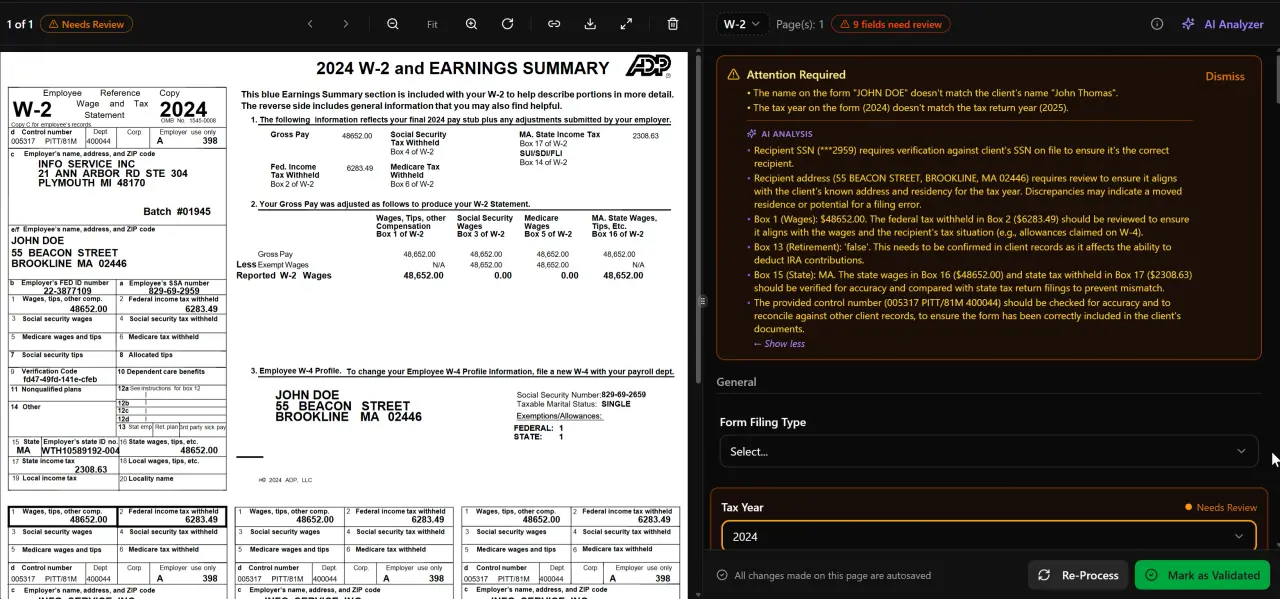
AI classifies, extracts, and validates every document automatically
Step-by-Step Workflow for Staff to Execute Without Senior Review
This workflow is designed to be handed to a trained staff preparer. It assumes the CPA has already confirmed the client is a more-than-2% shareholder and that the S corp pays or reimburses health insurance premiums.
Step 1: Collect Source Documents
Gather the following before touching the return: (a) all insurance premium invoices or statements for the tax year, (b) the shareholder's W-2 from the S corporation, (c) the S corp's Form 1120-S and any officer compensation detail, and (d) prior-year 1040 to confirm the deduction was claimed on Schedule 1, Line 17 in prior years. If the prior-year 1040 shows the deduction on Schedule A instead, flag it — that is almost certainly an error that should have been above-the-line. A misplaced deduction is one of the clearest signs that the health insurance deduction for S corp was not handled correctly in prior years.
Step 2: Verify Box 1 Includes the Premium Amount
Add up the annual premium total from the invoices. Compare to the shareholder's W-2 Box 1. Box 1 should exceed what you would expect from salary alone by exactly the premium amount (or close to it — year-end catch-up timing can cause minor rounding differences). If Box 1 does not include the premium, the deduction cannot be taken as-is. Document the discrepancy, contact the payroll provider or the client's bookkeeper, and determine whether a W-2c is needed. Do not claim the deduction on a W-2 that lacks Box 1 inclusion — this is a common preparer error that the IRS targets in correspondence audits.
Step 3: Confirm FICA Treatment is Correct
The premium should appear in Box 1 but NOT in Box 3 (Social Security wages) or Box 5 (Medicare wages). If the premium appears in Boxes 3 and 5, the payroll was configured incorrectly and FICA was overcollected. This is a payroll error that may require a corrected 941 in addition to a W-2c — flag for partner review. The shareholder paid FICA taxes they did not owe, and the S corp paid the matching employer FICA on amounts that were exempt. Amending the 941 recaptures those amounts. Correct FICA treatment is one of the non-negotiable requirements for a valid health insurance deduction for S corp shareholders, and errors here require more than just a W-2 correction to fully resolve.
Step 4: Enter the Deduction on Form 1040
On the shareholder's Form 1040, enter the premium amount on Schedule 1, Part II, Line 17 (Self-Employed Health Insurance Deduction). The figure should match the W-2 Box 1 add-back amount. In tax software, this field is typically populated from the K-1 entry or from a direct input field labeled "Self-Employed Health Insurance" — verify your software is not double-counting from both the K-1 and manual entry. Many platforms have a K-1 passthrough flag that auto-generates the deduction; confirm it pulled the correct amount against the actual W-2.
Step 5: Check the Section 199A Interaction
This is the step most competitor articles skip. The self-employed health insurance deduction reduces adjusted gross income (AGI), which in turn reduces the W-2 wage base used in the Section 199A qualified business income (QBI) deduction calculation for taxpayers above the threshold. Specifically: the health insurance deduction reduces the shareholder's taxable income, which can affect the 20% QBI deduction limitation when the taxpayer's income is above the phase-in thresholds ($197,300 single / $394,600 MFJ for 2024 under IRS Publication 535). Additionally, the health insurance deduction reduces the "self-employed earned income" figure that feeds the solo 401(k) or SEP-IRA contribution limit — a secondary planning implication staff should flag for the partner.
Step 6: Document and Archive
Create a workpaper that ties: insurance invoice total → payroll records → W-2 Box 1 → Schedule 1 Line 17. Store it in the client file with the year's supporting documents. This three-way tie-out is your audit defense. If your firm uses AI document extraction to process W-2s and supporting documents, the system's confidence scoring and cross-document validation can flag mismatches automatically, reducing the manual reconciliation burden on staff.
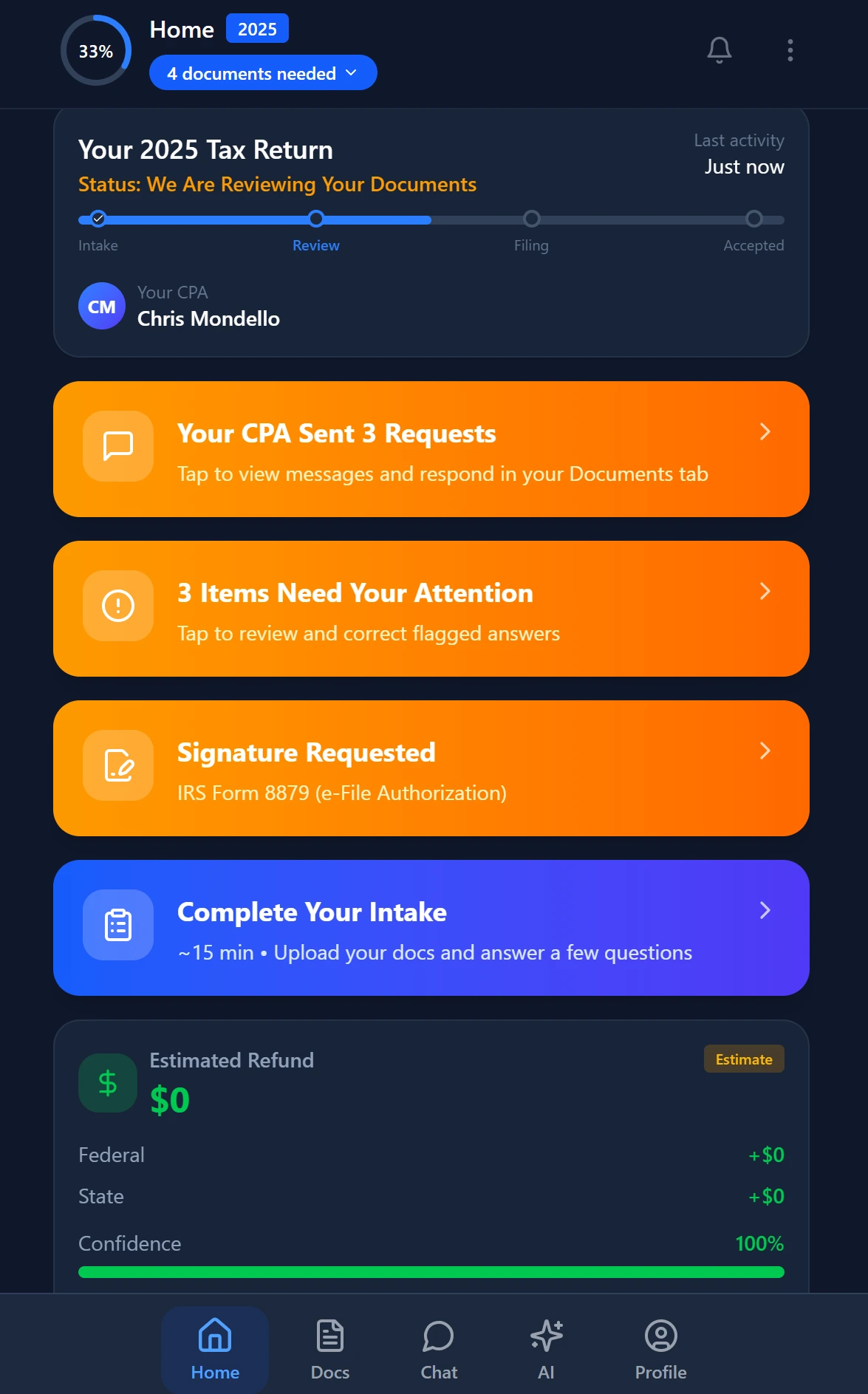
Smart intake auto-fills from uploaded documents and prior-year data
Catching Missed Deductions from Prior-Year Payroll Errors
When you take on a new S corp client whose prior accountant handled the returns, assume the health insurance was wrong until proven otherwise. The most common inherited scenario: the prior preparer claimed the deduction on Schedule 1 Line 17 without verifying that Box 1 actually included the premium. This is technically a deduction claimed without W-2 support — a preparer error that leaves the client exposed.
To audit an inherited return, pull three years of W-2s from the S corp and three years of insurance premium invoices. If Box 1 is consistently lower than salary plus premiums, the prior preparer either (a) did not set up payroll correctly and claimed the deduction anyway, or (b) did not claim the deduction at all. Scenario (a) is the more dangerous — you have an aggressive return position with no W-2 support. Scenario (b) is a missed deduction opportunity — you can amend up to three years back under normal statute of limitations rules per IRC § 6511.
For scenario (b), amended returns (Form 1040-X) can recover meaningful refunds. On a $15,000 annual premium for a shareholder in the 32% bracket, three years of missed health insurance deduction for S corp owners equals roughly $14,400 in recoverable tax — not counting state income tax. This is a high-value client service moment that demonstrates why a detail-oriented review process pays dividends. See our post on AI document extraction for CPAs for how AI-native platforms can surface these cross-year discrepancies during intake.
Medicare Premiums and Long-Term Care Premiums for 2% Shareholders
This is a nuance that most published CPA content ignores. For sole proprietors, Medicare Part B and Part D premiums paid out-of-pocket qualify as self-employed health insurance premiums deductible under IRC § 162(l), as clarified by IRS Notice 2009-46 and subsequent guidance. The question for S corp shareholders is whether the same treatment applies — and the answer is yes, with a catch.
A 2% S corp shareholder who has Medicare premiums deducted directly from their Social Security benefit can still have the S corporation reimburse those premiums (or include them in wages), making them eligible for the above-the-line deduction. The S corp must actually pay or reimburse the premium — it cannot sit at the individual level only. This requires a formal reimbursement arrangement, ideally documented as a board resolution or employment agreement amendment, before year-end. Premiums paid by Medicare on behalf of a beneficiary do not qualify, but premiums withheld from Social Security benefits and paid by the individual do. Properly documenting this reimbursement arrangement is a required step for the health insurance deduction for S corp to apply to Medicare premiums.
Long-term care (LTC) insurance premiums also qualify, subject to the age-based limits in IRC § 213(d)(10) — $480 to $5,880 per person for 2024, depending on age. The mechanics are identical to health insurance: the S corp reimburses the LTC premium, adds it to Box 1 wages (not FICA wages), and the shareholder deducts it on Schedule 1. Sole proprietors can deduct LTC premiums up to the age-based limit directly; 2% S corp shareholders must route the premium through payroll to access the deduction. The failure to route LTC premiums through the S corp payroll is another commonly missed deduction — ask every shareholder client over 50 whether they carry LTC coverage.
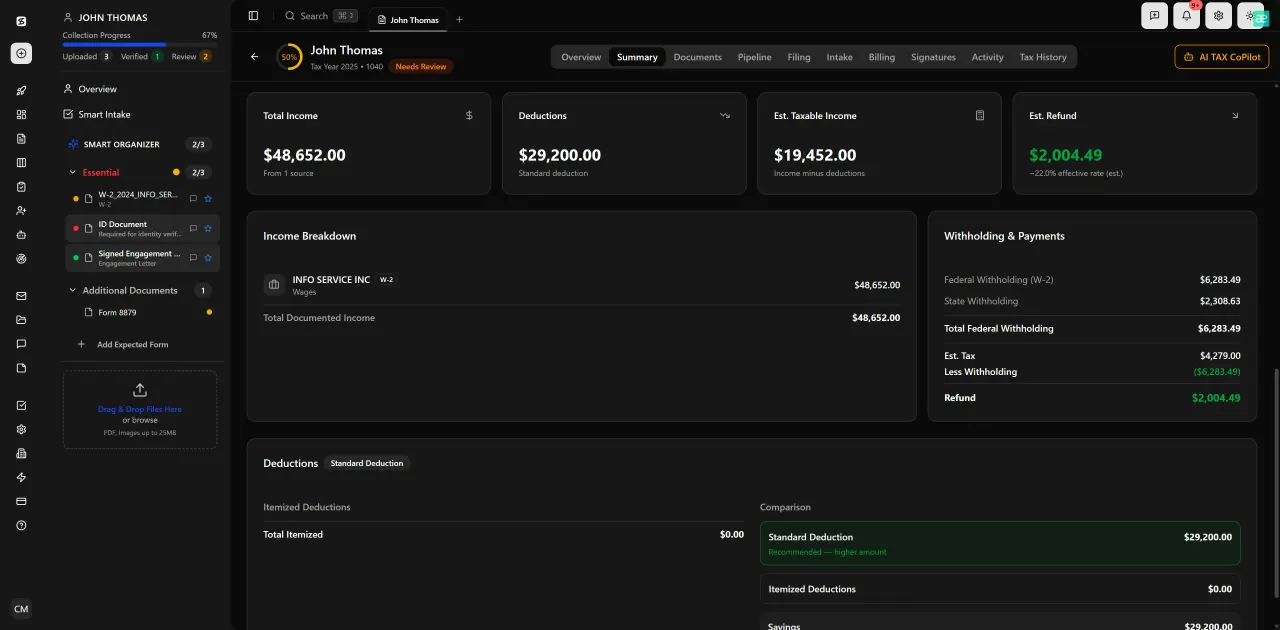
Review with AI assist — 9 agents answer questions with full client context

Every client gets organized documents, status tracking, and a complete history
The Section 199A QBI Deduction Interaction Explained
The Section 199A qualified business income deduction — the 20% deduction for pass-through business income introduced by the Tax Cuts and Jobs Act — interacts with the S corp health insurance deduction in a way that surprises many preparers. Understanding it is essential for clients with income near or above the phase-in thresholds.
For clients below the threshold ($197,300 single / $394,600 MFJ in 2024, indexed annually per IRS Rev. Proc. 2023-34), the health insurance deduction simply reduces taxable income and has no effect on the 20% QBI deduction. For clients above the threshold — particularly those in specified service trades or businesses (SSTBs) — the interaction is more complex. The self-employed health insurance deduction reduces AGI, which can reduce the taxpayer's "applicable percentage" within the phase-out range, potentially preserving more of the QBI deduction. This is counterintuitive: a deduction that reduces income can actually increase the QBI deduction for shareholder-employees near the top of the phase-in range. Running a "what if" scenario in your tax software before finalizing the return is best practice whenever a client is within $50,000 of the phase-in threshold. Firms that understand how the health insurance deduction for S corp interacts with Section 199A are better positioned to identify planning opportunities that others miss.
The second interaction involves the W-2 wage limitation on the QBI deduction. When income exceeds the threshold, the QBI deduction is limited to 50% of W-2 wages paid by the S corp (or 25% of wages plus 2.5% of qualified property basis). The health insurance add-back increases W-2 Box 1 wages, which might seem to increase the W-2 wage limitation — but because the health insurance is not subject to FICA, it is excluded from the W-2 wage base used in the Section 199A limitation calculation per Treasury Regulation § 1.199A-2. Staff should not assume the premium add-back increases the W-2 wage limitation — it does not. Document this in your workpapers to prevent future confusion. For more context on how TCJA provisions continue to affect S corp planning, see our resources on TCJA sunset provisions.
How to Build a Recurring Quality Control Checklist for S Corp Shareholder Returns
A written checklist eliminates the need for a senior partner to review every S corp shareholder return for health insurance treatment. The following items should appear on your S corp shareholder return checklist and be initialed by the preparer before the return is submitted for review.
Checklist items: (1) Confirm ownership percentage exceeds 2% — if exactly 2%, the rules do not apply and the standard employer-provided health benefit exclusion applies. (2) Confirm insurance premiums were paid or reimbursed by the S corp during the tax year. (3) Verify W-2 Box 1 includes the premium total; document the tie-out to invoices. (4) Verify W-2 Boxes 3 and 5 exclude the premium — FICA exemption is required. (5) Confirm Schedule 1 Line 17 entry matches the W-2 add-back amount. (6) Confirm no double-entry from K-1 passthrough in addition to manual entry. (7) Check whether client has Medicare or LTC premiums that should be routed through S corp payroll and are not. (8) Run Section 199A scenario if client income is within $50,000 of phase-in threshold. (9) Confirm no dependent was covered by an employer plan during the year — if a spouse was eligible for employer coverage, the deduction is disallowed for that spouse's portion under IRC § 162(l)(2)(B). Each item on this checklist is designed to protect the health insurance deduction for S corp shareholders from the most common failure points that surface during IRS review.
Embedding this checklist into your pipeline management workflow — with required fields that must be completed before a return moves to review — is how high-volume firms maintain quality without the senior partner touching every file. See other blog resources covering practice management workflows for additional firm-wide process ideas. For firms that want to reduce manual checklist maintenance entirely, TaxScout's AI research agents can surface relevant IRC rules and IRS notices during preparation, flagging potential issues before the checklist is even reached.
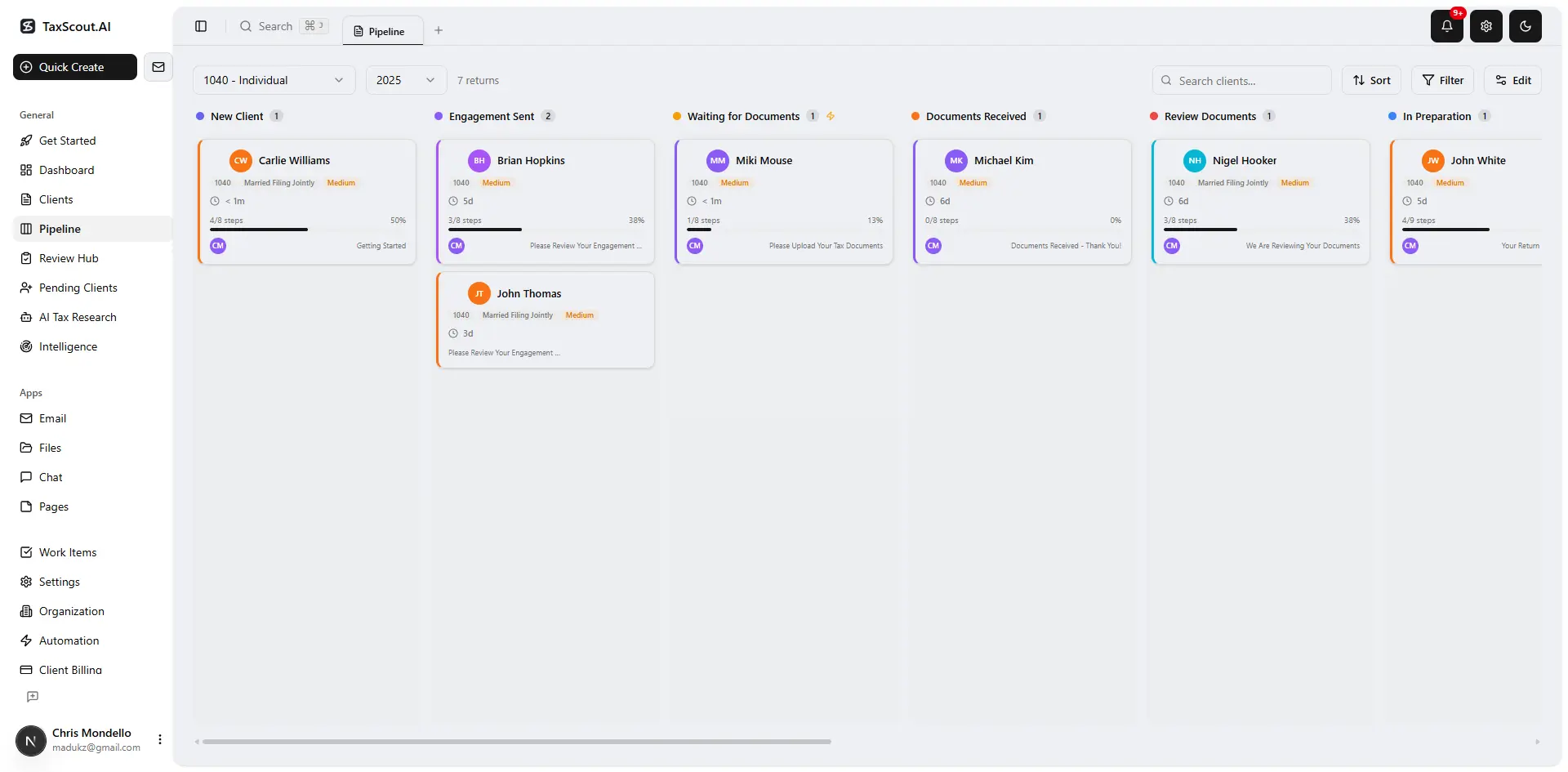
Track every return from intake to filed with drag-and-drop pipeline management
Worried that missed S corp health insurance deductions are hiding in your current client base?
TaxScout's 5-layer document validation and AI research agents surface W-2 mismatches, cross-reference prior-year returns, and alert your team to deductions that prior preparers left on the table — so your staff can fix issues before they become client complaints.

Your clients see your brand — OTP login, document upload, and real-time status
Common Errors That Trigger IRS Scrutiny and How to Avoid Them
The IRS matching program compares Schedule 1 Line 17 deductions to the corresponding W-2 Box 12 Code DD entries and Box 1 wages. If the self-employed health insurance deduction exceeds what can be traced to a W-2 Box 1 add-back, a CP2000 notice is likely. Common triggers include: (a) claiming the deduction when the W-2 Box 1 does not reflect the premium because payroll was never updated; (b) claiming a deduction larger than the net premium after any employer-level deduction on the 1120-S; (c) claiming the deduction in a year when the shareholder was eligible for employer-sponsored coverage through a spouse's plan — the eligibility alone, not actual enrollment, disqualifies the deduction under IRC § 162(l)(2)(B).
A subtler trigger: the S corporation must actually deduct the health insurance premiums as a business expense on Form 1120-S, Line 18 (Officer Compensation) or as a separately stated benefit expense. If the S corp did not deduct the premium at the entity level, the shareholder cannot claim the health insurance deduction for S corp purposes at the individual level. This creates an unexpected link between the 1120-S preparation and the 1040 — another reason to prepare the S corp and individual returns together or at minimum cross-reference them before filing either.
For firms that have adopted AI document extraction workflows, the ability to cross-reference W-2 data against K-1 data and against prior-year 1040 line items in a single review session dramatically reduces the chance of these errors slipping through. Paired with the electronic signature workflow that ensures clients sign off before filing, you create a closed-loop process where every required document is verified before the return is transmitted.
Ready to see the difference? TaxScout gives your firm AI extraction, 5-layer validation, and complete practice management — on flat firm pricing with unlimited team members. → Book a 15-Min Demo — See It Live
Frequently Asked Questions
No. The self-employed health insurance deduction under IRC § 162(l) reduces federal income tax by lowering adjusted gross income, but it does not reduce self-employment tax. S corp shareholders pay FICA on their wages, not self-employment tax on distributions, so this distinction matters less than it does for sole proprietors — but the deduction provides no FICA savings regardless of entity structure.
Keep reading
Backdoor Roth IRA: How CPAs Execute the Strategy Without Triggering Pro-Rata Tax
Oct 12, 2026 · 1 min read
Transparency in Coverage Final Rules: What CPA Firms Must Do Now
Oct 12, 2026 · 1 min read
Late Filing Penalty Relief: How CPAs Reduce or Eliminate IRS Failure-to-File Charges
Oct 12, 2026 · 1 min read
Stay up to date
Get the latest tax tech insights delivered to your inbox.