Form 1065 Partnership Return: What CPAs Need to File Right
Filing a Form 1065 partnership return involves more than transferring numbers — CPAs must navigate Schedule K-1 allocations, basis calculations, and a dense web of IRS rules that can trigger audits if mishandled. This guide walks through the full CPA workflow: key deadlines, the most common 1065…
The Form 1065 partnership return is one of the most document-intensive filings in a CPA's workflow. Unlike a straightforward individual return, every partnership filing cascades into multiple Schedule K-1s, each of which flows into partners' personal returns — meaning a single error upstream ripples across every downstream filing. For CPAs managing dozens of partnership clients, the compounding complexity is a real capacity drain.
Multi-member LLC tax filing adds another layer: many business owners don't distinguish between an LLC taxed as a partnership and a single-member LLC, so CPAs spend billable time on client education before ever opening a workpaper. Meanwhile, the March 15 deadline (or September 15 with a six-month extension under Form 7004) leaves little room for document-chasing when source materials arrive late. CPAs should clarify early in onboarding that a multi-member LLC electing partnership taxation requires a form 1065 partnership return, regardless of how the owners conceptualize their entity.
This guide is written for CPAs and their staff — not business owners. We'll walk through the critical workflow checkpoints, the specific error patterns that draw IRS scrutiny, how partnership income allocation works in practice, and where AI-native practice management tools can close the gap between a stressful season and a systematic one. Every section is grounded in the real-world complexity of preparing a form 1065 partnership return accurately and on time.
Form 1065 Deadlines and Extension Rules CPAs Must Know
The original due date for a Form 1065 partnership return is the 15th day of the third month after the partnership's tax year ends — March 15 for calendar-year partnerships. An automatic six-month extension (to September 15) is available by filing Form 7004 by the original deadline. That extension covers the return itself, but it does not extend any obligation to furnish Schedule K-1s to partners — a distinction the IRS enforces separately.
For your broader deadline calendar across entity types, our post on IRS Tax Deadlines 2026: What Every CPA Must Know maps every key date. The practical implication for partnership clients: if source documents (brokerage statements, cost-basis records, depreciation schedules, K-1s received from upper-tier partnerships) don't arrive by early February, you're already in extension territory. Building that expectation into your engagement letter — and your intake workflow — is the first line of defense. Late or incomplete source documents are one of the most common reasons a form 1065 partnership return gets extended rather than filed by the March 15 deadline.
Late K-1s carry a penalty of $290 per Schedule K-1 per partner (indexed for inflation under IRC §6722), with no de minimis exception for large partnerships. At a 10-partner fund, a missed furnishing deadline is a $2,900 exposure — before any accuracy-related penalties on the return itself. For firms evaluating their form 1065 partnership return approach, this trade-off compounds over time.
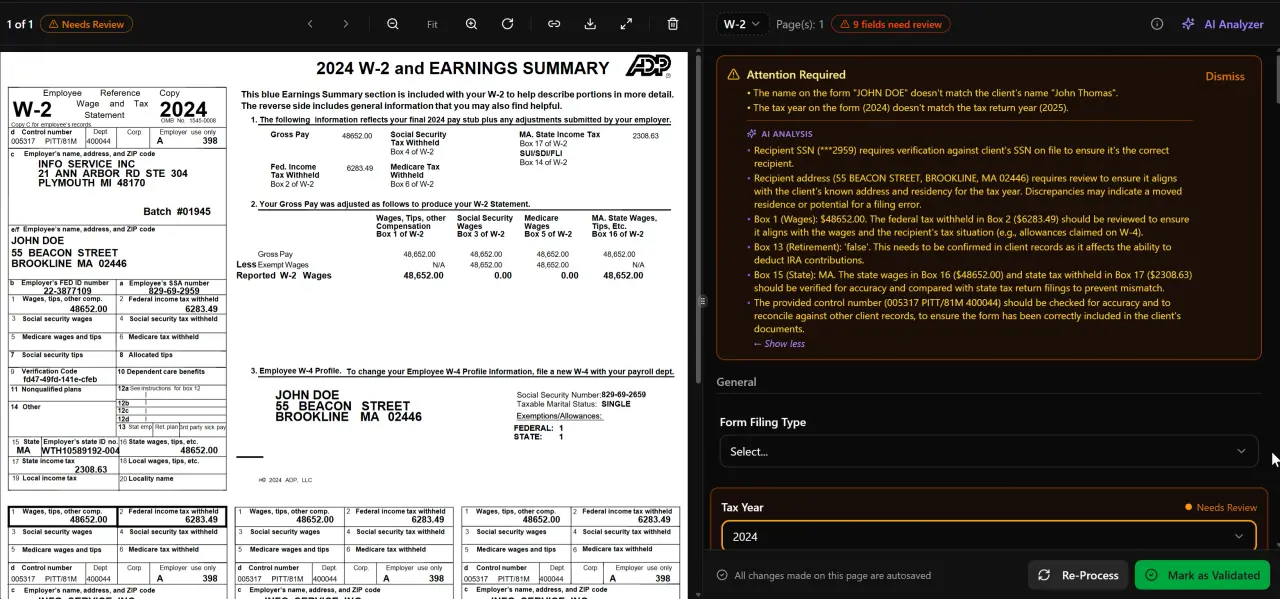
AI classifies, extracts, and validates every document automatically
Partnership Income Allocation: How It Actually Works
Partnership income allocation is governed by the partnership agreement — not a default IRS formula. Under IRC §704(b), allocations must have 'substantial economic effect' or be consistent with partners' interests in the partnership. In practice, this means your workpaper must reconcile the partnership agreement's stated allocation percentages against the actual economic arrangements, including any special allocations for depreciation, guaranteed payments, and preferred returns. Each of these factors directly shapes how form 1065 partnership return plays out in practice.
The glossary entry on pass-through entities provides a useful foundation for client conversations, but the CPA workflow is more granular. Each line of the Schedule K-1 — ordinary income, rental income, interest, dividends, capital gains, Section 179 deductions, and self-employment earnings — must be allocated separately and consistently with the agreement. When clients use a templated LLC operating agreement without custom allocation provisions, a default pro-rata allocation applies, but that default must still be documented. Understanding form 1065 partnership return in this context is what separates firms that scale from those that stall.
The QBI deduction adds a further complication: each partner's W-2 wages and qualified property share must be tracked at the partner level for their individual Form 8995-A calculation. Partnerships with significant fixed assets or payroll must supply this data on the K-1 itself (Box 17, Code V). Missing or incorrect QBI information is a common source of downstream notices for partners' returns. This is precisely where a deliberate form 1065 partnership return strategy pays off.
Tired of manually keying K-1 allocation data from PDFs into your tax software? Form 1065 partnership return sits at the center of this decision — get it wrong and the rest unravels.
TaxScout.ai extracts data from 180+ form types — including K-1s, brokerage statements, and depreciation schedules — with a 5-layer validation pipeline that catches errors before you file. When firms revisit their form 1065 partnership return priorities, the gaps usually surface here.

Click any extracted field to see its source highlighted on the original PDF

Your clients see your brand — OTP login, document upload, and real-time status
Schedule K-1 Filing: The CPA Workflow Checklist
Preparing accurate Schedule K-1s starts long before you open your tax software. The K-1 glossary entry covers the basics, but the CPA-side workflow involves at least six discrete steps: (1) reconciling the partnership's book income to tax income, (2) identifying and separating passive versus non-passive activities under IRC §469, (3) computing each partner's outside basis, (4) allocating each income and deduction item per the agreement, (5) completing the supplemental information schedules, and (6) furnishing completed K-1s to partners with sufficient lead time for their own preparers.
Outside basis tracking is where most errors compound. The IRS does not require partnerships to track partner basis — that obligation falls on each partner individually — but CPAs who prepare both the partnership return and partner returns carry a professional responsibility to flag basis limitations on losses. A partner cannot deduct a distributive share loss below their adjusted basis in the partnership interest (IRC §704(d)), and losses suspended by basis limitation must be tracked year-over-year.
For multi-member LLC tax filing that involves tiered structures — an LLC holding membership interests in another pass-through — CPAs must obtain K-1s from the lower-tier entity before completing the upper-tier return. This sequencing issue is a major source of extension requests in complex advisory engagements. AI-driven pipeline management that tracks document dependencies can flag these blockers weeks earlier than manual checklists.
1065 Common Errors That Trigger IRS Scrutiny
The IRS Large Business and International (LB&I) division has published several active compliance campaigns targeting partnership returns. Understanding which errors draw examinations helps CPAs prioritize review time. The most frequently identified 1065 common errors include: (1) inconsistent allocation percentages between the K-1s and the partnership agreement; (2) guaranteed payments misclassified as ordinary distributions (guaranteed payments are deductible by the partnership and reported on K-1, Box 4 — distributions are not deductible); (3) failure to report hot assets under IRC §751 on a transfer of a partnership interest; (4) missing or incomplete Form 8308 for reportable exchange transactions; and (5) book-to-tax differences in depreciation that create capital account discrepancies.
Tax basis capital accounts became mandatory for all partnerships filing Form 1065 starting with the 2020 tax year, per IRS Notice 2020-43. Partnerships that previously maintained GAAP or §704(b) capital accounts and did not restate to tax basis are a continuing examination target. If your new partnership client has prior-year returns showing capital accounts on a non-tax basis, a restatement workpaper is needed before you file the current year.
Self-employment tax treatment of LLC members is another audit flashpoint. Under IRS proposed regulations on self-employment tax for LLC members, the rules remain unsettled for members who are active in management but structured as limited partners. Until final regulations are issued, the conservative and defensible position is to treat active LLC members as general partners for SE tax purposes — but document your analysis.
Finally, the passive activity rules at the partner level mean that losses from rental activities embedded in the partnership K-1 can only offset passive income on the individual return. CPAs who prepare both sides of the filing should flag passive loss carryforwards proactively, not reactively when a client gets an IRS notice.
AI-Native vs. Traditional Practice Management for Partnership Return Prep
| Workflow Step | Manual / Legacy Tools | TaxScout.ai AI-Native |
|---|---|---|
| Document collection | Email attachments, manual sorting | Branded portal with OTP login, AI classification |
| K-1 and source doc extraction | Rekeying from PDFs | AI extraction across 180+ form types with 5-layer validation |
| Error detection | Preparer review only | 15 deterministic math rules + 18 post-extraction rules |
| Partner basis tracking | Separate spreadsheet | Client-context AI memory retains prior-year data |
| K-1 furnishing and e-signature | Email PDF, wet signature | E-signature via Documenso, portal delivery |
| Research on ambiguous issues | Manual IRS.gov search | 9 AI research agents with real-time IRS/Treasury search |
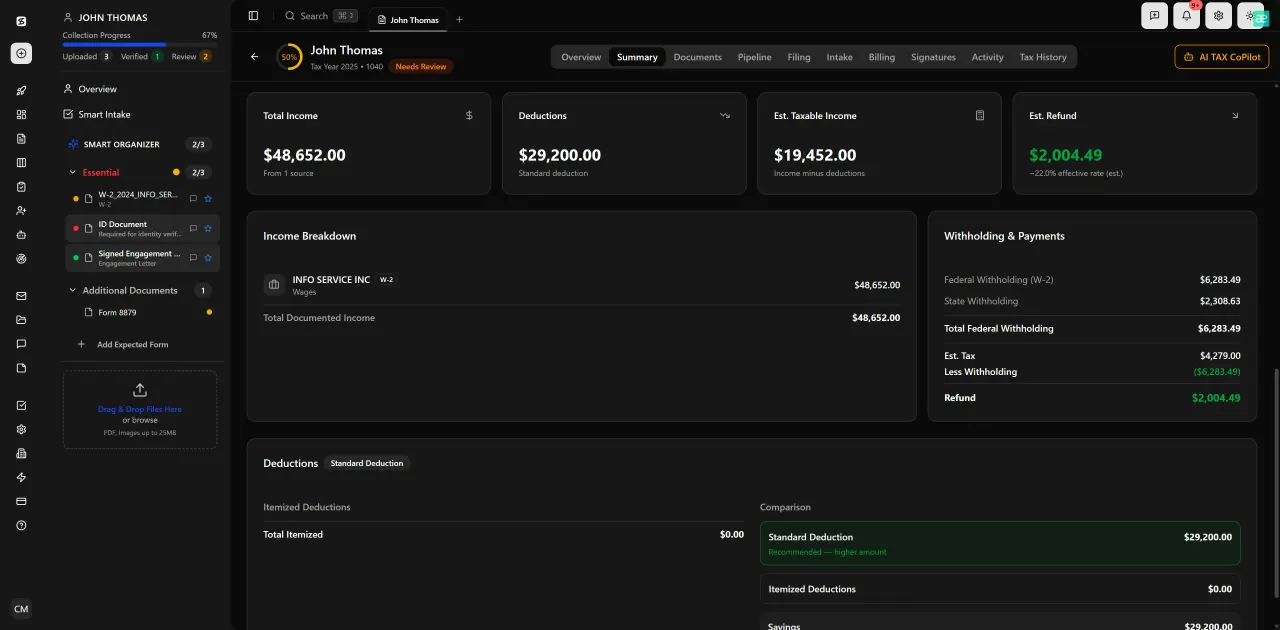
Review with AI assist — 9 agents answer questions with full client context
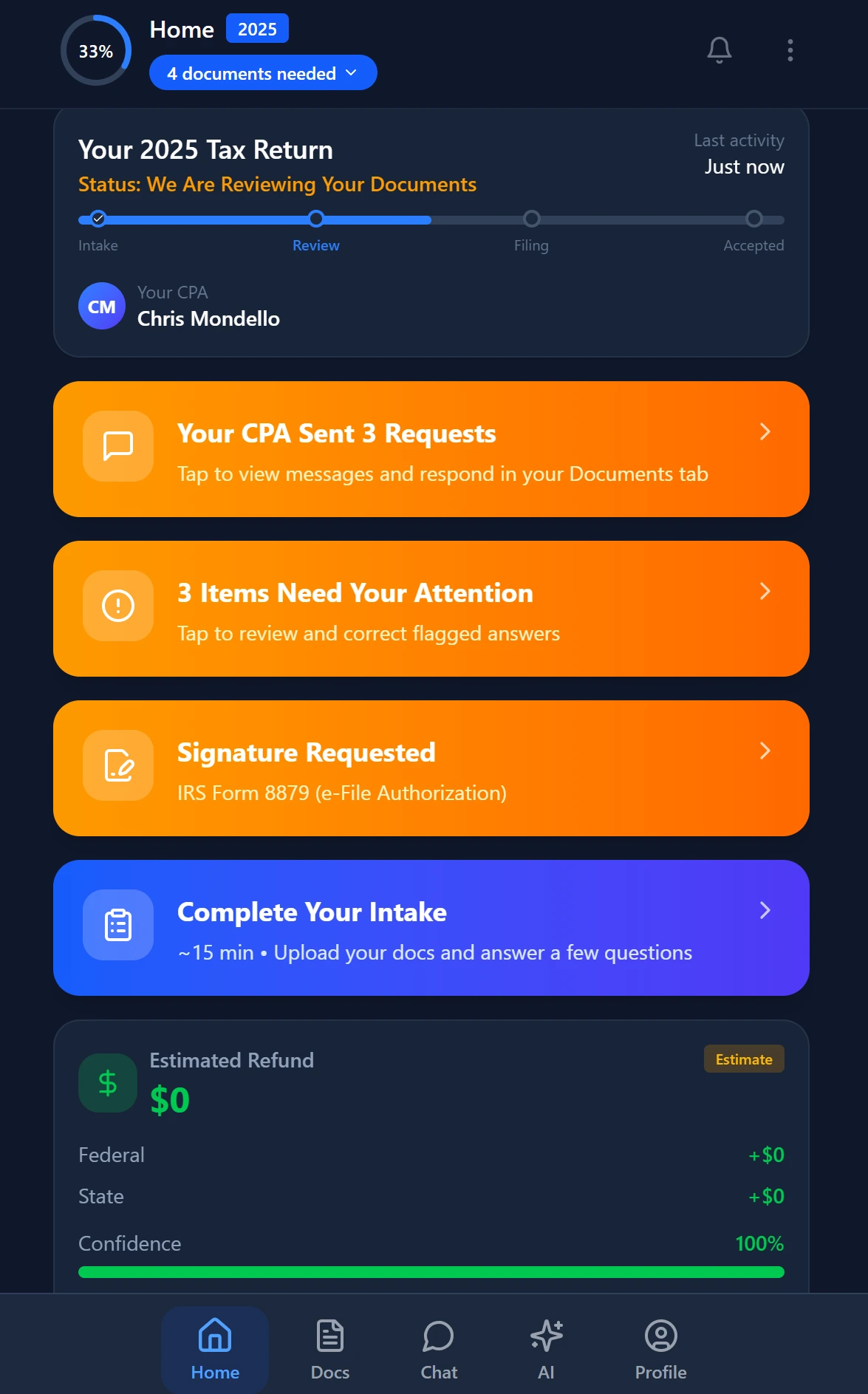
Smart intake auto-fills from uploaded documents and prior-year data
How AI Document Extraction Accelerates Partnership Return Prep
The most time-consuming part of preparing a partnership tax return CPA workflow isn't analysis — it's document processing. A typical mid-size partnership might submit brokerage 1099s, depreciation schedules, prior-year returns, loan statements, vendor 1099s issued, and K-1s received from upstream entities. Manually keying those figures and cross-referencing them across workpapers consumes hours that should be spent on review and advisory.
TaxScout.ai's AI document extraction handles 180+ form types, including all K-1 variants, the 1099 series, and 1098 forms. The 5-layer validation pipeline — document quality routing, AI extraction with confidence scoring, OCR cross-verification, 15 deterministic math rules, and 18 post-extraction rules — flags discrepancies before they become filing errors. The split-screen PDF viewer lets a reviewer click any extracted field and immediately see the source location in the original document, which transforms the review step from a blind trust exercise into a verifiable audit trail.
For CPAs who use Drake, CCH Axcess, UltraTax CS, Lacerte, ProConnect, or ProSeries, TaxScout.ai works alongside those platforms — it doesn't replace them. The AI handles document ingestion, validation, and data organization; your existing tax software handles computation and e-filing. This matters for the 1065 workflow specifically because most tax software lacks robust document management, and most document management tools lack tax-specific validation logic.
The smart intake engine is also relevant here: for multi-member LLC tax filing clients, the AI-powered intake questionnaire (modeled on IRS Form 13614-C) can surface entity structure questions, prior-year comparison gaps, and missing document prompts automatically — reducing back-and-forth before the return is even opened.
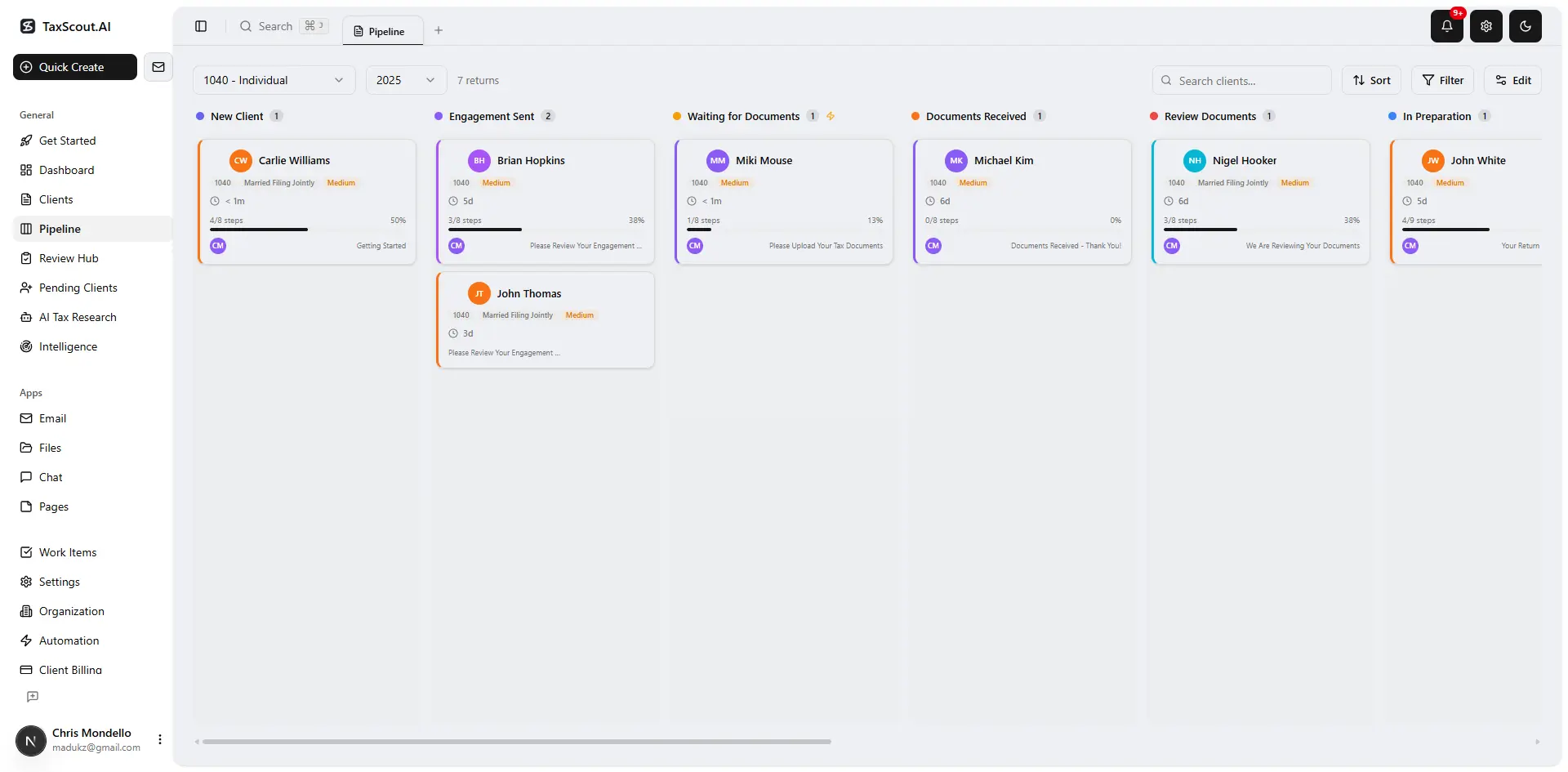
Track every return from intake to filed with drag-and-drop pipeline management
The Partnership Return as an Advisory Upsell Opportunity
Most competitor content treats the 1065 as a compliance task and stops there. But the information surfaced during partnership return preparation — income trends, capital account movements, guaranteed payment structures, basis limitations, retirement plan deductions — is a natural trigger for advisory services conversations that add revenue per engagement without adding new clients.
Year-end partnership planning discussions can cover: restructuring guaranteed payments to optimize SE tax exposure, timing large asset disposals to avoid IRC §751 hot-asset complications, evaluating whether an S corporation election (Form 2553) would reduce overall tax burden for active members, and setting up retirement plan contributions before the K-1 is finalized. The data is already in your hands — the question is whether your workflow gives you bandwidth to act on it.
Firms that have systematized the compliance side with AI tools consistently report gaining advisory capacity. When document extraction, K-1 population, and error-checking are partially automated, the hours recovered go directly into higher-margin review and planning work. For more on building this capacity systematically, see our guide on scaling from a solo practitioner to a multi-partner firm.
If you're evaluating practice management platforms and wondering how current tools stack up on the advisory-enablement dimension, our CPA software comparison shows where TaxScout.ai outperforms legacy tools on features directly relevant to partnership season.
Pricing That Does Not Penalize Growing Partnership Practices
One friction point CPAs encounter when evaluating practice management software is per-user pricing that scales against you as your team grows. TaxDome runs approximately $100 per user per month; at a 10-person firm that's roughly $500 per month just for the platform — before any add-ons. Canopy charges approximately $45 per user per module, and its smart intake feature adds $11 per client on top. For a firm with 80 partnership clients, that intake cost alone adds up quickly.
TaxScout.ai uses flat, all-inclusive pricing with no per-user fees and unlimited clients. The Prep Pro plan at $149 per month covers 10 seats, 500 returns per year, all 9 AI research agents, the full PDF toolbox, and 300 AI Tax Assistant queries per day. For a firm running partnership returns alongside individual and entity filings, this structure means the cost per return actually decreases as volume grows — the inverse of every per-user model. See the full breakdown at /pricing.
For firms already stretched thin during tax season, the per-user pricing glossary entry explains exactly why flat-fee models outperform per-seat pricing as headcount increases — and why the math shifts further in flat-fee's favor during extension season when temporary staff are added.
Ready to stop losing hours to manual K-1 data entry and missed error checks?
TaxScout.ai automates document extraction, validates against 33 built-in rules, and surfaces advisory opportunities — all on a flat monthly fee that doesn't grow with your team.

Every client gets organized documents, status tracking, and a complete history
Keep reading
Backup Withholding on Third Party Network Transactions: What CPA Firms Must Do Now
Sep 18, 2026 · 1 min read
Information Reporting Regarding Qualified Opportunity Zones: What CPA Firms Must Do Now
Sep 14, 2026 · 1 min read
Racial Nondiscrimination in Private Schools: What CPA Firms Must Do Now
Sep 9, 2026 · 1 min read
Stay up to date
Get the latest tax tech insights delivered to your inbox.