Remote Team Accounting Firm: AI Tools to Sync Your CPAs
Managing a distributed accounting firm in 2026 isn't a people problem — it's a systems problem. This guide breaks down how AI-powered workflows replace the coordination overhead that bogs down remote CPA teams. From async task management to intelligent handoffs, discover the infrastructure that…
Managing a remote team accounting firm in 2026 is less about trust and more about infrastructure. When your senior preparer is in Austin, your admin is in Phoenix, and your newest hire is working from a home office in Charlotte, the question isn't whether remote work can function — it's whether your practice management stack can keep everyone aligned without a daily standup call holding it all together.
Most CPA firm owners who struggle with distributed teams aren't dealing with a people problem. They're dealing with a systems problem. And the tools they're using — built before AI was practical — force remote coordination overhead onto the humans instead of the platform. Running a remote team accounting firm exposes these systems gaps faster than any in-office setup ever could.
This guide covers what a genuinely distributed accounting team looks like operationally in 2026: async workflows, AI-assisted task delegation, client communication visibility across time zones, and the platform decisions that determine whether your remote CPA firm runs smoothly or requires constant managerial intervention to stay on track. Whether you're building your first remote team accounting firm or scaling one that's already distributed across states, the operational decisions you make now will define your capacity ceiling for years.
Why Remote CPA Firm Management Breaks Down Without AI
The average CPA firm's coordination overhead looks roughly like this: a preparer finishes their work, drops a note in Slack, waits for a manager to review, the manager asks for a document that wasn't uploaded, the client follows up via email (which only the partner sees), and a deadline slips by three days before anyone notices. Multiply that by 40 active returns and a two-hour time zone gap, and you understand why remote CPA firms default back to micromanagement. In a remote team accounting firm, this same chain plays out in slow motion, stretched across time zones and disconnected inboxes with no single source of truth holding it together.
Traditional practice management platforms weren't designed for the async-first reality of distributed accounting teams. TaxDome charges ~$100/user/month and gives you a client portal and pipeline view — but it has no AI to surface what's actually blocking a return, no document intelligence to flag what's still missing, and no way to proactively tell a preparer in a different time zone that a client's K-1 confidence score is too low to proceed. Karbon is strong on email-centric workflow but offers minimal document management and lacks AI extraction entirely — which means remote teams still spend hours manually keying data before they can collaborate on a return at all. For firms evaluating their remote team accounting firm approach, this trade-off compounds over time.
When coordination depends on humans remembering to check things and notify each other, remote work creates lag. When coordination is handled by an AI layer embedded in the platform itself, remote work becomes a structural advantage. Each of these factors directly shapes how remote team accounting firm plays out in practice.
!TaxScout pipeline kanban showing active return stages for a distributed accounting team managing remote CPA firm workflows across time zones
Async Workflow Design for Distributed Accounting Teams
The foundation of a high-functioning distributed accounting team is a pipeline that advances itself. That means the platform — not a manager — determines when a return is ready to move forward, what's blocking it, and who needs to act next. Understanding remote team accounting firm in this context is what separates firms that scale from those that stall.
TaxScout's pipeline management uses 12 customizable stages from New Client through Filed. Each stage can auto-advance when specific conditions are met — documents uploaded, intake complete, review approved — without anyone manually updating a status. When a loopback is required (say, a preparer sends a return back to document collection because a 1099-SA arrived late), the system requires a note explaining the reason, creating a paper trail that every team member can read asynchronously. This is precisely where a deliberate remote team accounting firm strategy pays off.
For a remote team accounting firm, this means the Austin preparer doesn't need to tell the Phoenix admin "I've moved this to review." The pipeline does it. The Phoenix admin opens their queue in the morning and sees exactly what requires their attention — without a 7 AM Slack message triggering the update.
This kind of structured async handoff isn't just convenient. It's how you eliminate the class of coordination failures that kill productivity in distributed accounting teams: the status ambiguity, the "did you see my message?" follow-up, the work that stalls because nobody knew it was their turn. Remote team accounting firm sits at the center of this decision — get it wrong and the rest unravels.
The async-first design principles that work for remote CPA firms:
- Every task has a defined owner and a next-action state in the platform, not in someone's memory
- Stage transitions are automatic where possible, manual-with-required-notes where discretion is needed
- Client communications are visible to all team members with appropriate access — not siloed in one person's inbox
- Document status is AI-surfaced, not manually tracked
Tired of chasing status updates across time zones? See how TaxScout's pipeline keeps distributed CPA teams moving without the check-in calls. → Book a 15-Min Demo — See It Live

Your clients see your brand — OTP login, document upload, and real-time status
AI-Assisted Task Delegation Across Your Remote Accounting Team
One of the most underappreciated advantages of an AI-native platform for accounting firm team collaboration is automatic work routing. When a document comes in, the platform should already know which client it belongs to, what type of document it is, what's still missing from that client's file, and whether the extracted data passes validation — before any human on your team looks at it.
TaxScout's AI document extraction processes 180+ tax form types through a 5-layer validation pipeline. Every field gets a confidence score between 0.0 and 1.0. A W-2 that extracts cleanly at high confidence routes differently than a handwritten K-1 that triggers cross-verification flags. The platform surfaces extraction issues automatically, which means a manager in a different time zone doesn't need to manually audit every document upload — the AI does the first-pass triage and flags only the items that need human judgment.
For the remote team accounting firm that's onboarding clients across tax seasons, this matters operationally. As detailed in our guide to AI document extraction for CPAs, the 5-layer validation catches problems that manual review routinely misses — including phantom 1099-INT hallucinations and W-2 component explosion detection. In a distributed team context, that validation layer acts as a quality gate that operates 24 hours a day, regardless of which time zone your preparers are working from.
The practical result: when your Charlotte hire processes a complex K-1 package at 6 PM Eastern, they don't need the Austin manager awake to review it before moving forward. If the extraction confidence is high and validation passes all 33 checks, the return advances. If flags are triggered, the system holds it and surfaces the specific issue with a clear next-action — so the Austin manager sees a prioritized queue the next morning, not a vague "please review."
Client Communication Visibility for Remote Work CPA Firm Operations
The communication breakdown in remote CPA firms rarely starts with team-to-team coordination. It starts with client-to-firm communication landing in one person's inbox and never getting visibility.
A partner gets an email from a client asking about their extension status. The partner is traveling. The preparer handling that return has no idea the client emailed. Three days pass. The client calls frustrated. This scenario is so common it's almost universal in practices that haven't unified their communication infrastructure.
TaxScout's email integration connects Gmail (via OAuth 2.0), Microsoft Outlook and 365 (via Graph API), and IMAP/POP3 accounts, with AI classification that routes incoming messages by client and urgency. Our shared inbox solution for accounting firms covers how this eliminates the single-inbox bottleneck in detail — but the remote team dimension adds another layer. When your team is distributed, visibility into client communications isn't a nice-to-have. It's the difference between a smooth client experience and a client who assumes they're being ignored because their CPA is working remotely.
The client portal reinforces this by giving clients a single branded channel for document submission, status updates, and e-signature requests — with OTP login that requires zero passwords and zero account creation. Client activity in the portal is logged and visible to all team members with appropriate access. A client who uploads their final documents at 11 PM appears in the queue for whoever opens it first the next morning — not just for the preparer who happens to check their email first.
!TaxScout client portal branded interface showing document submission status and e-signature requests for a remote work CPA firm team

Click any extracted field to see its source highlighted on the original PDF
How AI Research Agents Replace the "Quick Question" Interruption
In a co-located firm, the quick-question dynamic is inefficient but functional. A junior preparer walks to a senior's desk, asks about foreign tax credit carryover rules, gets a two-minute answer, and moves on. In a remote accounting team, that same question becomes a Slack message that sits unread for two hours, blocks the preparer's progress, and costs more than the 30-second answer would have warranted.
TaxScout's 9 specialized AI research agents address this directly. The Tax Calculation Agent, Risk Assessment Agent, Filing Specialist Agent, and Contextual Q&A Agent give preparers immediate, client-context-aware answers to exactly the questions that would otherwise require a senior escalation. And because the AI holds each client's full profile — entity structures, filing history, documents, intake data, prior-year returns — the answers are calibrated to that specific client's situation, not just generic IRS guidance.
The research is live, not cached. The platform searches IRS.gov, law.cornell.edu, congress.gov, treasury.gov, and ssa.gov in real time. For the kind of nuanced multi-state and cross-border questions that come up constantly in complex practices — topics that tools like AI agents for multi-state returns explore in depth — this matters more than a static knowledge base.
For a distributed accounting team, this shifts the dynamic from "wait for a senior to be available" to "get a research-backed answer now and flag it for senior review only if the confidence threshold requires it." Senior CPAs stop being bottlenecks. Junior preparers stop stalling. Work keeps moving regardless of time zones.
The Cost Comparison That Should Drive Your Platform Decision
Here's the practical math for a 10-person remote CPA firm evaluating practice management software:
| Feature | TaxScout Pro | TaxDome | Karbon |
|---|---|---|---|
| Monthly cost (10 users) | $149 flat | ~$1,000/mo | ~$590/mo |
| AI document extraction | 180+ forms, 5-layer validation | None | None |
| Per-field confidence scoring | Yes | No | No |
| Real-time IRS research | Yes | No | No |
| Client-context AI memory | Yes | No | No |
| Pipeline auto-advance | Yes, 12 stages | Yes | Yes |
| E-signatures | Yes (8879, 4868, FBAR, more) | Yes | Rolling out |
| Shared client portal | Yes, OTP login | Yes, mobile app | Basic only |
| Email classification by urgency | Yes, AI-classified | No | Core feature |
| Annual cost (10 users) | $1,788/yr | ~$12,000/yr | ~$7,080/yr |
The $10,000+ annual cost difference between TaxScout and TaxDome at 10 users is, by itself, a meaningful efficiency gain for most small and mid-size CPA firms. But the more important difference for a remote team accounting firm is the AI layer: TaxDome gives you a place to track work; TaxScout gives you a platform that actively advances work without requiring human coordination at every handoff.
As we analyzed in our TaxScout vs TaxDome comparison, the per-user pricing model creates a scaling trap — every hire becomes a recurring cost increase, which creates pressure to limit platform access. That's the opposite of what a growing distributed accounting team needs.
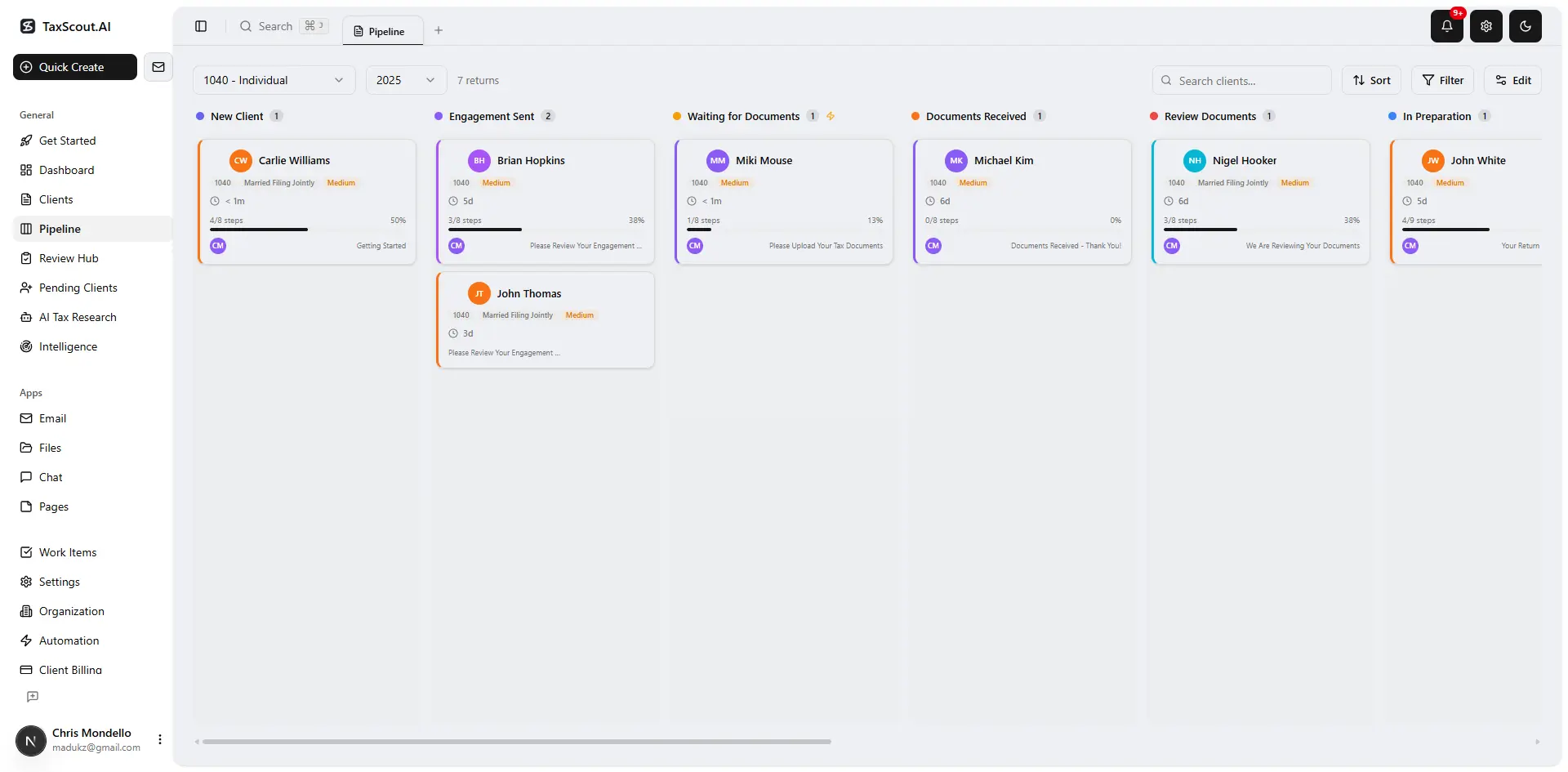
Track every return from intake to filed with drag-and-drop pipeline management
Building a Remote Accounting Firm That Doesn't Depend on Geography
The CPA firms that will win on distributed talent in 2026 aren't the ones with the best Zoom culture. They're the ones whose platform design means work advances automatically, information is visible to everyone with appropriate access, and the AI handles the coordination layer so senior CPAs can focus on judgment calls instead of status updates.
Firms running on flat-rate AI-native infrastructure also gain a specific talent advantage: they can hire the best preparer regardless of geography, offer genuine flexibility, and not worry about the coordination tax that remote work imposes on platforms designed for co-located teams. The staff retention research consistently shows that remote-first flexibility ranks among the top factors CPAs cite when evaluating firm offers — and the firms that can actually operationalize it have a material recruiting edge.
The practical steps for a remote CPA firm management setup:
- Centralize document intake through the client portal — no more emailed documents landing in individual inboxes
- Run all returns through an AI extraction queue with confidence scoring before any human reviews
- Build pipeline stages that auto-advance so work moves without manager intervention at every step
- Connect email to the platform with AI classification so client communications are team-visible, not siloed
- Use AI research agents for preparer questions before escalating to senior staff
This isn't a technology-first argument. It's an operational one. The coordination overhead that distributed teams pay when using legacy tools isn't inherent to remote work — it's a product of platforms that were never designed to handle async handoffs intelligently.
Ready to run your remote team accounting firm without the coordination overhead? TaxScout gives distributed CPA teams AI-native workflow management for $149/mo flat — no per-user pricing, no coordination tax. → Book a 15-Min Demo
Frequently Asked Questions
TaxScout's AI delegation engine monitors each team member's active workload, time zone, and skill level to automatically route incoming tasks without requiring a manager to intervene. When a return lands in the queue at 11 PM EST, TaxScout assigns it to the next available preparer based on capacity data — not a group Slack message that nobody sees until morning. Firms using this feature report cutting average task-to-assignment time from 4+ hours to under 12 minutes across distributed teams.
Keep reading
Equity Partner Compensation: How CPA Firms Structure Pay for Owners
Sep 18, 2026 · 1 min read
CPA Firm Standard Operating Procedures: Build an SOP Library That Runs Without You
Sep 18, 2026 · 1 min read
Accountant Shortage Solutions: How CPA Firms Survive the Talent Crisis Without Overpaying
Sep 18, 2026 · 1 min read
Stay up to date
Get the latest tax tech insights delivered to your inbox.