Equity partner compensation is the most consequential financial decision a CPA firm makes — and the least discussed. Industry publications overflow with advice on billing rates, staff bonuses, and client retention, yet the question of how firm owners structure their own pay is treated like a private matter that partners are supposed to figure out over a handshake and a partnership agreement drafted in 1997.
That silence has a cost. Firms that operate without a documented, formulaic compensation framework suffer predictable problems: the rainmaker who dominates every profit discussion, the service partner who quietly builds resentment, and the founding partner who can't retire because no one agreed on a buy-out formula when things were simpler. These aren't edge cases — they are the standard trajectory for firms that grow past two equity owners without formalizing ownership compensation. Establishing a clear equity partner compensation policy from the start is the single most effective way to prevent these conflicts from taking root.
This guide addresses equity partner compensation directly. We cover the three dominant models used by accounting firms — eat-what-you-kill, lockstep, and modified lockstep with units — alongside real numbers for buy-in structures, profit distribution mechanics, and how AI-assisted scenario modeling can help partners stress-test compensation designs before committing to them.
The reluctance to formalize equity partner compensation is deeply human. When a firm has two or three partners who trust each other and revenue is growing, ambiguity feels harmless. Why risk a difficult conversation when the current arrangement seems to work? The answer is that informal arrangements work until they don't — and the moment they fail is almost always triggered by a stress event: a partner wanting to reduce hours, a lateral hire seeking equity, or a retirement that requires a buy-out.
There is also a structural reason: most CPA firm founders are outstanding technicians and client-service professionals, not compensation designers. The Journal of Accountancy has documented the tension between technical excellence and business management at small-to-midsize firms for decades. Very few CPA programs teach partnership economics, and the subject rarely surfaces in CPE catalogs. Designing a fair equity partner compensation system requires a different skill set than preparing a complex tax return, and most firm founders simply never learned it.
A third factor is the sheer variety of firm structures. A two-partner S-corporation paying both owners a reasonable compensation salary plus distributions operates very differently from a four-partner LLC taxed as a pass-through entity allocating profits by ownership units. The IRS treats these entities differently — S-corporation elections under Form 2553 carry specific compensation requirements — and that complexity deters informal conversations. Browse other blog resources for additional guides on firm structure and operations. This variety means there is no universal equity partner compensation template that works across all firm structures, making professional guidance especially valuable.
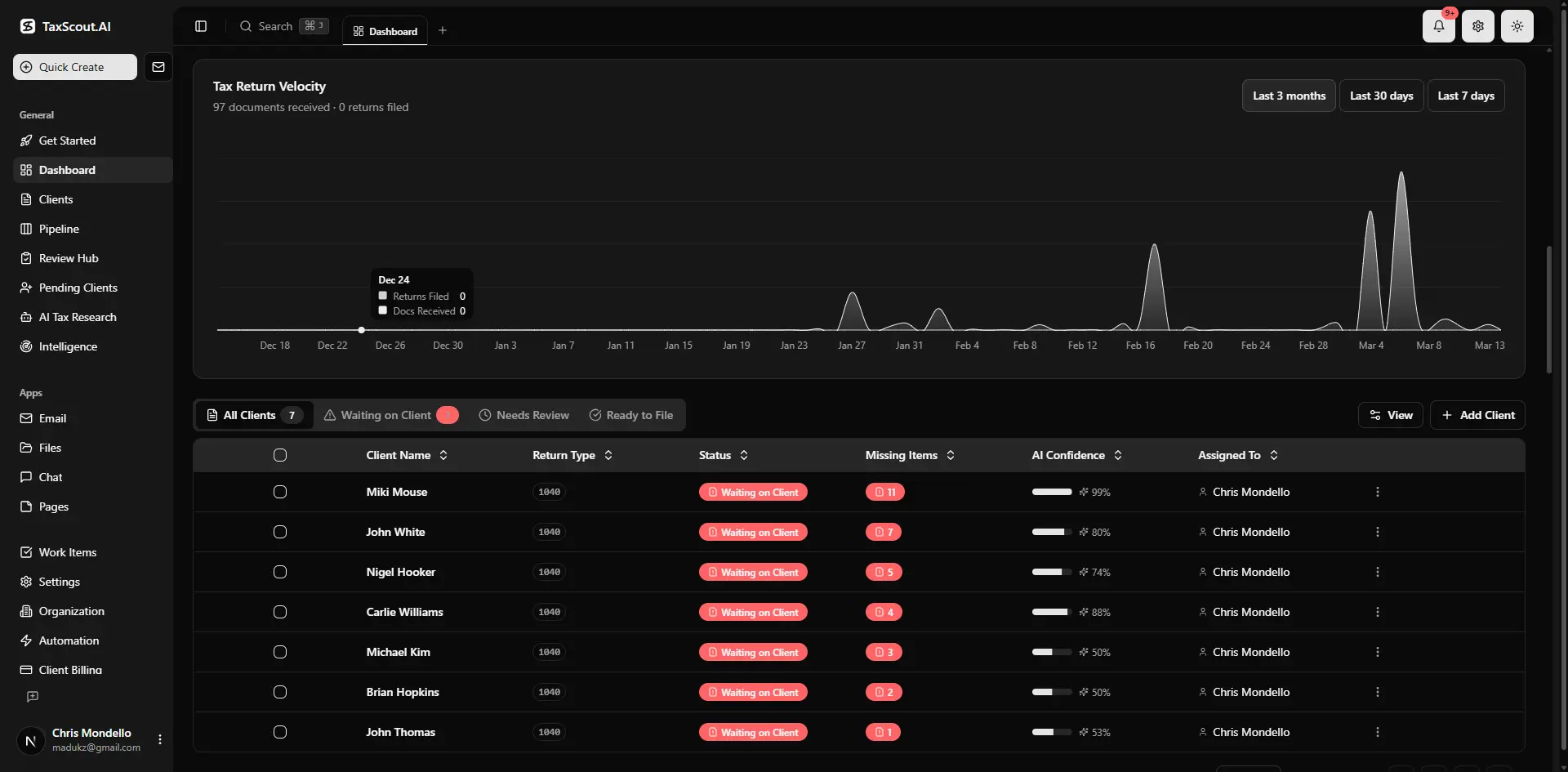
Real-time dashboard showing returns in progress, revenue, and upcoming deadlines
Nearly every accounting firm compensation arrangement is a variation of three foundational models. Understanding each model's mechanics — not just its label — is the prerequisite for choosing or designing an appropriate structure for your firm. For firms evaluating their equity partner compensation approach, this trade-off compounds over time.
In an eat-what-you-kill (EWTK) model, each partner is credited with the revenue they personally generate or control. After firm-level overhead is allocated — often as a flat percentage or per-head charge — each partner keeps what their book produces. This model is common at sole-practitioner-origin firms where the founding partner and a later equity addition simply want to avoid subsidizing each other. Each of these factors directly shapes how equity partner compensation plays out in practice.
EWTK has real advantages: it is simple, self-funding, and aligns pay with production. Partners who grow their books are rewarded immediately. The model breaks down when the firm needs internal investment — in training, infrastructure, or practice management technology — because every dollar spent on shared resources comes out of individual draws. It also creates disincentives for client referrals across practice groups, since the originating partner's credit doesn't transfer. Understanding equity partner compensation in this context is what separates firms that scale from those that stall.
For firms considering formalized accounting firm ownership compensation structures, EWTK is frequently the starting point. The transition away from it is the single most politically sensitive move a multi-partner firm can make. This is precisely where a deliberate equity partner compensation strategy pays off.
Lockstep compensation assigns each equity partner a fixed percentage of firm profits based on years of partnership seniority. Every partner at the same tier earns the same amount regardless of individual production. This model is associated with large law and accounting firms — the Big Four historically used modified versions of it — because it promotes collaboration, long-term client stewardship, and internal mentoring. Equity partner compensation sits at the center of this decision — get it wrong and the rest unravels.
Pure lockstep rarely survives at firms below 20 equity partners. When one partner is a consistent business developer and another manages primarily internal operations, the equal-pay outcome becomes untenable. More practically, lockstep provides no mechanism for rewarding exceptional individual performance, which creates retention risk for the firm's highest producers. When firms revisit their equity partner compensation priorities, the gaps usually surface here.
The U.S. Bureau of Labor Statistics reports median accountant and auditor wages at the staff level, but partner-level accounting firm ownership compensation is not captured in public wage data — a gap that makes benchmarking genuinely difficult for smaller firms.
The dominant model at growth-stage CPA firms (roughly five to fifty partners) is a hybrid sometimes called modified lockstep or, more precisely, a unit-based compensation system. Each partner holds a fixed number of units — analogous to shares — that determine their percentage of distributable profits. Units are assigned at buy-in and can be adjusted annually or biennially based on performance, seniority, and committee evaluation.
Unit-based structures elegantly solve the core tension of partner compensation: they provide predictability (your units don't change unless the partnership votes to change them), while allowing the firm to reward exceptional contributors through unit reallocation. They also establish a clear valuation framework for buy-ins and buy-outs.
A typical unit-based model might assign incoming equity partners 100 units on a base of 1,000 total units, granting them a 10% profit interest. If the firm distributes $1,500,000 in annual profits, that partner receives $150,000 from profit distribution alone, separate from any base draw. CPA partner draw structure in this context often combines a monthly guaranteed draw (essentially an advance against expected profits) with a year-end true-up based on actual unit entitlement.
Spending more time modeling partner comp in spreadsheets than advising clients?
TaxScout's Excel 1040 calculator (66 sheets, ~36,000 formulas) and AI research agents can model compensation scenarios and surface relevant IRS guidance in one platform — so your partners can make informed decisions faster.
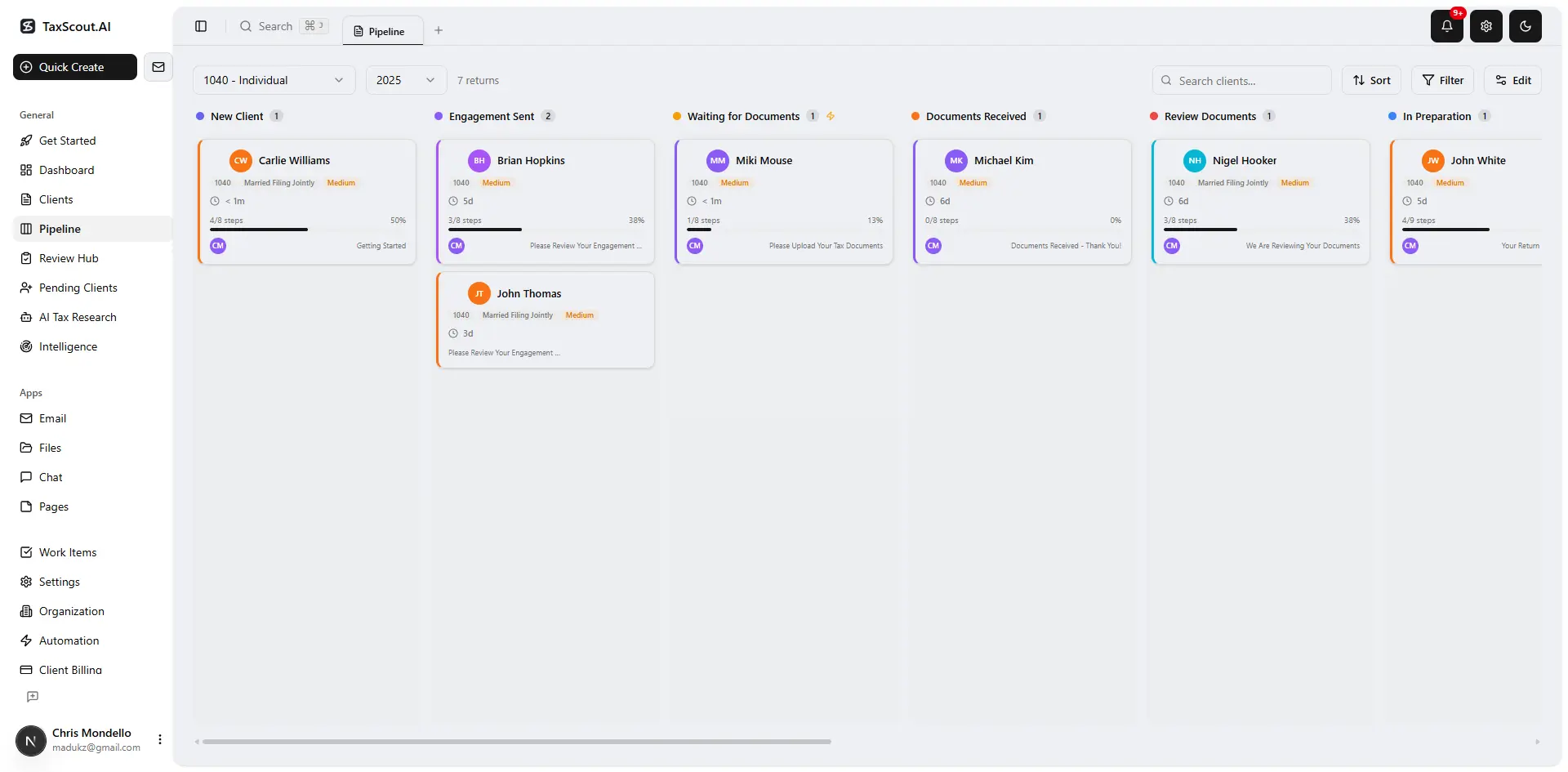
Track every return from intake to filed with drag-and-drop pipeline management

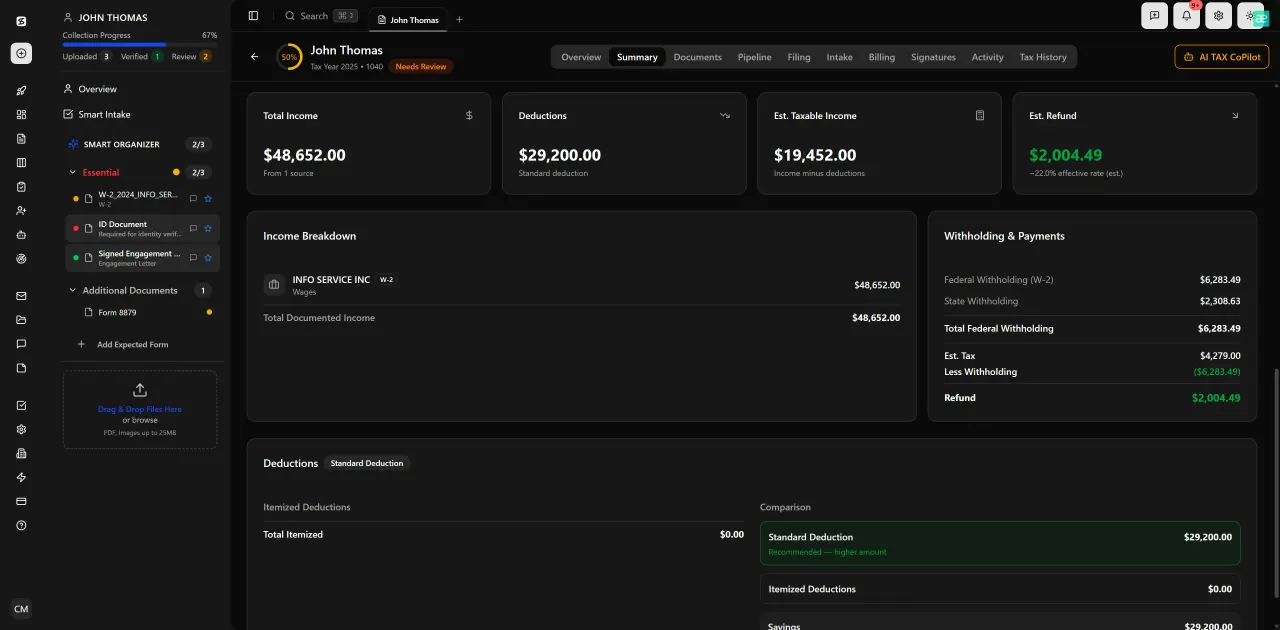
Every client gets organized documents, status tracking, and a complete history
Partner buy-in is the entry price a new equity partner pays to acquire an ownership stake. It serves two purposes: it capitalizes the firm (buy-in proceeds often fund working capital or retire debt) and it filters candidates by creating financial commitment. The structure of the buy-in heavily influences how new partners think about their CPA firm profit distribution expectations.
Buy-in amounts vary widely by firm size and profitability. For firms with under $3 million in annual revenue, buy-ins typically range from $50,000 to $150,000 per 10% ownership unit block. For firms between $3 million and $10 million, the range is frequently $100,000 to $400,000. These figures are not published in a single authoritative source, but the AICPA's Private Companies Practice Section and state CPA society surveys — including data from the Texas Society of CPAs — provide periodic benchmarks.
Most CPA firms structure partner buy-ins using one of three payment approaches. The first is a lump-sum capital contribution, often financed by the incoming partner through a personal loan or practice loan from a commercial bank. The second is a note payable to the firm, where the incoming partner pays over three to seven years with interest — typically tied to the applicable federal rate published monthly by the U.S. Treasury. The third is a sweat equity arrangement where buy-in is financed through reduced compensation during an earnout period, common when the firm is promoting an internal senior manager.
What often surprises incoming partners is that the buy-in amount is separate from the valuation formula used for future buy-outs. Firms that fail to document both at the same time create enormous disputes when a senior partner retires. The standard valuation approaches are a multiple of annual fees collected (typically 0.75x to 1.25x depending on client retention risk), a multiple of EBITDA, or a unit-based book value calculation tied to the unit structure described above.
Equity Partner Compensation Model Comparison — Key Characteristics
| Model | Profit Driver | Best Fit | Key Risk |
|---|---|---|---|
| Eat-What-You-Kill | Individual origination credit | 2-4 partner firms, independent practices | No shared investment incentive; silo culture |
| Lockstep | Seniority tier | Large firms (20+ equity partners) | Retains low performers; loses top producers |
| Unit-Based (Modified Lockstep) | Ownership units + performance review | 5-50 partner growth firms | Annual unit negotiations require strong governance |
| Hybrid Draw + Bonus | Base salary + production pool | Firms transitioning from EWTK | Complexity in tracking individual production credits |
Managing partner salary in an accounting firm is a distinct question from profit distribution. A managing partner — the partner responsible for firm administration, strategic direction, and staff oversight — typically receives an administrative premium on top of their unit-based profit share. This premium compensates for time spent on firm management rather than client production.
The size of the premium varies by firm size and how much of the managing partner's time is devoted to administrative versus client-facing work. A commonly cited benchmark is an additional 10% to 20% of average partner compensation. For a firm where average partner earnings are $300,000, this translates to a managing partner premium of $30,000 to $60,000 annually. This is separate from any bonus tied to firm-wide performance metrics.
Some firms address managing partner compensation by reducing their production expectations instead of paying a cash premium — essentially giving the managing partner a smaller book and acknowledging that their time is spent elsewhere. This is cleaner from a tax perspective in an S-corp structure where all distributions must track ownership percentages, but it requires that the other partners accept the arrangement as equitable.
Firms tracking accounting firm KPIs frequently discover that the managing partner premium is poorly calibrated. If managing partner time is not being tracked separately from billable hours, it is impossible to assess whether the firm is over- or under-compensating for administrative leadership. A pipeline management platform that captures time allocation by role can provide the data necessary to make this case objectively.
Review with AI assist — 9 agents answer questions with full client context
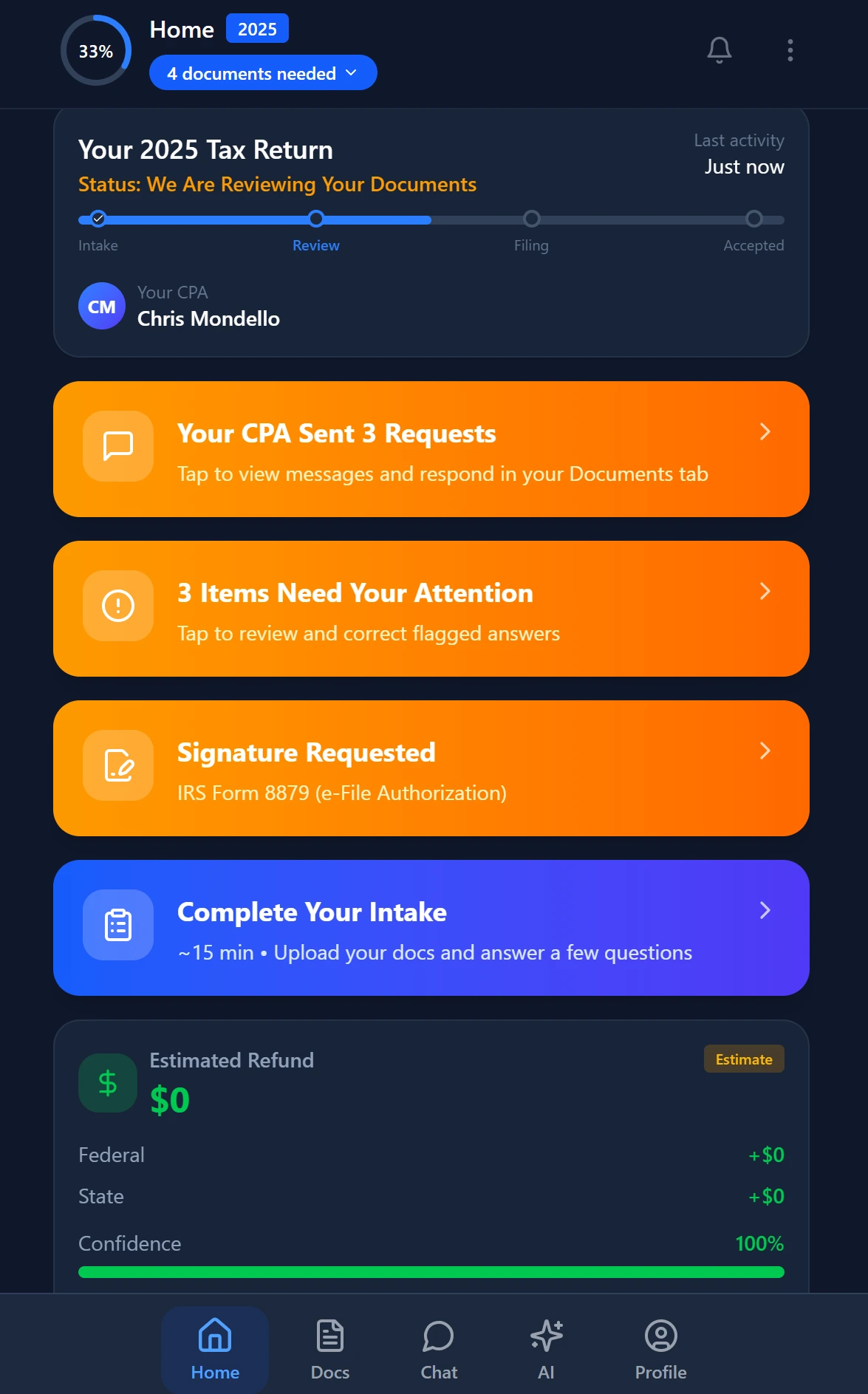
Smart intake auto-fills from uploaded documents and prior-year data
One of the most underutilized tools in CPA firm compensation design is structured scenario modeling. The question is not simply 'what do we pay partners this year?' but 'if we shift from EWTK to a unit-based model, what does each existing partner earn under various revenue growth assumptions over the next five years?' That is a multi-variable projection that benefits significantly from systematic modeling.
TaxScout's Excel 1040 calculator — with 66 sheets and approximately 36,000 formulas — was designed for tax return computation, but its underlying structure illustrates how layered formula-based models can handle complex interdependencies. The same logic applies to partner compensation modeling: a well-built unit-value projection tool inputs assumptions for firm revenue growth rate, new partner admissions, retiring partner buyout timing, and annual unit reallocation percentages, then outputs each partner's projected earnings and equity value over a defined horizon.
Beyond spreadsheet modeling, TaxScout's AI research agents can surface relevant IRS guidance on partner compensation, self-employment tax treatment of guaranteed payments, and pass-through entity allocation rules in real time. When a firm is restructuring its equity compensation framework, the tax consequences of moving from S-corp salary-plus-distribution to LLC guaranteed payments are non-trivial — and having real-time IRS and Treasury search integrated into the workflow reduces the risk of modeling an economically optimal structure that creates an unintended tax liability.
Firms exploring flat-fee billing models alongside compensation redesign will find that revenue predictability materially improves the accuracy of multi-year unit-value projections. Predictable recurring revenue is the single factor that most stabilizes partner draw expectations and reduces the eat-what-you-kill pressure that causes partner dissatisfaction at growing firms.
The most politically fraught moment in CPA firm compensation history is the transition from an informal draw arrangement to a documented formulaic structure. This happens most commonly when a founding partner adds a second or third equity partner, or when a firm acquires another practice and the acquired partners bring different compensation expectations.
The transition requires four sequential decisions. First, the firm must agree on the compensation model — EWTK, unit-based, or hybrid. Second, existing partners must be assigned units or percentages that reflect current equity, which often requires a formal firm valuation. Third, the new structure must be modeled under multiple revenue scenarios so each partner can see their expected earnings before committing. Fourth, the agreement must be documented in a new or amended partnership agreement — ideally reviewed by an attorney familiar with law.cornell.edu's LLC and partnership statutes — with clear provisions for future partner admissions, exits, and dispute resolution.
The most common failure mode is skipping step three. Partners who agree to a unit-based structure in the abstract but have not seen modeled outcomes under a slow-growth scenario frequently discover that their new guaranteed draw is lower than their old informal draw — not because the model is flawed, but because their old draw was drawing down firm capital rather than reflecting sustainable earnings. That discovery, made after the agreement is signed, is corrosive.
Firms that have already built robust client and operational data in a practice management platform have a distinct advantage here. When client revenue by partner, realization rates, and capacity utilization are tracked systematically, the modeling inputs are based on real data rather than partner recollection. The client management and pipeline management modules in TaxScout are designed to make this data continuously available — not just at year-end when compensation discussions are already heated.

Track firm performance with real-time analytics and client activity monitoring

Your clients see your brand — OTP login, document upload, and real-time status
A compensation structure that exists only in partner memory is not a structure — it is a pending dispute. Formalizing equity partner compensation requires three documents working in concert: the partnership or operating agreement (which governs profit allocation, voting rights, and buy-out triggers), the compensation policy document (which details the specific formula, draw schedule, unit assignment methodology, and performance review process), and annual compensation letters that confirm each partner's units and draw for the coming year.
E-signatures on these documents are increasingly standard and legally recognized under the Electronic Signatures in Global and National Commerce Act (E-SIGN) and parallel state laws. TaxScout supports e-signatures via Documenso for engagement letters, partnership agreement amendments, and annual compensation confirmations — providing a timestamped audit trail that is critical if a partner compensation dispute ever reaches arbitration.
Annual governance of the compensation agreement typically involves a compensation committee of senior partners who review individual partner performance against defined metrics — origination, utilization, realization, client satisfaction scores, and internal contribution — and recommend unit adjustments. The committee's recommendations go to a full partner vote, with supermajority thresholds (typically two-thirds) required for any reallocation that reduces an existing partner's units.
Firms that maintain strong accounting firm capacity planning data will find that the committee review process is far more objective when partner utilization and realization statistics are drawn from a centralized system rather than self-reported. This is the operational connection between practice management infrastructure and compensation governance: the better your data, the more defensible your compensation decisions.
Ready to build the operational foundation your compensation model actually needs?
TaxScout gives CPA firms pipeline data, client revenue tracking, e-signatures, and AI research — all under one flat monthly fee with no per-user charges.