
Without documented CPA firm standard operating procedures, losing your senior tax preparer to a two weeks' notice can bring your practice to its knees. In 48 hours, you realize you have no idea how she processed K-1 packages, which clients she had pending conversations with, or what her personal checklist looked like before she'd push a return to review. That institutional knowledge — the real operating system of your firm — walked out the door with her. For firms evaluating their CPA firm standard operating procedures approach, this trade-off compounds over time.
CPA firm standard operating procedures exist precisely to prevent that scenario. But most CPA firms either have no SOPs at all, or they have a Google Doc graveyard that nobody has touched since it was written in 2021. Neither approach protects you. This article is about building an SOP library that actually runs your firm — one that enforces itself through workflow automation rather than relying on staff to remember to read it.
The Bureau of Labor Statistics projects consistent demand for accounting professionals through 2032, but the supply side tells a different story. The U.S. accounting pipeline has been shrinking — accounting program enrollments dropped significantly over the last decade, and the PCAOB and state boards are seeing fewer new CPA candidates. Firms are competing harder for qualified staff, and turnover is expensive. Each of these factors directly shapes how CPA firm standard operating procedures plays out in practice.
When a staff accountant leaves, the replacement cost is estimated at 50–200% of their annual salary once you factor in recruiting, onboarding, and productivity lag. But the hidden cost is worse: the process knowledge that leaves with them. How did she handle amended returns? Which clients required a second review before filing? What was the internal cutoff for partner review on returns over a certain complexity threshold? CPA firm standard operating procedures directly address this hidden cost by capturing institutional knowledge before it walks out the door.
None of that is in your Drake dashboard. None of it is in your folder structure. It lived in her head, and now it's gone. Understanding CPA firm standard operating procedures in this context is what separates firms that scale from those that stall.
CPA firm standard operating procedures convert that tribal knowledge into firm property. When processes are documented and embedded in a workflow system, a new preparer can execute correctly on Day 1 — not because they're exceptional, but because the system makes the right sequence obvious.
The IRS itself requires documentation standards for tax professionals practicing under Circular 230, and state boards increasingly expect firms to demonstrate quality control systems during peer review. An SOP library isn't bureaucratic overhead — it's your quality control infrastructure, and firms that treat CPA firm standard operating procedures as a strategic priority rather than an afterthought consistently outperform those that don't during peer review cycles. This is precisely where a deliberate CPA firm standard operating procedures strategy pays off.
Tired of watching critical processes disappear when staff leave? See how TaxScout's pipeline management auto-enforces your SOPs at every stage. → Book a 15-Min Demo — See It Live CPA firm standard operating procedures sits at the center of this decision — get it wrong and the rest unravels.
Most small business SOP guides talk about generic processes. CPA firms need documentation for a fundamentally different category of work — one where errors carry penalty exposure, where IRS deadlines are non-negotiable, and where confidentiality obligations are federal requirements. Your accounting firm SOPs need to address at least these six categories: When firms revisit their CPA firm standard operating procedures priorities, the gaps usually surface here.
1. Client Intake and Onboarding Who sends the engagement letter? What triggers the conflict check? When does the new client appear in the pipeline? What documents are required before work begins? The answers to those questions should not depend on which partner the client called. A solid client onboarding checklist for accounting firms starts with standardized triggers, not relationship-based judgment calls.
2. Document Collection and Classification When a client uploads a PDF, who reviews it? What happens if a W-2 is missing? Who chases the outstanding documents — and by what method, on what schedule? This is where most firms hemorrhage hours. Without a documented escalation path, document collection becomes a series of individual emails that never get answered. Firms with mature CPA firm standard operating procedures in place for document collection report dramatically fewer missed follow-ups and faster average turnaround times.
3. Return Preparation Workflow Which preparer handles which return types? What is the review sequence? At what complexity level does a return escalate to a manager or partner? What happens if the preparer has a question the manager can't answer? CPA workflow documentation here should map the entire sequence from document complete to return filed.
4. Review and Quality Control What does a reviewer actually check? Is there a checklist, or does it depend on the reviewer's personal standard? How do you ensure that every return gets the same quality gate regardless of who prepared it? This is where accounting standard operating procedures create real liability protection — a documented QC checklist is your first line of defense if a return error becomes a client dispute.
5. E-Signature and Filing When does the 8879 go out? What is the turnaround expectation for client signature? What happens if the client doesn't sign within five business days? Who authorizes e-filing? These are not questions that should be answered differently depending on the week.
6. Billing and Collections When does the invoice generate? What triggers the first reminder? Who handles collections calls? Your invoicing process should have a documented sequence that doesn't require the billing partner to personally supervise every overdue account.
Click any extracted field to see its source highlighted on the original PDF
A lot of CPA firm process documentation stops at the "what" — here's the list of steps. Functional SOPs go two layers deeper.
Layer 1: The Process Steps (The "What") A linear sequence of tasks, each with a defined owner and expected output. "Preparer completes return preparation checklist → Submits for manager review with supporting work papers attached."
Layer 2: The Decision Rules (The "When and If") Branch logic for exceptions. "If return has foreign income, escalate to senior preparer before manager review." "If engagement letter is not signed within 14 days, send automated reminder and flag for partner attention." This is where most accounting firm procedures manuals are silent, and where errors cluster. Building this layer into your CPA firm standard operating procedures is what transforms a static checklist into a genuine risk management tool.
Layer 3: The Ownership Layer (The "Who") Each SOP should assign role-based ownership. Staff accountants own preparation checklists. Managers own review checklists. Partners own client relationship milestones and signing authority. When you assign accountability by role rather than by individual, your SOPs survive staff turnover — because the role persists even when the person doesn't.
!TaxScout pipeline kanban view showing 12 customizable stages with role-based task assignments for CPA firm standard operating procedures enforcement
Here's the problem with a Google Doc SOP library: it relies on staff to read it, remember it, and execute it — under deadline pressure, when client emails are stacking up and a partner is asking for a status update. That's not a realistic operating condition.
TaxScout's pipeline management makes your CPA firm standard operating procedures self-executing. Instead of a document someone has to remember to consult, your SOP becomes the workflow itself.
The pipeline engine supports 12 customizable stages — from New Client through Document Collection, Preparation In Progress, Manager Review, Partner Review, E-Signature Pending, Filed, and Billed. Each stage transition can be gated: a return cannot move from Preparation to Review until a defined checklist is complete. That's your QC SOP, enforced automatically.
Stage transitions also support auto-advance logic — when a client signs the Form 8879 via the e-signatures flow, the return can automatically advance to the Filed stage with no manual intervention. When an invoice is paid through the client portal, the billing stage closes. Your documented process isn't a reminder — it's the gate.
Role-based access control enforces the ownership layer. TaxScout's 7-role RBAC system (Owner, Admin, Manager, Preparer, Staff, Viewer, Custom) means that certain workflow actions — like marking a return ready to file — can be restricted to the Manager role. Staff preparers can complete their checklist and submit for review; they cannot advance past review without a manager action. That's your escalation SOP, built into permissions.
The workflow automation layer handles the exception notifications that most SOPs document but nobody monitors. When a return has been sitting in Manager Review for more than 48 hours, an automated notification fires. When a document request has gone unanswered for five days, a follow-up triggers. Your documented escalation policy executes without anyone having to remember to check.
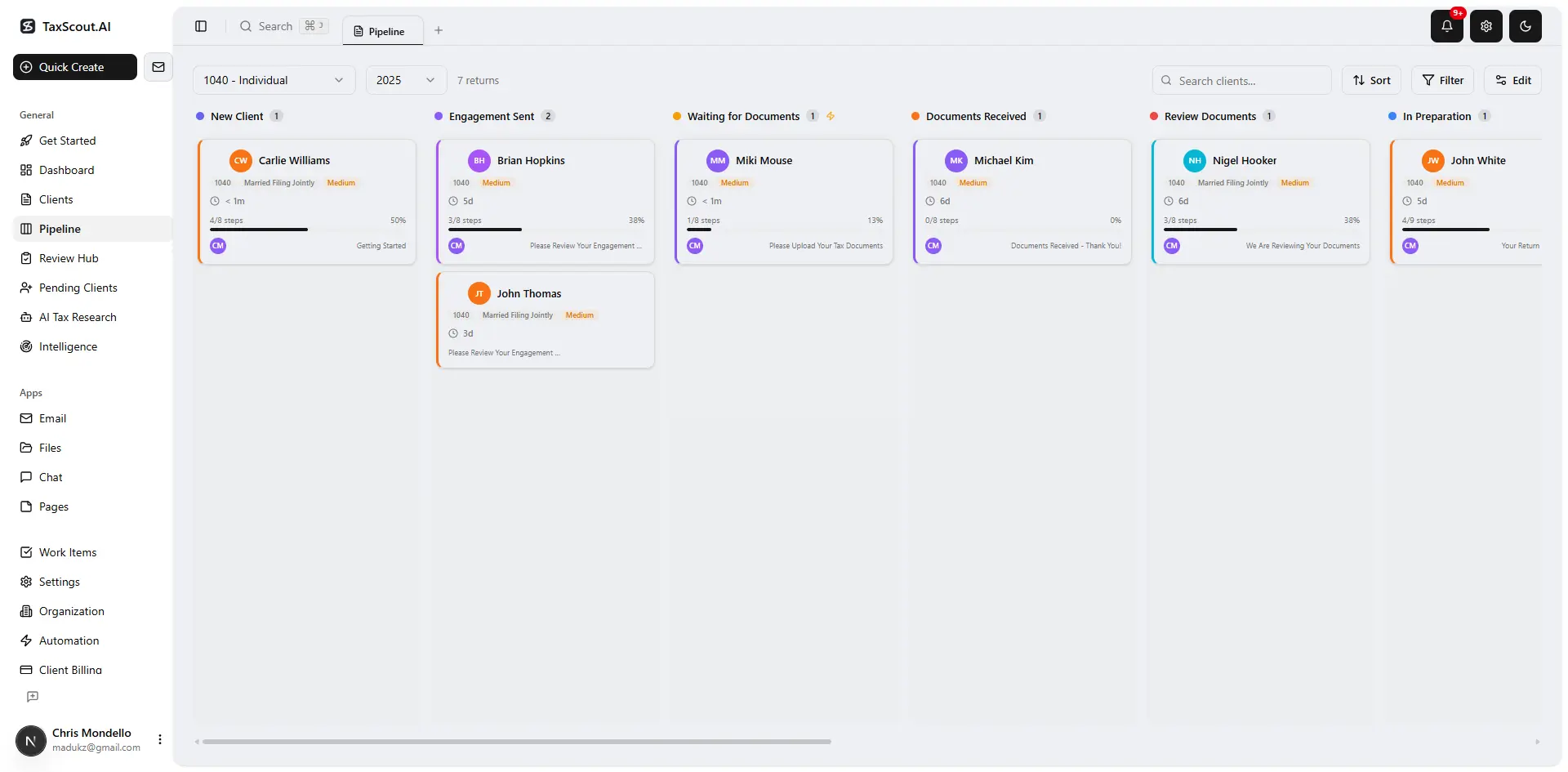
Track every return from intake to filed with drag-and-drop pipeline management
Starting from scratch feels overwhelming. A more practical approach is to document the workflows you already have — you just need to surface them.
Step 1: Identify Your Core Workflows List the 8–12 processes that happen on every engagement, every cycle. Don't start with edge cases. Start with: new client intake, annual engagement letter, document collection, return preparation, manager review, e-filing authorization, billing. These are your primary SOPs.
Step 2: Shadow Your Best Performers Your senior preparer's personal checklist is your first SOP draft. Ask her to walk through a return start-to-finish and narrate every step. Record it. Transcribe the sequence. You'll surface the decision rules she makes automatically that she's never written down.
Step 3: Assign Each SOP to a Role, Not a Person As you document each workflow, note which role is responsible for each step. "Staff preparer completes preparation checklist" — not "Maria completes preparation checklist." This is the single most important structural decision in your accounting firm knowledge management system, and it is what allows your CPA firm standard operating procedures to outlast any individual employee.
Step 4: Map Each SOP to a Pipeline Stage Every documented process should correspond to a specific pipeline stage in TaxScout. If you have a six-step review SOP, that SOP lives in the Manager Review stage. If you have a four-step intake SOP, that lives in the New Client or Document Collection stage. The mapping creates accountability — the stage isn't complete until the SOP steps are done.
Step 5: Build in Exception Paths For each core workflow, document the two or three most common exceptions and what the decision rule is. Foreign income? Amended return from prior year? Deceased taxpayer? These branch paths are where your experienced staff make judgment calls that new hires can't replicate without guidance.
Step 6: Version-Control and Review Cadence SOPs become outdated. The IRS tax deadline calendar shifts each year. State requirements change — the California Franchise Tax Board, for example, updates guidance on its FTB compliance programs annually in ways that affect your QC checklist. Build a semi-annual SOP review into your post-season debrief. Your [post tax season review](/blog/post-tax-season-accounting-firm-review) is the right moment to identify which documented processes broke down and need revision.
!TaxScout workflow automation settings showing stage-gating conditions and auto-advance rules for accounting firm standard operating procedures
A documented CPA operations playbook has an ROI that goes beyond preventing knowledge loss. It directly compresses new-hire ramp time.
When a new preparer joins a firm without SOPs, they spend their first 60–90 days learning by observation and making mistakes. With a documented SOP library embedded in a workflow system, they can execute correctly on Day 1 because the system shows them exactly what step comes next, what's required to complete it, and who to escalate to if they hit an exception. The ramp time compression is real — firms with documented workflows report new hires reaching full productivity in 30–45 days versus the industry average of 90–120 days.
This is directly relevant to the CPA hiring market. When you advertise a role at your CPA firm, candidates ask whether you have structured onboarding. A documented SOP library backed by a workflow system is a recruiting advantage — it signals to a candidate that they're joining a professional operation, not walking into chaos. Increasingly, experienced candidates specifically ask about CPA firm standard operating procedures during interviews as a proxy for how well-run the practice is.
The retention angle is equally important. Staff who work in structured environments with clear expectations and documented escalation paths report lower stress and higher job satisfaction. Your SOP library is not just operational infrastructure — it's part of your culture.
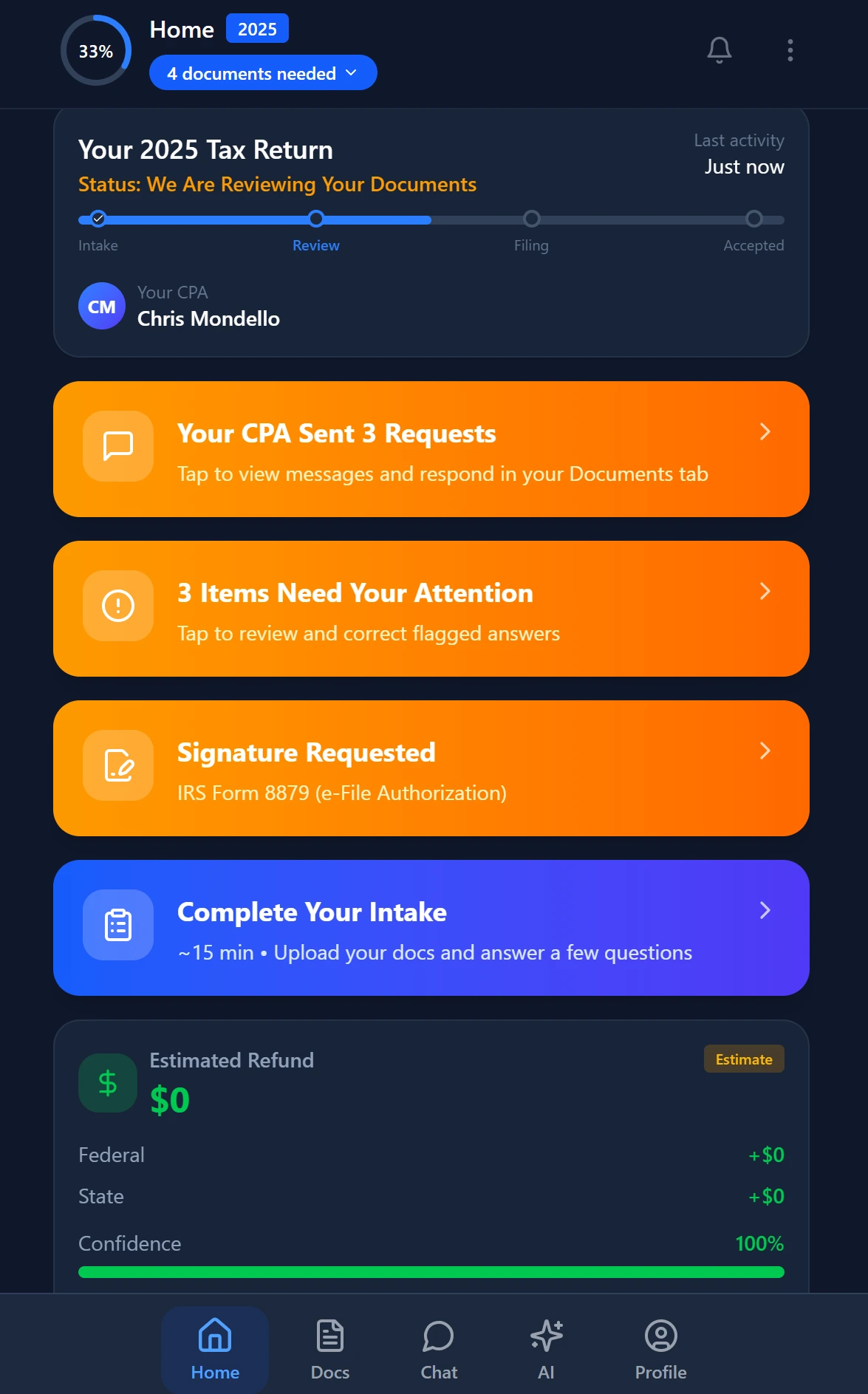
Smart intake auto-fills from uploaded documents and prior-year data
Standard operating procedures apply beyond the return preparation cycle. Consider documenting:
Notice Response Workflow: When a CP2000 or other IRS notice arrives for a client, what is the exact response sequence? Who reviews it? What is the client communication protocol? What is the internal deadline for responding to the IRS? A documented notice response SOP protects you from the chaos of a notice arriving in August when your senior staff is on vacation.
Client Termination Process: Disengaging from a client has legal consequences if handled incorrectly. Your engagement termination SOP should document the notification letter, the file closeout checklist, and the data retention protocol.
Data Security Incident Response: When a client calls to say their email was compromised, what do you do? Who do you call? What do you document? This SOP should exist and be reviewed annually. The IRS Written Information Security Plan (WISP) requirement means you're legally obligated to have documented security procedures — and treating your WISP as one component of a broader CPA firm standard operating procedures framework ensures it stays current and enforceable rather than sitting in a drawer.
State-Specific Filing Checklists: If you have clients in multiple states, each state jurisdiction should have a documented filing checklist capturing that state's specific requirements, deadlines, and forms. The Cornell Legal Information Institute's tax code repository is a useful reference for federal code citations, but state-level SOPs require state-level sources.
There's one reason many small CPA firms skip SOP infrastructure: the practice management platforms that support workflow automation are priced at ~$100/user/month (TaxDome) or ~$45/user/module (Canopy), making full-featured workflow automation cost $500–$660/month for a 10-person team.
TaxScout's flat-rate pricing eliminates that barrier. Prep Pro at $149/month — total, for your entire team — includes the full pipeline management engine, workflow automation, 9 AI Research Agents, and unlimited clients. There are no per-user fees. A 10-person firm pays $149/month total, versus ~$500/month for TaxDome or ~$660/month for Canopy.
That pricing model makes it economically rational to build your SOP infrastructure properly, rather than settling for a Google Doc because you can't justify the cost of a workflow system.
Ready to build a CPA firm that runs without you? TaxScout gives your firm self-executing SOPs and workflow automation for $49/month flat. → Book a 15-Min Demo
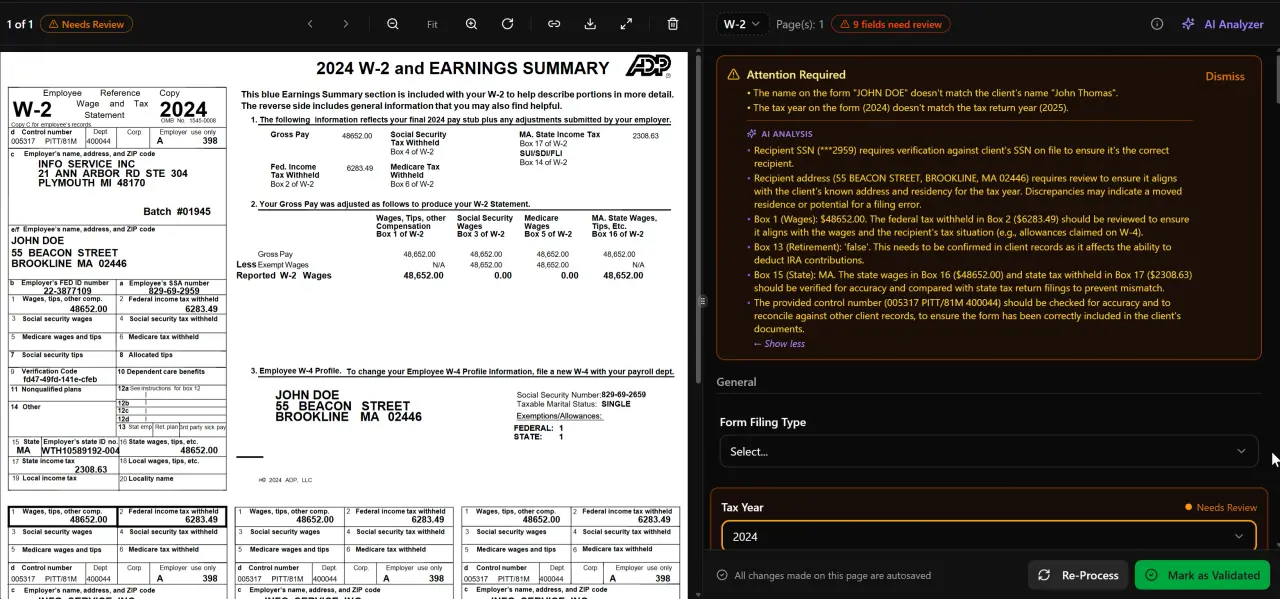
AI classifies, extracts, and validates every document automatically
CPA firm standard operating procedures are not a paperwork exercise. They are the mechanism by which your firm's best practices become institutional property rather than individual knowledge. A staff departure should be an HR event — not an operational crisis.
The firms that scale past founder dependency are the firms that documented their processes before they had to. They built their accounting standard operating procedures when they could think clearly — not when a deadline was burning and a key employee was walking out the door.
TaxScout's pipeline management and workflow automation make those SOPs self-executing. Your documented process becomes the gate that controls stage transitions, the checklist that must be completed before a return advances, the automated notification that fires when something sits too long. Your operations playbook stops being a document nobody reads and starts being the actual operating system of your firm.
Ready to see the difference? TaxScout gives your firm AI extraction, 5-layer validation, and complete practice management — for $49/mo flat. → Book a 15-Min Demo — See It Live