
You opened your CPA firm this month. You have a license, a few referral leads lined up, and a half-finished website that you are quietly embarrassed about every time someone asks for your URL. Sound familiar? Threads on r/taxpros are full of solo and early-stage CPAs who are paralyzed by an imperfect CPA firm website — convinced that prospects will judge them harshly for a site that looks DIY, or that Google will never rank them anyway, so why bother?
The truth is blunter than most marketing advice admits: a mediocre website that is live and easy to contact beats a beautiful website that is perpetually 'in progress.' Prospects are not comparing your site to Apple.com — they are comparing it to nothing, because you handed them a business card and they Googled you at 10 p.m. What they need to see in those 30 seconds is enough trust to send an email or book a call. Before anything else, your CPA firm website needs to simply exist and be reachable.
This guide walks through the six concrete elements that move a CPA firm website from 'holding page' to 'lead generator,' in roughly the order you should build them. It also covers the back-end infrastructure — client intake, document collection, and e-signatures — that makes those leads worth having once they convert. You can explore other blog resources on firm operations, pricing, and technology to round out your setup.
The single most common mistake on a new accounting firm website is a generic headline like 'Quality Tax and Accounting Services.' Every firm says that. The first thing a visitor sees — before they scroll — should answer three questions in plain English: who you serve, what problem you solve, and where you are (or that you work remotely). A formula that works: '[Service] for [Niche] in [City/Remote].' For example: 'Tax preparation and planning for real estate investors across Florida.' Specific beats generic every time. A strong CPA firm website immediately communicates a specific value proposition rather than defaulting to industry-wide clichés.
Below the headline, add a single primary call-to-action button. 'Schedule a free 15-minute call' outperforms vague labels like 'Learn More' because it sets clear expectations and low commitment. Use a tool like Calendly or TidyCal for the booking link so prospects can self-schedule without a back-and-forth email thread. Research from the U.S. Small Business Administration on small business marketing consistently shows that reducing friction at the first point of contact is the highest-leverage conversion activity for service businesses. Every effective CPA firm website makes it effortless for a visitor to take the next step without hunting for contact information.
If you serve a niche — real estate investors, freelancers, medical practices, S-corps — say so here. Niche language repels the wrong clients and magnetizes the right ones. A niche pricing strategy also becomes far easier to defend when your website pre-qualifies visitors before they ever talk to you. For firms evaluating their CPA firm website approach, this trade-off compounds over time.
Your clients see your brand — OTP login, document upload, and real-time status
Before a stranger sends you their Social Security number, they need to trust you. Most visitors will not read your entire site — they will scan for a handful of signals that say 'this is a real, credentialed professional.' Missing even two or three of these is enough to send them back to Google. Each of these factors directly shapes how CPA firm website plays out in practice.
The five trust signals that matter most for a CPA firm website are: (1) your CPA license number and state, displayed in the footer or About page — this is non-negotiable; (2) a professional headshot or team photo, because faces build trust faster than logos; (3) at least two or three client testimonials with first name and industry, ideally with a photo; (4) a clear 'Services' page listing exactly what you do and for whom, with pricing or at minimum a pricing range; and (5) a physical address or a statement like 'Virtual firm serving clients nationwide' so prospects understand your model.
The Journal of Accountancy's guidance on client relationships repeatedly emphasizes that transparency about credentials and scope of services reduces client anxiety during the sales process — and CPA firm websites that omit this information see measurably higher bounce rates. You should also link to your state CPA society profile if one exists; for example, CPAs licensed in California can reference the California Society of CPAs to add an additional layer of verifiable credibility.
One thing you can skip at launch: case studies. They take time to produce and require client permission. Collect them over your first six months and add them later. A simple 'Results' section with two or three bullet points ('Helped a freelance client reduce self-employment tax by restructuring as an S-corp') can stand in until you have full case studies ready. Understanding CPA firm website in this context is what separates firms that scale from those that stall.
Does your new firm still lack a client portal, intake forms, and e-signatures? This is precisely where a deliberate CPA firm website strategy pays off.
TaxScout gives solo and small CPA firms a branded client portal, smart intake engine, and e-signatures in one flat-fee platform — no per-user fees, unlimited clients. CPA firm website sits at the center of this decision — get it wrong and the rest unravels.
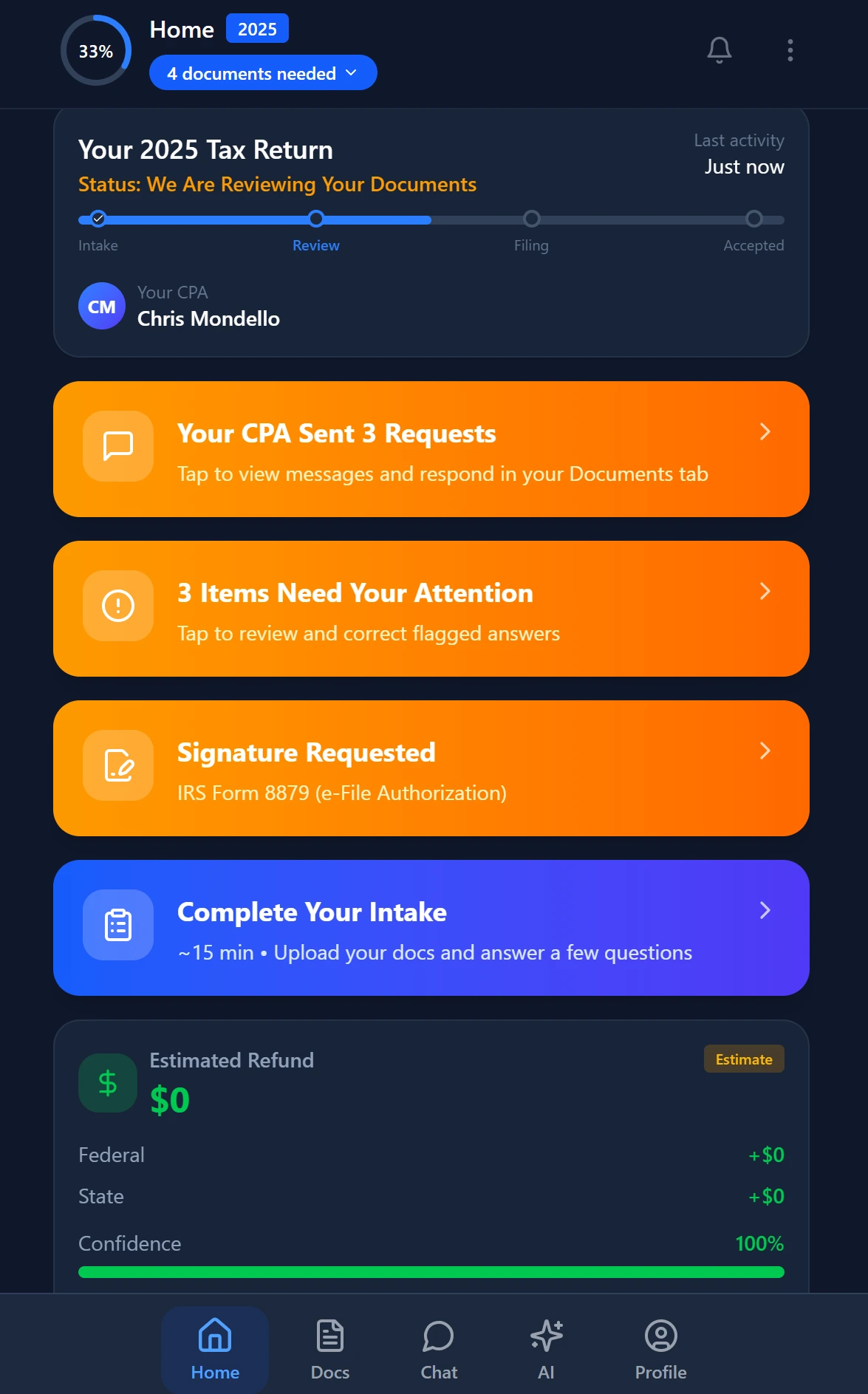
Smart intake auto-fills from uploaded documents and prior-year data

Click any extracted field to see its source highlighted on the original PDF
A services page without pricing is a lead-generation speed bump. Many new CPAs hide their fees because they are worried about being 'too expensive' or 'too cheap.' The reality is that listing a starting price — even a range like 'Individual returns starting at $350' — filters out the wrong prospects before they waste your time on a discovery call. The IRS Taxpayer Advocate Service annual report documents that taxpayers most commonly cite cost uncertainty as a reason for delaying professional help, which means price transparency actually increases conversion rather than killing it.
Structure your services page as a simple grid or bulleted list: service name, one-sentence description, and a starting price or 'custom quote.' Link from each service to a short intake form or to your scheduling page. If you offer packages — for example, a bookkeeping-plus-tax bundle for small business owners — outline the package tiers on this page rather than making people email to find out what is included. This is the foundation of a flat-fee billing model for CPAs that removes friction and sets clear client expectations from day one.
For accounting firm website design purposes, keep the services page scannable. Use headers for each service category, short paragraphs of two to three sentences, and a CTA button at the bottom of each section. Avoid PDFs — they are harder to update, not indexable by Google in the same way as HTML text, and create friction on mobile devices.
This is the step that most new CPA websites skip, and it is the one that costs the most time once clients start coming in. A client intake form on your website does two things: it pre-qualifies leads (separating tire-kickers from serious prospects) and it starts the data-collection process before your first meeting, so you arrive to a discovery call knowing whether the prospect is a W-2 employee, a self-employed consultant, or a small business owner with three LLCs.
A minimal intake form for a solo CPA firm website should capture: name and email, filing status and entity type, a rough sense of complexity (W-2 only, rental income, business income, multi-state), how they heard about you, and an open field for 'anything else I should know.' You do not need 30 fields — you need enough to route the inquiry correctly and personalize your follow-up.
When your firm grows beyond the spreadsheet stage, replacing that basic form with a structured smart intake engine makes a significant difference. TaxScout's AI intake feature models the IRS Form 13614-C with four-layer prefill — it pulls from prior-year data, uploaded documents, and client profile to pre-populate fields and flag gaps before the taxpayer submits. That is not something you need on day one, but it is worth knowing exists so you architect your client experience to scale. For more on going fully digital with client intake, see our guide on how to run a paperless accounting firm in 2026.
For the best website builder for CPA firm use cases, the intake form is often the forcing function that determines which platform to choose. Squarespace, Wix, and Webflow all support basic embeddable forms. WordPress with a plugin like WPForms or Gravity Forms gives you more logic and routing capability. At the high end, purpose-built CPA platforms can replace your public website form entirely with a branded client portal that handles intake, document collection, and e-signatures in one flow.

Track firm performance with real-time analytics and client activity monitoring
Once a prospect converts into a client, your website's job shifts from marketing to operations. The biggest operational failure point for new solo CPA firms is document collection — clients email PDFs, text photos of forms, share Google Drive folders, and generally create a chaotic paper trail that eats hours of administrative time every tax season. Your website should link directly to a secure client portal from day one, even if that portal is minimal at launch.
At minimum, a client portal for a new CPA firm needs: a way to receive files securely (not email attachments), a way to send documents for e-signature, and a way to send and collect payment. The IRS Publication 4557 on safeguarding taxpayer data makes clear that transmitting sensitive taxpayer information over unencrypted channels creates compliance exposure — and that includes unencrypted email attachments with W-2s and SSNs.
TaxScout's client portal feature gives your firm a branded portal with OTP login (no passwords for clients to forget), secure document upload, and integrated e-signatures via Documenso for engagement letters, Form 8879, and extensions. It connects directly to the AI document extraction pipeline so uploaded W-2s, 1099s, and K-1s are automatically read, validated, and attached to the correct client file. For a solo CPA website, this replaces three or four separate tools — a file-sharing service, a signature tool, an invoicing app, and an intake form — with one system. See how document management works for CPA firms in our deeper technical guide.
On the cybersecurity essentials side, your client portal should use AES-256 encryption, role-based access, and audit logging. These are not optional for a licensed CPA firm — they are part of your professional responsibility under most state boards' data security rules and FTC Safeguards Rule requirements.
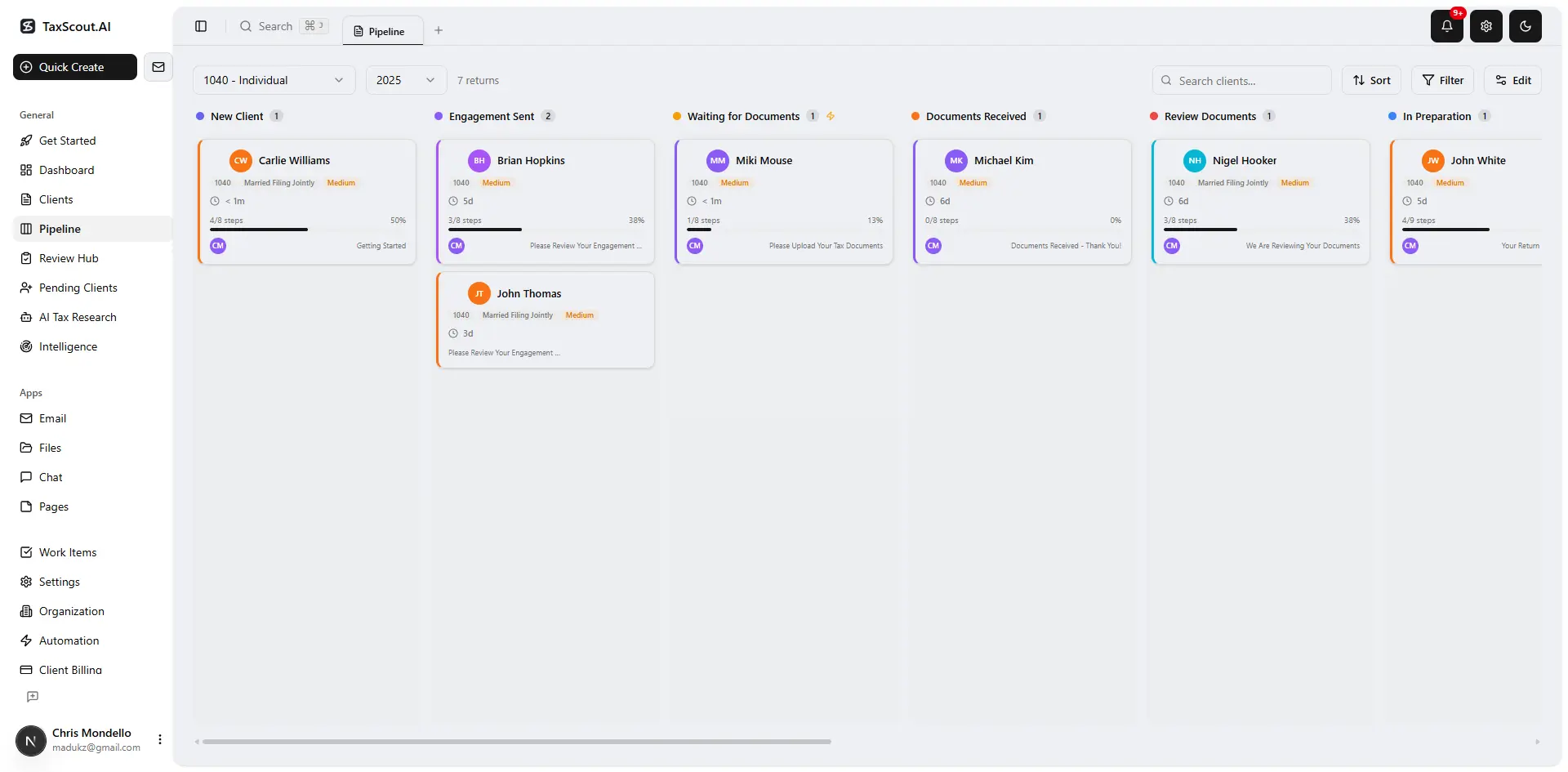
Track every return from intake to filed with drag-and-drop pipeline management
Two processes that new CPA firms routinely handle by printing, signing, scanning, and emailing — engagement letters and invoices — should both be digital before you take your first paying client. The reason is simple: every paper-and-email cycle adds two to five days to a workflow that should take minutes, and it creates version-control and delivery-confirmation problems that can create professional liability exposure.
E-signatures for CPA firms have been legally valid under the ESIGN Act (15 U.S.C. § 7001) since 2000 and are explicitly accepted by the IRS for Form 8879 (the taxpayer authorization to e-file), engagement letters, and Form 4868 extension authorizations. The IRS's guidance on electronic signatures has expanded acceptance in recent years. TaxScout's e-signature feature covers Form 8879, 4868, FBAR, engagement letters, W-9, and state forms — all in one workflow, with audit trail.
For invoicing, connect a Stripe account so clients can pay by card immediately after receiving an invoice. Chasing checks is a time sink that is entirely avoidable in 2026. TaxScout's invoicing feature runs on Stripe Connect Express and can be triggered automatically when a return reaches a specific pipeline stage — so you spend zero manual effort generating and sending invoices. The Bureau of Labor Statistics Occupational Outlook for accountants projects continued strong demand for CPA services, which means the firms that compete on client experience — fast intake, easy signing, instant payment — will outgrow those competing purely on price.
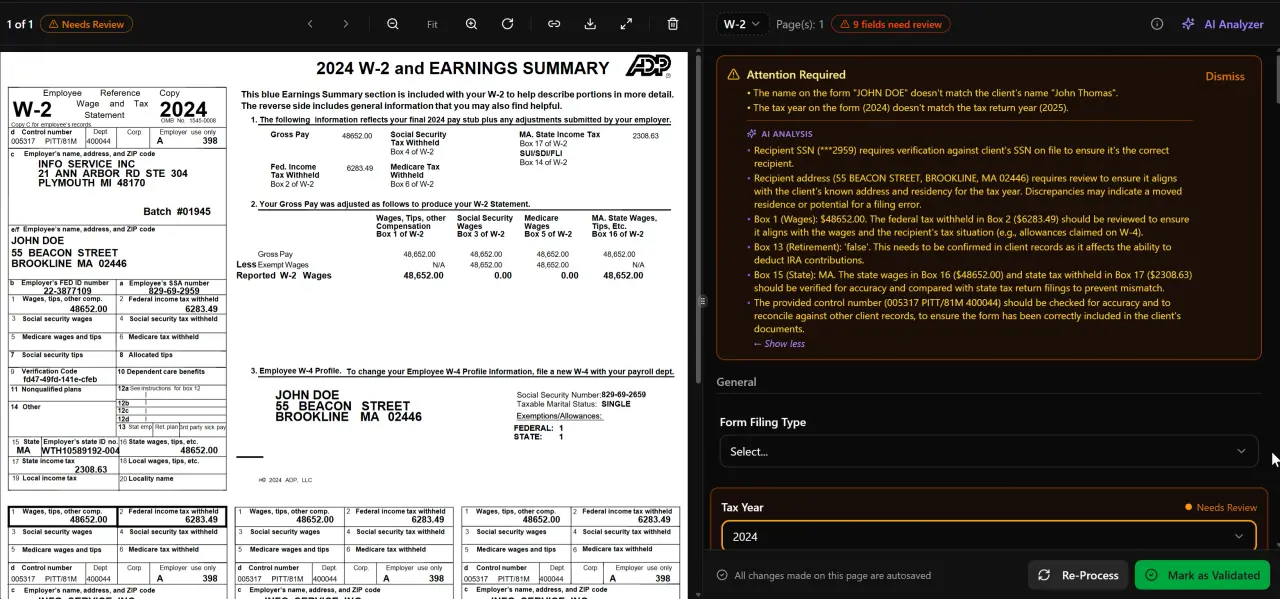
AI classifies, extracts, and validates every document automatically
Solo CPA website tips are most useful when they distinguish between 'must have before your first client' and 'nice to have by year two.' The table below separates the two categories so you can stop agonizing over perfection and start converting leads.
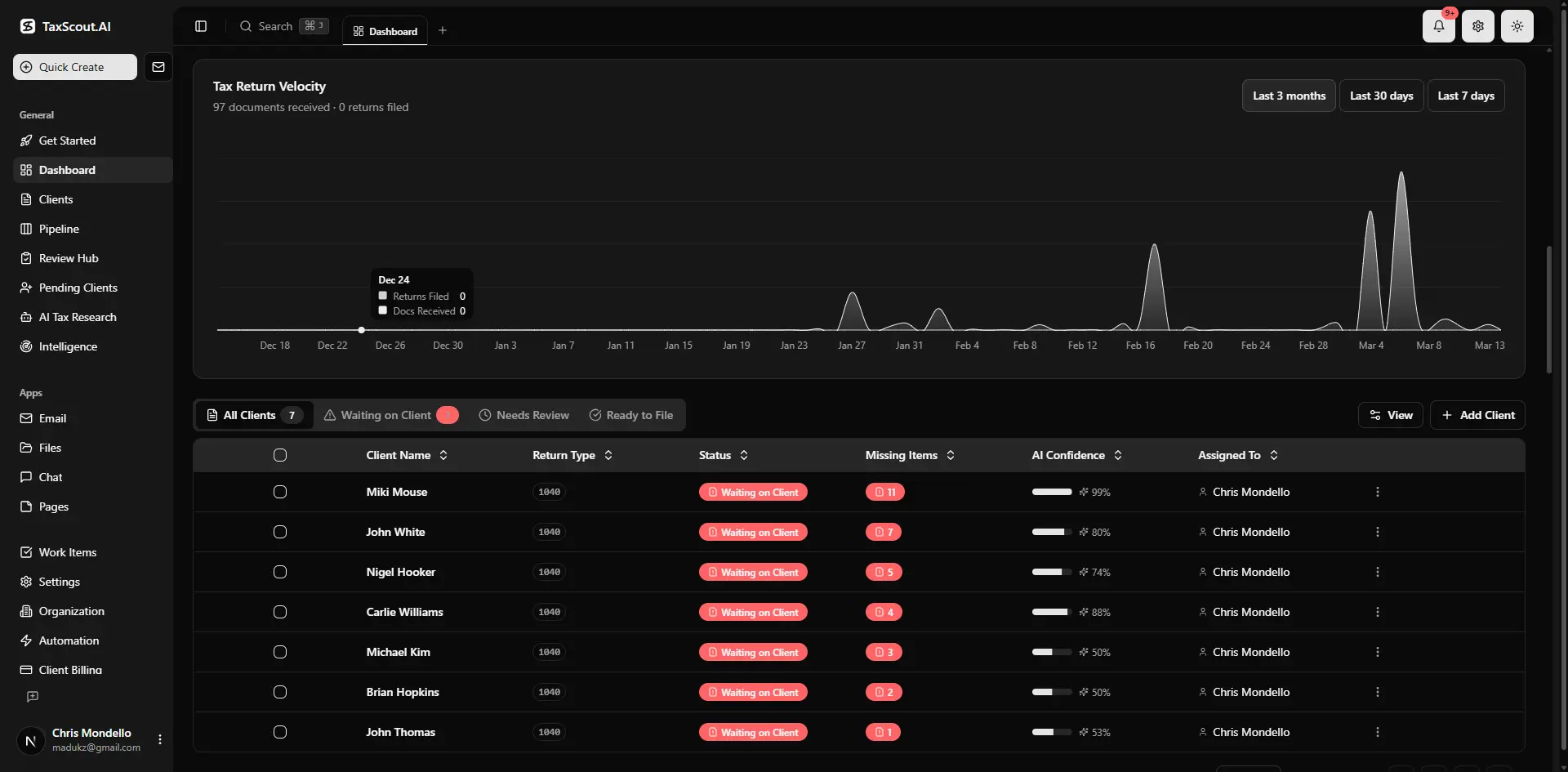
Real-time dashboard showing returns in progress, revenue, and upcoming deadlines
CPA website checklist: launch essentials vs. phase-two improvements
| Element | Launch Essential | Phase Two |
|---|---|---|
| Specific headline (niche + location) | Yes | Refine with A/B test |
| Professional headshot | Yes | Add team photos |
| License number in footer | Yes | Link to state board listing |
| Services page with starting prices | Yes | Add package tiers |
| Client intake form (6-10 fields) | Yes | Upgrade to smart intake engine |
| Scheduling link (Calendly or similar) | Yes | Embed in portal |
| Secure client portal with file upload | Yes | Add AI document extraction |
| E-signature for engagement letters | Yes | Add Form 8879, state forms |
| Stripe invoicing link | Yes | Automate invoice triggers |
| 2-3 client testimonials | Yes | Add case studies with results |
| Blog / SEO content | No — add after launch | Quarterly publishing cadence |
| Case studies | No — collect over 6 months | Publish with client permission |
| Video content | No | Add once systems are stable |
| Custom illustrations or animations | No | Only if budget allows |
How Practice Management Software Completes Your Accounting Firm Website Design
Your CPA firm website is the front door, but what clients experience after they walk through it — how quickly you respond, how easy it is to submit documents, how smoothly they get to a signed engagement letter and a paid invoice — determines whether they refer you to others. This is where accounting firm website design bleeds into practice management software selection.
For solo and small firms, a purpose-built platform can replace the patchwork of separate tools (Dropbox for files, HelloSign for signatures, FreshBooks for invoices, Typeform for intake, Google Calendar for scheduling) with a single system that knows each client's history and filing status. TaxScout is built specifically for CPA firms: it integrates with Drake, CCH Axcess, UltraTax CS, Lacerte, ProConnect, and ProSeries — so you keep your existing tax preparation software and add a client-facing layer that handles everything from intake through payment. Explore the full /pricing page to see flat-fee plans starting at $49/month with no per-user fees and unlimited clients.
If you are evaluating alternatives, it is worth knowing that TaxDome charges approximately $100 per user per month and lacks AI document extraction, while Canopy charges roughly $45 per user per month per module and bills an additional $11 per client for smart intake. For a three-person solo-to-small firm, TaxScout Prep Starter at $49/month flat represents a meaningful cost difference — while including features those platforms do not offer at any price tier.
Is your firm still stitching together five separate tools for intake, documents, signatures, and invoices?
TaxScout consolidates your entire client workflow — from branded portal to AI extraction to e-signatures — in one flat-fee platform built for solo and small CPA firms.